Ask ChatGPT which help desk software a 200-person SaaS company should buy, and it will name five or six products in about four seconds. Is yours one of them? For a growing share of B2B buyers, that single answer now does the work a week of Google searches used to do, and it happens before your sales team knows the account exists.
AI visibility is whether AI assistants name your product when buyers ask which software to use. It sits on top of the search visibility you already work for, and it behaves differently enough that a strong Google ranking guarantees nothing in an AI answer. I have watched brands with page-one rankings stay completely absent from ChatGPT, Claude, and Gemini for the exact commercial questions their buyers ask.
The encouraging part for anyone outside the top two names in a category: this race is early and the field is open. Zen Media, a B2B PR and AI visibility firm, benchmarked 1,000 buyer prompts across four AI engines (Claude, ChatGPT, Gemini, and Grok): more than 450 SaaS brands surfaced across 30+ categories, with about a dozen leaders and challengers tracked in depth and the top 100 averaging just 9% visibility, so the slots below the leaders are winnable. Here is how AI visibility works for SaaS, what drives it, how each engine differs, and how to measure whether your effort is landing.
AI Assistants Now Build the SaaS Shortlist Before You Do
Buyer research that used to start with a Google query now often starts with a question to an AI assistant, and the answer arrives as a ready-made shortlist of named products. In a March 2026 survey of 1,076 B2B software buyers, 51% said they now start research with an AI chatbot more often than with Google, up from 29% a year earlier. The single-conversation shortlist is becoming the default first step in software research.
The reason this matters more than a channel-mix note: the AI answer arrives before the buyer builds a list themselves. When the same G2 research found that 69% of buyers chose a different vendor than they had planned after chatbot guidance, and one in three bought from a vendor they were not previously familiar with, the shortlist stopped being a reflection of existing awareness and became something the answer itself creates. If you are not in the answer, you are not in the running, and nothing about that shows up in your CRM as a lost deal because the deal never opened.
Why AI Sits Closer to the Buying Decision Than Search Did
AI recommendations land during evaluation, the stage where buyers narrow a field to two or three real candidates. That is later and higher-stakes than the awareness-stage traffic search work usually targets. When a buyer asks an assistant to compare tools for their specific situation, the products it names walk straight into the consideration set. What decides who gets named is fit, not fame: 53% of B2B buyers noticed a vendor in an AI answer because it closely matched their use case, and only 7% pointed to brand recognition.
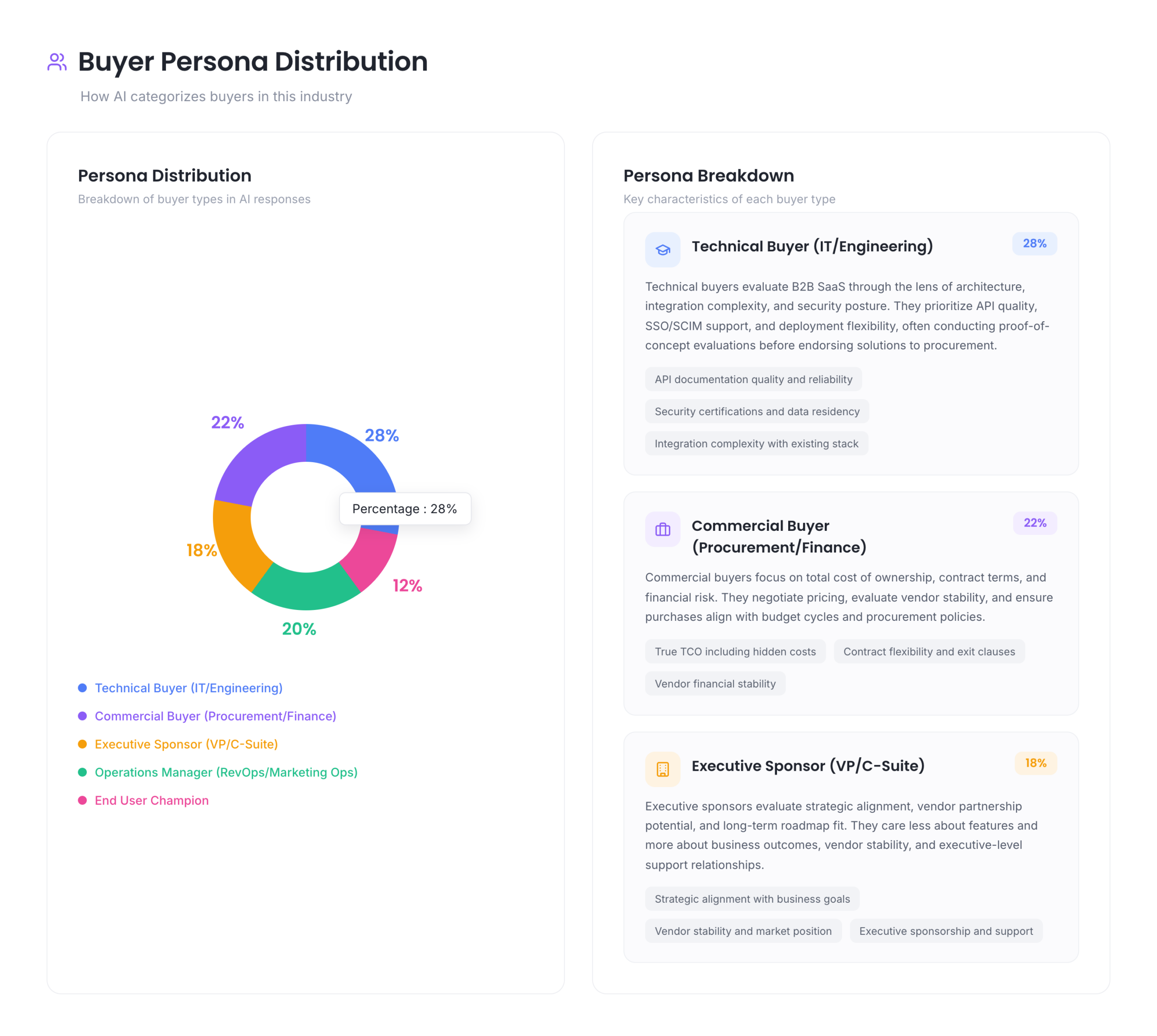
AI also reads the whole buying committee. Across the benchmark it categorized buyers as technical evaluators (28%), commercial or procurement buyers (22%), operations managers (20%), executive sponsors (18%), and end-user champions (12%), so an answer that speaks to only one of them reaches a fraction of the room.
SaaS teams have run a version of this race before. The visibility work that put feature pages, integration pages, and comparison pages in front of Google for commercial queries is the same muscle, pointed at a new destination. The difference is that the assistant does the narrowing, so the reward for matching a buyer’s use case precisely is larger and the penalty for vague positioning is harsher. This is where generative engine optimization and traditional B2B SEO start to diverge in practice, even when they share source material.
SaaS AI Visibility Is Still Wide Open
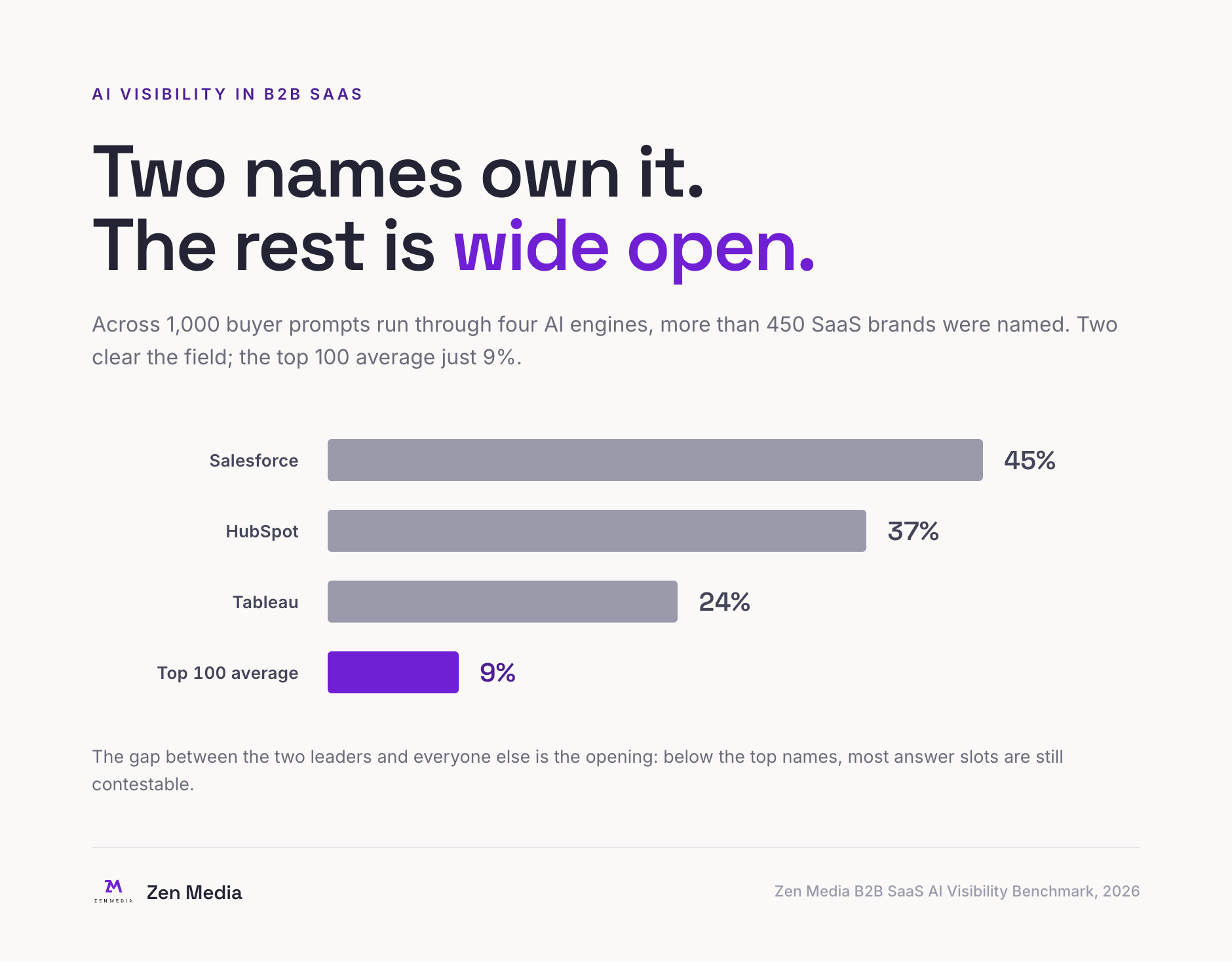
Look at who holds the top slots and the concentration is stark. In that same benchmark, Salesforce led at 45% visibility and HubSpot at 37%, with Tableau at 24% and the top 100 averaging just 9%. The gap between the two leaders and everyone else is the opening: below the top names, answer slots stay contestable, so a focused product can win them for the questions it fits.
One AI Mention Is Not Visibility
A single appearance can be luck. A buyer asks one question, on one engine, in one session, and your product happens to surface. Real visibility looks different: your product shows up across the sequence a buyer works through, from the broad problem question to the narrow head-to-head. Presence across that whole path is positioning. A one-off mention is a coin flip you happened to win.
Answer share is the percentage of relevant AI answers that name or cite you across a fixed set of buyer prompts. It replaces the single-prompt spot check with a rate, so you can tell the difference between being genuinely present in a category and being named once by accident. It is the metric that turns AI visibility from a screenshot into something you can track.
Answer share also exposes where you are strong and where you vanish. You might hold real presence on integration questions and disappear entirely on comparison questions, which tells you exactly where the next piece of work goes. Build the prompt set to cover the full range of buyer intent: in Zen Media’s benchmark, 58.6% of the 1,000 prompts were informational, 20.8% were comparison questions, and 20.6% were buy-intent questions, so a set that skips the commercial prompts misreads your real position. To use it well, it helps to understand how an answer engine assembles a response in the first place: it breaks a question into parts, retrieves evidence for each part, and stitches the pieces into one answer.
What Makes an AI Assistant Name Your SaaS
Four things move a product from absent to named, and each one is buildable. They map to how models retrieve and assemble answers: the model needs to know what you are for, trust that the claim is corroborated somewhere it did not write itself, see a product that fits the specifics of the question, and find a page it can lift the answer from. The peer-reviewed research that coined generative engine optimization found that structuring content for these systems can lift visibility in AI responses by up to 40%.
These reinforce each other. Third-party evidence is worth more when your own pages are clear enough to be quoted, and a rich integration ecosystem only helps if a model can retrieve the page that documents it. For a deeper look at how crawlers read and store these signals, our guide to how AI crawlers shape brand visibility covers the retrieval side in detail.
The SaaS Pages That Feed AI Answers
SaaS teams already own the pages that answer buyer questions. The work is making each one answer its question directly, in language a model can retrieve. Many of these pages currently bury the answer under brand copy, which an engine cannot lift. The table below maps the buyer question to the asset that should answer it, and what “retrievable” looks like for that asset.
| Buyer question | Page that feeds the answer | What makes it retrievable |
|---|---|---|
| What does it do? | Feature and use-case pages | Names the job and the buyer in the first line |
| Does it work with my stack? | Integration and marketplace pages | Lists the exact tools and workflows by name |
| How does it compare? | Comparison and alternative pages | Answers the “better for X” question up top |
| What will it cost? | Pricing pages | States tiers and what gates each one plainly |
| Is it safe to buy? | Security and compliance docs | Names certifications and data handling directly |
The pattern across every row is the same: lead with the answer. A page that opens with the specific claim a buyer is checking is a page an engine can quote. Zen Media’s guide to generative engine optimization goes deeper on how to structure these pages for retrieval without gutting the copy that converts human readers.
Why the Same Brand Gets Different Visibility on Each Engine
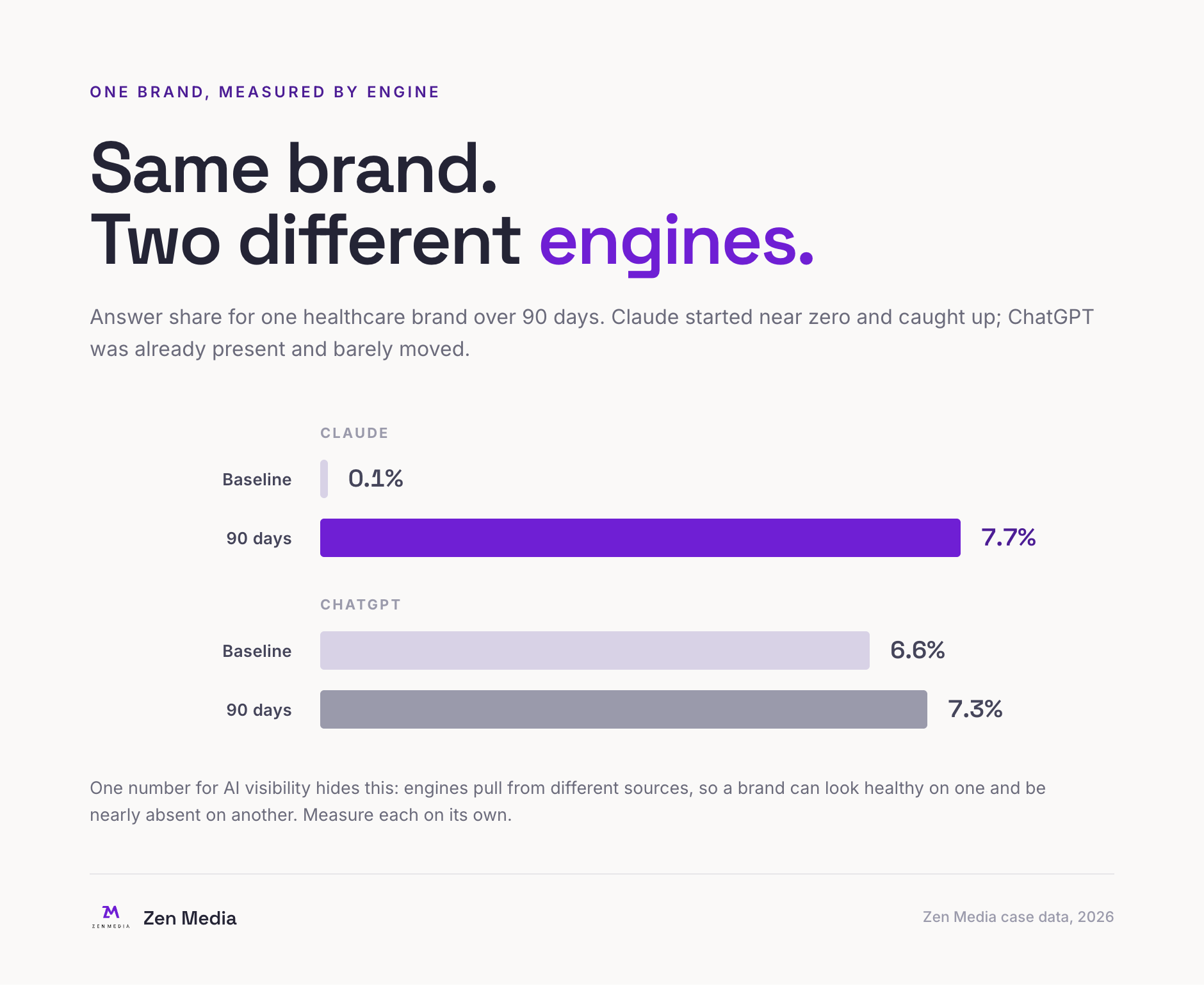
One number for “AI visibility” hides more than it shows, because engines pull from different sources and cite differently. In a healthcare AI visibility campaign Zen Media ran, the same brand moved from 0.10% to 7.70% answer share on Claude over 90 days while ChatGPT moved from 6.60% to 7.30% in the same window. Same content, same period, very different starting points and slopes. A brand can look healthy on one engine and be nearly absent on another.
The practical consequence: one asset rarely wins every engine, and an average across engines can flatter or bury the truth. You have to measure each engine on its own and prioritize where a specific engine is weak for the prompts your buyers use. Ads and citations are also starting to change what these engines surface, which our breakdown of ChatGPT ads and AI citations in 2026 tracks in more detail.
What AI Visibility Looks Like Once You Measure It
Measurement is where the abstract becomes falsifiable. The three campaigns below all started from the same place, real subject-matter strength paired with near-zero presence in AI answers, and all three moved the number in about 90 days. They are useful precisely because they are specific: named competitors displaced, per-engine breakdowns, and answer share tracked prompt by prompt.
The clearest case is SpecialistID, a specialist in ID badge holders and credentialing products with strong Google rankings and no presence in AI recommendations. After a rebuild of its category and product pages around buyer language, structured data, and third-party seeding, it started winning named slots on high-intent prompts and displacing far larger names.
Two healthcare campaigns show the same method in higher-trust categories, where models are conservative about citing unknown sources. Both paired an authoritative anchor article with earned media placements, and both tracked answer share by buyer persona and by engine so the movement could be attributed to the work with confidence. In the technical health brand’s campaign, several high-value buyer segments passed 25% answer share even as the overall number moved from 18% to 21%.
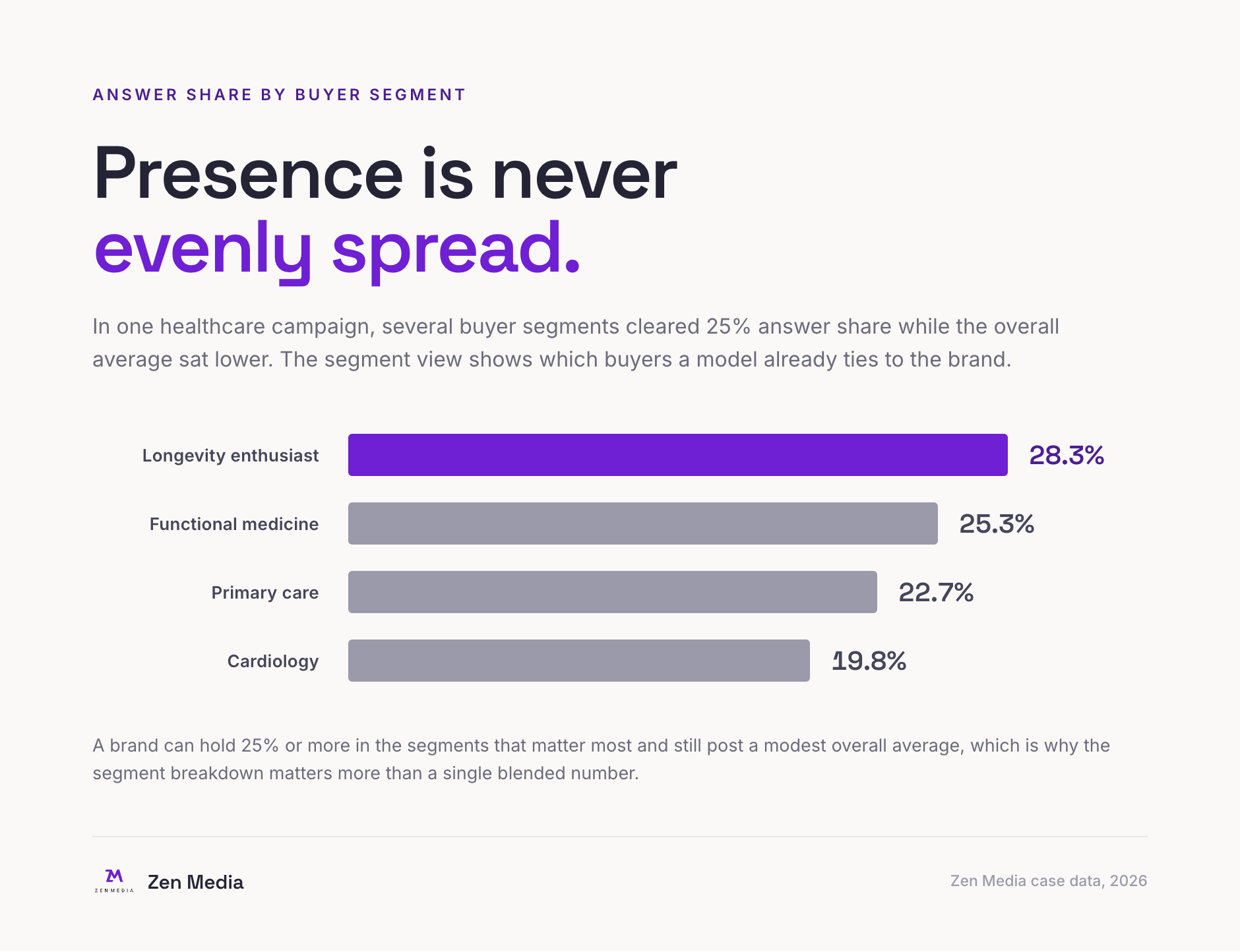
Reading answer share by buyer persona is what separates a real campaign from a vanity number. In that healthcare campaign, longevity-health and functional-medicine buyers cleared 25% answer share while primary-care and cardiology segments sat lower. A brand can hold 25% or more in its strongest segments and still show a modest overall average, and the segment view is what tells you which buyers the model already associates with you. This same measurement approach carries across verticals; our companion piece on AI visibility for industrial B2B ecommerce shows how the method holds up in a very different buying context.
How to Build AI Visibility for Your SaaS
The build follows the buyer’s own sequence. You construct a prompt set that mirrors how a real buyer narrows from a category question to a purchase decision, then you work the drivers behind each prompt where you are weakest. Here is the sequence I use with SaaS teams starting from zero.
With the prompt set built, ownership matters as much as tactics. AI visibility touches SEO, product marketing, product, and PR at once, so name one owner for the measurement and a directly responsible person for each driver. If you would rather not staff it internally, this is the core of how an AI visibility agency keeps brands present in the answer layer.
How to Measure AI Visibility Accurately
AI answers are non-deterministic, so a single screenshot proves almost nothing. Ask the same question three times and you can get three different lists, and different tools give different readings of the same prompt set. That is the honest objection to a lot of AI visibility tooling, and it is a fair one. The fix is to measure like a pollster, sampling repeated runs and averaging them into a rate you can trust.
A defensible reading comes from sampling. Run each prompt several times in fresh sessions, average the result into an answer share, hold the prompt set fixed, and re-run on a set cadence so you can separate campaign impact from model drift. The checklist below is the minimum protocol I trust.
Watch one failure mode that measurement will not fix on its own. Attribution inside AI answers is opaque: as International SEO consultant Aleyda Solis notes, an AI answer “might cite sources via footnotes or subtle links, but attribution is opaque compared to traditional search.” Being named and being clicked are different outcomes. When an AI summary appears in Google results, users click a source link inside it only 1% of the time, so the payoff of AI visibility is the recommendation itself: the buyer carries your name into the shortlist whether or not they ever click through.
Handled this way, AI visibility becomes a managed number you can act on. You know your answer share by engine and segment, you know which prompts you lose, and you know whether last quarter’s work moved anything. If you want a partner to run the measurement and the earned-media side that feeds it, Zen Media’s B2B tech PR team does exactly this, or you can talk to us about your own AI visibility baseline.
Frequently Asked Questions
What is AI visibility for SaaS companies?
AI visibility for SaaS companies is whether AI assistants such as ChatGPT, Claude, Gemini, and Perplexity name your product when buyers ask which software to use. It sits on top of search visibility as a second discovery layer, and a strong Google ranking does not guarantee it. A product earns AI visibility through category clarity, third-party evidence, a documented product ecosystem, and pages that answer buyer questions directly.
Is AI visibility replacing SEO for SaaS companies?
No. AI visibility adds a second discovery layer on top of the search work you already do. The same feature, integration, comparison, pricing, and security pages that rank in Google also feed AI answers, but they have to answer questions directly to be retrieved and cited. Search visibility and AI visibility are tracked separately because a page can rank well and still never be named in an AI answer.
How concentrated is AI visibility in B2B SaaS?
It is still wide open. Across a benchmark of 1,000 buyer prompts run through four engines, more than 450 distinct SaaS companies were named. Salesforce led at 45% visibility and HubSpot at 37%, but the top 100 brands averaged just 9%. Outside the two or three category leaders, the named slots below them are contestable, which is why challengers can build visibility without a category-leading budget.
Why is appearing in one AI answer not enough?
A single mention can be luck. Real AI visibility shows up as repeated presence across the different questions a buyer asks: the problem-definition question, the use-case question, the integration question, and the head-to-head comparison. A product named across that full sequence is positioned in the model’s answers. A product named once, on one prompt, on one engine, is not.
Can smaller SaaS companies get named by AI without a big budget?
Yes. In buyer research, 53% of B2B buyers noticed a vendor in an AI answer because it closely matched their use case, and only 7% pointed to brand recognition. Sharp category and use-case clarity, third-party evidence, and retrievable pages outweigh brand size. That is why specialist products regularly displace larger names in AI answers for specific, high-intent questions.
How should SaaS companies measure AI visibility?
Build a fixed set of real buyer prompts across category, use-case, integration, comparison, pricing, and security questions. Run each prompt several times in fresh sessions on every engine you care about, then record answer share: the percentage of relevant answers that name you. Track each engine separately and re-run on a set cadence so you can tell campaign impact from model drift.
Which SaaS pages help improve AI visibility?
Feature pages, integration pages, comparison pages, industry and use-case pages, pricing pages, security and compliance documentation, and help articles all feed AI answers when they answer a specific buyer question directly. The page has to state the answer plainly and early. A page that buries the answer under positioning copy is hard for an engine to retrieve and cite.
Do all AI engines show the same visibility for a SaaS brand?
No. The same brand often has very different visibility on each engine. In one healthcare campaign, answer share on Claude moved from 0.10% to 7.70% over 90 days while ChatGPT moved from 6.60% to 7.30% in the same period. Engines pull from different sources and cite differently, so one asset rarely wins every engine and each has to be measured on its own.
About the author: Sarah Evans is Partner and Head of PR at Zen Media, a global B2B PR and marketing agency. With 23+ years in communications, she architects PR strategy, drives earned media initiatives, and helps brands navigate AI-driven visibility. She is a regular contributor to Entrepreneur and has been recognized as a top writer on business and tech.