An automation engineer needs a safety PLC for a new packaging line. Before opening a single vendor site, they type the question into ChatGPT: which suppliers are reliable, which integrate with the existing Allen-Bradley stack, which carry the right certifications. Ninety seconds later they have a shortlist of four names.
If your brand is missing from that shortlist, when exactly did you lose the deal? You lost it before the buyer ever reached your website. The AI answer narrowed the field first, and traditional web traffic now arrives after that filter has already run. This is the pattern that surfaced when Zen Media ran 1,000 real buyer prompts through the four AI engines industrial teams rely on and analyzed the 4,000 responses that came back. Over half of those prompts came from people trying to buy. The engines answered by naming the same handful of suppliers again and again.
The pattern I keep seeing in industrial marketing is that visibility gets treated as a website problem when it has become an answer-layer problem. AI visibility for industrial automation is now the layer that decides who makes the shortlist, and it runs on different rules than the SEO that automation brands still budget for. Here is what the prompt data shows, and what it takes to get named.
How AI Builds the Industrial Automation Shortlist Before Buyers Reach You
AI visibility decides which suppliers get named when a buyer asks an AI assistant for recommendations, and it now happens upstream of your website. When an engineer asks ChatGPT for the best PLC suppliers or Perplexity for vendors that offer installation and commissioning, the engine returns a synthesized shortlist built from whatever evidence it can find. That shortlist is the new top of the funnel, and few automation brands have ever measured their place in it.
The same idea goes by other names, LLM visibility or AI brand visibility, and it now shapes supplier discovery across manufacturing broadly, beyond industrial automation alone. This matters because industrial buying starts with discovery, and discovery has moved. Procurement teams and automation engineers increasingly open an AI assistant before a search engine, because a single answer replaces an afternoon of tab-hopping across datasheets and distributor catalogs. The engine reads the technical detail, weighs the sources, and hands back a filtered set of names. Whoever is missing from that set never enters the evaluation, no matter how strong the product is.
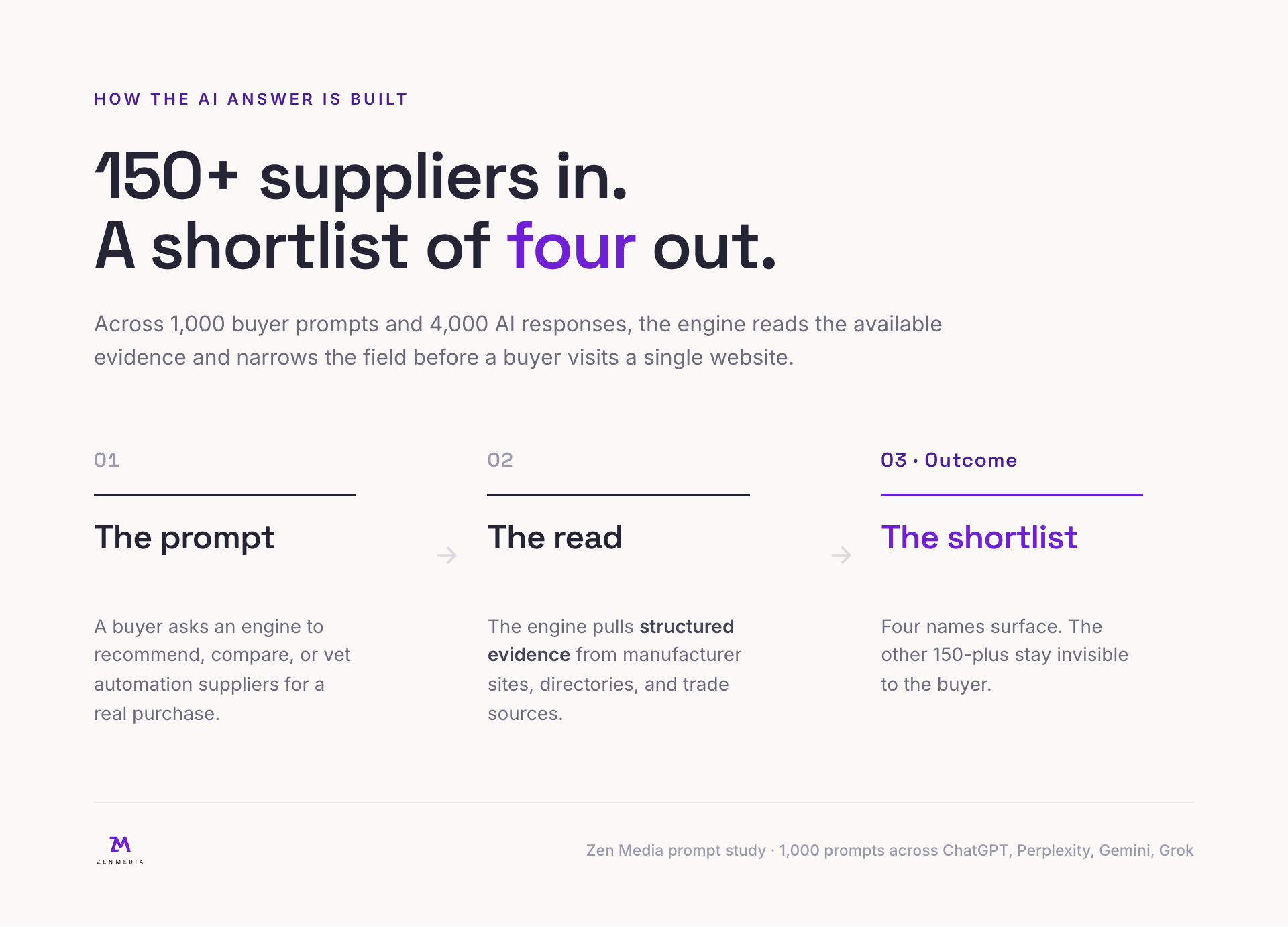
Zen Media set out to measure this layer directly for the automation sector. The study ran 1,000 prompts written the way real buyers phrase them, spanning eight market segments from PLCs and control systems to industrial robotics, sensors, motion control, and vision inspection. Each prompt ran across four engines, producing 4,000 responses and more than 150 distinct companies named. The numbers below come from that dataset, published in full as Zen Media’s industrial automation AI visibility report.
Why AI Answers Concentrate on Four Suppliers
Four brands dominate the automation answer layer. Siemens appeared in 21% of responses, Rockwell Automation in 17%, ABB in 16%, and Schneider Electric in 16%. Grainger followed at 13% and AutomationDirect at 12%. Below the top handful, more than 150 companies split a long tail where the average appearance rate is just 4%. The concentration is steep, and it tracks documentation depth more than company size.
Share of AI answers by supplier
Appearance rate across 4,000 AI responses
Caption: top six suppliers by AI answer share. Zen Media prompt study, 2026.
The four leaders share one trait: they publish more machine-readable evidence than anyone else. Siemens documents its TIA Portal integration, digital-twin capability, and full PLC-to-software portfolio in structured detail. Rockwell frames the Allen-Bradley ecosystem the same way. When an engine assembles an answer, it reaches for the supplier whose capabilities are written down clearly and corroborated elsewhere. The engine reads documented, structured evidence, and these four publish it in volume while the long tail leaves it implied.
Does this mean a mid-market supplier is locked out? No. The concentration is strongest on broad prompts asking for the top automation companies in the world. On narrower prompts tied to a specific application or component, the leaders thin out and specialists surface. The opening is real, and later sections show how a challenger like AutomationDirect earned its share by owning a defined position in a specific category.
What Industrial Buyers Ask AI When They Are Buying
Buyers come to AI ready to buy. In the 1,000-prompt dataset, 51% of prompts carried direct purchase intent: people asking where to buy, which supplier to trust, and who offers installation, warranty, or emergency parts. The remaining prompts split across comparison, evaluation, and background research. The stakes sit heavily on the buying half, because a name that surfaces at the point of purchase is worth far more than one that surfaces during idle reading.
Based on 1,000 industrial automation prompts. Zen Media prompt study, 2026.
The prompts themselves read like a procurement queue. These four are verbatim examples from the dataset, each tagged to a real buyer persona, and each one an answer where a named supplier wins or loses a sale.
The engines answer six recurring personas, and they weight them unevenly. Automation engineers drove 25% of the buyer profiles the models inferred, procurement managers 22%, plant managers 18%, maintenance managers 15%, IT and OT security managers 12%, and executive decision-makers 8%. Each persona asks in its own language and rewards different evidence, which is why a single generic capabilities page rarely surfaces across the full spread of prompts.
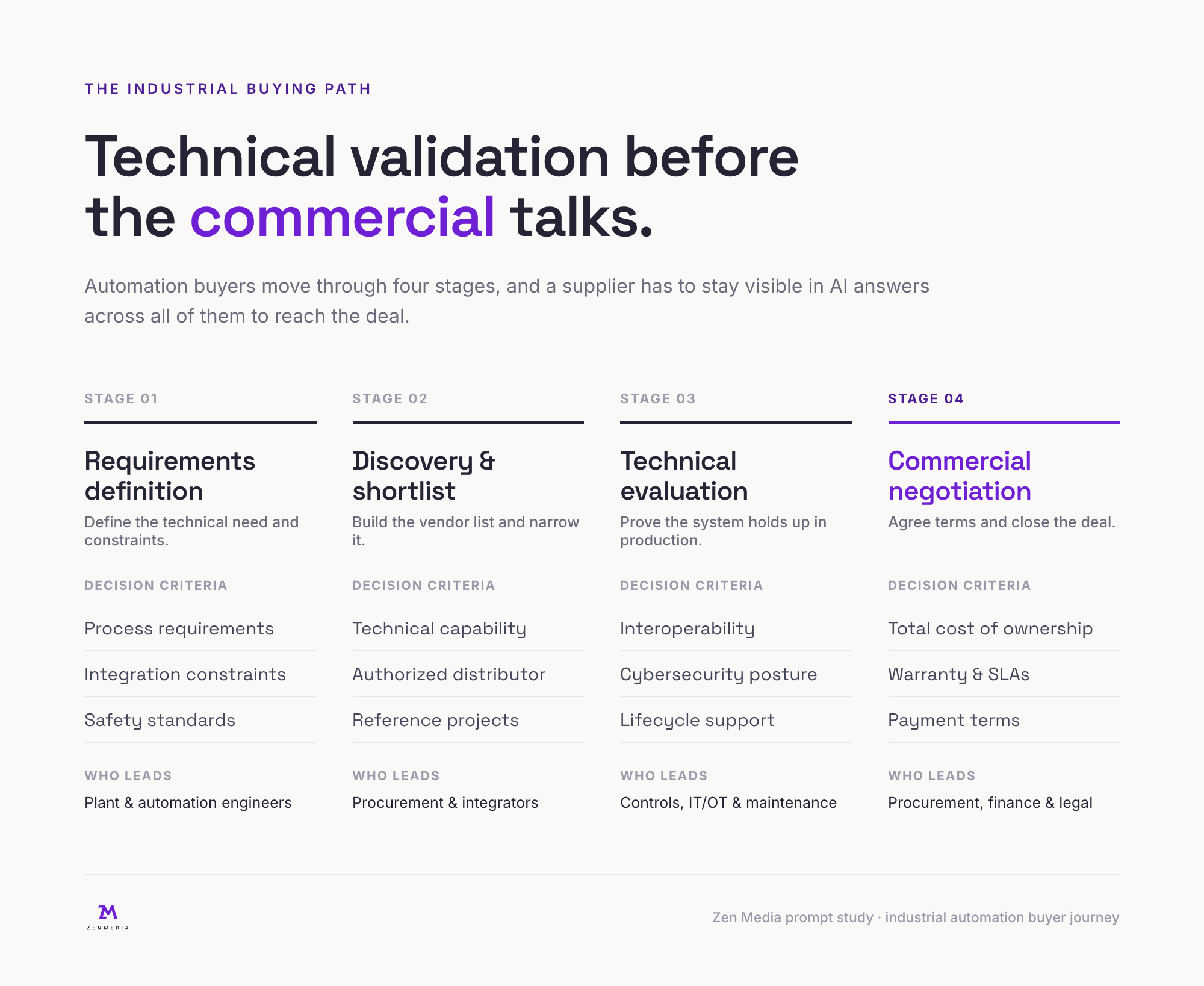
Those personas move through a four-stage path, and technical validation runs before commercial talks begin. It starts with requirements definition led by plant and automation engineers, moves to vendor discovery and shortlisting where procurement and system integrators weigh technical fit and authorized-distributor availability, then technical evaluation on interoperability, cybersecurity posture, and lifecycle support, and finally commercial negotiation on total cost of ownership, warranty, and service-level terms. AI visibility has to hold across all four stages, because a supplier named at discovery but absent at evaluation still drops out of the deal.
The Signals AI Rewards in Automation Answers
AI engines reward evidence density, the core mechanic behind generative engine optimization: how much structured, verifiable proof a supplier publishes about a small number of decision-critical themes. Four themes dominated the 4,000 responses. System integration appeared in 92% of substantive answers, total cost of ownership in 88%, cybersecurity and OT security in 85%, and authorized-channel importance in 82%. Suppliers who document these thoroughly get named; suppliers who mention them in passing do not.
Themes AI engines emphasize in answers
Share of substantive responses referencing each theme
Caption: the four themes that shaped automation answers. Zen Media prompt study, 2026.
Reading a chart is one thing; building the evidence is another. These are the four signals to write into public-facing content, worded as an engine can lift them into an answer.


Where AI Pulls Its Evidence for Automation Answers
Engines lean on a predictable set of sources, and manufacturer sites lead by a wide margin. Manufacturer official websites were referenced in 92% of sourced answers, the Control System Integrators Association in 78%, Automation.com in 65%, Thomasnet in 58%, and DirectIndustry in 52%. If your brand is thin or inconsistent on these, the engine has nothing authoritative to pull, and it names a competitor instead.
The lesson for earned media is direct. Your own site carries the greatest weight, so it has to be complete and structured first. After that, presence on the International Society of Automation and CSIA ecosystems, on Automation.com, and on Thomasnet is what teaches the model to corroborate your claims. This is where public relations and answer-engine strategy converge: the same third-party validation that builds buyer trust is the validation an engine reads. Our deeper walkthrough of how answer engine optimization works covers the mechanics behind this.
Top cited sources in automation answers
Share of sourced responses referencing each source
Caption: the sources engines reference for automation. Zen Media prompt study, 2026.
AI Visibility Across Industrial Automation Verticals
Visibility does not spread evenly across the automation stack, so AI visibility measurement has to run per vertical. In the study, PLCs and control systems drew 28% of all supplier mentions, industrial robotics 22%, sensors and instrumentation 18%, motion control and drives 15%, vision systems 10%, and distribution and fulfillment 7%. Each vertical is a separate answer race, and a specialist that documents one segment thoroughly can win its prompts while the four leaders dominate the broad ones.
Share of AI mentions by automation segment
Which parts of the stack the engines talk about most
Caption: share of AI supplier mentions by segment. Zen Media prompt study, 2026.
The specialists prove the point. Precision-measurement and machine-vision prompts surface Keyence and Cognex, collaborative-robot prompts point to Universal Robots, process-industry reliability prompts bring up Emerson, and requests for obsolete or hard-to-find parts land on Radwell. They do not outrank Siemens on the broad prompts, and they do not need to. Each owns the narrow, high-intent prompts inside its vertical, which is where its buyers already are.
Regulated verticals raise the bar again. AI answers for pharmaceutical and medical production cite FDA 21 CFR Part 11 compliance, machine-safety applications invoke IEC 62061 and ISO 13849, hazardous-area installations call for ATEX and IECEx, critical-infrastructure and utility buyers raise NERC CIP and NIS2, and food and beverage brings in 3-A Sanitary standards. A supplier that serves a regulated vertical but omits its certifications goes missing on the exact prompts where compliance decides the shortlist.
Geography narrows the field further. North America drove 42% of supplier mentions, Europe 30%, and Asia Pacific 22%, with different regional leaders surfacing in each market. A brand that is strong in one region can still be absent from an engine session framed around another.
AI Visibility for Industrial B2B Ecommerce Suppliers and Distributors
Engines read where you sell as a signal of how far to trust you. Across the responses, marketplace listings on eBay drew cautionary language 45% of the time, while authorized distributors drew caution just 2% of the time. Grok was the bluntest, wrapping unfamiliar-supplier and marketplace recommendations in verification warnings. For an automation supplier, that gap decides if the engine presents you as a safe default or flags you as a buyer-beware option.
Marketplace listings drew cautionary AI language 45% of the time. Authorized distributors drew it 2% of the time. Where you sell is read as proof of how far you can be trusted, and it moves engines toward or away from naming you.
The distributor and B2B ecommerce layer has its own visibility hierarchy, and individual distributors appear far more often than the 7% share the distribution segment holds of all mentions. Grainger surfaced in 13% of responses, RS Components in 10%, McMaster-Carr in 8%, DigiKey and Newark in 7% each, and Mouser in 6%. These names win because they pair deep, structured product catalogs with the authorized-channel trust the engines reward; the same part listed on a general marketplace rarely earns equal confidence.
| Sales channel | How AI presents it | What earns the mention |
|---|---|---|
| Online marketplace (eBay, Amazon) | Flagged with caution around 45% of the time | Hard to earn; listings trigger verification warnings |
| Authorized distributor (Grainger, McMaster-Carr) | Presented as a safe default | Structured catalog, warranty, authorized status |
| Direct-to-buyer ecommerce (AutomationDirect) | Recommended as the value option | Transparent pricing, free resources, direct model |
The direct-to-buyer model changes the math for B2B ecommerce sellers. Ecommerce-first suppliers like AutomationDirect earned outsized AI recommendation, showing up as a top pick in roughly 23% of the mentions where it surfaced, precisely because they pair transparent pricing and a direct-purchase model with the authorized-channel trust the engines look for.
Fulfillment speed doubles as a visibility lever. Maintenance and downtime prompts, where a buyer needs a part the same day, surfaced McMaster-Carr, Grainger, and AutomationDirect as the fulfillment leaders. A B2B ecommerce supplier that publishes real inventory counts and same-day capability gets named on the urgent prompts that carry the highest purchase intent.
A smaller supplier can win this, and the clearest proof comes from Zen Media’s own work. SpecialistID is a specialist B2B ecommerce brand that was absent from AI answers dominated by Amazon, Staples, and Office Depot. By rebuilding its content around real buyer prompts, deploying schema on every product, and seeding validation across the sources engines trust, it moved from invisible to named on the prompts that mattered to its buyers.
The mechanics transfer cleanly to automation. Structured evidence, schema-marked specifications, buyer-language content, and validation on trusted sources are what moved a badge-holder supplier past Amazon, and they are what moves a motion-control or sensor supplier past a distributor default. For a broader view of the earned-media side, our guide to how AI crawlers shape brand visibility connects the content work to the crawl.
How Each AI Engine Behaves Toward Automation Suppliers
The four engines do not answer the same way, and a supplier has to satisfy all of them because buyers use all of them. ChatGPT named more suppliers per answer than any engine, 5.8 on average, and gave the deepest competitive context. Perplexity leaned hardest on citations, while Gemini organized answers by category and Grok stayed cautious and verification-first. Each rewards a different emphasis in your content.

| Engine | How it answers | What to give it |
|---|---|---|
| ChatGPT | Widest coverage, 5.8 suppliers named per answer; deepest ecosystem and total-cost context. | Integration detail, ecosystem positioning, and lifecycle economics. |
| Perplexity | Citation-first; organizes answers around source authority and distributor tiers. | Authoritative sources and clear authorized-channel presence. |
| Gemini | Structured and category-driven; sorts vendors into defined market segments. | Clear category leadership and explicit segment definitions. |
| Grok | Risk-aware; adds verification caveats and flags marketplace sourcing. | Authorized-channel proof and verifiable, consistent brand data. |
The practical takeaway is that a single strong asset will not carry you across all four. Authoritative sourcing earns Perplexity citations, ecosystem depth earns ChatGPT coverage, category clarity earns Gemini placement, and channel proof calms Grok. The metric that ties them together is answer share, and our breakdown of answer share as a visibility-to-revenue metric explains how to track it across engines.
The 5-Step AI Visibility Playbook for Industrial Automation
Closing the gap runs as a five-step sequence. The steps below move a supplier from an unknown position in the answer layer to a measured, defended one, and they map directly to what the prompt data rewards. Start with measurement, because a change you cannot see is a change you cannot prove.
AI Visibility Scorecard for Automation Suppliers
Use this checklist to find your gaps before a competitor does. Each item maps to a signal or source the prompt data showed the engines reward. If you cannot tick most of these, you have found the reason a rival keeps getting named in your category.
The suppliers who will own the automation answer layer over the next two years are the ones treating it as measurable ground to hold. If you want the baseline done for you, Zen Media runs this analysis as a service; you can talk to our team about measuring where your brand stands today. For how brands hold that position over time, see our guide on staying visible in the answer layer, and our industrial marketing strategies guide sets AI visibility in the full demand context.
Frequently Asked Questions
What is AI visibility for industrial automation?
AI visibility for industrial automation is how often, and how prominently, an automation supplier gets named when engineers and procurement teams ask AI assistants like ChatGPT, Perplexity, Gemini, and Grok to recommend vendors, compare products, or vet suppliers. It is measured by tracking brand mentions and ranking position across a large set of real buyer prompts.
Why do the same few automation suppliers keep appearing in AI answers?
Across 4,000 AI responses, Siemens, Rockwell Automation, ABB, and Schneider Electric captured the largest share of mentions because they publish dense, structured evidence: product specifications, integration documentation, compliance detail, and third-party validation. AI engines assemble answers from that evidence, so the suppliers with the densest documentation are named far more than the rest, independent of product quality.
How is AI visibility different from SEO for manufacturers?
SEO earns a ranked list of blue links a buyer clicks through. AI visibility earns a place inside the synthesized answer itself, before the buyer visits any website. SEO rewards keywords and backlinks; AI visibility rewards structured evidence, entity consistency, and presence on the sources engines trust, such as manufacturer sites, CSIA, Automation.com, and Thomasnet.
Which AI platforms should automation suppliers prioritize?
ChatGPT names more suppliers per answer than any other engine and favors ecosystem and integration detail. Perplexity is citation-driven, rewarding authoritative sources and authorized channels, while Gemini organizes answers by category and rewards clear segment leadership. Grok is the risk-aware one, flagging marketplace sourcing. A supplier needs to satisfy all four, because buyers use all four.
What sources do AI engines cite when recommending automation suppliers?
Manufacturer official websites were referenced in 92% of sourced answers, followed by the Control System Integrators Association at 78%, Automation.com at 65%, Thomasnet at 58%, and DirectIndustry at 52%. Presence and accuracy on those sources correlates directly with how often a supplier is named.
Can a smaller automation supplier outrank Siemens or Rockwell in AI answers?
Yes, within a defined category. AI answers narrow by use case, so a specialist that documents one segment thoroughly can win the prompts that matter to its buyers. SpecialistID, an ID-badge supplier, reached a 72% appearance rate on high-intent prompts in 90 days and displaced Amazon, Staples, and Office Depot in AI Overview results using this approach.
How long does it take to improve AI visibility?
Retrieval-based engines such as Perplexity can begin reflecting new structured content and schema within four to eight weeks. Training-based models like ChatGPT update on a longer cycle, so citation there builds over several months as the corpus refreshes and third-party sources accumulate.
How do I measure AI visibility for my automation brand?
Build a representative set of buyer prompts across your personas and intents, run them across ChatGPT, Perplexity, Gemini, and Grok on a fixed schedule, and record if your brand appears, in what position, and against which competitors. That appearance rate and share of voice is your baseline, and it is the only way to know if content changes are working.
Does AI visibility drive revenue for industrial suppliers?
It does when the visibility lands on purchase-intent prompts. In the analysis of 1,000 industrial automation prompts, 51% carried direct buy intent. When SpecialistID improved its AI answer presence, AI-originated visits produced an 18% sales uplift tracked in GA4, a direct line from being named in the answer to booked revenue.
How does AI visibility work for industrial distributors and B2B ecommerce suppliers?
Distributors and B2B ecommerce suppliers appear when they pair deep, structured product catalogs with authorized-channel trust. Grainger, McMaster-Carr, RS Components, and DigiKey ranked highest, while general marketplaces were flagged with caution around 45% of the time. Transparent-pricing direct sellers like AutomationDirect earn value-focused recommendations.
Does AI visibility differ by industrial automation vertical?
Yes. PLCs and control systems drew 28% of supplier mentions, industrial robotics 22%, sensors 18%, motion control 15%, vision systems 10%, and distribution 7%. Each vertical is a separate answer race, so a specialist that documents one segment can win its prompts even while Siemens, Rockwell, ABB, and Schneider dominate the broad ones.
How do regulated manufacturers show up in AI answers?
Regulated verticals surface compliance in the answer. AI cites FDA 21 CFR Part 11 for pharma and medical production, IEC 62061 and ISO 13849 for machine safety, ATEX and IECEx for hazardous areas, NERC CIP and NIS2 for critical infrastructure, and 3-A Sanitary for food and beverage. A supplier that omits its certifications goes missing on compliance-driven prompts.
About the author: Sarah Evans is Partner and Head of PR at Zen Media, a global B2B PR and marketing agency. With 23+ years in communications, she architects PR strategy, drives earned media initiatives, and helps brands navigate AI-driven visibility. She is a regular contributor to Entrepreneur and has been recognized as a top writer on business and tech.