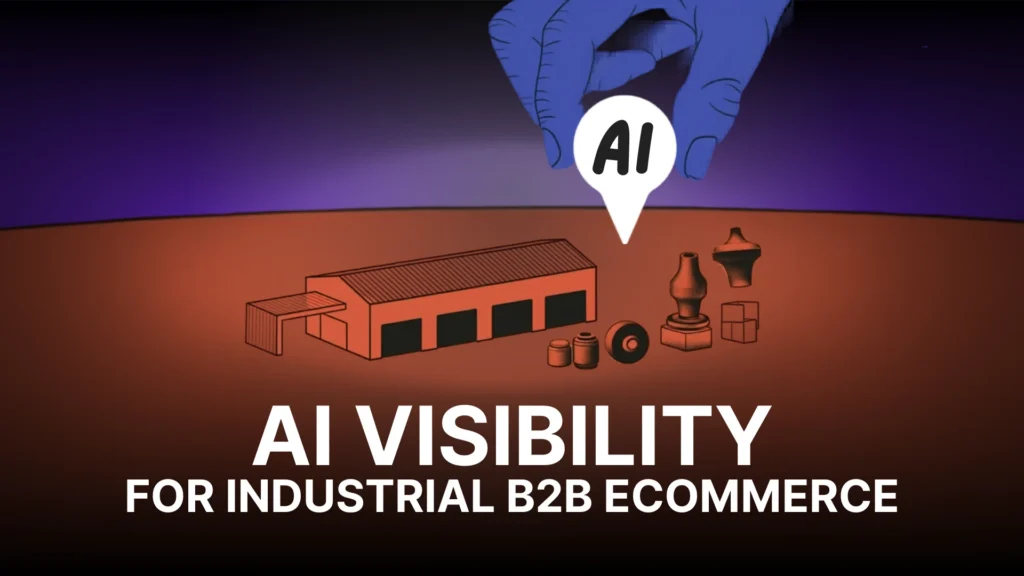
Just like buyers in other B2B categories, industrial procurement teams are no longer building the first shortlist only through Google, supplier websites, and product catalogs. They open ChatGPT, Claude, or Perplexity and ask the question directly: which supplier carries industrial bearings with regional availability, which distributor supports recurring bulk orders, or which vendor has the documentation needed for compliance review?
Before the buyer reaches your website, the AI answer has already narrowed the field. It frames the options, explains why certain suppliers fit the request, and surfaces a small set of names worth checking first. By then, the first supplier list has already taken shape, and every company outside that answer is fighting from behind.
For industrial B2B eCommerce companies, the risk is straightforward. If your company is missing from those answers, the buyer’s first comparison moves on without you. Stronger pricing, faster fulfillment, better service, or deeper technical expertise doesn’t help if AI systems can’t connect that advantage to the way buyers ask.
How AI Visibility Concentrates in Industrial B2B eCommerce

When procurement questions move into AI answers, the industrial eCommerce market doesn’t show up evenly. The answers start with the names AI systems can explain fastest: established distributors with visible proof around inventory depth, ordering workflows, technical documentation, and supplier reliability.
Across the benchmark, the leading distributors captured the majority of measured AI visibility, while regional distributors, specialty vendors, and manufacturer-direct sellers split the remaining visibility across narrower, more specific prompts.
This concentration appears across industrial categories, from automation to precision tooling, because the gap comes down to evidence density. The companies leading visibility have more structured product catalogs, procurement guidance, compliance documentation, and third-party references for AI systems to recognize and reuse across buyer questions.
AI Visibility Share by Industrial Distributor
ZAVI AI Visibility Engine Benchmark
The top four distributors captured roughly 67% of all AI visibility. Category specialists made up more than 10%, and the rest was spread across hundreds of regional distributors, specialty vendors, and manufacturer-direct sellers.
The prompt examples make the concentration easier to understand. Buyers asked AI for help finding suppliers that could ship replacement parts quickly, support recurring bulk orders, provide compliance documentation, and make reordering easier across multiple facilities. The suppliers with public proof around those needs had an advantage because their content matched the way buyers described the problem.
Those questions favor companies that have already documented the details many industrial sellers leave buried. Product catalogs, technical specifications, compliance pages, buying workflows, and procurement guidance become more powerful when they also appear in industry publications, engineering forums, maintenance communities, and customer references. That repeated evidence makes the supplier easier to recognize, easier to explain, and easier to recommend.
Smaller suppliers with better pricing, faster service, or deeper technical support still fall out of early answers when their evidence trail is thinner. Visibility concentrates because AI leans on what has already been documented, referenced, and reinforced across sources over time.
About the Research
The data referenced in this article is drawn from Zen Media’s Industrial B2B eCommerce AI Visibility Benchmark, conducted using the ZAVI AI Visibility Engine. The analysis covered 1,000 buyer-style prompts and 2,000 AI responses across ChatGPT and Claude, examining industrial distributors, category specialists, manufacturer-direct sellers, and regional suppliers. Get your AI visibility report to see how your brand appears in similar procurement prompts.
Buyers Aren’t Asking Casual Questions
If you pay attention to what buyers ask, you see a different pattern. 65% of prompts reflected active procurement decisions (purchase + comparison), while only 5% came from early research.
Prompt Intent Distribution
1,000 buyer-style prompts
The chart shows how close these prompts were to actual purchasing decisions. A buyer asking about 200+ SKUs of Parker hydraulic fittings with same-day shipping to the Midwest is already working through availability, timing, and risk. The same is true for Net 60 bulk bearing orders, ISO documentation for automotive manufacturing, or emergency replacement-part reordering across multiple facilities. These questions carry purchase pressure, which makes visibility in this layer more valuable than a broad informational mention. When a company appears here, it enters the buyer’s active evaluation set while pricing, availability, delivery risk, and documentation are still being compared.
The Market Divides Into Three AI Visibility Tiers
The closer the prompts got to supplier selection, the easier it became to see how uneven visibility was. Some suppliers appeared across a wide range of procurement prompts regardless of category. Others surfaced consistently but only in narrower contexts. Most appeared only when the prompt became highly specific.
AI Visibility Tiers
The Default Set
Appear across multiple product categories and buyer types
Grainger, MSC Industrial Supply, Fastenal, McMaster-Carr, and other national distributors
Category Specialists
Appear consistently in narrower contexts
Hydraulics specialists, fastener distributors, electrical component vendors
Long Tail
Appear in isolated responses or specific wording
Regional distributors, manufacturer-direct sellers, specialty vendors
Tier 1: The Default Set
National distributors with broad product catalogs, established multi-category suppliers, and large-volume vendors appeared across most procurement prompts, regardless of specific product question or buyer type. Their visibility extended across product categories, buyer types, and procurement questions, which made them the most repeatable names in those answers.
For these companies, visibility creates a new kind of pressure. Once AI already knows the name, the weak spot becomes the description. A distributor can appear often and still sound generic if the answer doesn’t explain what it owns, where it wins, or why a buyer should see it differently from the next supplier on the list.
Tier 2: Category Specialists
Category specialists showed up when the prompt matched their technical lane. A hydraulics supplier had a better chance around fluid power questions, a fastener distributor appeared around hardware procurement, and an electrical components vendor surfaced when the buyer asked about control panel sourcing. Their visibility was narrower than the default set, but it still came from real buyer intent.
From there, the work is to widen the circle without diluting the expertise that made the supplier credible in the first place. The goal is to move from one narrow prompt cluster into the adjacent buying questions that surround it.
Tier 3: The Long Tail
Most suppliers sit in the long tail: regional distributors, manufacturer-direct sellers, specialty vendors, and smaller industrial eCommerce suppliers. They appear in isolated responses or only when the prompt gets specific enough to match their category, location, product line, or service model.
For this group, the work starts with inclusion. These suppliers often have real expertise, competitive advantages, and satisfied customers, but that proof sits inside sales conversations, internal PDFs, quote desks, and ERP systems. They need enough public evidence in the right places for AI systems to recognize what they sell, where they are strong, and which buyer questions they deserve to appear in.
Each tier points to a different kind of work. Market leaders need more control over how they are described. Category specialists need to widen their visibility into adjacent buyer questions without losing the expertise that made them credible. Long-tail suppliers need enough citation strength to enter the answer before positioning even matters.
Worth reading
AI visibility is concentrating in other technical B2B markets too. In robotics and factory automation, we found the same pattern. A small group of recognized OEMs appeared far more often across buyer prompts, whether buyers asked about vendor comparisons, integration risk, compliance, or reliability. Industrial eCommerce suppliers face the same pressure, but the buyer questions focus on parts availability, bulk ordering, lead times, compliance documentation, and reorder workflows. Read AI Visibility for the Robotics Industry for a closer look at how supplier visibility concentrates in technical B2B categories.
Case Study: How the Visibility Gap Shows Up in Industrial eCommerce
SpecialistID.com shows how this visibility gap looks in a real industrial eCommerce category. The company had buyer demand, a clear product use case, and a market where procurement questions already existed. AI answers still leaned toward larger, more familiar names because the public evidence around availability, ordering, and category fit wasn’t strong enough yet.
That’s why the playbook starts with measurement. Before content, PR, or AI Notices can do useful work, the company needs to know which answers already include it, which competitors keep taking the space, and which buying questions lack enough supporting evidence. Once that baseline is clear, the next work is more focused: build the content, citations, and structured assets that help AI systems connect the company to the buying situations it already serves.
The 5-Step AI Visibility Playbook for Industrial B2B eCommerce Companies
Industrial B2B eCommerce companies already have real inventory, technical knowledge, compliance documentation, category expertise, and customers who rely on them. AI often sees a thinner version of the supplier. It sees a product page, a few specs, maybe an old directory listing. The stronger proof sits inside quote desks, PDFs, sales conversations, support tickets, ERP data, and customer relationships.
Adding another product page rarely changes the answer. The work starts with the questions buyers are already asking and the evidence missing from those answers.
The sequence below follows that order. First, measure where the brand appears and where it disappears. Then build the missing evidence through procurement-focused content, third-party citations, structured media assets, and ongoing visibility measurement.
Worth reading
For a deeper look at AI visibility measurement, read What Is Answer Share? and Prompt Discovery Index™.
AI Visibility Scorecard for Industrial B2B eCommerce Companies
This scorecard shows how visible your company is when buyers use AI to research industrial buying options.
If your company keeps missing from AI answers, one content update or one press mention won’t fix the problem. The issue sits deeper because AI systems need connected evidence to understand where your brand belongs, which buyer questions it should appear in, and why the company deserves to be included. Without that evidence, the answer layer sees scattered product pages instead of a procurement story strong enough to place your company in the shortlist.
For industrial B2B eCommerce companies, the work starts with a baseline. Which prompts include your brand? Which ones leave it out? Which competitors keep appearing instead? Once that picture is clear, the next move is to build the missing evidence through procurement-focused content, third-party citations, and structured media assets that make your expertise easier to recognize.
Published Monthly turns that work into a repeatable system. Instead of treating PR as one-off coverage, it builds a steady citation layer around the questions buyers, analysts, and AI systems use to understand the market.
If your brand is missing from the AI answers buyers use before they contact sales, the market is seeing an incomplete version of your company. Zen Media helps industrial B2B brands measure that gap, strengthen the evidence behind their expertise, and improve how they appear across the prompts that shape supplier shortlists. Contact us to see how your brand currently appears across the prompts that matter.
Frequently Asked Questions
What is AI visibility in industrial B2B eCommerce?
AI visibility in industrial B2B eCommerce means how often a supplier appears, gets recommended, or gets described accurately when buyers use AI tools to research suppliers, product availability, lead times, bulk ordering, compliance, or procurement decisions. It is different from traditional SEO because the buyer is using the answer to narrow the supplier list before outreach begins.
Why do established distributors show up more often in AI answers?
Established distributors often show up more because they have stronger evidence density. Their product catalogs, procurement guides, technical documentation, third-party mentions, customer references, and category language give AI systems more material to recognize and reuse. When that evidence appears across multiple public sources, the supplier becomes easier to include in procurement-style answers.
What is evidence density in AI visibility?
Evidence density is the amount of clear, consistent, searchable proof around a company. For industrial suppliers, that includes product data, buying guides, compliance pages, technical documentation, customer proof, trade media mentions, and category-specific language. A supplier with thin documentation gives AI less to work with, even if the business has strong capabilities in the real market.
How can smaller industrial suppliers improve AI visibility?
Smaller industrial suppliers improve AI visibility by building public evidence around the questions buyers already ask. That means creating procurement-focused content, publishing stronger product and compliance documentation, earning third-party citations, adding customer proof, and measuring prompt coverage over time. The first step is a baseline that shows where the brand appears, where it disappears, and which competitors appear instead.
Is AI visibility replacing SEO for industrial B2B eCommerce?
AI visibility adds another layer to SEO. SEO helps suppliers rank in search results. AI visibility helps suppliers get included, framed correctly, and cited inside generated answers. Industrial suppliers need both because buyers still search, but more of the early shortlist now forms inside AI tools before a buyer reaches a website.
What is the best first step for measuring AI visibility?
The best first step is running a prompt baseline. Identify 25 to 50 high-intent buyer prompts, test them across ChatGPT, Claude, Gemini, and Perplexity, then record which suppliers appear, how they are described, and which sources support the answer. That baseline shows whether the issue is missing content, weak citations, unclear positioning, or limited category coverage.
About the author: Sarah Evans is Partner and Head of PR at Zen Media, a global B2B PR and marketing agency. With 23+ years in communications, she architects PR strategy, drives earned media initiatives, and helps brands navigate AI-driven visibility. She is a regular contributor to Entrepreneur and has been recognized as a top writer on business and tech.