The Answer Layer Changed Discovery in AI Search
Most people do not notice when their habits change. They just wake up one day and realize they have stopped clicking as much.
Search did not disappear. In AI search, it got rearranged.
Buyers still compare options. They still look for proof, validation, and reassurance. The difference is where understanding begins. More often now, it begins inside an AI-generated summary instead of inside a website.
When someone asks a question in Google, ChatGPT, or Perplexity, the response is already interpreted. It pulls from multiple sources, resolves contradictions, and delivers an answer that feels complete enough to act on. For many users, that summary becomes the working truth long enough to narrow the list.
Older searches made you work for your opinion. You clicked, scanned, compared, and built context. Now the context arrives first, and the click happens only if the summary leaves something unresolved.
Brand visibility starts to fracture in subtle ways.
A company can publish consistently, rank for important keywords, and still be missing inside the summaries buyers rely on. Sometimes the brand appears, but its meaning gets smoothed into something generic. A specialized product becomes “a tool.” A complex service becomes “a platform.” The nuance that drives buying decisions does not always survive compression.
The impact is rarely a sudden traffic drop. It shows up as buyers arriving with assumptions already formed, then comparing you inside a frame you did not choose.
That gap between ranking and interpretation is why the phrase “AI visibility agency” started circulating. Discovery is increasingly mediated by systems that summarize first and invite clicks later.
What Is an AI Visibility Agency?
An AI visibility agency focuses on how a brand shows up inside AI-generated answers, not only whether the brand ranks in traditional search results. Traditional SEO strategy still matters. It just does not fully cover how brands get summarized and framed inside AI search.
That sounds simple until you watch how often brands get misrepresented in the answer layer. A company can be well known in its niche and still get described like a generic vendor. A category leader can get left out of the comparison entirely. A product can be framed as something adjacent, which is sometimes worse than being missing because it puts the brand into the wrong evaluation track.
This work is not about chasing every model update or trying to force mentions. It is about reducing the reasons an AI system would hesitate. These systems include what they can explain cleanly. They avoid what feels inconsistent, unclear, or risky to summarize.
An AI visibility agency tries to make the story legible across the surfaces AI systems pull from, owned pages, third-party references, and structured content that can be extracted without distortion.
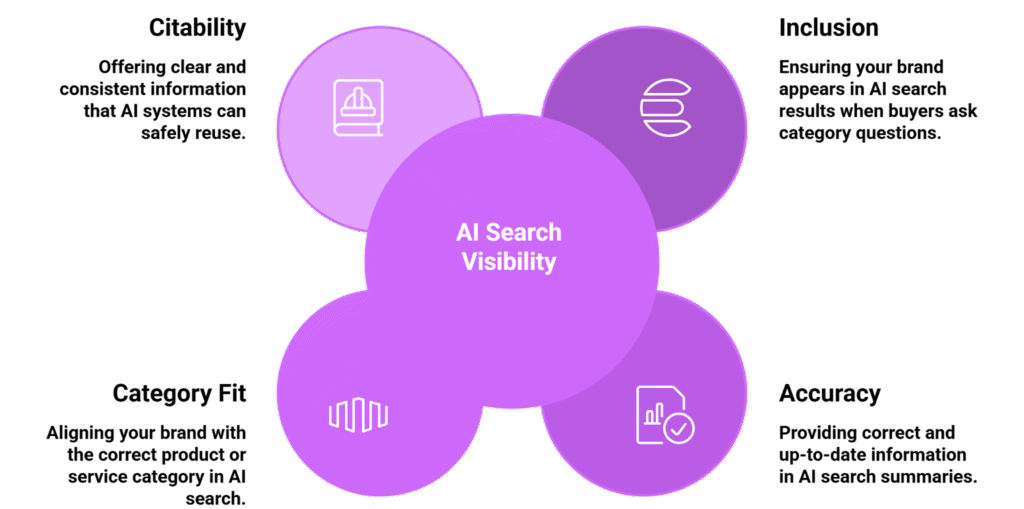
If you strip the concept down to its core, most AI visibility work aims at four outcomes.
1. Inclusion
A buyer asks a category question and gets a neat shortlist back. Your brand either shows up in that list or it does not exist for them yet. Inclusion is about earning brand mentions in AI search answers before anyone thinks to type your name.
2. Accuracy
Getting mentioned is not the win if the summary is wrong. Accuracy depends on data accuracy across the sources AI pulls from, your site, listings, and third-party references, so the answer layer reflects what you actually do instead of recycling outdated or generic framing.
3 Category fit
The category is the lens. If the system places you in the wrong lens, everything that follows gets warped: who you are compared against, what “good” looks like, and what the buyer expects your pricing and capabilities to be. Category fit means you land in the frame you actually compete in.
4. Citability
AI systems reuse what they can repeat safely. “Citability” means your site gives them clean definitions, specific claims that hold up, and terminology that stays consistent across pages, so the system can borrow your wording without twisting it.
Traditional search visibility is often measured in rank and clicks. AI visibility is measured in interpretation. When your footprint gets compressed into a short answer, the question becomes blunt: does the summary preserve what makes you distinct, or does it blur you into the default version of your category?
This is not only relevant for large brands. It matters most when the offer is easy to misunderstand, when the positioning has evolved, when the category is new, or when the company wins on nuance. In those cases, the first explanation is the fight. If the answer layer explains you wrong, everything downstream becomes harder.
How AI Systems Decide What to Mention and Where an AI Visibility Agency Fits
AI models do not browse the web like a person. They assemble answers from patterns across many sources, then choose what feels safest to summarize.
This is the layer an AI visibility agency works in. The job is not to control the model. The job is to reduce uncertainty around the brand so inclusion and accurate framing become easier.
Several patterns shape what gets mentioned and how it gets described.

Entity Clarity
AI systems need to understand what a company is. If your core description changes across pages, listings, and third-party sources, the system has to reconcile conflicting definitions. An AI visibility agency reduces this by tightening how the brand is defined across key surfaces so the “what are you” question has one stable answer.
Cross-source Consistency
Answers are built from owned pages, directories, partner sites, articles, reviews, and category explainers. When these sources contradict each other, the model has to guess. Agencies focus on resolving those contradictions so the model does not have to improvise.
Topic Association and Depth
Models favor brands that appear repeatedly within a topic cluster, not brands that show up once. An AI visibility agency helps map which buyer questions matter, then strengthens coverage and internal linking so the brand becomes harder to ignore in that cluster.
Structural Clarity
AI systems compress information into short outputs. Content that defines terms clearly and answers questions directly is easier to compress without distortion. Agencies improve structure and language so meaning survives summarization.
Third-party Reinforcement
External references reduce risk because they validate the brand’s framing. Agencies evaluate where third-party sources support or distort the brand and prioritize fixes that increase alignment.
Put simply, AI visibility agencies exists because the answer layer rewards coherence more than volume. Traditional SEO can make you discoverable. This work makes you interpretable.
Where AI Visibility Agencies Sit Compared to SEO and GEO
SEO is built to earn rankings and clicks. GEO usually aims to increase the chance of being referenced inside generative answers. AI visibility agencies sit a step above both, because the focus is not only whether a brand appears, but also whether the brand is interpreted correctly when the answer layer summarizes the category.
A strong SEO foundation still matters here. Clear structure helps. Authority helps. The difference shows up in how success is measured. SEO is judged by traffic and rankings. AI visibility is judged by AI mentions, meaning how and where your brand is referenced inside generated answers, whether it is placed in the right context, and whether your meaning survives compression when buyers ask shortlist shaping questions.
It also helps to be honest about what can and cannot be controlled. No agency controls model training. No one can guarantee inclusion in every answer. Outputs change based on query phrasing, platform behavior, and context. The practical objective is to remove contradictions and unclear framing so the answer layer has fewer reasons to omit you or flatten you into something generic.
Why This Matters Going Forward
AI-generated answers are increasingly part of how people research, compare, and narrow options. For many buyers, the summary is no longer a shortcut. It is the starting point.
That changes where perception forms.
The first explanation of your company may come from a machine that never interacted with your team. It assembles its version from whatever signals are publicly available and internally consistent. If your footprint is clear and reinforced, the summary can align with your positioning. If your footprint is fragmented or outdated, the summary will reflect that instead.
This is not only about traffic metrics. It is about narrative formation at the earliest stage of evaluation. Buyers who feel they already understand the landscape move faster. If your brand is missing or misframed at that moment, recovery requires more effort later in the funnel.
This is also why AI visibility agencies exist as a distinct category. Someone has to manage interpretation as a discipline, not as a one-time fix.
As AI-driven interfaces continue to sit between users and websites, being interpreted correctly becomes part of basic digital infrastructure. Whether the label “AI visibility” remains or evolves, the underlying requirement stays the same: when machines compress your presence into a few lines, the meaning needs to hold.
When AI systems compress your footprint into a short answer, your differentiation can get diluted, misframed, or missed entirely.
Most companies do not realize how they are being framed inside generative answers until they review them closely. The patterns are not always obvious. Inclusion gaps, outdated positioning, and subtle category drift tend to happen quietly.
Zen Media’s Prompt Discovery Index™ maps the high-intent prompts buyers are using in your category and shows how your brand appears inside AI-generated answers for those queries. It highlights where your positioning is unclear or misaligned and where competing brands are being interpreted more cleanly.
If you want to understand how buyer language and AI interpretation are shaping early perception of your brand, contact us to run a Prompt Discovery Index™ assessment.
Frequently Asked Questions
What is an AI visibility agency?
An AI visibility agency focuses on how a brand appears inside AI-generated answers. The work looks at whether a company is included in summaries, described accurately, placed in the correct category, and supported by signals that reduce ambiguity. Agencies typically audit and align these signals across owned content and influential third-party surfaces.
How is AI visibility different from SEO?
SEO focuses on earning rankings and driving organic traffic from search engines. AI visibility focuses on how a brand is interpreted inside generated answers that may appear before a user clicks any link. Strong SEO foundations often support AI visibility, but the measurement changes from traffic outcomes to interpretation quality and category framing.
Is AI visibility the same as generative engine optimization?
The terms are related but not identical. Generative engine optimization usually refers to tactics designed to increase the likelihood of appearing in AI answers. AI visibility takes a broader view. It looks at how positioning, language discipline, content structure, and third party reinforcement combine to shape how systems interpret the company.
Why does my brand not appear in ChatGPT or Google AI Overviews?
Absence often traces back to ambiguity. If the system cannot confidently identify what your company is, how it fits into a category, or whether external sources reinforce your positioning, it may prioritize brands with clearer signals. This usually points to inconsistent language, thin topic coverage, limited third party reinforcement, or unclear category framing.
How long does it take to improve AI visibility?
There is no fixed timeline because improvements depend on how fragmented the current footprint is and how competitive the category is. Some changes, such as clarifying positioning language or restructuring key pages, can influence interpretation relatively quickly. Broader signals, such as strengthening topic authority and external reinforcement, take longer to stabilize.
Does traditional SEO still matter?
Yes. Technical health, content depth, backlinks, and authority signals all contribute to how a brand is perceived across the web. AI systems rely on many of the same underlying signals that search engines use. Ignoring SEO weakens the foundation that AI visibility depends on.
How can I test my current AI visibility?
Start by asking high-intent category questions across multiple systems. Look for three things:
- Whether your brand appears at all
- Whether the description aligns with your current positioning
- Whether the category framing matches how you compete
If the summaries are inconsistent, outdated, or missing your brand entirely, you are looking at an AI visibility issue rather than a pure ranking problem.