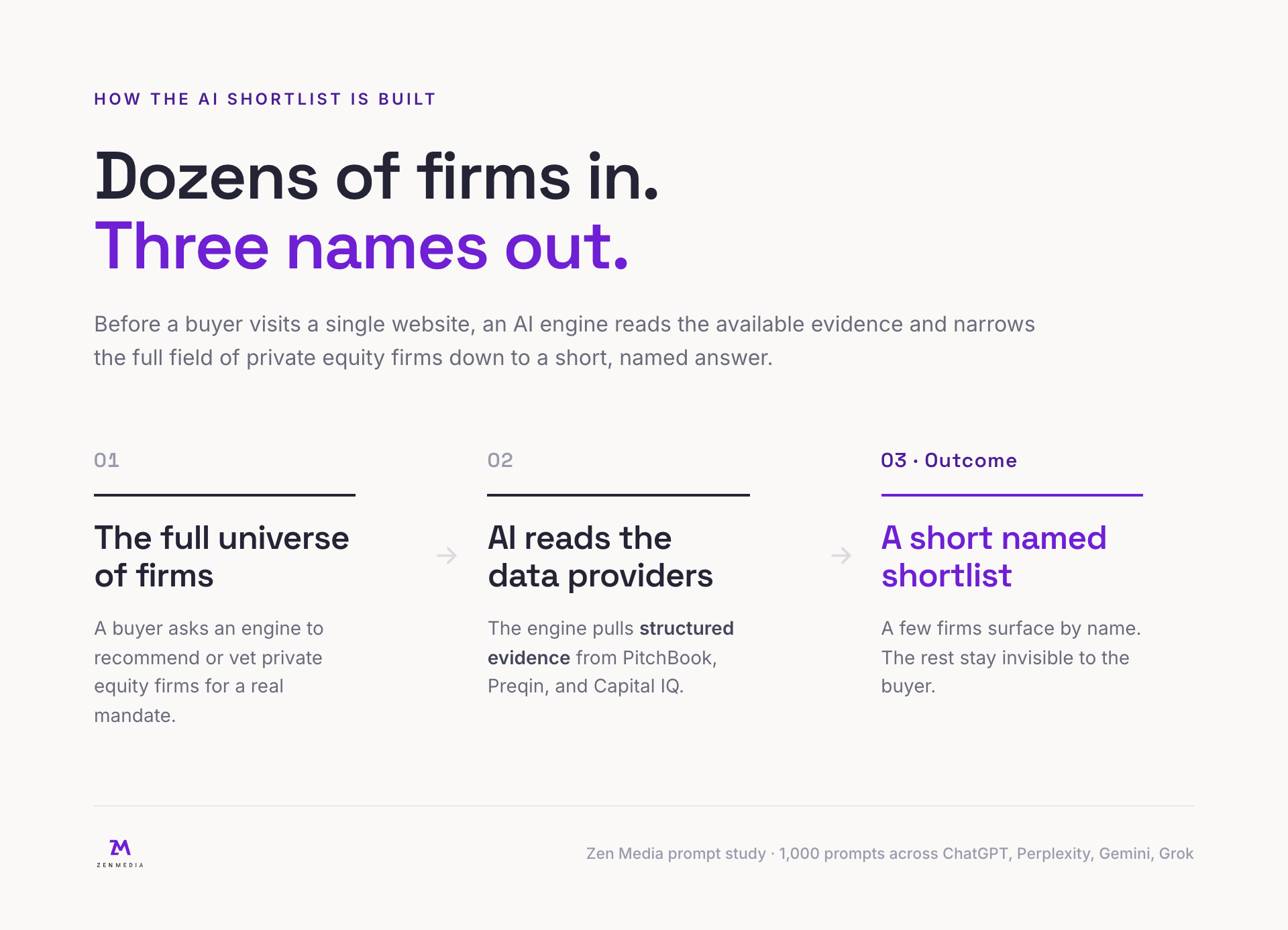
A founder weighing a majority recapitalization opens ChatGPT before they call a banker. They ask which kind of sponsor fits a $25M EBITDA software business, how to tell an operating partner from a financial engineer, and which firms have actually built platforms in their sector. Ninety seconds later they have a framework and a shortlist. If you run marketing or investor relations at a private equity firm, here is the uncomfortable question: was your firm on that list, or did the answer name three mega-funds and point the founder to PitchBook to find the rest?
For almost every firm, it was the second one. That is the pattern that surfaced when Zen Media ran 1,000 real buyer prompts through the four AI engines that founders, limited partners, and advisors now use to research sponsors, then analyzed the 4,000 responses that came back. The engines answered by naming the same handful of large firms and the data providers behind them, and named the long tail of capable specialists almost never. The buyer builds a shortlist from inside that answer, and the answer forms before anyone reaches your website or your data room.
The pattern I keep seeing in private equity marketing is that firm visibility gets treated as a website and brand problem when it has become an answer-layer problem. AI visibility for private equity firms is the layer that decides which sponsors a founder or an LP even considers, and it runs on different rules than the brand work and SEO that firms still budget for. Here is what the prompt data shows, and what it takes to get your firm named.
How AI Builds the PE Shortlist Before LPs and Founders Reach You
AI visibility decides which private equity firms get named when a founder, an LP, or an advisor asks an AI assistant for help, and it now happens upstream of your website. When someone asks ChatGPT which sponsors fit a healthcare services roll-up or Perplexity which firms have a track record in enterprise software buyouts, the engine returns a synthesized answer built from whatever evidence it can find. That answer is the new front door to a mandate, a fund commitment, or a sell-side process, and few firms have measured their place in it.
The same idea goes by other names, LLM visibility or AI brand visibility, and it now shapes how founders and institutional investors discover and screen sponsors. This matters because capital decisions start with research, and the research has moved. A growing share of founders and LPs open an AI assistant before a search engine when they need to evaluate a firm, and a single answer replaces hours of reading across firm sites, press, and databases. The engine reads the track record, weighs the sources, and hands back a filtered set of names and next steps. Whoever is missing from that set never enters the consideration, no matter how strong the fund’s returns are.
Zen Media set out to measure this layer directly for private equity. The study ran 1,000 prompts written the way real buyers phrase them, spanning the decisions people bring to a sponsor, from a founder weighing an exit and an LP conducting fund diligence to an M&A advisor shortlisting buyers for a client. Each prompt ran across four engines, producing 4,000 responses and 98 distinct firms named. The numbers below come from that dataset, published in full as Zen Media’s AI visibility report for private equity firms.
Why Mega-Funds and Data Providers Own the PE Answer Layer
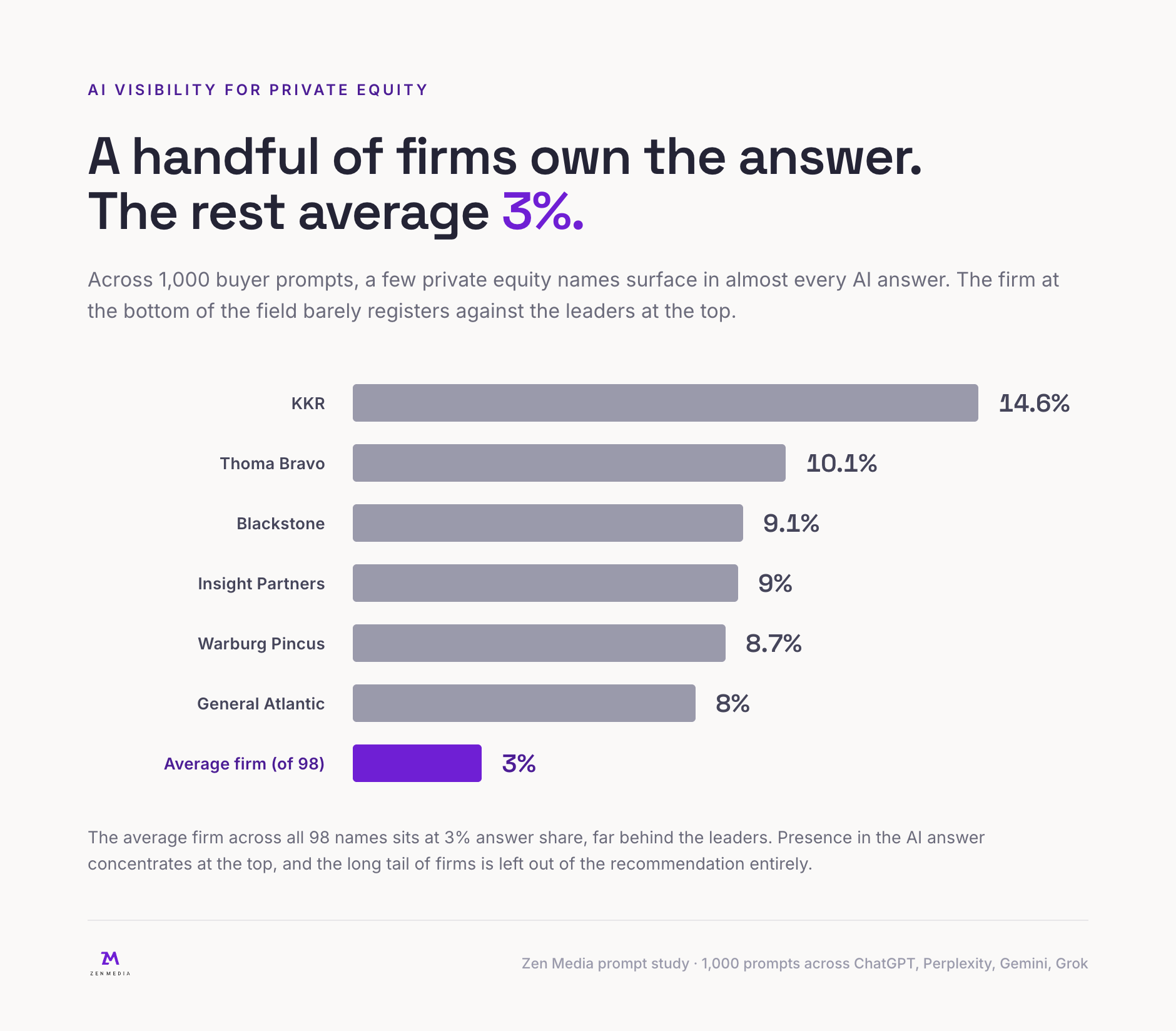
A short list of firms dominates the private equity answer layer. KKR appeared in 14.6% of responses, Thoma Bravo in 10.1%, and Blackstone in 9.1%, followed by Insight Partners at 9%, Warburg Pincus at 8.7%, and General Atlantic at 8%. Below that leading group sits a long tail of firms that surface only rarely, which is why the average firm among the 98 named landed near 3%. The concentration is steep, and it favors the sponsors the data providers document in the greatest depth.
Share of AI answers by firm
Appearance rate across 4,000 AI responses
Caption: a handful of firms own the answer while the long tail sits near the 3% average. Zen Media prompt study.
The reason is evidence. AI treats a sponsor recommendation as a high-stakes decision and leans on the sources built to document private equity: PitchBook, Preqin, Capital IQ, and the recognized benchmarking providers. Those platforms publish structured, cross-checkable records of funds, deals, exits, and sector focus in a format an engine can read and corroborate. A firm’s own site usually asserts expertise in prose an engine cannot confirm. Facing a question as consequential as which sponsor should a founder trust, the engine reaches for the source it can verify, and a data provider is built to be verified. The largest firms carry the deepest records, so they surface first by default.
What Buyers Ask AI When They Are Choosing a PE Firm
Private equity buyers come to AI at the decision point. In the 1,000-prompt dataset, 41% of prompts carried direct buy intent and another one in five were comparison-framed, so roughly three in five queries came from someone weighing or ready to pick a sponsor. Informational and best-practice questions made up the rest. That buy weight is the tell. A founder comparing operating-focused sponsors to financial buyers is close to a mandate, and the name that surfaces in that comparison has an enormous advantage.
Prompt intent across 1,000 PE queries
Share of prompts by intent type
Caption: buy and comparison intent together drive roughly 62% of prompts. Zen Media prompt study.
The prompts themselves read like a buyer thinking out loud. These four are representative examples from the dataset, each tagged to a real buyer persona, and each one an answer where a named firm wins or loses a place in the process.
The engines answer a recognizable set of buyer personas, and they weight them unevenly. Business owners seeking an exit drove the largest share of the buyer profiles the models inferred at 24%, followed by institutional investors and LPs at 15%, founders seeking growth capital at 12%, M&A advisors at 11%, healthcare business owners at 8%, and family office CIOs at 6%. Each persona asks in its own language and rewards different evidence, which is why a single generic firm-overview page rarely surfaces across the full spread of prompts.
The Signals AI Rewards in Private Equity Answers
AI engines reward verifiable evidence of capability, the core mechanic behind generative engine optimization: how much cross-checkable proof a firm publishes about the themes that decide a sponsor selection. A handful of themes dominated the 4,000 responses. Sector expertise validation appeared in 88% of substantive answers, reference-check due diligence in 82%, and buy-and-build value creation in 79%, with operating-partner differentiation close behind at 75%. Firms that document these signals get named; firms that assert them without proof do not.
Themes AI engines emphasize in PE answers
Share of substantive responses referencing each theme
Caption: the themes that shaped PE answers. Zen Media prompt study.
Reading a chart is one thing; building the evidence is another. These are the four signals to write into public-facing content, data-provider records, and partner commentary, worded so an engine can lift them straight into an answer.


Where AI Pulls Its Evidence for PE Answers
Engines lean on a predictable set of sources, and the analyst data providers lead by a wide margin. PitchBook was referenced in 92% of sourced answers, Preqin in 88%, Cambridge Associates in 72%, Capital IQ in 68%, and Burgiss in 58%, with trade press such as Mergermarket and official SEC filings behind them. If your firm is thin, stale, or inconsistent on these, the engine has nothing authoritative to pull, and it frames the answer around the largest documented sponsors while your firm goes unnamed.
Top cited sources in PE answers
Share of sourced responses referencing each source
Caption: the sources engines reference for PE answers. Zen Media prompt study.
The lesson for earned media is direct. Analyst databases and official filings carry the weight here, so the job is to be complete, accurate, and consistent everywhere an engine looks. Current PitchBook and Preqin records, matching fund and deal data on Capital IQ, accurate Form ADV filings, and genuine trade coverage are what teach a model to corroborate your claims. This is where public relations and answer-engine strategy converge: the same third-party validation that builds LP and founder trust is the validation an engine reads. Our deeper walkthrough of how answer engine optimization works covers the mechanics behind this.
AI Visibility Across PE Segments
Visibility does not work the same way across the market, so AI visibility measurement has to run per segment and per sector. AI mentions split across five solution categories, led by mega-cap buyout funds at 28% of mentions, software and technology PE at 24%, and growth equity at 22%, with lower-middle-market specialists at 16% and healthcare-focused PE at 10%. Each segment is a separate answer race with its own decisive signal and its own buyer, and a firm that documents one thoroughly can win its prompts even while mega-funds frame the broad ones.
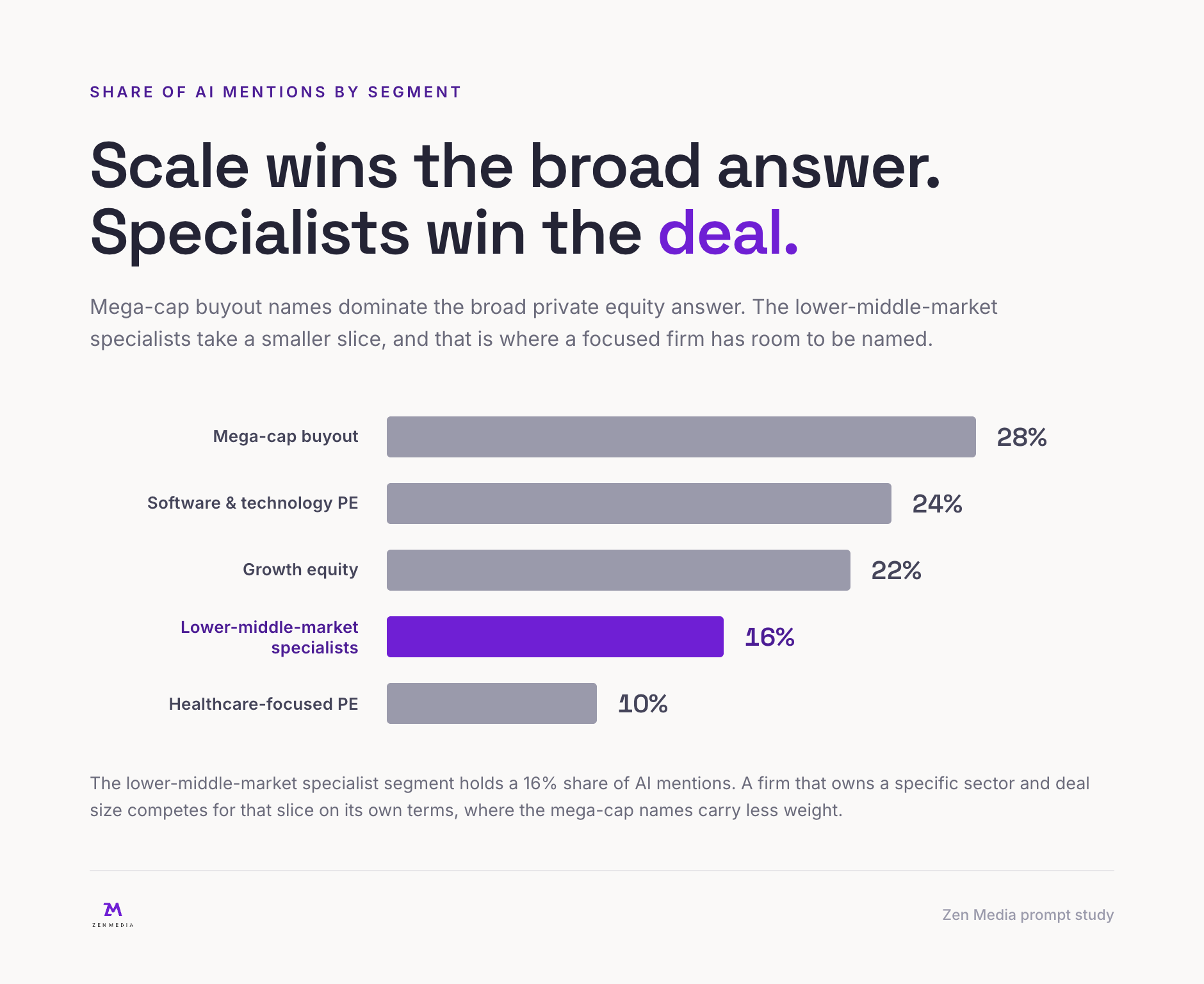
The decisive signal changes from one segment to the next, which is why a firm has to know its own race before it competes for the answer. The table maps each segment to what earns a firm the mention in it.

| Segment | AI mention share | What earns the mention |
|---|---|---|
| Mega-cap buyout | 28% | Global platform scale, cross-asset capability, and a long documented exit record |
| Software and technology PE | 24% | Enterprise-software focus, a repeatable buy-and-build playbook, named mega-exits |
| Growth equity | 22% | SaaS pattern recognition, operating support, and founder-friendly deal structures |
| Lower-middle-market specialists | 16% | Deal-size fit at $5M to $30M EBITDA, hands-on value creation, platform-building proof |
| Healthcare-focused PE | 10% | Provider and life-sciences depth, compliance expertise, clinical-quality preservation |
The opening for smaller firms sits in that table. AI surfaced lower-middle-market specialists for specific transaction types in software, healthcare, and business services, naming firms positioned for $5M to $30M EBITDA platforms even when they carry a fraction of a mega-fund’s assets. The data was consistent on this point: sector specialization and operating capability drove visibility more than fund size. Geography narrows the field further, with North America carrying 72% of mentions, Europe 18%, and Asia-Pacific 7%, so a firm strong in one region can be absent from an answer scoped to another, which is why regional presence and sector-specific content matter as much as the global profile.
How Each AI Engine Behaves Toward PE Firms
The four engines do not answer private equity questions the same way, and a firm has to satisfy all of them because buyers use all of them. ChatGPT named more firms per answer than any other engine, at 8.8 on average, and tied each recommendation to transaction context. Gemini built the longest tiered lists by strategy, sector, and geography, Perplexity was citation-first and reached for track-record validation, and Grok taught evaluation frameworks and often declined to name specific firms. Each rewards a different emphasis in your content.
| Engine | How it answers | What to give it |
|---|---|---|
| ChatGPT | Densest answers, 8.8 firms named on average; ties each recommendation to transaction context and tradeoffs. | Clear fit criteria by deal type, sector, and situation, with verifiable context. |
| Gemini | Builds exhaustive tiered lists, often 15-plus firms, grouped by strategy, size, and sector focus. | Clean sector and stage categorization and complete data-provider presence. |
| Perplexity | Citation-first; organizes answers around validated track-record and reference sources. | Corroborated performance evidence and documented, verifiable exits. |
| Grok | Process-oriented; teaches diligence frameworks and often declines to name specific firms. | Clear evaluation criteria and a documented, repeatable value-creation methodology. |
The practical takeaway is that a single strong asset will not carry you across all four. Transaction-context content earns ChatGPT placement, clean sector categorization earns Gemini’s tiered lists, corroborated track record earns Perplexity citations, and a documented methodology earns a mention even from a framework-first Grok. The metric that ties them together is answer share, and our breakdown of answer share as a visibility-to-revenue metric explains how to track it across engines. For transaction-ready buyers, prioritize ChatGPT; for broad sector searches, Gemini; for research-driven LPs, Perplexity.
AI Visibility vs Traditional PE Firm Marketing
Firms already invest in a polished website, brand, and the demand generation that supports portfolio-company growth, and that work still matters. It is worth being clear on how firm-level AI visibility differs, because a firm can have an excellent site and a strong brand and remain invisible in the AI answer that now sits above search results. Traditional marketing competes for attention and clicks. AI visibility competes for a place inside the synthesized answer itself, which forms before the buyer clicks anything.
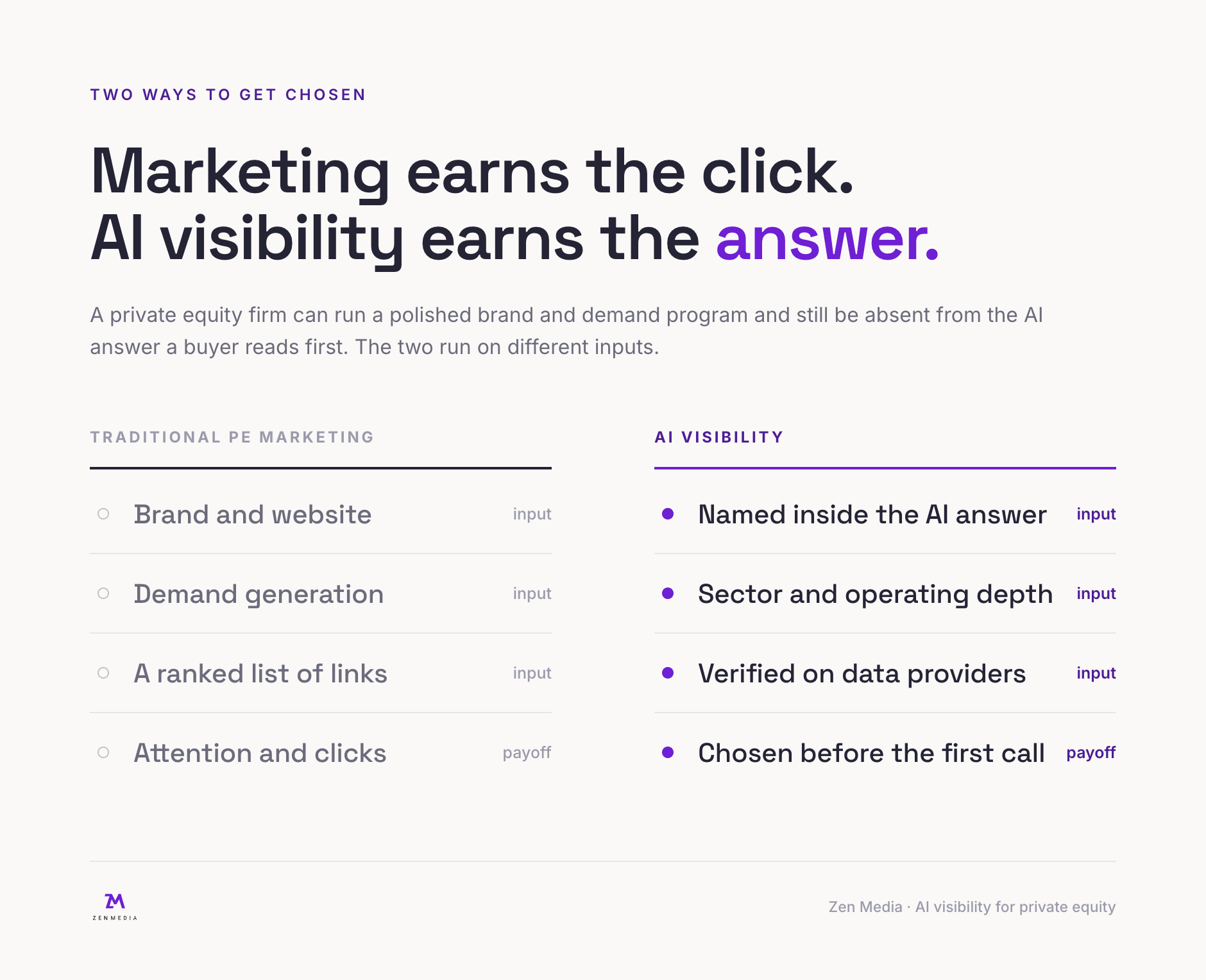
There is also a distinction firm marketers live with that AI makes sharper. Firm marketing budgets lean heavily toward portfolio-company demand generation, the SEO and content that help operating companies sell. Firm-level visibility, how the sponsor itself shows up when a founder or an LP asks AI, is a separate discipline with separate inputs: documented sector expertise, operating-partner depth, verifiable track record, and entity consistency across every data provider. The two reinforce each other, because the structured, well-cited evidence that earns AI mentions is the same evidence that earns rankings and LP trust. The firms that win the next few years will treat answer engine optimization and brand as a single program. For the strategic frame behind that program, our guide to how AI crawlers shape brand visibility connects the content to the crawl.
What SEC-Regulated Firms Can and Cannot Say
Private equity firms carry a constraint that unregulated marketers do not, and it is the question that stops firm marketing teams before they start: what can an SEC-regulated adviser actually publish? The answer is more room than teams usually assume, inside clear lines. The SEC Marketing Rule governs how an adviser presents performance, testimonials, and endorsements, Form ADV sets the public disclosures an engine can already read, and private-placement rules under Regulation D shape how a firm discusses funds and track record in public. Healthcare-focused firms carry an added layer, where Stark Law and Anti-Kickback provisions touch how provider platforms are described.
The reassuring part is that compliant content and AI-visible content are the same content. AI engines reward factual, verifiable, well-documented claims: sectors invested in, platforms built, exits completed, operating resources available, and accurate fund facts. Those are exactly the statements a compliance team can clear, because they are grounded in the documented record and make no performance promise. A firm that documents its strategy, its team, and its completed transactions in plain, substantiated language is building the asset an engine cites and staying inside the Marketing Rule at the same time. The discipline that keeps a firm compliant is the discipline that earns the citation.
The 5-Step AI Visibility Playbook for Private Equity Firms
Closing the gap runs as a five-step sequence. The steps move a firm from an unknown position in the answer layer to a measured, defended one, and they map directly to what the prompt data rewards. Start with measurement, because a change you cannot see is a change you cannot prove to an investment committee or a managing partner.
Does this move deal flow, or just rankings? The method has a track record. When Zen Media applied this same sequence for SpecialistID, a specialist B2B supplier that was absent from AI answers dominated by national giants, the firm rebuilt its content around real buyer prompts, structured its evidence, and seeded validation on trusted sources. The mechanics that moved a specialist past far larger competitors are the same ones that move a focused sponsor past a mega-fund default, and the result panel below shows what that produced.
How to Measure Your Firm’s AI Visibility
Visibility only becomes a program once it is a number. The baseline is an appearance rate: across a representative set of buyer prompts, how often is your firm named, in what position, and against which competitors. Build the prompt set the way founders, LPs, and advisors actually ask, spanning your sectors, your deal sizes, and the investor types that matter to your fund, then run it across all four engines on a fixed schedule and record the result. The metric that makes it comparable over time is answer share, the portion of relevant answers in which your firm appears, and our guide to answer share as a visibility-to-revenue metric walks through how to calculate and report it.
Two measurement habits matter for a PE firm specifically. First, track accuracy alongside presence, because AI describing your strategy or AUM incorrectly is its own problem, and the fix is to correct the underlying source data an engine reads. Second, measure by segment, since a firm can hold strong visibility in one sector and none in an adjacent one, and the prompt set you build is what makes those gaps visible before a competitor exploits them.
AI Visibility Scorecard for Private Equity Firms
Use this checklist to find your gaps before a competitor does. Each item maps to a signal or source the prompt data showed the engines reward. If you cannot tick these boxes, you have found the reason a rival sponsor keeps getting named in your sector.
The firms that will own the private equity answer layer over the next few years are the ones treating it as measurable ground to hold. If you want the baseline done for you, Zen Media runs this analysis as a service; you can talk to our team about measuring where your firm stands today. For how brands hold that position over time, see our guide on staying visible in the answer layer, and our look at AI visibility for SaaS companies shows how the same playbook plays out in another vertical.
Frequently Asked Questions
What is AI visibility for private equity firms?
AI visibility for private equity firms is how often, and how prominently, a firm gets named when someone asks an AI assistant like ChatGPT, Perplexity, Gemini, or Grok to recommend a sponsor, compare firms, or vet a buyer. It is measured by tracking how a firm and the data providers it appears on surface across a large set of real buyer prompts, by sector, deal size, and investor type.
Why do AI engines name mega-funds over smaller PE firms?
Across 4,000 AI responses to private equity prompts, a handful of firms captured a disproportionate share of the mentions. KKR appeared in 14.6% of responses, Thoma Bravo in 10.1%, and Blackstone in 9.1%, while the average firm among the 98 surfaced sat at roughly 3%. AI leans on data providers like PitchBook and Preqin that document the largest, best-documented sponsors, so a firm thin on those sources rarely surfaces on its own.
How is AI visibility different from traditional PE firm marketing?
Traditional marketing and SEO earn a ranked list of links a reader clicks. AI visibility earns a place inside the synthesized answer itself, before the reader visits any site. Marketing rewards keywords, a polished site, and portfolio-company demand generation; AI visibility rewards documented sector expertise, operating-partner depth, verifiable track record, and third-party corroboration on the sources engines trust, such as PitchBook, Preqin, and SEC filings.
Which AI platforms should private equity firms prioritize?
ChatGPT names more firms per answer than any other engine and ties recommendations to transaction context, making it the priority for deal-ready buyers. Gemini builds exhaustive tiered lists by strategy, sector, and geography. Perplexity is citation-first and rewards firms with verifiable track-record evidence, which matters especially for LP research. Grok teaches evaluation frameworks and often declines to name firms. A firm needs to satisfy all four, because buyers use all four.
What sources do AI engines cite when recommending PE firms?
PitchBook led at 92% of sourced answers, followed by Preqin at 88%, Cambridge Associates at 72%, Capital IQ at 68%, and Burgiss at 58%. Trade press such as Mergermarket and official SEC filings followed. Accurate, complete, consistent presence on these analyst and official sources correlates directly with how often a firm is named in AI answers.
Can a lower-middle-market or sector-specialist firm get named in AI answers?
Yes. The data showed sector specialization and operating capability mattered more than fund size. Lower-middle-market specialists captured 16% of category mentions, and AI surfaced named specialists for specific transaction types in software, healthcare, and business services. A firm that documents one sector thoroughly, with a clear buy-and-build record and operating-partner depth, can win the prompts that matter to its deal sources even while mega-funds frame the broad answers.
How do data providers like PitchBook and Preqin affect a firm’s AI visibility?
They are the primary path into AI answers for private equity. Because PitchBook and Preqin lead the cited sources and AI leans on them for sponsor identification and diligence, a firm’s profile and data accuracy on those platforms is often what an engine reads to decide if it names your firm. Complete, current, consistent records across the major data providers are the foundation of a firm’s AI visibility.
Does AI visibility help with fundraising and LP relationships?
It does when the visibility lands on diligence-stage prompts. Institutional investors and family offices now use AI assistants to research fund managers, screen track records, and shortlist sponsors before a first call. A firm named with accurate, corroborated evidence at that moment enters the diligence set; one that is absent, or described with stale information, never does or starts the conversation correcting the record.
How long does it take to improve a PE firm’s AI visibility?
Retrieval-based engines such as Perplexity can begin reflecting updated data-provider records, new structured content, and fresh coverage within four to eight weeks. Training-based models like ChatGPT update on a longer cycle, so citation there builds over several months as third-party sources accumulate and the corpus refreshes. Firms should treat it as an ongoing program measured on a cadence.
Can SEC-regulated PE firms do AI visibility work compliantly?
Yes, within the same rules that already govern a firm’s website and marketing. The SEC Marketing Rule, Form ADV disclosures, and private-placement rules under Regulation D shape how a firm presents track record, testimonials, and performance. Credential-accurate, factual, well-documented content is both compliant and exactly what AI engines reward, so the discipline that keeps a firm inside the rules is the discipline that earns the citation.
How do I measure my firm’s AI visibility?
Build a representative set of buyer prompts across your sectors, deal sizes, and investor types, run them across ChatGPT, Perplexity, Gemini, and Grok on a fixed schedule, and record if your firm or its data-provider profiles appear, in what position, and against which competitors. That appearance rate and share of voice is your baseline, and it is the only way to know if your changes are working.
What role does PR and earned media play in AI visibility for PE firms?
A central one. AI engines corroborate a firm’s claims against third-party sources before naming it. Deal announcements, trade and mainstream coverage, partner commentary, portfolio-company executive references, and consistent recognition are the earned-media signals that teach an engine a firm is credible. This is the layer a standard SEO checklist does not touch, and it is where public relations and answer-engine strategy converge.
What should a PE firm do if AI describes it inaccurately?
Start by documenting exactly what each engine says, since the error usually traces to stale or thin source data about the firm. Correct the underlying records on PitchBook, Preqin, Capital IQ, and the firm’s own site, publish current, structured facts about AUM, strategy, and recent deals, and earn fresh third-party coverage that overwrites the outdated signal. Retrieval engines reflect the correction first; trained models catch up as the corpus refreshes.
About the author: Sarah Evans is Partner and Head of PR at Zen Media, a global B2B PR and marketing agency. With 23+ years in communications, she architects PR strategy, drives earned media initiatives, and helps brands navigate AI-driven visibility. She is a regular contributor to Entrepreneur and has been recognized as a top writer on business and tech.