Your website now has two audiences. One is the human buyer who reads a page and decides. The other is a machine that reads the same page, keeps what it finds, and speaks for your brand later when a buyer asks an AI assistant and never opens a browser. Has anyone on your team checked what that second audience is taking away?
That question rarely gets a clear answer, because the reading happens silently. A crawler requests your pages, lifts your claims and your numbers, learns how your category describes you, and moves on. Weeks later that extracted picture shows up inside an answer, often with no link and no visit you could trace. The gap between what you think your site says and what AI systems repeat back is where brands quietly lose the recommendation.
An AI visibility audit closes that gap. It is the practice of checking how AI systems read, store, and cite your brand, then fixing what they get wrong. This guide is the full version: how crawlers turn a page into an answer, how to audit what they are taking, which bots to block and which to keep open, and how to measure the result with Answer Share. The work I have watched deliver here is rarely the flashiest; it is the brand that audited early and kept showing up.
How an AI crawler turns your website into an answer
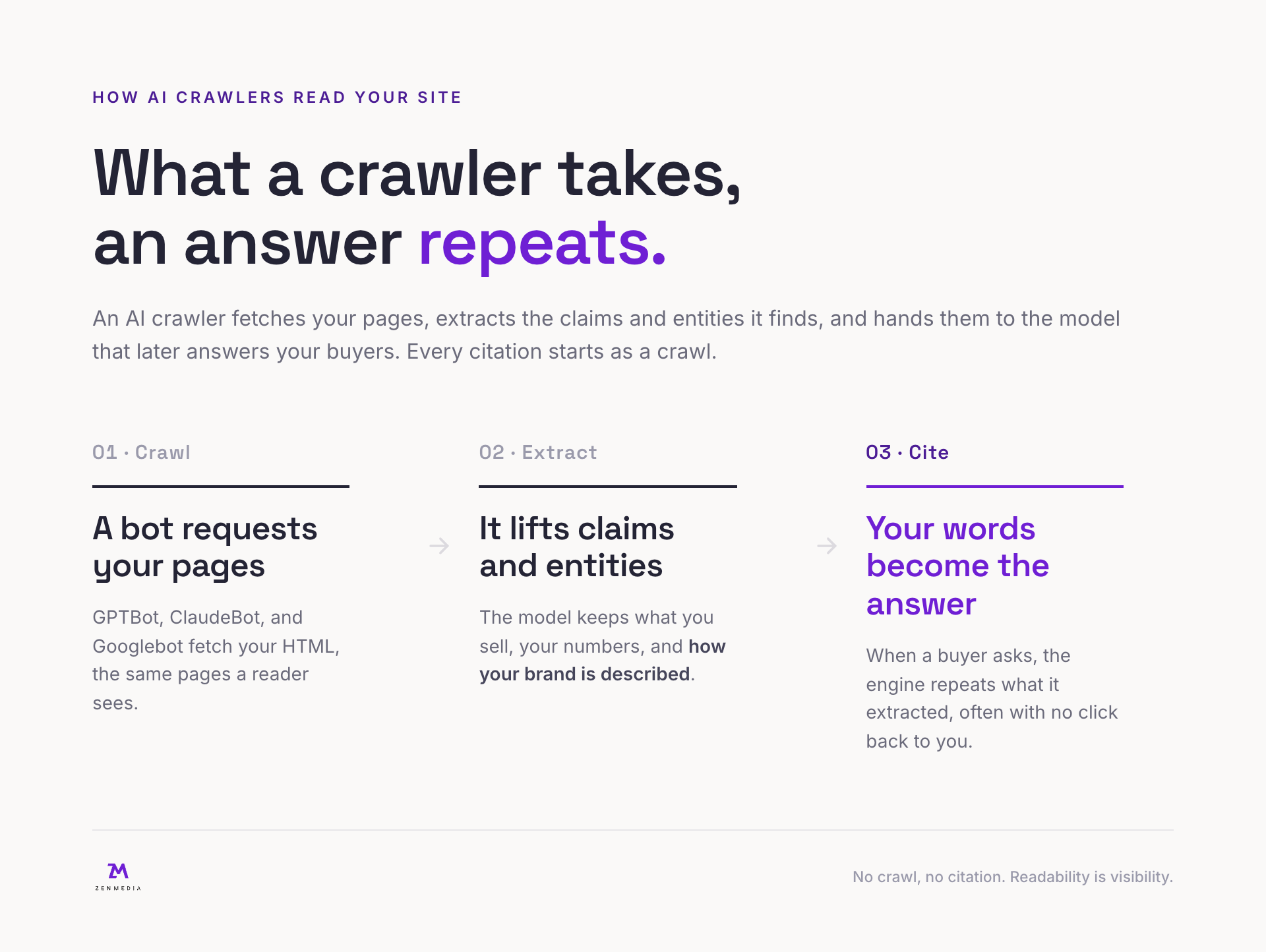
Every AI answer about your brand begins as a crawl. A bot sends a request to your server, downloads the HTML a reader would see, and passes it on. From there the content takes one of two routes: it feeds a model in training, or it is pulled in real time to compose an answer for someone who just asked a question. Either way, the words on your page become raw material for a machine that will later describe you.
The extraction step is where brand risk lives. A crawler lifts claims, numbers, named entities, and the product language others use about your category, with no eye for nuance. If your strongest proof point sits inside an image, a PDF, or a script the bot cannot parse, it never makes it into the model. What the crawler can read becomes what the engine can say, so readability is visibility.
This is why a page that ranks well in Google can still be invisible in AI answers. Search rewards a link; an answer engine rewards an extractable fact. A buyer who asks an assistant for a shortlist never sees your meta title or your hero video. They hear a sentence the model assembled from whatever it managed to read, and your job is to make sure your brand is in that sentence.
The three jobs AI crawlers do on your pages
Not every bot wants the same thing, and the mix matters for how you respond. Crawlers split into three jobs. Training crawlers collect content to teach a model. Mixed-use crawlers blend training, search, and real-time fetching under a single identity. A smaller slice handles pure search indexing and live user fetches, where a bot grabs your page because a person just asked their assistant something. Across the web in 2026, training is the dominant purpose, and it is climbing fast.
What AI crawlers come for
Share of AI crawler requests by purpose, 2026
Training share is approximate and rising. Figures from Cloudflare, 2026.
The practical takeaway: a crawl rarely brings a visitor. A training bot may read your entire site and send nobody back, which is why old traffic reports understate how much AI is already using your content. The value shows up later, inside an answer, and you can only see it by measuring the answer itself.
What AI crawlers can and cannot read on your site
Crawlers read what a browser renders as plain HTML text, and they skip or stumble over the rest. The working test is simple: if a person has to click, hover, or wait for a script before your claim appears, a crawler probably never sees it. Server-rendered copy, headings, lists, and real tables come through cleanly, which is why the structure of a page matters as much as the words on it, the same technical groundwork that drives B2B SEO.
The common blind spots trip up strong brands with weak markup. Text baked into an image or an infographic is invisible to a crawler unless the same words live in the body copy. PDFs get read inconsistently. Content that only appears after JavaScript runs is often missed, because the crawler takes the raw HTML and moves on. A fact trapped in any of these formats is a fact no engine can quote.
The fixes are structural and cheap. State your core claim in the first sentence of each section, use descriptive H2 and H3 headings a model can map, and add FAQ and Organization schema so engines get clean, labeled facts to lift. These overlap the SEO fundamentals a PR team should own. Pair every chart or diagram with the same figures in the prose. These are the readability repairs step two of the audit is built to catch, and they are what turn a page a crawler can reach into a page an engine will quote.
The bot operator list is the new media list
For years a PR team kept a media list: the outlets and journalists who shaped how the market saw a brand. The machine operators now sit beside them, a change our team has tracked since AI search rewrote visibility, influence, and reputation. A handful of companies run the crawlers that feed the answer engines buyers use, and each one reaches your content through named agents. Knowing who they are, and what each crawler powers, is the first move in any AI visibility audit.
| Operator | Named crawlers | What it powers |
|---|---|---|
| OpenAI | GPTBot, OAI-SearchBot, ChatGPT-User | ChatGPT answers and training |
| Anthropic | ClaudeBot, Claude-User | Claude answers and training |
| Googlebot, Google-Extended | Search, AI Overviews, Gemini | |
| Perplexity | PerplexityBot, Perplexity-User | Perplexity answers with citations |
| Meta | Meta-ExternalAgent | Meta AI and model training |
| Common Crawl | CCBot | An open dataset models train on |
Reading this list the way a PR team reads a media list changes the questions you ask. You stop asking only “did we get coverage” and start asking “which operators can reach us, what are they extracting, and does our story survive the trip.” A brand that has never checked which of these agents reach its pages is guessing about its place in every AI answer.
How to run an AI visibility audit in five steps
How confident are you that ChatGPT describes your brand the way you would? An AI visibility audit turns that uncertainty into a measurable baseline. It answers four questions in order: who is reading you, can they read you well, what are buyers asking, and how often do answers name you against rivals. Run it as five steps, and keep the output so you can compare it next quarter.
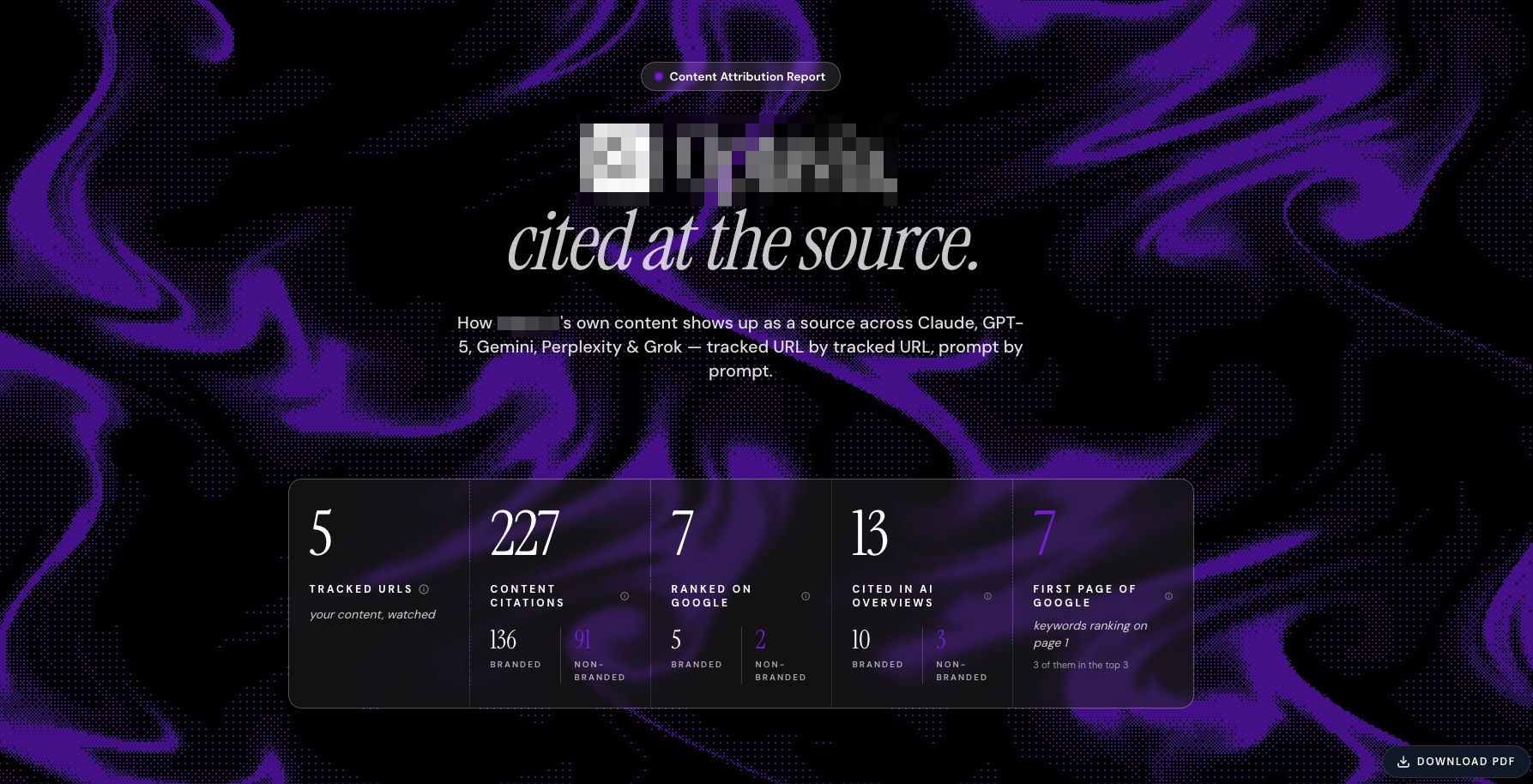
A finished audit view: every tracked URL and citation, counted engine by engine and prompt by prompt.
If you only have time for part of this, start with steps one and four. Knowing which bots reach you and what your Answer Share is already puts you ahead of the field, and it gives you a number to defend. For the deeper measurement mechanics, our guide to what Answer Share is and how it connects to revenue picks up where this section ends.
Should you block AI crawlers?
When the data showed bots crossing half of all web traffic in 2026, security teams often reacted by blocking AI crawlers across the board. That instinct protects servers, and it reads as caution. For a brand that wants to be found, it is often the more expensive choice, because the same block that stops a training bot can also stop the crawler that would have cited you in an answer.
The decision gets clearer once you separate the two jobs from Part 1. Blocking a training crawler keeps your content out of the next model, which some brands with proprietary material genuinely want. Blocking an answering crawler erases you from the live response a buyer sees right now. A B2B brand usually has far more to lose from invisibility than from training, so the smart move is a selective block that leaves the answering crawlers reachable.
robots.txt and llms.txt: what to block and what to allow
Two small files control much of what AI systems do on your site. Your robots.txt sets crawl permissions: which agents may request which paths. A newer file, llms.txt, does the opposite job, guiding an AI system to your best pages once it is already reading you. robots.txt decides access; llms.txt shapes navigation, and the two work together.
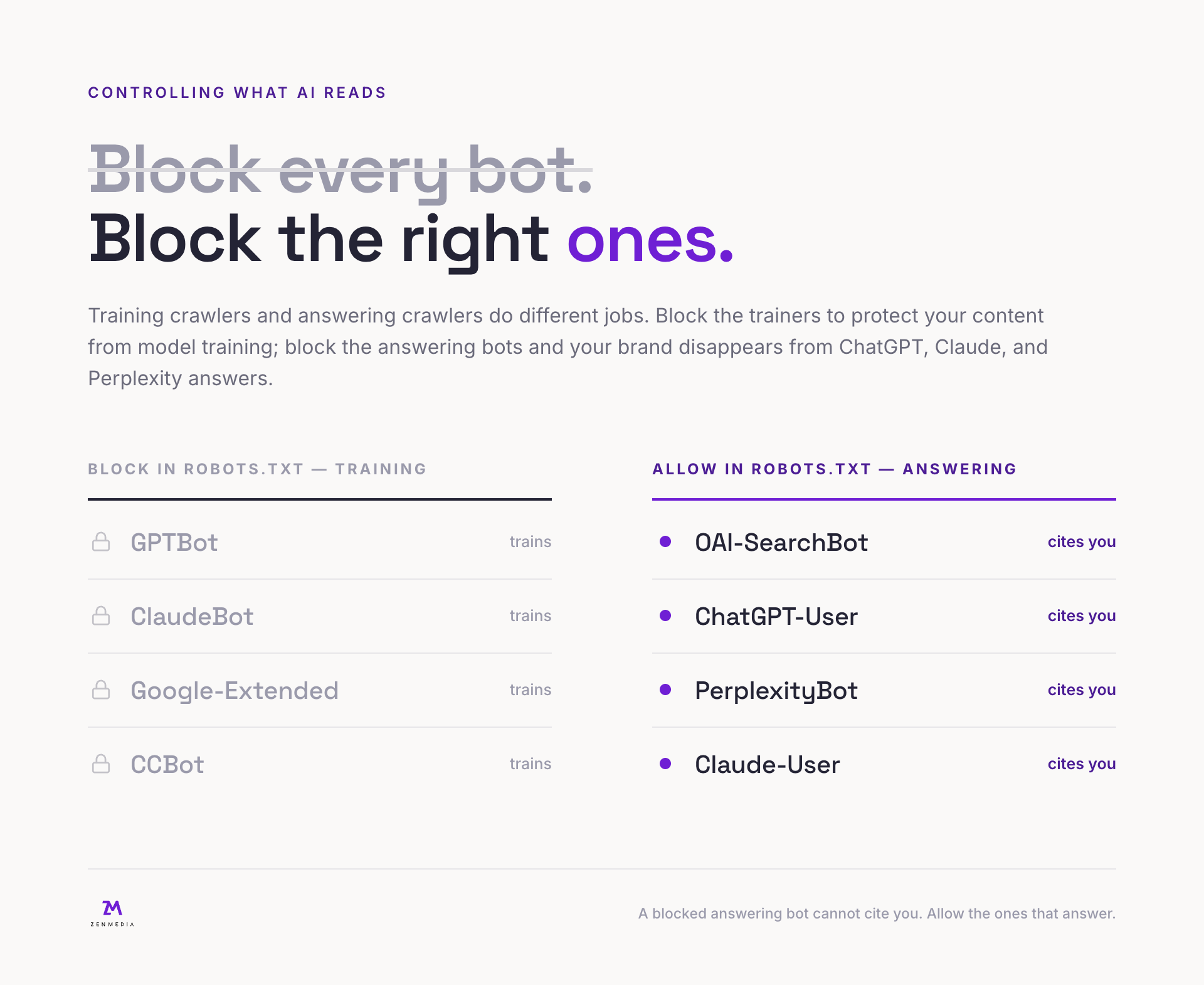
For visibility, the defensible 2026 setup is to block the pure training crawlers, keep the answering crawlers open, and always allow Googlebot. The table below turns that into a per-crawler decision you can apply during the audit. Each row names the agent, what it does, and the call a visibility-focused brand usually makes.
| Crawler | What it does | Visibility-first call |
|---|---|---|
| GPTBot | Trains OpenAI models | Block only to opt out of training |
| OAI-SearchBot | Fetches pages for ChatGPT answers | Allow, so you stay citable |
| ClaudeBot | Trains Anthropic models | Block only to opt out of training |
| Claude-User | Fetches pages for Claude answers | Allow |
| Google-Extended | Trains Gemini | Block to opt out, without losing Search |
| Googlebot | Indexes for Search and AI Overviews | Always allow |
| PerplexityBot | Powers Perplexity answers | Allow |
| CCBot | Common Crawl, a dataset models reuse | Block to limit broad reuse |
Publishing an llms.txt is the complementary move. It lets you point answering engines at your definitive pages, state how you want to be described, and prioritize the pages you want cited first. The open llms.txt specification documents the format, and it pairs naturally with the allow rules above: robots.txt lets the right bots in, llms.txt shows them where to look.
What makes your content survive extraction and get cited
Letting the right crawlers in is necessary, and it is only the start. Once a bot can read you, the question is whether your content survives extraction in a form an engine will reuse. Three traits decide that: clarity, specificity, and third-party corroboration. Pages that state a claim plainly, back it with a concrete number or named detail, and are echoed by sources the model already trusts are the ones that end up in answers.
SpecialistID is the clearest proof I have seen of these traits working together. The brand had strong traditional SEO yet was absent from AI answers, while Amazon and Staples owned the recommendations. Zen Media rewrote its category and product pages in buyer language, added structured data and FAQ markup matched to real prompts, and seeded corroborating content on sources LLMs reference. Within 90 days the brand was appearing in 72% of its high-intent AI answers.
Why smaller brands keep displacing larger ones
One of the clearest findings an audit surfaces is that clarity beats size in AI answers. Answer engines assemble a response from the clearest, best-corroborated content they can read, so a focused brand with specific pages can be named ahead of a larger competitor whose site is vague. Domain authority helps a model find you; clarity is what makes it quote you.
Two healthcare programs show the pattern. An oncology navigation platform with deep clinical expertise was barely visible in AI answers until a structured anchor asset and earned coverage gave engines something consistent to cite. A second healthcare brand with genuine category authority was absent from technical prompts until a 4,000-prompt audit and aligned content moved it into the answer set. In both cases readable, corroborated specificity did the work, and budget was secondary.
When an engine builds an answer, it reaches for the source it can quote with confidence. A specialist that states its claim plainly and backs it with evidence gives the model exactly that, which is how a focused brand ends up named ahead of a household name with a vaguer page.
Measuring AI visibility with Answer Share
Answer Share is the percentage of relevant AI answers that mention or cite your brand across a tracked set of prompts. It is the metric that replaces keyword rank in AI search, because an answer engine writes a fresh response every time and gives you no fixed position to hold. You cannot sit at number three in a list that is rewritten on every query, so you measure how often you make the answer at all.
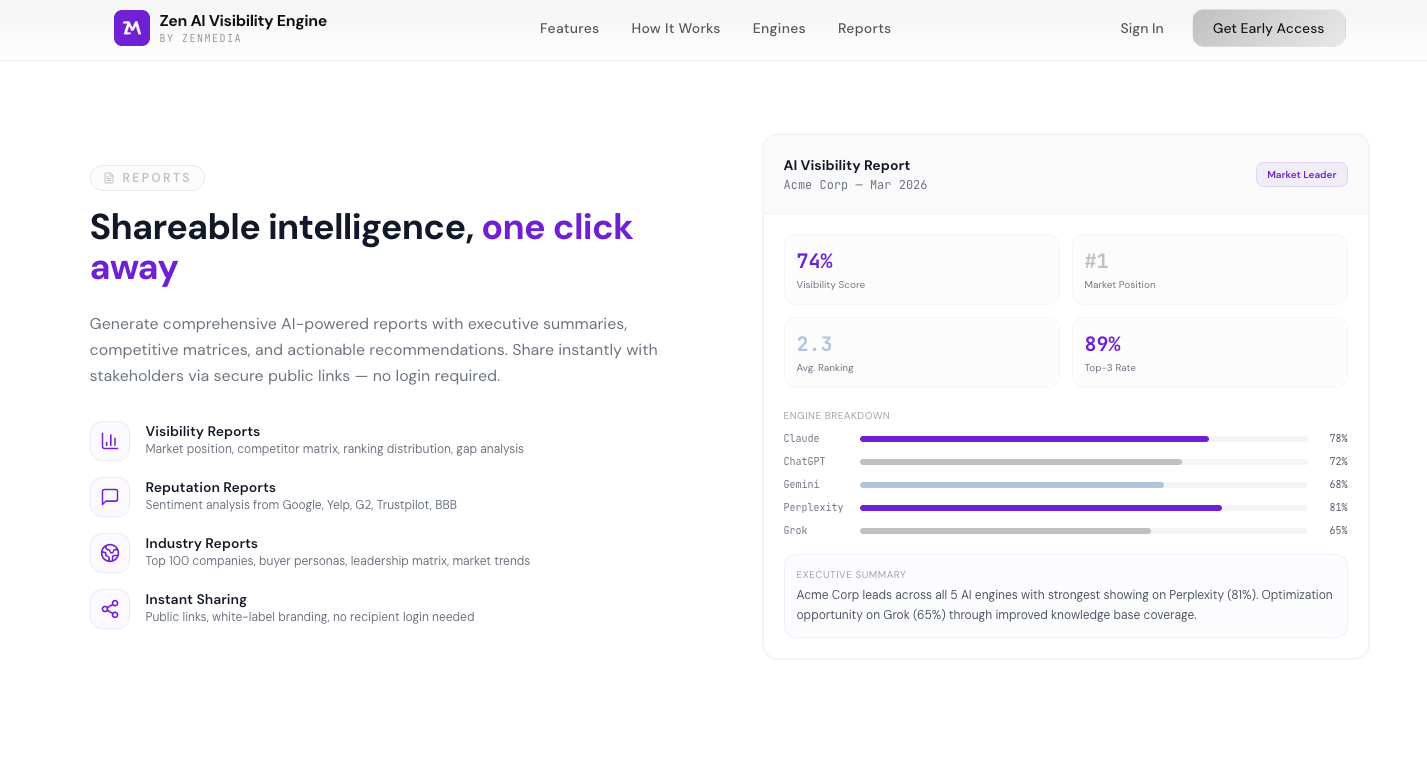
A Zen AI visibility report: one score, with per-engine visibility broken out across every answer engine.
The number earns its keep because it is comparable over time and across engines. Measured monthly, it shows whether your content and earned-media work is moving the needle, and it exposes platform gaps: a brand can sit near zero on Claude while holding steady on ChatGPT, which points to exactly where the next effort should go. That is the asymmetry the oncology program revealed, where Claude climbed from near-zero while ChatGPT barely moved.
Answer Share also connects visibility to pipeline, because the prompts you track are the ones buyers use to build shortlists. Zen Media runs this measurement continuously inside Published Monthly, and the deeper mechanics live in our explainer on Answer Share as an AI-era PR metric. For the broader discipline of earning citations across engines, our guide to generative engine optimization covers the content side in depth.
Why starting your AI visibility work now compounds
AI visibility compounds over time, and that works in favor of whoever moves first. Every time a model retrains, it re-reads the web and re-learns which brands belong in which answers. A brand that is already clear, cited, and corroborated gets reinforced on each cycle, while a brand that waits has to overcome a pattern that is hardening against it. The lead compounds, which is why the audit comes first.
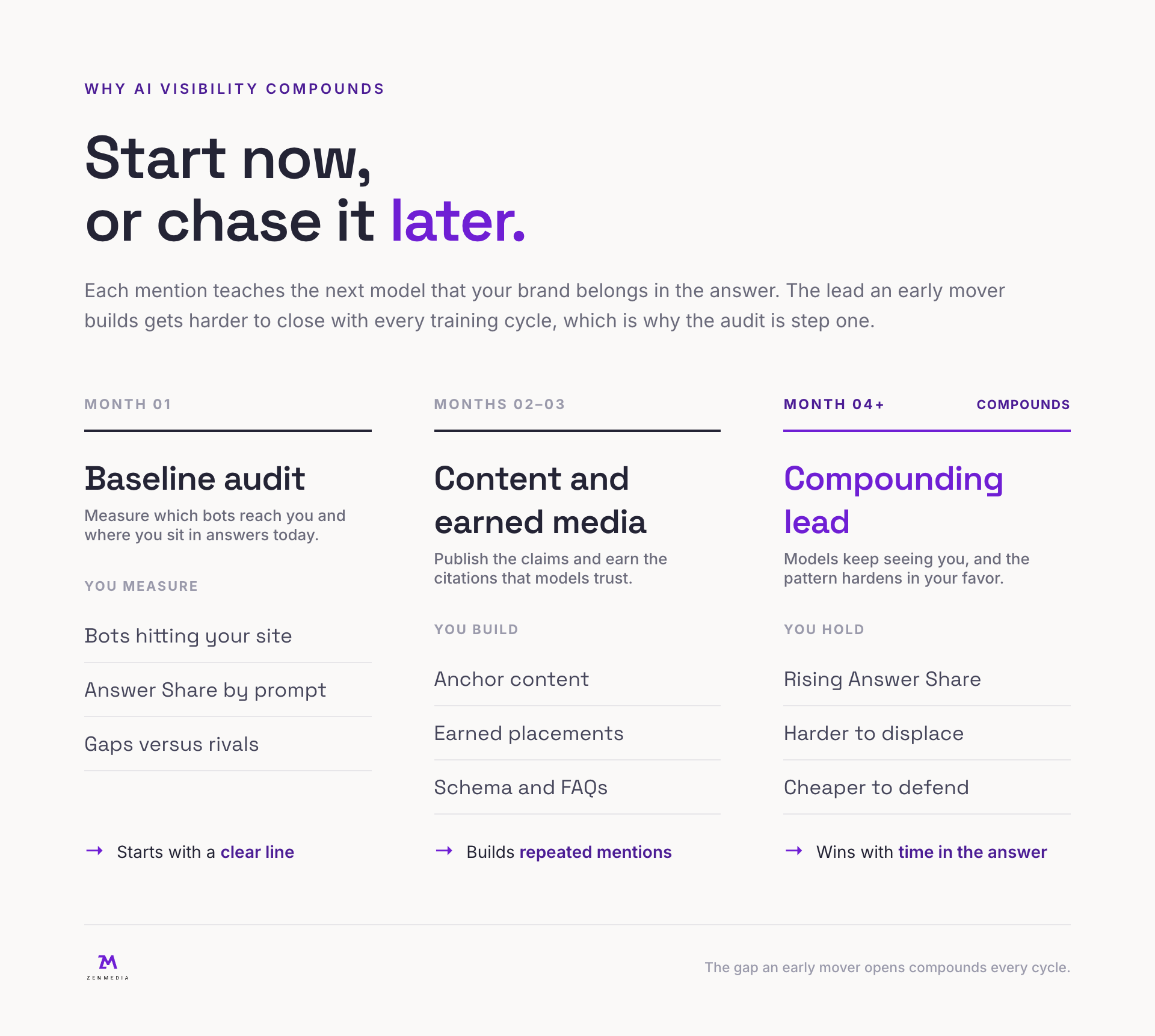
The brands I have watched build durable AI visibility share one habit: they measured early, fixed what the crawlers could not read, and kept earning mentions while competitors were still debating whether any of this mattered. By the time a slower rival starts, the early mover is the default answer: its Answer Share keeps rising, it grows harder to displace, and it costs less to defend each quarter. Running your AI visibility audit now is how you claim that position before someone else does. For teams that want the full answer-engine playbook, start with our guide to how answer engine optimization works, then put a measurement cadence in place or bring in an AI visibility partner to hold the answer layer. To get a baseline run for you this quarter, book an AI visibility audit with our team.
Frequently asked questions
What is an AI visibility audit?
An AI visibility audit is a review of how AI systems read, store, and repeat your brand. It inventories which crawlers reach your site, checks whether your key pages are readable, maps the prompts buyers ask, and measures how often answer engines name you against competitors. The output is a baseline you can improve.
How do I know if AI crawlers are visiting my site?
Check your server logs or CDN analytics for named user agents such as GPTBot, ClaudeBot, OAI-SearchBot, PerplexityBot, and Google-Extended. Hosting dashboards and tools like Cloudflare break out AI bot traffic directly. If you see those agents requesting pages, AI systems are reading your content right now.
Should I block AI crawlers like GPTBot and ClaudeBot?
Block training crawlers only if protecting your content from model training matters more than being cited. For a typical B2B brand, the bigger risk is invisibility. Block GPTBot or ClaudeBot and you lose a say in how models describe you, so block selectively and keep the answering crawlers open.
What is the difference between training crawlers and answering crawlers?
Training crawlers such as GPTBot, ClaudeBot, and Google-Extended collect content to train models. Answering crawlers such as OAI-SearchBot, Claude-User, and PerplexityBot fetch pages in real time to build a live answer and can cite you. The two do different jobs and deserve different robots.txt rules.
Does blocking AI crawlers hurt my brand’s visibility?
Blocking answering crawlers does. If ChatGPT or Perplexity cannot fetch your page, they cannot cite your brand, and the answer defaults to whoever they can read. Blocking training crawlers has no effect on whether you appear in live answers, so the two decisions carry very different costs.
How often should I run an AI visibility audit?
Run a full AI visibility audit quarterly, and check your Answer Share monthly once a baseline exists. Models retrain, competitors publish, and answers drift, so a number that was accurate in January can be stale by April. A light monthly check catches movement before it becomes a gap.
What is Answer Share?
Answer Share is the percentage of relevant AI-generated answers that mention or cite your brand across a set of tracked prompts. It replaces keyword rank as the core AI visibility metric because answer engines write a fresh response each time, with no fixed list to sit on. You measure it by sampling prompts across engines.
Can smaller brands outrank larger ones in AI answers?
Yes. Answer engines reward clarity and evidence over domain size. A focused brand with specific, well-structured content and consistent third-party mentions can be named ahead of a larger competitor whose pages are vague. Zen Media has moved specialized brands past Amazon and Staples in AI answers this way.
What is llms.txt and do I need one?
llms.txt is a plain-text file that tells AI systems how to navigate your site and which pages to prioritize once they are already reading you. It does not block training; robots.txt does that. llms.txt helps answering engines find your best content and guides them to the pages you want cited first.
About the author: Sarah Evans is Partner and Head of PR at Zen Media, a global B2B PR and marketing agency. With 23+ years in communications, she architects PR strategy, drives earned media initiatives, and helps brands navigate AI-driven visibility. She is a regular contributor to Entrepreneur and has been recognized as a top writer on business and tech.