Ask ChatGPT how to fix a stalled B2B pipeline and it answers in a tidy paragraph. No ten blue links, no scrolling, no click. When the answer arrives fully formed, which sources does the AI decide to quote, and how does your brand become one of them? That question is the one every marketing and communications leader is quietly sitting with now.
That is the whole job of answer engine optimization. Search used to send people to your page to find an answer. Now the answer is assembled for them, and the only visibility that counts is being named inside it. If a buyer reads your position in an AI answer and never touches your site, did you win that search or lose it? In the AI answer layer, being the cited source is the win.
I have spent more than two decades helping brands earn attention in channels that keep reinventing themselves, and AEO is the biggest reinvention of search since mobile. Google keeps shipping new answer surfaces on top of it, including the Preferred Sources button it gave publishers in August 2026, which we cover later in this guide. The mechanics are learnable, and once you see how a citation gets chosen, the work to earn one stops feeling like guesswork.
What Is Answer Engine Optimization (AEO)?
An answer engine answers a question directly. It generates a written response and names a few sources, where a classic search engine would return a page of links. Google AI Overviews and AI Mode, ChatGPT, Perplexity, Gemini, and Microsoft Copilot all work this way. Each runs the same broad sequence: it reads the question, retrieves a pool of trusted pages, lifts the passages that answer the question directly, and stitches them into a single response that cites a handful of sources.
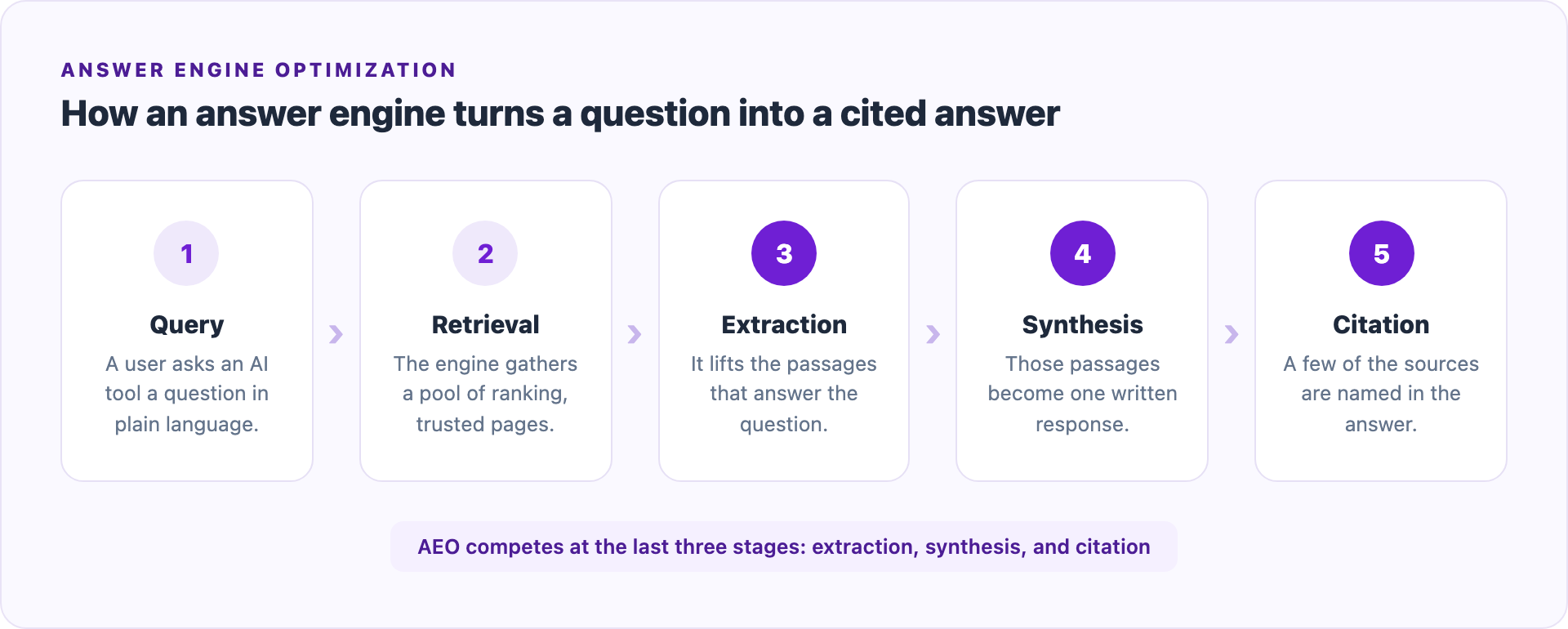
Traditional optimization competes to be on the page. AEO competes to be in the paragraph. Ranking still matters, because it gets a page into the retrieval pool the engine draws from. Citation is the second contest: once a page is in the pool, the engine decides which passages are clean enough to lift and credible enough to attribute. A page can rank on the second page of results and still get quoted, while a page ranked first can be passed over because nothing on it stands alone as a quotable answer.
This is why AEO reads as familiar and new at the same time. The inputs (useful content, technical health, authority) come straight from the generative engine optimization playbook that PR and SEO teams already know. The same work also goes by GEO and, less often, LLMO for large language model optimization; the labels differ, the goal is identical. What changes is the target. You are no longer optimizing a page for a rank; the goal is to make a passage the sentence an AI repeats to your buyer. For the strategic version of this change, our deep dive on winning traffic and trust in AI-driven search maps the full playbook.
Why AI Answers Moved to the Center of Search
Answer engines went mainstream because they got good enough to trust and big enough to matter in the same eighteen months. Google’s AI Overviews reached 2.5 billion monthly users, and its conversational AI Mode passed 1 billion monthly users within a year of launch. ChatGPT crossed 800 million weekly users, and the way it surfaces and monetizes citations keeps changing, as our read on ChatGPT ads and AI citations tracks. When a behavior reaches that scale, it stops being an experiment and becomes the front door to search.
The second force is behavioral. When an AI summary sits at the top of a results page, people stop clicking through. Pew Research Center found that users clicked a traditional search result on just 8% of visits where an AI summary appeared, against 15% where none did, and only 1 percent clicked a link inside the summary itself. Sessions ended without any further click 26 percent of the time when a summary was present, compared with 16 percent without one.
Clicks collapse when an AI summary appears
Share of Google searches that led to a click
Sample: 900 U.S. adults, 68,879 searches. Pew Research Center, 2025. source
Direct clicks from AI tools are still modest in raw volume, so the payoff is influence over the answer itself. The buyer forms an opinion inside the response before any site visit happens. If the response quotes a competitor’s framing of the problem, you are arguing against a position the buyer already absorbed. The B2B playbook for answer engines treats that first synthesized answer as the new top of the funnel.
How AEO Differs From SEO, and Where They Overlap
The usual objection to AEO is that it is SEO wearing a new hat. That objection is half right, and the half it gets right is worth stating plainly. Google’s own May 2026 guidance is direct about it: in Google’s framing, optimizing for AI search is still SEO. Lily Ray, VP of SEO Strategy and Research at Amsive, put the overlap bluntly, calling the connection to “what we’ve been doing in the SEO space before AI search existed” very, very strong.
The half the objection gets wrong is the unit of work. SEO optimizes a page to rank. AEO optimizes a passage to be extracted and attributed. The signals change accordingly: authority moves from links pointing at your domain toward mentions of your brand across sources the model already trusts, and success moves from position in a list toward citation rate inside answers. The table below maps what carries over and what changes.

| Element | Traditional SEO | AEO |
|---|---|---|
| Goal | Rank in a list of results | Get cited in a generated answer |
| Core unit | The page | The passage or answer block |
| Success metric | Rankings and clicks | Citation rate and Answer Share |
| Primary signals | Backlinks, relevance, authority | Extractability, structure, third-party mentions |
| Competitive set | Pages targeting the same query | Any source the model can pull from |
| How fast it moves | Builds slowly, holds steady | Shifts faster, needs monitoring |
The practical takeaway: you do not abandon SEO to do AEO. You keep the technical health and authority that put a page in the running, then add the extractability and third-party validation that decide the citation. A page has to earn its way into the pool before any of the answer-layer work pays off.
How Answer Engines Decide What to Cite
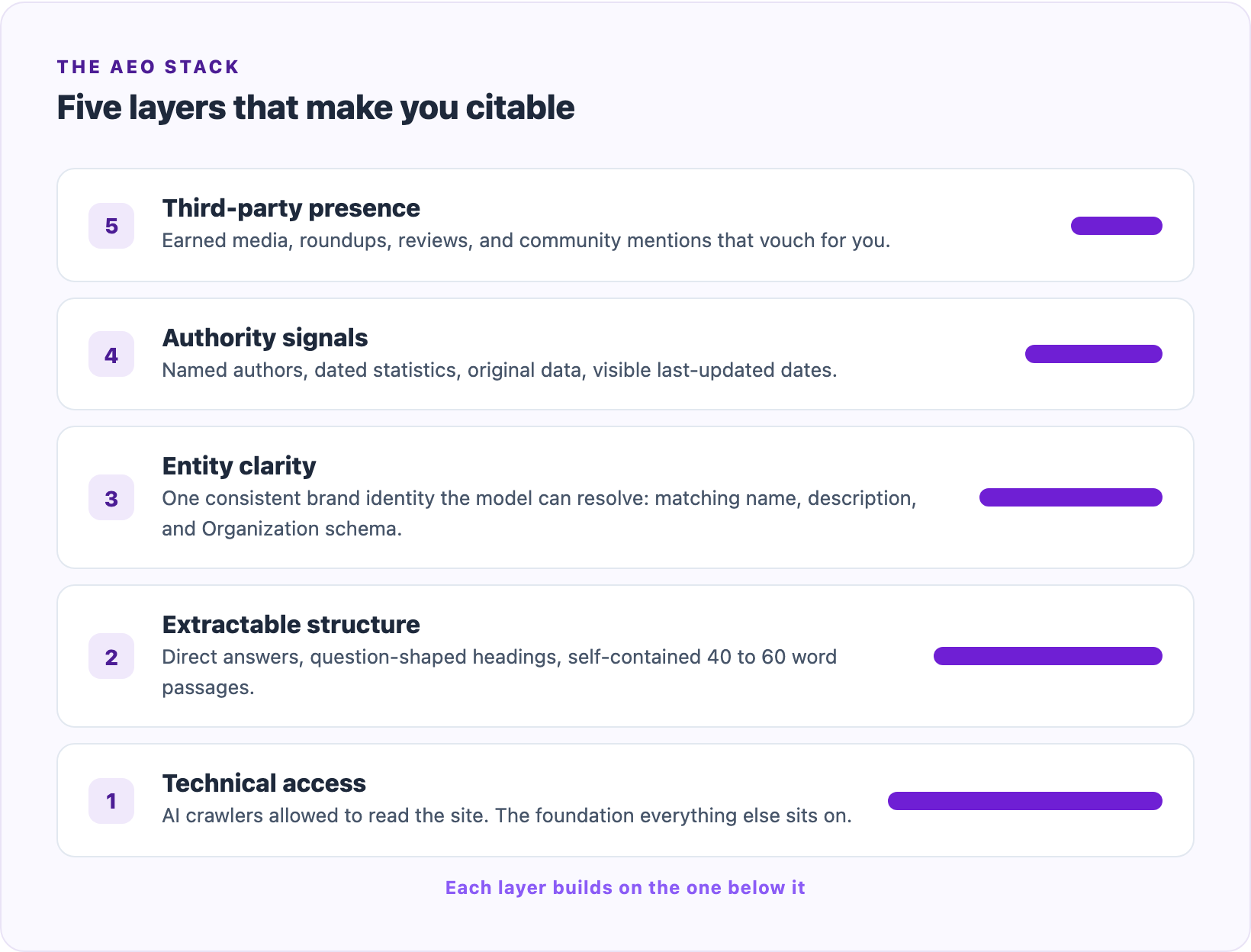
Once a page is in the retrieval pool, three tests decide if it gets quoted: a passage that can be lifted cleanly without the surrounding context, a source credible enough to attribute, and independent backing from other sources. Content that clears all three tends to get cited; content that misses one tends to get skipped, no matter how well written it reads.


There is peer-reviewed evidence for the content moves that work. A Princeton-led study, the original research that named generative engine optimization, tested rewrites across live answer engines and found that adding citations, quotations, and statistics lifted a source’s visibility in generated answers by up to 40%. Keyword stuffing, the reflex from old-school SEO, performed worse than leaving the content alone.
Answer engines weigh what other credible sources say about you more heavily than what you say about yourself. That single fact is why AEO is a public-relations discipline as much as a technical one. The brands winning citations are the ones showing up in earned coverage, expert roundups, and community discussions, so the model sees independent agreement before it ever quotes your own page.
That third-party layer is the part technical AEO guides tend to underweight, and it is exactly where an earned-media program compounds. Coverage in a trusted publication does double duty: it reaches readers, and it becomes a signal the model reads when it decides who to cite. Zen Media’s take on GenAI-referenced media goes deeper on how that coverage feeds the answer layer.
What an Extractable Passage Looks Like
Extractability is easier to see than to define. Here is the same answer written two ways: one an engine can lift whole, one it has to skip.
The strong version leads with a direct definition, stays under 60 words, and needs no context from the paragraphs around it. The weak version hedges, buries the point, and hands the engine nothing clean to quote. Write every key section to clear that same bar, and read each one back on its own to check that it still answers the question.
The Technical Floor: Crawler Access and Schema
Beneath those three signals sits a technical floor: the engine has to be allowed to read your site. Each platform ships a named crawler you can allow or block in your robots.txt file, including GPTBot and OAI-SearchBot from OpenAI, ClaudeBot from Anthropic, PerplexityBot, and Google-Extended for Gemini. Block the wrong one and you vanish from that engine’s answers, whatever your content looks like. Confirm which AI crawlers your site allows before anything else.
Schema markup helps, with one caveat worth stating. FAQ, Article, and Product markup give an engine cleaner context, and that benefit carries straight over from standard SEO. Google’s guidance is explicit that there is no AEO-specific schema, so treat structured data as ordinary SEO hygiene: helpful for context, never a shortcut to a citation. The SpecialistID work later in this guide pairs deep structured data with strong content and earned media, and that combination is what produced the result.
Entity Clarity: Help AI Recognize Your Brand
Before an engine can cite you, it has to know who you are and read every mention as the same organization. Entity clarity is a single, consistent identity the model can resolve across the web. Use one brand name and one-sentence description everywhere, add Organization schema to your site, and keep your profile accurate on the sources models lean on for identity, from your own About page to Wikipedia, Wikidata, LinkedIn, and Crunchbase. Earned coverage reinforces that same entity in the knowledge graph, so every placement doubles as an identity signal. When your identity is fuzzy, the model hedges or hands your work to a better-known name.
How the Major Answer Engines Differ
The same prompt can return a different answer on different engines, because each one pulls from its own index and weights freshness and authority in its own way. You do not build for a single engine; you satisfy the shared signals, then track where you stand on each. The table maps what the major engines lean on and what that means for your content.
| Engine | What it leans on | What that means for you |
|---|---|---|
| ChatGPT | A broad web index plus widely referenced reference and community sources | Be present on the established sources it already trusts, including your earned coverage |
| Perplexity | Live retrieval with visible citations, weighted toward fresh, source-dense pages | Keep priority pages current and packed with cited facts |
| Google AI Overviews and AI Mode | Google’s own index and existing ranking signals | Traditional SEO strength carries almost directly into these answers |
| Gemini | Google’s ecosystem and knowledge graph | Clear entities and structured data help the model place you |
| Microsoft Copilot | The Bing index | Maintain Bing visibility, an often-ignored source of citations |
Because answers vary this much from one engine to the next, and even from one day to the next, chasing any single engine’s quirks wastes effort. Satisfy the shared signals that all of them reward first, then let the differences guide where you push last.
How to Do AEO, Step by Step
AEO work runs as a repeatable loop. Each cycle, you map the questions buyers ask, structure content to answer them, prove authority, earn outside validation, and adjust based on what the answers show. This sequence is how Zen Media runs an AI visibility engagement.
What Google Says to Skip
Because the AEO market moves fast, a lot of tactics get sold that do nothing. Google’s May 2026 optimization guidance is unusually direct about which ones to drop, and taking the free advice saves budget you can spend on the work that moves citations.
Common AEO Mistakes That Waste Budget
A handful of mistakes show up again and again, and each one quietly caps how often you get cited. Fixing these usually does more than any new tactic.
Which Content Formats Win AI Citations
Format follows extractability. The content that gets cited tends to give the model clear criteria and specific detail it can lift: comparisons, criteria-based buying guides, definition-led explainers, and data-backed analysis. Broad opinion posts and marketing copy with no supporting numbers give the model little to quote, so they underperform even when they read well. A piece titled “AEO vs. SEO: seven differences that change how AI cites you” gives an engine seven liftable answers; “trends shaping AI visibility this year” gives it none.
First-party data is the format multiplier. Original research, benchmark numbers, and proprietary survey results are quotable by definition and hard for a competitor to reproduce, which is why publishing data others cite is a durable citation strategy competitors cannot easily copy. If you want the formatting mechanics for press assets, the guide on press releases written for generative AI covers how to structure a release so an engine can lift it.
Your First 90 Days
New programs stall when they try to do everything at once. This phased sequence gets a team from zero to a defensible Answer Share without spreading the work too thin.

| Phase | Focus | What you should see |
|---|---|---|
| Weeks 1 to 4 Baseline | Build the prompt set, run it across every engine, and fix crawler access | Your starting Answer Share and the exact prompts competitors own |
| Weeks 5 to 8 Structure | Rewrite priority pages for extraction, add named authors and dates, publish original data | Early movement on structural and long-tail prompts |
| Weeks 9 to 12 Authority | Earn media coverage and third-party mentions, expand content to the prompts you still miss | Rising share on competitive, high-intent prompts |
Past the first quarter, the work turns to maintenance and expansion: re-run the prompt set on a schedule, defend the prompts you won, and target the next cluster of questions.
How Google Preferred Sources Fits Into AEO
On August 20, 2026, Google gave publishers an embeddable Preferred Sources button, the first direct way for a reader to tell Google which sites to prioritize inside Search and its AI experiences. It is the newest answer surface an AEO program can act on, and it sits on top of everything above: the button only matters once the content behind it is worth returning to.
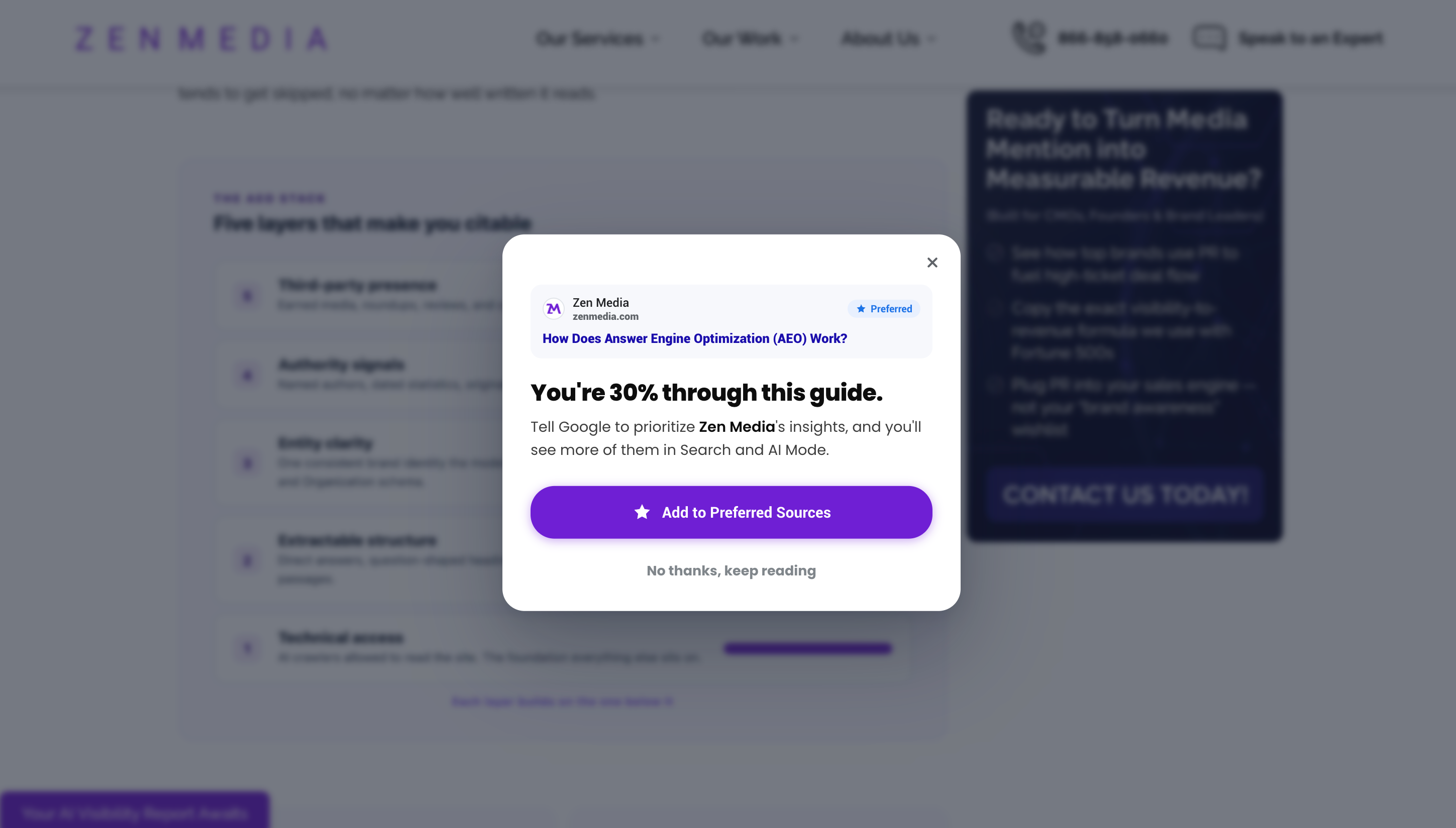
Zen Media implemented the button across its own properties, zenmedia.com and optimum7.com, and the popup above is what a reader sees partway through this guide. The mechanics are deliberately small: Google’s standard JavaScript version adds an auto-localized, Google-styled button with two lines of HTML, documented in Google’s Search Central guide to Preferred Sources. Reader adoption has been fast.
Eligibility Works at the Domain Level
Preferred Sources works at the domain and subdomain level. A root domain like example.com or a subdomain like news.example.com can be selectable on its own; a folder such as example.com/blog rolls up to example.com, so a company publishing there is selectable only as the root domain and the reader’s preference lands there. Site architecture sets the selectable unit before content does. Google publishes no full explanation of how availability is decided and offers no application process, and its documentation notes that sites updated infrequently may be unavailable. Check whether your site appears in Google’s source preferences before you plan around it.
The Button Is Two Lines; the Visibility Is the Content
A reader selects a source once, and the selection does not guarantee the site appears for every search. Google says selected sources show up more often in Top Stories when the site publishes fresh content relevant to the query, so consistent publishing across the subjects a buyer researches is what creates repeat opportunities to surface. The button also does not, on its own, get a brand cited in an AI answer, and Google does not state that one reader’s choice changes which sources are cited for anyone else. The feature gives an existing reader a way to ask for more of you; the content still has to earn the moment it is asked for.
That is why we treat Preferred Sources as one lever inside a wider AEO program. Zen Media runs it as a three-part sequence.
The value shows up when a brand already publishing strong, useful content gives readers a way to say, directly inside Google Search, that they want more from that source. Preferred Sources rewards the brands that did the citable-content work first, which is the same lesson every layer of AEO keeps teaching.
How to Measure Your AI Visibility
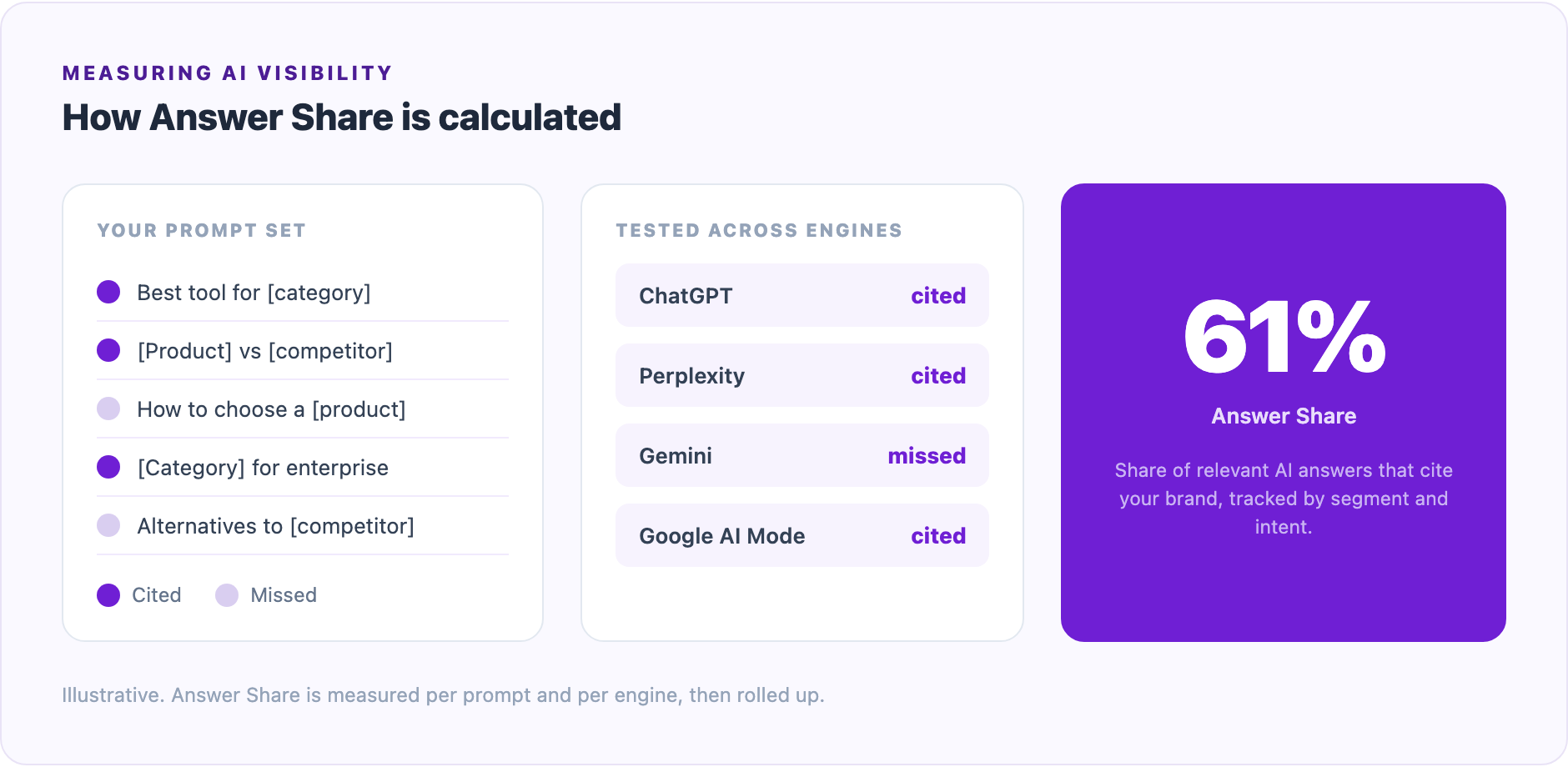
Measurement is where AEO advice tends to go quiet, and it is the question every leader asks first: how do I know it worked? Rankings and clicks do not capture citation, so the field needed a new metric. Answer Share fills that gap by measuring the percentage of relevant AI answers that name or cite your brand across the prompts and engines you care about. Different tools label the same idea their own way, from mention rate and citation rate to share of voice or an AI visibility score; they all try to answer one question, which is how often AI names you.
The reason a single metric matters is attribution. Answer Share segmented by buyer persona and intent shows which questions you own, which a competitor holds, and where a new asset moved the needle. Zen Media’s breakdown of Answer Share as an AI-era metric connects that visibility to pipeline, because a rising share on high-intent prompts is a leading indicator of demand.
A Real Before-and-After
SpecialistID had strong traditional SEO yet was absent from AI answers when buyers asked for product recommendations, while Amazon, Staples, and Office Depot dominated those responses. Zen Media rebuilt its category and product content around real buyer language, added structured data and Q&A content, and seeded credible third-party presence. The prompt-level results show what winning citation looks like in practice.
Answer Share also exposes how differently engines behave. In a separate healthcare engagement, an oncology navigation brand grew overall Answer Share from 3.35% to 7.50% in three months, but the platform split told the real story: its share on Claude climbed from near-zero to 7.70%, while its already-established share on ChatGPT barely moved. One campaign, two very different starting points by engine, which is why measuring per platform matters.
How Long AEO Takes to Show Results
Structural fixes to extractability can register within a few weeks, as engines re-crawl and regenerate answers. Authority and third-party signals compound over months, the same curve as traditional SEO authority. The honest framing for a leadership team: expect early movement on structure inside a quarter, and plan for competitive, high-value prompts as a sustained campaign that runs for quarters. Because cited sources change constantly, the work does not end when you first appear.
Tools and Manual Checks
You can start measuring today with nothing but the engines themselves: run your priority prompts across ChatGPT, Perplexity, Gemini, and Google AI Mode, and log who appears. A category of purpose-built platforms now automates that tracking across engines and languages when manual checks stop scaling. Google Search Console does not yet break out AI Overview citations, so use Google Analytics 4 to watch referral traffic from AI platforms as a directional proxy while the native reporting catches up. For an ongoing view of what to track, the prompt discovery index lays out how to build and maintain a prompt set.
Is AEO Worth the Investment Yet?
Answer engines already shape the buyer’s first impression while sending relatively few direct clicks, and that gap is the honest center of the cost-benefit question. The case for acting now rests on two forces. High-intent AI referrals convert well, because a buyer who arrives after an AI recommended you is already pre-qualified. And the field is still uncrowded: fewer competitors structure for citation today than will a year from now, so a prompt you claim now costs less to win than the same prompt will once every rival is chasing it.
The case for waiting is thin. The behavior keeps growing, the platforms add new answer surfaces every quarter, and the structural work itself, from clean extraction to named authors to real coverage, improves ordinary SEO whatever happens to AI search. Teams that fund AEO as an extension of the content and PR they already run carry almost no wasted spend, because the same assets earn rankings, referrals, and citations at once. The disciplined move is to start with the prompts tied to revenue, measure Answer Share honestly, and scale only what earns citations.
The Compounding Advantage of Early AI Visibility
The brands showing up consistently in AI answers built content for citation before their competitors treated it as real work. That lead compounds the same way domain authority does, and it compounds faster, because a source the model has already learned to trust is the source it reaches for again. Early citations feed the third-party presence that earns the next citation. AI search has rewritten how visibility and reputation build, and the brands that adjusted first hold the lead.
The teams that win the answer layer are the ones that treat it as a standing program: a living prompt set, content built to be lifted, real earned media behind it, and Answer Share reported like any other pipeline metric. If you want a partner to run that program, Zen Media’s AI visibility and PR services are built around exactly this work, and the team is one message away through the Zen Media contact page.
Frequently Asked Questions
What is the difference between SEO and AEO?
SEO earns a page a high rank in a list of results. AEO earns a passage a citation inside an AI-generated answer on Google AI Overviews, ChatGPT, Perplexity, or Gemini. The foundations overlap, but AEO adds a layer: content has to be extractable, backed by visible authority, and validated by other sources.
Does AEO replace traditional SEO?
No. Answer engines pull from content that already has search visibility and authority, so a page with no ranking rarely gets cited. AEO builds on SEO by making already-competitive pages easier to lift into an answer. Google states that optimizing for AI search is still SEO.
How long does AEO take to show results?
Structural fixes can change visibility within a few weeks as engines re-crawl and regenerate answers. Competitive, high-intent prompts take longer and depend on how often the engine refreshes and how strong the incumbent sources are. Treat AEO as continuous monitoring, because cited sources change month to month.
Is AEO the same as GEO?
They describe the same goal. GEO, or generative engine optimization, comes from academic research into how large language models select sources. AEO is the practical industry term. LLMO, or large language model optimization, is a third label for the same work. Pick one and stay consistent internally.
Which types of businesses benefit most from AEO?
Any business that depends on organic discovery benefits, and the effect is strongest where credibility drives the decision: professional services, finance, healthcare, and technology. Buyers in those categories ask AI tools for recommendations and comparisons before they ever reach a website, so citation shapes the shortlist.
How do I know if AI search engines are citing my content?
Run your priority prompts across each engine and record if you appear and who appears instead. Purpose-built tools automate this at scale. Google Search Console does not yet report AI Overview citations, but Google Analytics 4 shows referral traffic from ChatGPT, Perplexity, and other AI platforms as a proxy.
What content should I create first for AEO?
Start with the pages tied to how buyers describe their problem, then make each section answerable on its own in 40 to 60 words. Add named authors, sourced statistics, and original data worth quoting. Comparison and criteria-based content earns citations faster than broad opinion posts.
How do I know if my site is eligible for Google Preferred Sources?
Search your root domain or subdomain in Google’s source preferences. If it appears, readers can select it as a preferred source; if it does not, the site is not yet available. Eligibility is domain-level: a root domain or subdomain can qualify, but a folder or subdirectory cannot on its own.
Does adding Google’s Preferred Sources button get my brand cited by AI?
No. The button gives readers a way to select your site as a preferred source, and it does not guarantee inclusion in an AI Overview or AI Mode answer. The underlying content still has to be relevant enough to surface. Zen Media folds Preferred Sources into a wider answer engine optimization program.
About the author: Sarah Evans is Partner and Head of PR at Zen Media, a global B2B PR and marketing agency. With 23+ years in communications, she architects PR strategy, drives earned media initiatives, and helps brands navigate AI-driven visibility. She is a regular contributor to Entrepreneur and has been recognized as a top writer on business and tech.