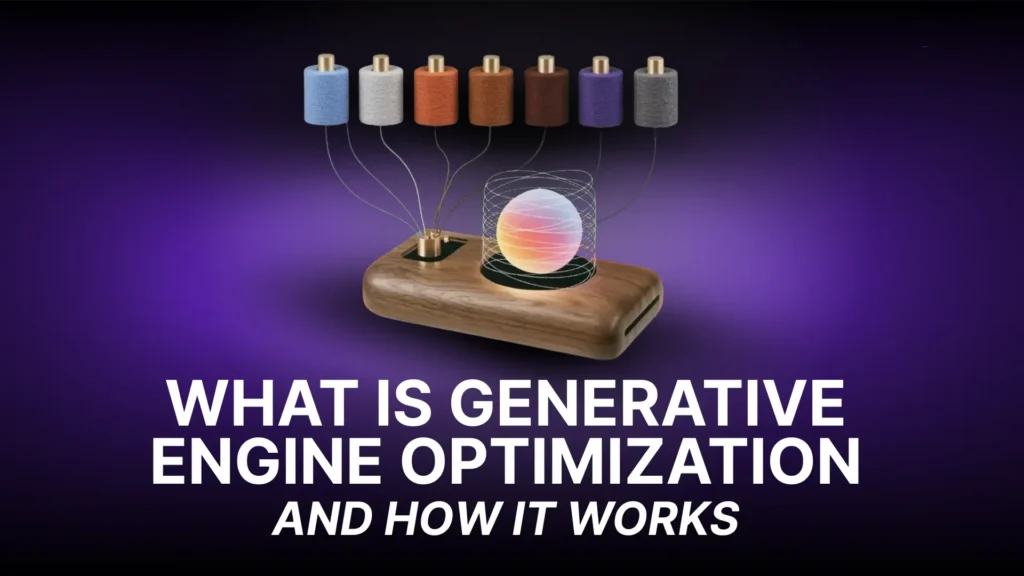
Generative engine optimization is the work of making a brand understandable, verifiable, and citeable inside AI-generated answers, because search behavior has changed faster than marketing strategies have adapted. Buyers still use search engines, but the experience looks different from what it was even a few months ago. AI-generated overviews appear above organic listings, and conversational AI tools return direct answers with no list of links to navigate.
The search results page still exists, but it sits further downstream in more buying journeys than it used to. In some categories, buyers reach it as the second screen after AI has already shaped their thinking. HubSpot’s 2026 AI search research found that 42% of CRM buyers used AI search during their evaluation process, and those buyers were 36% more likely to purchase. For B2B brands, the higher-stakes question has moved from keyword rankings to something harder to track: brand presence in the answer AI gives when a buyer asks about the problem.
Generative AI tools don’t retrieve a ranked document and surface it to the user. They synthesize a response from multiple sources, weight the ones they treat as credible, and produce a coherent answer that doesn’t always reveal where it came from. The synthesis step is where buyer perception begins to form, and it happens before they see a single link.
Worth reading
GEO explains how brands become visible inside AI-generated answers. The next question is how that visibility is earned across the systems buyers already use. The B2B AI Visibility Playbook breaks down how brands get cited by ChatGPT, Perplexity, and Gemini, and why earned trust, structured content, and third-party authority now shape the buyer’s first impression.
AI Systems Cite Brands They Can Verify and Understand
AI systems are already deciding which brands are clear enough to include in an answer. When a buyer asks about a vendor, a category, or a business problem, the model has to understand what the brand does, find outside sources that support that description, and pull from information specific enough to reuse. Thin or inconsistent signals make the brand harder to include, even when it ranks well in traditional search.
Generative engine optimization is the work of making those signals easier to read. It builds clarity across owned content, earned coverage, external references, and category language so AI systems can identify the brand, verify the claim through outside sources, and describe it accurately when a buyer asks. SEO still helps a page become discoverable. GEO helps a brand become citable inside the answer itself.
SEO and GEO begin with the same business pressure. A brand needs to be found, trusted, and chosen. Search still evaluates how well a page answers a query. Generative AI looks at the larger brand footprint and decides whether the brand is clear, supported, and relevant enough to appear inside an answer.
Worth reading
A B2B brand practicing GEO treats its content as reference material for machines. Structural clarity, factual specificity, and coverage consistency all help AI systems decide how confidently they can cite that brand when a buyer asks. See How Answer Engine Optimization (AEO) Works to understand the broader search behavior behind this shift, and What Is Answer Share to understand how B2B teams measure and track AI visibility.
Why Rankings Don’t Predict AI Presence
Brands hold page-1 rankings across a dozen competitive terms and still remain invisible in AI-generated answers about their category. Marketing teams testing this for the first time are surprised by the gap.
The reason comes down to what AI systems optimize for when they synthesize responses. They skip the top-ranked page and pull from sources that satisfy a different set of trust signals: third-party corroboration, factual precision, structural legibility, and topical authority built across multiple independent references. A brand’s own blog ranks well because it targets the right keywords. AI systems don’t treat it as a primary credible source for claims about that brand’s capabilities, because it’s the brand saying it about itself.
The search results page isn’t disappearing, but for B2B categories where buyers use AI to run vendor research before shortlisting, the rankings a brand worked for aren’t producing the impressions they used to. High search rankings don’t guarantee AI presence.
Companies have spent years producing content that ranks, and that content still performs in the traditional results page. In the generative answer layer, a single tier-1 media placement that names the brand clearly, describes its positioning, and appears in a publication the AI system treats as authoritative carries more weight than the same claim repeated across every page of owned content.
Worth reading
How brands in different B2B verticals are showing up across the generative answer layer right now. See Zen Media’s AI visibility benchmark reports across industries.
Five Signals AI Systems Use to Decide Which Brands to Cite
The brands that appear consistently in AI-generated answers have built several overlapping signals. The brands that don’t show up are missing two or three, and those gaps explain why rankings don’t translate to answer-layer visibility.
Earned Media Presence
Third-party citations AI systems use to verify brand relevance
Structured, Citation-worthy Content
Specific claims, named frameworks, definitions precise enough to quote
Consistent Brand Language
Coherent positioning across every reference
E-E-A-T Signals
Named bylines, cited research, external confirmation
Prompt-aligned Content
Answers the actual questions buyers ask ChatGPT and Perplexity when researching your category.
Earned media presence
Third-party validation changes the trust calculation. When a brand’s positioning is described in a trade publication, referenced in an industry analyst report, or quoted in a category roundup, those citations create a pattern AI systems use to verify the brand’s relevance to a topic. The brand’s owned content gets cross-referenced against what independent sources say about it, and when those sources agree, the brand’s authority in that space becomes something the AI can confirm rather than just accept.
Structured, citation-worthy content
AI systems pull from content that makes specific, verifiable claims. A page that explains a methodology, defines a concept, or walks through a framework with named steps gives the AI something to reference. A page built around general benefits or optimistic outcome language gives it nothing to work with. The content architecture matters: headers that describe the argument clearly, definitions precise enough to quote, and factual claims grounded in evidence rather than assertion.
Consistent brand language
AI systems build a representation of a brand from every reference they encounter. When that representation is coherent across owned content, earned coverage, and third-party mentions, the machine has a cleaner model to draw from. When positioning language varies across channels, the representation becomes fragmented, and the generated answer reflects that fragmentation.
E-E-A-T signals
Experience, expertise, authoritativeness, and trustworthiness are the signals Google introduced to guide its quality evaluation, and they apply directly to GEO. A brand whose principals publish named bylines in credible outlets, whose content cites verifiable research, and whose claims hold up under scrutiny generates a different trust profile than a brand whose content lives only on its own properties and never gets referenced independently (Google’s AI optimization guide details exactly how these signals factor into AI-generated responses).
Prompt-aligned content
Buyers ask AI systems specific questions: “What’s the best B2B PR strategy for a company entering a new market?” “Which PR agencies work with B2B SaaS companies?” If a brand’s content doesn’t address those questions with the specificity and structure AI needs to pull from it, the brand won’t appear in responses to those queries. GEO requires mapping the actual prompts buyers use and building content that answers them with enough precision to become the source the AI reaches for. Zen Media tracks over 1,000 AI Prompts across B2B categories, and the gaps in prompt coverage are where brands lose answer share to competitors who mapped those prompts first. The Prompt Discovery Index shows exactly how that mapping process changes content prioritization and closes visibility gaps before competitors fill them.
Why Earned Media Became GEO Infrastructure

PR has always functioned as a third-party credibility mechanism. A brand describes its own expertise on its own website indefinitely, but what earns market trust is having that expertise confirmed by sources outside the brand’s control. That dynamic holds in the GEO era, and now the audience doing the confirming includes the AI systems that summarize brands before buyers decide to investigate further.
Earned media placement in credible publications creates a signal structure AI systems read as authority. A brand that appears in a tier-1 trade outlet, gets named in a category analysis by an industry analyst, and receives consistent press coverage across a 12-month period registers as a different kind of source than a brand with the same market position and no external coverage. The first brand has been confirmed, while the second brand has only confirmed itself.
Worth reading
Earned media only compounds when it becomes consistent enough for AI systems to recognize a pattern. Published Monthly shows how ongoing coverage turns scattered brand mentions into structured proof that supports answer-layer visibility over time.
For B2B brands, the coverage that builds GEO presence has to do more than mention the company name. It needs to place the brand inside the right category, describe its positioning clearly, and appear in publications the AI system treats as authoritative in that vertical. A general business profile builds awareness, but a substantive trade placement gives AI systems cleaner evidence about where the brand belongs and why it should be included.
The Oncology AI Visibility Optimization case study shows how that evidence changes AI representation in practice. Earned coverage and structured content worked together to give AI systems a clearer, more defensible picture of the brand inside a high-stakes category.
The Gap Between What Ranks and What AI Cites
B2B brands with an established content library and media history have more GEO raw material than they realize, but most of those assets were created before AI-generated answers became part of the buying journey. Ranking pages, press placements, and brand messaging already carry value, yet they only support GEO when the signals connect clearly across the surfaces AI systems read.
The audit starts by looking at how much of the brand’s footprint can be reused as evidence. Content needs to make specific, verifiable claims instead of relying on broad benefit language. Media coverage needs to describe the brand clearly and consistently, not only mention it in passing. Brand messaging needs to hold together across the website, press, executive bylines, analyst references, and third-party profiles. When those surfaces tell slightly different stories, AI systems compress the inconsistency into a weaker or less accurate answer.
GEO programs build from that audit. When Zen Media works through this with B2B teams, the weak points appear in the same places. Some brands rank well but get described incorrectly because their language has drifted across channels. Others have strong owned content but do not appear in AI answers because trusted third-party sources have not confirmed the same positioning. Some have both content and coverage, but the claims are too vague for AI systems to reuse with confidence.
Testing those assumptions against real buyer prompts turns the issue from a theory into something visible. SpecialistID had visibility assets in place, but the question was how those assets translated inside AI-generated answers. The case study below shows how structured content, clearer positioning, and external validation changed the way AI systems represented the brand.
Worth Checking
Zen Media’s ZAVI platform maps how brands appear across the prompts buyers are actually using. It shows where AI systems understand the brand, where the story gets misread, and where competitors are supplying the clearer answer.
The brands getting ahead in GEO are restructuring existing assets to perform as reference material and building earned coverage that gives AI systems external confirmation of what the brand claims about itself. Ranking content alone will not solve that. AI systems look for consistent category language, third-party validation, and proof they can reuse with confidence. If your brand is missing or misrepresented in the prompts your buyers use, contact us to understand how AI systems currently read your category and take the first step toward changing the answer.
Frequently Asked Questions About Generative Engine Optimization
What is generative engine optimization?
Generative engine optimization (GEO) is the practice of structuring a brand’s content, earned media, and digital presence so that AI-powered systems can accurately identify, describe, and cite the brand in generated responses. Where SEO optimizes for search engine crawling and ranking, GEO optimizes for how generative AI models read, synthesize, and represent a brand when buyers ask questions about a category, a problem, or a vendor.
How is GEO different from SEO?
SEO focuses on how a search engine retrieves and ranks documents. GEO focuses on how a generative AI system synthesizes an answer from multiple sources. Ranking high in search results doesn’t guarantee appearance in AI-generated answers because AI systems don’t pull from the top-ranked page. They pull from sources that satisfy a different set of trust signals: third-party citations, structural clarity, consistent positioning, and external validation from authoritative sources.
Why do B2B brands need a GEO strategy?
B2B buyers increasingly use AI tools to research vendors, compare categories, and form initial impressions before contacting any company directly. The brands that appear in those AI-generated responses enter the buyer’s consideration set before any sales motion begins. Brands that don’t invest in GEO are being summarized by their competitors or left out of the answer entirely, and that absence starts shaping perception long before the buyer opens a company website.
What content works best for GEO?
Content that makes specific, verifiable claims. Methodology explanations, category definitions, frameworks with named steps, and data-backed observations all give AI systems something to reference and cite. Vague benefit language and general outcome claims don’t. The structural quality matters as much as the subject: clear headers, precise definitions, and factual specificity signal to AI models that the content is a reliable source to draw from.
What signals matter for GEO authority?
Earned media placements in authoritative publications, consistent positioning language across all external surfaces, structured content with specific and verifiable claims, and E-E-A-T signals that AI systems read as indicators of expertise and trustworthiness. Owned content contributes, but it carries less weight than independent third-party references that confirm what the brand says about itself.
How do you measure GEO performance?
GEO measurement focuses on Answer Share: how frequently and accurately a brand appears in AI-generated responses to the queries its target buyers are asking. Brands track their presence across tools like ChatGPT, Perplexity, Google’s AI Overviews, and other generative platforms, capturing not just whether the brand appears but how it’s described. The accuracy of that description is as important as the frequency, because AI impressions that misrepresent positioning do as much damage as absence.
Does GEO replace content marketing?
GEO doesn’t replace content marketing, but it changes the success criteria for it. Content built to rank for keywords and drive traffic still matters. Content that also serves as machine-readable reference material, makes specific claims with verifiable evidence, and builds topical authority across a consistent theme performs in both channels. The brands treating every content asset as a potential AI citation are producing less content, not more, and building more authority per piece.
About the author: Duran Inci is the CEO of Zen Media, where he leads work at the intersection of AI visibility, B2B demand generation, and category authority. He helps industrial and technical brands strengthen how they are discovered, cited, and understood across generative search, AI-generated answers, and the modern decision journey.