A parent facing a custody fight opens ChatGPT before they open a phone book. They ask which kind of lawyer they need, how to tell a good one from a bad one, and who to trust in their city. Ninety seconds later they have a plan and a shortlist. If you run a family law practice, here is the uncomfortable question: was your firm on that list, or did the answer just point them to Avvo and tell them to verify a few names through the state bar?
For almost every firm, it was the second one. That is the pattern that surfaced when Zen Media ran 1,000 real client prompts through the four AI engines people now use to find lawyers and analyzed the 4,000 responses that came back. The engines answered by naming directories and bar associations again and again, and named individual firms almost never. The client decides who to call from inside that answer, and the answer forms before anyone reaches your website.
The pattern I keep seeing in legal marketing is that visibility gets treated as a website problem when it has become an answer-layer problem. AI visibility for law firms is the layer that decides who a prospective client even considers, and it runs on different rules than the SEO that firms still budget for. Here is what the prompt data shows, and what it takes to get your firm named.
How AI Builds the Attorney Shortlist Before Clients Reach You
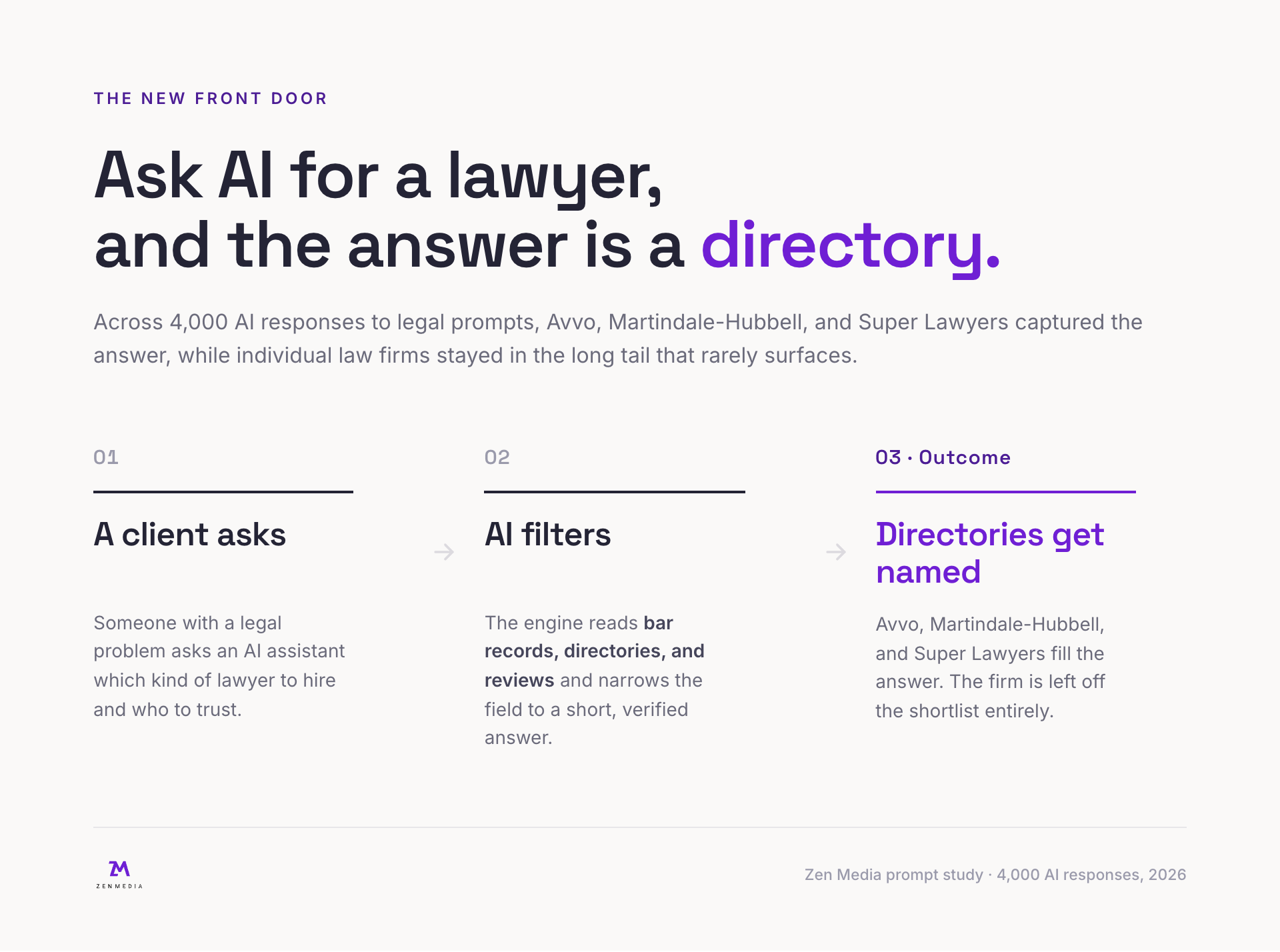
AI visibility decides which firms get named when a prospective client asks an AI assistant for help finding a lawyer, and it now happens upstream of your website. When someone asks ChatGPT how to choose a personal injury attorney or Perplexity which firms handle a specific kind of case in their state, the engine returns a synthesized answer built from whatever evidence it can find. That answer is the new front door to legal hiring, and few firms have measured their place in it.
The same idea goes by other names, LLM visibility or AI brand visibility, and it now shapes how legal clients discover representation across every practice area. This matters because legal hiring starts with research, and the research has moved. A growing share of people now open an AI assistant before a search engine when they need a lawyer, and a single answer replaces an afternoon of tab-hopping across firm sites and review pages. The engine reads the credentials, weighs the sources, and hands back a filtered set of names and next steps. Whoever is missing from that set never enters the consideration, no matter how strong the practice is.
Zen Media set out to measure this layer directly for the legal sector. The study ran 1,000 prompts written the way real clients phrase them, spanning the practice areas people hire for most, from personal injury and family law to criminal defense, immigration, and estate planning. Each prompt ran across four engines, producing 4,000 responses and roughly 50 distinct entities named. The numbers below come from that dataset, published in full as Zen Media’s AI visibility report for law firms.
Why Directories Own the Legal Answer Layer
Directories dominate the legal answer layer. Avvo appeared in 45% of responses, Martindale-Hubbell in 32%, and Super Lawyers in 24%, followed by FindLaw at 15%, LegalZoom at 13%, and Justia at 11%. Below those platforms sits a long tail of general-purpose sources and, further down still, individual firms that surface only rarely, and usually only when a client already knows the firm’s name. The concentration is steep, and it favors the platforms that aggregate and verify attorneys.
Share of AI answers by source
Appearance rate across 4,000 AI responses
Caption: directories own the legal answer while individual firms sit near zero. Zen Media prompt study, 2026.
The reason is trust. AI treats legal hiring as a high-stakes decision and leans on sources built to verify attorneys. Directories publish structured, cross-checkable evidence: bar admission, practice areas, disciplinary history, peer ratings, and client reviews, all in a format an engine can read and corroborate. A firm’s own site usually asserts expertise in prose an engine cannot confirm. Facing a question as consequential as who should represent me, the engine reaches for the source it can verify, and a directory is built to be verified.
The Six Entity Categories AI Names in Legal Answers
A flat leaderboard mixes very different players, so grouping the same 4,000 responses by entity type is where the pattern turns useful. AI mentions split across six categories. Legal directories and rating platforms take the largest share at 45%, followed by professional associations and referral services at 20%, online legal services at 15%, legal aid and pro bono resources at 10%, government and regulatory bodies at 8%, and general review platforms at 2%.
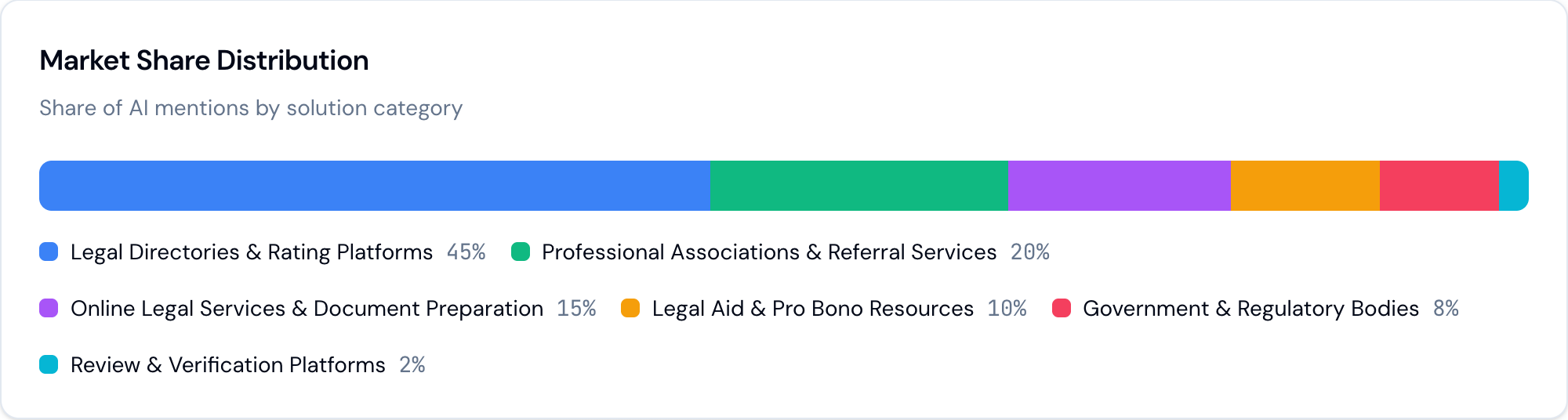
One absence defines the whole map: there is no law firm category. Every group AI names is an intermediary or an institution, a platform that aggregates firms, a body that credentials them, or a service that routes around them. An individual firm reaches a prospective client only by earning its place inside the directory, association, and review layers that do get named.

| Entity category | AI mention share | Who leads it | What it is |
|---|---|---|---|
| Legal directories and rating platforms | 45% | Avvo, Martindale-Hubbell, Super Lawyers, FindLaw | Profile, rating, and review aggregators |
| Professional associations and referral services | 20% | State bar associations, the ABA, AILA | Bar and credentialing bodies |
| Online legal services and document prep | 15% | LegalZoom, Rocket Lawyer, Nolo | Self-service document platforms |
| Legal aid and pro bono resources | 10% | Legal Services Corporation, Legal Aid Societies | Free and low-cost legal help |
| Government and regulatory bodies | 8% | USCIS, EEOC, IRS | Official process and information |
| Review and verification platforms | 2% | Google Reviews, Yelp | General consumer review sites |
Does this mean an individual firm is locked out? No. The concentration is strongest on broad prompts asking for the best lawyers or how to find an attorney. On narrower prompts tied to a specific practice area, jurisdiction, or situation, the directories still frame the answer but the door opens for named firms that have done the work. The rest of this guide is about becoming one of them, and it starts with understanding what clients are asking.
What Legal Clients Ask AI When They Are Hiring
Legal clients come to AI to weigh a decision. In the 1,000-prompt dataset, roughly 72% of prompts were comparison-framed: people asking how one option stacks up against another, whether a specialist beats a generalist, or whether to hire a local firm or use an online service. The remaining 28% were informational, learning how a process works before choosing. That comparison weight is the tell. Someone comparing a board-certified attorney to a general practitioner is close to hiring, and the name that surfaces in that comparison has an enormous advantage.
Based on 1,000 legal client prompts. Zen Media prompt study, 2026.
The prompts themselves read like a client’s decision-making out loud. These four are representative examples from the dataset, each tagged to a real client persona, and each one an answer where a named firm wins or loses a case.
The engines answer a recognizable set of client personas, and they weight them unevenly. Accident victims drove the largest share of the client profiles the models inferred at 18%, followed by divorcing spouses at 12%, immigration applicants at 10%, estate planners at 8%, small business owners at 7%, and financially distressed consumers at 6%. Each persona asks in its own language and rewards different evidence, which is why a single generic practice-areas page rarely surfaces across the full spread of prompts.
The Signals AI Rewards in Legal Answers
AI engines reward verifiable trust signals, the core mechanic behind generative engine optimization: how much cross-checkable proof a firm publishes about the themes that decide a legal hire. A handful of themes dominated the 4,000 responses. Credential verification appeared in 92% of substantive answers, specialization over generalization in 87%, and fee transparency in 85%, while firm size proved largely irrelevant, showing up as a non-factor in 78% of answers. Firms that document these signals get named; firms that assert them without proof do not.
Themes AI engines emphasize in legal answers
Share of substantive responses referencing each theme
Caption: the themes that shaped legal answers. Zen Media prompt study, 2026.
Reading a chart is one thing; building the evidence is another. These are the four signals to write into public-facing content and directory profiles, worded so an engine can lift them straight into an answer.


Where AI Pulls Its Evidence for Legal Answers
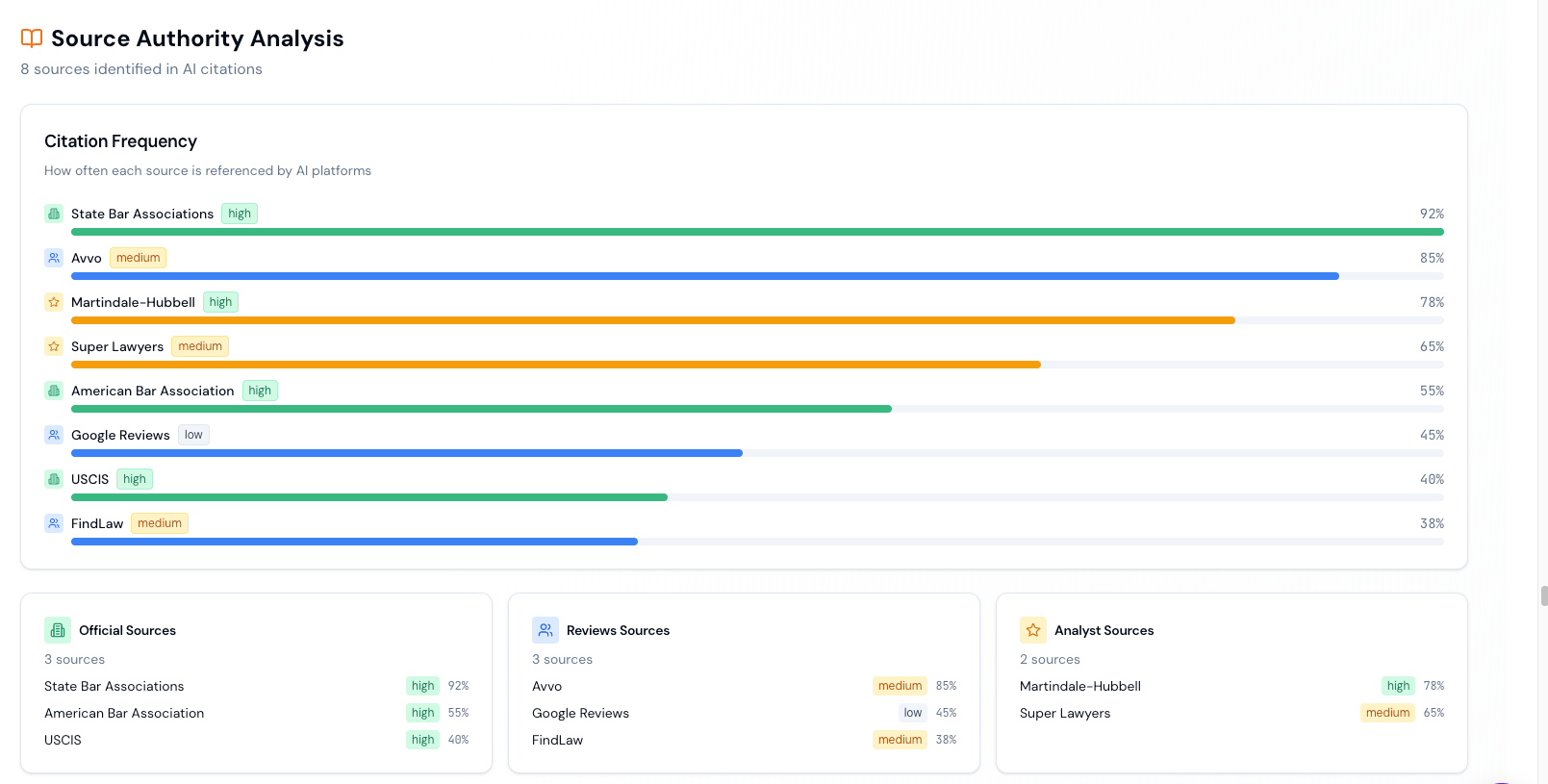
Engines lean on a predictable set of sources, and official verification leads by a wide margin. State bar associations were referenced in 92% of sourced answers, Avvo in 85%, Martindale-Hubbell in 78%, Super Lawyers in 65%, and the American Bar Association in 55%, with Google Reviews and FindLaw close behind. If your firm is thin, inconsistent, or unverifiable on these, the engine has nothing authoritative to pull, and it frames the answer around the directory while your firm goes unnamed.
Top cited sources in legal answers
Share of sourced responses referencing each source
Caption: the sources engines reference for legal answers. Zen Media prompt study, 2026.
The lesson for earned media is direct. Official and third-party sources carry the weight here, so your job is to be complete, accurate, and consistent everywhere an engine looks. A verified state bar profile, full and matching listings on the American Bar Association and the major directories, and genuine peer and client recognition are what teach a model to corroborate your claims. This is where public relations and answer-engine strategy converge: the same third-party validation that builds client trust is the validation an engine reads. Our deeper walkthrough of how answer engine optimization works covers the mechanics behind this.
AI Visibility Across Legal Practice Areas
Visibility does not work the same way across practice areas, so AI visibility measurement has to run per area and per jurisdiction. Each practice area is a separate answer race with its own decisive signal, its own client persona, and its own trust threshold. A firm that documents one area thoroughly can win its prompts even while directories frame the broad ones. The table below maps what clients ask in each area and what earns a firm the mention.

| Practice area | What the client asks | What earns the mention |
|---|---|---|
| Personal injury | How contingency fees work and which firm to trust with a claim | Clear contingency terms, trial and settlement track record, free consultation |
| Family law | Local attorney versus online service, cost and approach to custody | Local court familiarity, transparent pricing, board certification where offered |
| Criminal defense | Board-certified specialist versus general practitioner, speed of response | Charge-specific experience, certification, local prosecutor and court knowledge |
| Immigration | How to verify a lawyer is legitimate and authorized to practice | Explicit authorization to practice immigration law, visa-category experience |
| Estate planning | An attorney versus an online will service for a will or trust | Document validity and state compliance, tax and trust expertise |
Two patterns cut across every area. First, online legal services like document-preparation platforms surfaced constantly, but AI framed them as suitable only for simple matters and repeatedly cautioned that they cannot give legal advice. That caution is an opening: a firm that clearly handles the complex version of a matter wins the client the online service cannot serve. Second, compliance is part of the answer. State bar licensing, attorney advertising rules, and, in areas like personal injury, contingency-fee regulations all shape what a firm can claim, and a firm that presents credential-accurate, compliant content is presenting exactly what the engines reward.
Geography narrows the field further. Legal hiring is local and jurisdiction-bound, so an engine framing an answer around a specific city or state surfaces different names than a national query. A firm strong in its metro can still be absent from an answer scoped to the state next door, which is why local directory presence and jurisdiction-specific content matter as much as the national profile.
How Each AI Engine Behaves Toward Law Firms
The four engines do not answer legal questions the same way, and a firm has to satisfy all of them because clients use all of them. Gemini named more entities per answer than any other engine, at 2.8 on average, and leaned hardest on directories and review sources. Perplexity was citation-first and reached for state bar and official sources, Grok was action-oriented and surfaced specialty practice organizations, and ChatGPT held back, rarely naming firms and emphasizing due diligence. Each rewards a different emphasis in your content.
| Engine | How it answers | What to give it |
|---|---|---|
| Gemini | Densest answers, 2.8 entities named on average; sorts options by category and leans on directories. | Clear practice-area categorization and complete directory presence. |
| Perplexity | Citation-first; organizes answers around official and authoritative sources. | State bar verification and authoritative, corroborated credentials. |
| Grok | Action-oriented; surfaces specialty practice organizations and specific attorney types. | Specialty credentials and professional association membership. |
| ChatGPT | Conservative and cautious; rarely names firms and emphasizes how to vet before choosing. | Clear evaluation criteria and strong, verifiable brand recognition. |
The practical takeaway is that a single strong asset will not carry you across all four. Complete directory presence earns Gemini placement, official verification earns Perplexity citations, specialty credentials earn Grok mentions, and broad, verifiable recognition is what it takes to be named by a cautious ChatGPT. The metric that ties them together is answer share, and our breakdown of answer share as a visibility-to-revenue metric explains how to track it across engines.
AI Visibility vs Traditional Law Firm SEO
Firms already invest in law firm SEO, and that work still matters. It is worth being clear on how the two differ, because a firm can rank on page one of Google and remain invisible in the AI answer that now sits above those results. Traditional SEO competes for a ranked list of links a client clicks. AI visibility competes for a place inside the synthesized answer itself, which forms before the client clicks anything.
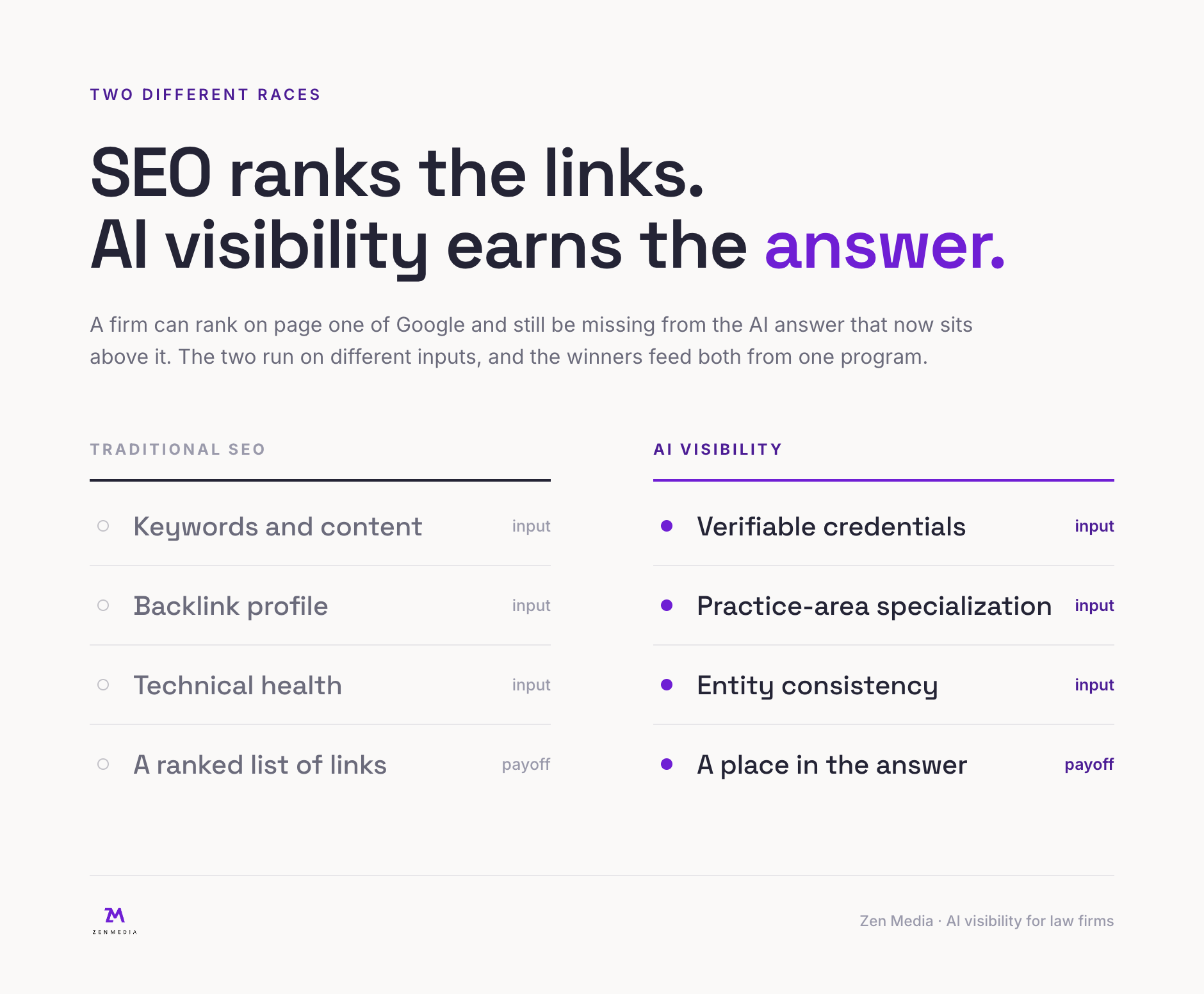
The inputs differ too. SEO rewards keywords, technical health, and backlinks. AI visibility rewards verifiable credentials, practice-area specialization, entity consistency across every directory and bar profile, and third-party corroboration on the sources engines trust. The good news is that the two reinforce each other: the credential-accurate, well-structured, well-cited content that earns AI mentions is the same content that earns rankings. The firms that win the next few years will treat answer engine optimization and SEO as a single program and link the same earned-media work to both. For the strategic frame behind that program, our guide to how AI crawlers shape brand visibility connects the content to the crawl.
The 5-Step AI Visibility Playbook for Law Firms
Closing the gap runs as a five-step sequence. The steps move a firm from an unknown position in the answer layer to a measured, defended one, and they map directly to what the prompt data rewards. Start with measurement, because a change you cannot see is a change you cannot prove to a managing partner.
Does this move revenue, or just rankings? The method has a track record. When Zen Media applied this same sequence for SpecialistID, a specialist B2B ecommerce brand that was absent from AI answers dominated by national giants, the firm rebuilt its content around real buyer prompts, structured its evidence, and seeded validation on trusted sources. The mechanics that moved a specialist past far larger competitors are the same ones that move a focused law firm past a directory default, and the result panel below shows what that produced.
AI Visibility Scorecard for Law Firms
Use this checklist to find your gaps before a competitor does. Each item maps to a signal or source the prompt data showed the engines reward. If you cannot tick these boxes, you have found the reason a rival firm keeps getting named in your practice area.
The firms that will own the legal answer layer over the next two years are the ones treating it as measurable ground to hold. If you want the baseline done for you, Zen Media runs this analysis as a service; you can talk to our team about measuring where your firm stands today. For how brands hold that position over time, see our guide on staying visible in the answer layer, and our look at AI visibility for SaaS companies shows how the same playbook plays out in another vertical.
Frequently Asked Questions
What is AI visibility for law firms?
AI visibility for law firms is how often, and how prominently, a firm or attorney gets named when someone asks an AI assistant like ChatGPT, Perplexity, Gemini, or Grok to recommend a lawyer, compare options, or vet a firm. It is measured by tracking how a firm and the directories it lives on appear across a large set of real client prompts, by practice area and location.
Why do AI assistants recommend directories over individual law firms?
Across 4,000 AI responses to legal prompts, directories captured the answer while individual firms were almost never named. Avvo appeared in 45% of responses, Martindale-Hubbell in 32%, and Super Lawyers in 24%. AI treats legal hiring as a high-trust decision and leans on directories, bar associations, and rating platforms as verification layers, so a firm without strong, consistent presence on those sources rarely surfaces on its own.
How is AI visibility different from law firm SEO?
SEO earns a ranked list of blue links a client clicks through. AI visibility earns a place inside the synthesized answer itself, before the client visits any site. SEO rewards keywords and backlinks; AI visibility rewards verifiable credentials, practice-area specialization, entity consistency across directories, and third-party validation on the sources engines trust, such as state bar associations, Avvo, and Martindale-Hubbell.
Which AI platforms should law firms prioritize?
Gemini names more entities per answer than any other engine and leans on directories and review sources, making it the densest opportunity. Perplexity is citation-first, rewarding state bar and official sources. Grok is action-oriented and surfaces specialty practice organizations, while ChatGPT stays cautious, rarely naming firms and emphasizing due diligence. A firm needs to satisfy all four, because clients use all four.
What sources do AI engines cite when recommending attorneys?
State bar associations led at 92% of sourced answers, followed by Avvo at 85%, Martindale-Hubbell at 78%, Super Lawyers at 65%, and the American Bar Association at 55%. Google Reviews and FindLaw followed. Accurate, complete presence on these sources correlates directly with how often a firm is named in AI answers.
Can a small or solo law firm get named in AI answers?
Yes, within a defined practice area and location. AI answers narrow by case type and jurisdiction, so a firm that documents one specialty thoroughly, verifies its credentials, and earns third-party validation can win the prompts that matter to its clients. The data showed firm size to be largely irrelevant to how AI weighs quality; specialization and verifiable credentials mattered far more.
How do legal directories like Avvo and Martindale-Hubbell affect AI visibility?
They are the primary path into AI answers for law firms. Because directories dominate the responses and are among the most-cited sources, a firm’s profile on Avvo, Martindale-Hubbell, Super Lawyers, FindLaw, and Justia is often what an engine reads to decide whether to name it. Complete, consistent, credential-accurate profiles across all major directories are the foundation of a firm’s AI visibility.
How long does it take to improve a law firm’s AI visibility?
Retrieval-based engines such as Perplexity can begin reflecting new directory profiles, credential updates, and structured content within four to eight weeks. Training-based models like ChatGPT update on a longer cycle, so citation there builds over several months as third-party sources accumulate and the corpus refreshes.
Does AI visibility bring in clients?
It does when the visibility lands on hiring-intent prompts. In the legal study, roughly 72% of prompts were comparison-framed, people weighing one option against another before hiring. A firm named at that moment enters the decision; one that is absent never does. Zen Media has tracked AI-originated visits producing measurable sales uplift in other verticals using the same method.
What role does PR and earned media play in AI visibility for law firms?
A large one. AI engines corroborate a firm’s claims against third-party sources before naming it. Coverage in trade and mainstream press, bar association leadership, expert commentary, and consistent recognition are the earned-media signals that teach an engine a firm is credible. This is the layer a standard SEO checklist does not touch, and it is where PR and answer-engine strategy converge.
How do I measure my law firm’s AI visibility?
Build a representative set of client prompts across your practice areas, personas, and jurisdiction, run them across ChatGPT, Perplexity, Gemini, and Grok on a fixed schedule, and record whether your firm or its directory profiles appear, in what position, and against which competitors. That appearance rate and share of voice is your baseline, and it is the only way to know if your changes are working.
Do attorney advertising rules affect AI visibility content?
Yes. State bar advertising rules govern how firms describe their services, claim expertise, and present results, and those rules apply to AI-facing content the same way they apply to a website. Specialization claims often require board certification, and testimonials or outcome statements may need disclaimers. Firms should build credential-accurate, compliant content, which happens to be exactly what AI engines reward.
About the author: Sarah Evans is Partner and Head of PR at Zen Media, a global B2B PR and marketing agency. With 23+ years in communications, she architects PR strategy, drives earned media initiatives, and helps brands navigate AI-driven visibility. She is a regular contributor to Entrepreneur and has been recognized as a top writer on business and tech.