

TL;DR: 88% of in-house counsel and C-suite decision-makers say traditional media is the most credible form of brand visibility a professional services firm can earn, the highest rate in seven years of tracking. For law firms, PR is not a marketing add-on. It is the function that builds the trust that clients, referral sources, and journalists use to evaluate which firms are worth their attention.
Law firms face a communications challenge that most businesses do not. Bar association rules restrict advertising claims. Attorney-client confidentiality limits what can be said about successful outcomes. And the reputational stakes of a single poorly handled media moment are significantly higher for a firm that sells credibility than for a company that sells a product. Public relations navigates all of that while still building the visibility and trust that drive new business.
PR does what advertising cannot. Where paid media says “we are the best,” earned media lets third-party publications, journalist profiles, and expert placements say it instead. That distinction matters enormously to the clients most law firms want: sophisticated buyers who discount advertising and weight editorial credibility heavily when evaluating which firm to hire.
This guide covers the full spectrum of law firm public relations: defining what it is, building a PR strategy, handling crises, measuring results, integrating PR with other marketing functions, and choosing the right agency. Each section is practical enough to apply directly, whether you are building a PR program from zero or strengthening one already in motion.
The Fundamentals of Law Firm Public Relations

1. Defining Law Firm Public Relations
Law firm public relations is the practice of managing how a legal practice is perceived by the audiences that matter most: prospective clients, current clients, referral sources, the media, and the broader professional community. Unlike general PR, legal PR operates under specific constraints. Communications must account for non-disclosure agreements, active litigation, attorney-client privilege, and bar association regulations that vary by jurisdiction.
Legal PR teams handle several overlapping functions. These include crafting and maintaining brand messaging, building and managing media relationships, handling crisis communications, creating thought leadership content, and monitoring how the firm appears across media channels. All of these require an understanding of the legal environment that a generalist communications team typically lacks. A quote that is perfectly appropriate for a technology company can create liability for a law firm if it implies a specific legal outcome or guarantee.
The scope of legal PR also extends beyond earned media. Events, awards submissions, speaking opportunities, and podcast appearances all fall within the PR function. Together, they shape the narrative around a firm’s expertise over time, building the kind of credibility that sustains new business conversations long after the first contact.
2. The Role of PR in Shaping Public Perception
Law firms do not control how they are perceived. They only influence it. PR is the function that does that influencing systematically, through media coverage, expert commentary, and consistent narrative positioning rather than paid claims. A profile in a trade publication, a partner quoted in a news story, or a bylined article in a business journal all communicate authority in ways that a banner ad or sponsored post cannot replicate.
Perception is built or damaged in a handful of critical moments: a high-profile case, a partner departure, a data breach, a controversial client, or a media inquiry on a sensitive topic. PR teams prepare for those moments in advance, building the media relationships and pre-drafted response frameworks that allow the firm to respond credibly when they arrive. The firms that handle these moments well rarely do it by improvising. They do it through preparation done long before the crisis started.
Day-to-day perception builds more slowly, through consistent media presence and the cumulative effect of expert commentary in relevant publications. Legal journalists and trade media are actively looking for attorneys who can translate complex legal developments into clear, timely analysis. Law firms that make themselves useful to those journalists, consistently and on deadline, build the media relationships that generate sustained brand visibility.
3. The Key Components of an Effective PR Strategy
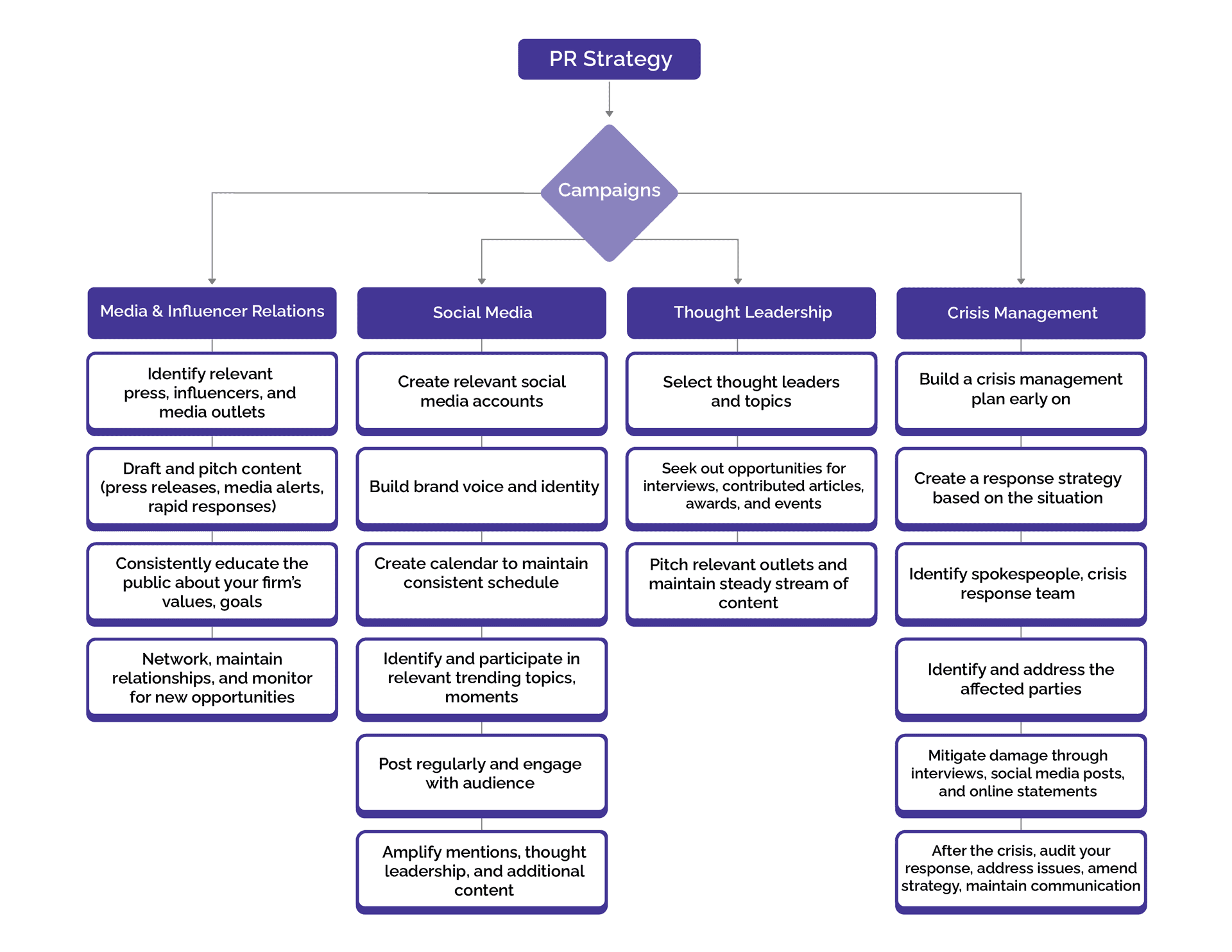
An effective law firm PR strategy has six interconnected components. Media relations covers building and maintaining relationships with journalists who cover legal affairs, industry trade media, and business publications relevant to the firm’s practice areas. Thought leadership encompasses bylined articles, speaking opportunities, podcast appearances, webinars, and contributed content that positions partners as authoritative voices. Social media amplification distributes earned coverage and original commentary, primarily on LinkedIn for legal audiences. Networking and community covers the conferences, bar association events, and industry groups where offline relationships generate referrals. Crisis communications is the proactive plan that exists before a reputational threat materializes. Awards and recognition covers directory submissions and industry programs that provide third-party credibility markers.
No single component is sufficient alone. A firm that does excellent thought leadership but has no crisis plan is exposed. A firm with a strong media contact list but no social presence misses the amplification layer that makes media coverage work harder. The strategy works when all six elements reinforce each other on a consistent schedule.
Benefits of Hiring a Professional PR Firm
1. Leveraging the Expertise of PR Specialists
Legal PR is a specialty. The professionals who do it well bring three things that are hard to build in-house quickly: established media relationships, fluency in legal ethics rules across jurisdictions, and the ability to craft messaging that is both compelling and compliant. A PR specialist who has spent years working with legal clients has already built the contacts at legal trade media and business publications that an in-house hire would need years to develop from scratch.
Media relationships matter in legal PR because legal reporters receive substantial inbound pitch volume. The contacts that get placed are the ones whose PR representatives have already built credibility by being useful in the past. An experienced agency brings that relationship equity on day one. An in-house team building it from zero will spend the first year establishing baseline credibility before generating consistent placements.
Ethical familiarity is equally important. Bar rules on attorney advertising vary by state. What a firm can imply about case outcomes, how it can describe results, and how it can position itself relative to competitors are all regulated. A PR agency specializing in legal clients understands these constraints as a baseline condition, not as something it researches case by case. That expertise protects the firm from communications missteps that could generate bar complaints or reputational risk.
2. Building and Maintaining a Positive Reputation
Reputation is the primary asset a law firm has. Unlike product companies, law firms cannot differentiate primarily on price or features. They differentiate on trust. Clients choose attorneys they believe are competent, credible, and aligned with their interests. PR is the function that communicates those trust signals to the market systematically.
75% of potential clients visit between two and five law firm websites before making first contact, according to FindLaw research compiled in MyCase’s 2026 Law Firm Marketing Statistics report. That research phase is not limited to website content. It includes checking media coverage, reading thought leadership, and forming judgments about credibility from where a firm appears across multiple channels. The firms that show up consistently in quality publications have a significant advantage in that evaluation window.
91% of law firms say they rely on repeat clients and referrals as their primary business source, according to CallRail data in the same report. Reputation management is therefore not just a new business function. It is a retention function as well, since clients who feel proud of their counsel’s public standing are more likely to renew, expand, and refer.
3. Gaining Media Exposure and Coverage
Earned media is one of the most credible forms of visibility a law firm can have. Unlike paid advertising, it carries third-party validation: a journalist or editor found the firm credible enough to include. That signal is something money cannot directly replicate. A quote in a national publication or a profile in a relevant trade outlet implies an endorsement by the editorial process that advertising simply does not provide.
Media exposure compounds over time. A firm that builds a relationship with a reporter covering healthcare regulation will be called on repeatedly as relevant regulatory news develops. Each placement reinforces credibility from previous ones, and the cumulative library of coverage becomes a tangible sales asset. Sharing a collection of recent media placements in a new business meeting tells a prospective client something about a firm’s standing that no marketing brochure can.
Newsjacking is especially valuable for law firms. When legislation changes, a major court ruling lands, or a regulatory agency issues new guidance, journalists covering that story need expert legal commentary quickly. Law firms with media contacts and prepared spokespersons can turn those moments into placements within hours. Firms without that infrastructure miss them entirely, yielding those visibility windows to competitors who were ready.

Strategies for Law Firm Public Relations
1. Crafting a Unique Brand Story
Every law firm has a founding story, a set of practice specializations, and a collection of client relationships that define what it stands for. PR strategy starts by distilling those raw materials into a coherent brand narrative that can be communicated consistently across media placements, partner bios, LinkedIn profiles, and press releases.
A strong brand story answers three questions clearly: What does the firm do that others do not? Who specifically does it serve best? What outcome do clients achieve? The more specific the answers, the more useful the narrative. “A full-service firm with expertise in litigation and regulatory matters” is not a story. “We represent growth-stage biotech companies in FDA enforcement actions and licensing disputes” is a story that a biotech general counsel can immediately identify with and remember.
Brand story development typically involves partner interviews, review of past media coverage, analysis of the firm’s most successful client relationships, and a competitive audit of how peer firms position themselves. The output is a messaging framework that PR teams use consistently, ensuring every press release, spokesperson quote, and social post reinforces the same positioning rather than drifting based on whoever drafted it that week.
2. Identifying and Targeting the Right Audience
Law firm PR works best when it is targeted. A firm representing institutional investors in securities litigation needs visibility in the publications those investors read, not just in general legal trade media. A firm handling employment disputes for mid-market companies needs to reach HR professionals and general counsel at those companies, not just other attorneys.
Audience identification involves building buyer personas for each key client segment. For each persona, the PR team identifies which publications they read, which events they attend, which LinkedIn voices they follow, and what content they engage with. That map becomes the targeting framework for media pitches, contributed article placements, and speaking opportunity submissions. Pitching to publications your actual clients do not read is a waste of PR budget regardless of placement rate.
Competitor analysis runs parallel to audience research. Understanding where peer firms appear and which topics they own helps identify the gaps where differentiated positioning is available. A firm specializing in cannabis law that finds most cannabis industry coverage comes from general business publications rather than legal trade media can redirect its pitching strategy and capture a disproportionate share of an underserved editorial space at lower competitive pressure.
3. Leveraging Digital PR for Online Visibility
Digital PR sits at the intersection of traditional media relations and search visibility. When a firm earns a mention and backlink from a high-authority publication, it creates two forms of value simultaneously: direct credibility from the placement itself, and domain authority that improves search rankings over time. Google’s “Mentioned in” feature now surfaces publication references directly in search results, giving earned media a new, visible function in how firms appear when potential clients search for legal expertise.
87% of law firms have websites and 89% are on social media, with 87% specifically on LinkedIn, according to ABA data compiled in MyCase’s 2026 Law Firm Marketing Statistics. Despite that near-universal digital presence, most firms have not connected their media coverage to a structured link-building strategy. Earned coverage in credible publications is one of the highest-quality backlink sources available, and most firms leave that SEO value uncaptured.
Related: Link-Building Strategies That Build Domain Authority and Rankings
4. Implementing Thought Leadership Initiatives
Thought leadership positions firm partners as the go-to expert voices on specific legal topics or industry issues. It includes contributed articles in trade publications, bylined pieces in business media, conference speaking slots, podcast appearances, webinars, and LinkedIn publishing. 81% of law firms treat content marketing as their top marketing investment, according to data compiled by FWD Lawyer Marketing’s 2025 Law Firm Marketing Statistics. The ROI on consistent thought leadership compounds over years as a partner becomes a trusted source that journalists and event organizers call proactively.
For thought leadership to scale across a firm, it requires a system: a calendar of submission deadlines for target publications, a library of talking points partners can use for podcast appearances and panel discussions, and a workflow for turning case outcomes into anonymized insights that can be published without violating confidentiality. Ad hoc thought leadership, where partners write occasionally when time permits, rarely builds the consistent presence that generates compounding visibility.
Related: The Ultimate Guide to Thought Leadership for Professional Services
5. Organizing Events to Showcase Expertise
Events are one of the most effective ways for law firms to demonstrate expertise in a format that creates direct relationships with prospective clients and referral sources. Webinars, roundtable discussions, CLE programs, and panel events give firm partners a platform to speak authoritatively on their practice areas in front of exactly the right audience. 44% of law firms already rank event sponsorships as their most-used traditional marketing channel, according to ABA data compiled by MyCase.
The PR value of events extends beyond the attendees in the room. A well-produced webinar with notable co-panelists is pitchable as a news item in its own right. Post-event coverage in trade media, recap content distributed on LinkedIn, and follow-up articles expanding on the key themes extend the visibility of the original event for weeks after it occurs. Events generate content assets that fuel the entire PR and content marketing ecosystem when they are planned for that purpose from the start.
Crisis Management and Reputation Repair

1. Understanding the Importance of Crisis Communication
Only 49% of companies have a formal crisis communications plan, according to research published by PR News, which means the majority of organizations including most law firms are operating without one. That is a significant exposure. Reputational threats arrive without warning and tend to escalate quickly in media cycles that move faster than most firms can convene a response team, much less draft one.
For law firms, the stakes in a reputational crisis are compounded by the nature of the business. Clients choose law firms based on trust in the firm’s judgment and integrity. A crisis that calls either into question can affect not just the subject of the coverage but the entire partnership’s credibility with every current and prospective client. The firm is not just managing a news cycle. It is managing whether clients maintain confidence in their counsel.
Effective crisis communications begins with acknowledgment. Audiences, clients, and media do not expect perfection from the firms they work with. They do expect transparency, speed, and a credible commitment to addressing the problem. Firms that go silent, deny before facts are established, or treat every inquiry as adversarial tend to extend the crisis cycle significantly longer than firms that lead with a clear, fact-based statement and a visible plan for resolution.
2. Preparing for and Handling PR Crises
Crisis preparation starts well before any crisis occurs. The first step is a scenario-mapping exercise that identifies the specific risk events most likely for the firm given its practice areas, client base, geographic reach, and any known reputational vulnerabilities. For a firm handling high-profile litigation, a leak of case strategy or a verdict that draws media attention is a plausible scenario. For a firm handling M&A transactions, allegations of conflicts of interest are a predictable risk. For any firm, a data breach or cybersecurity incident is now a near-universal exposure.
For each scenario, the crisis plan should include: a designated crisis response team (typically a managing partner, communications lead, and relevant practice area chair), pre-drafted holding statements that can be released within the first hour of a public incident, a decision tree for who approves communications before release, and a protocol for who notifies which audiences (clients, staff, the media) in what sequence. The plan also needs to specify which information remains confidential for legal reasons and how that constraint is communicated to external audiences.
Speed matters. The first statement a firm makes in response to a crisis sets the frame for all subsequent coverage. A delayed, lawyered response that arrives 48 hours after the initial report allows the media narrative to develop without the firm’s participation. A fast, factual holding statement that acknowledges the situation and commits to further communication maintains some control over the narrative frame while the full response is being developed.
3. Rebuilding Trust and Reputation After a Crisis
Rebuilding after a reputational crisis is a slower process than managing the initial response, and many firms underinvest in it. Once the immediate coverage cycle ends, the crisis still exists in search results, media archives, and the memories of clients and referral sources who followed the story. Post-crisis reputation repair is a deliberate, sustained PR effort rather than a one-time statement.
The post-crisis phase starts with an audit: what was said about the firm, in which publications, with what framing? That audit identifies the specific reputational narrative that needs to be countered and the audiences that most need to hear a different story. For some crises, the repair effort is primarily about reinforcing credibility with current clients. For others, it requires building a new body of thought leadership that repositions the firm in areas unaffected by the crisis.
Ongoing stakeholder communication matters throughout. Clients who have been kept informed during and after a crisis tend to remain clients. Those who feel they were left to find out through media coverage tend not to. A post-crisis communications cadence that proactively updates clients on what the firm is doing to address the underlying issue is both a retention tool and a signal to the broader market that the firm takes its responsibilities seriously.
Related: Crisis Communication for B2B: How to Protect Your Brand When It Matters Most
Measuring PR Success and ROI
1. Key Performance Indicators (KPIs) for PR Campaigns
Measuring law firm PR requires a combination of quantitative metrics and qualitative assessment. The core quantitative KPIs include share of voice (how much earned media coverage the firm generates relative to peer firms targeting the same audiences), media placement volume and the domain authority of the publications where placements appear, website referral traffic from press coverage, LinkedIn engagement metrics on thought leadership content, and brand search volume trends that reflect growing audience awareness.
Inbound lead sourcing is one of the most valuable but least tracked PR metrics for law firms. When intake processes ask how a prospective client first became aware of the firm, the answers over time reveal whether earned media and thought leadership are influencing new business inquiries. Firms that track this consistently find that PR-influenced leads often have shorter conversion timelines and higher average matter size than leads from paid advertising, because the trust component was already established through editorial coverage.
Coverage quality matters alongside coverage volume. A single placement in a publication that a firm’s target clients actually read is worth more than ten placements in outlets they do not. KPI frameworks should weight publication relevance (does this outlet reach the firm’s actual target clients?) and message accuracy (does the coverage reflect the firm’s intended positioning?) rather than counting placements indiscriminately.
2. Analyzing the Impact of PR Efforts on Business Growth
PR attribution is genuinely difficult, and law firm marketing teams should acknowledge that difficulty honestly rather than either overclaiming or giving up on measurement entirely. Much of PR’s impact flows through “dark social”: private conversations, direct referrals, and word-of-mouth exchanges that do not show up in analytics dashboards. A managing partner who forwards a client a link to a thought leadership article they found through media coverage has generated direct business value that no attribution tool will capture.
Despite the attribution challenge, the pattern is observable over time. Firms that sustain consistent earned media programs over 18 to 24 months see measurable increases in branded search volume, inbound inquiry rates, and referral quality. The phrase “I’ve been reading your firm’s work on this topic” in a new business call is a PR metric even if it does not appear in any dashboard. Building the qualitative tracking infrastructure to capture and document those signals is as important as configuring Google Analytics correctly.
The “press begets press” phenomenon is real and worth tracking. Once a firm partner has been quoted in a major publication, that clip becomes a credential that makes it easier to secure the next placement. The compounding visibility effect means that the ROI of PR investment typically increases over time rather than remaining static, which is why firms that abandon PR programs after six months of building rarely see the returns available to those who sustain them for two or three years.
3. Demonstrating the Value of PR to Stakeholders
Monthly or quarterly PR reporting serves two purposes: informing the communications team’s strategic decisions and maintaining partner confidence in the PR investment. Reports should combine quantitative data (placement count, domain authority distribution, referral traffic, LinkedIn reach) with qualitative context (the editorial significance of key placements, the relevance of speaking opportunities secured, the tone of coverage in key publications).
22% of law firms say they struggle to measure the results of their marketing investment, according to CallRail data compiled by MyCase’s 2026 Law Firm Marketing Statistics. For those firms, the reporting challenge is partly a data infrastructure problem and partly a framing problem. Partners who think about PR in terms of press release volume will never find the metric convincing. Partners who understand that earned media placements represent validated expert positioning at a fraction of the cost of paid advertising are much better equipped to evaluate what they are getting for the investment.
Integrating PR with Other Marketing Strategies

1. Synergizing Public Relations and Content Marketing
PR and content marketing serve different but complementary functions. Content marketing builds owned audiences on the firm’s website, LinkedIn, and email list. PR earns visibility in third-party media that the firm does not own or control. The most effective law firm marketing programs treat them as a single, coordinated effort rather than separate workstreams with different owners and separate editorial calendars.
In practice, this integration means that every piece of firm-produced content is also a PR asset, and every earned media placement is also a content asset. A white paper produced by the firm’s regulatory practice group can be pitched to trade publications as a contributed article, summarized in a LinkedIn post series, and referenced in media pitches as supporting expertise. A major media placement can be excerpted in client newsletters, republished as a LinkedIn article, and used as a credential in new business proposals. Neither asset reaches its full potential when managed in isolation.
Related: Strategic Public Relations Planning: Process and Execution
2. The Interplay of PR and Social Media Marketing
LinkedIn is the dominant social platform for legal audiences. 87% of law firms use LinkedIn for marketing, and 71% of lawyers report generating new business leads through social media, according to data compiled by FWD Lawyer Marketing’s 2025 Law Firm Marketing Statistics. Social media for law firms is primarily a distribution and amplification channel rather than a direct lead-generation tool, and PR provides the content worth distributing.
Reporters increasingly use social media to identify and vet expert sources. 46% of reporters use social media to connect with potential interview subjects, primarily Instagram, LinkedIn, and Facebook, according to Cision’s 2024 State of the Media Report cited by Jaffe PR. Law firm partners who maintain active LinkedIn profiles and publish original commentary on legal topics are more likely to be found by journalists looking for expert sources on short deadlines. Social media visibility directly feeds media relations effectiveness.
3. Collaborating with Influencers and Ambassadors
Legal influencers are a growing category. Attorneys with large LinkedIn or podcast followings have built audiences that trust their perspective on legal developments. Partnering with legal influencers allows firms to reach audiences that do not follow firm accounts directly but do follow individual attorneys who cover related topics. These collaborations work best as genuine content partnerships: co-authored articles, shared webinar stages, or podcast appearances rather than promotional sponsorships.
Client advocates and alumni networks are an underused form of influencer collaboration for law firms. Former clients who are willing to speak on the record about their experience working with the firm, or former associates who have moved into general counsel roles, represent a highly credible form of third-party endorsement. These relationships are built through sustained relationship management rather than transactional arrangements, and they tend to generate referrals and media opportunities long after the original engagement ended.
Ethical Considerations in Law Firm PR
1. Ensuring Compliance with Legal and Ethical Standards
Law firm PR operates under a layer of regulatory constraint that most industries do not face. Bar association rules in each jurisdiction govern what attorneys can say publicly about their practice, their results, and their qualifications. Model Rule 7.1 of the ABA prohibits false or misleading communications about a lawyer’s services. State rules build on that foundation with additional restrictions that vary significantly across jurisdictions. PR teams working with law firms need to be fluent in these rules as a baseline operating condition, not a checklist to consult when something seems uncertain.
The most common compliance risk in law firm PR is result-based language. Statements that imply a firm guarantees specific outcomes, that characterize past results as typical without qualification, or that compare the firm’s record favorably to competitors in ways that cannot be substantiated are all potential bar rule violations. Media pitches, press releases, and website copy should all go through a compliance review process that involves both the communications team and a partner with familiarity with the relevant jurisdiction’s advertising rules.
AI tools are increasingly present in legal marketing workflows. 45% of legal professionals use AI daily for tasks including content creation, according to MyCase’s 2026 Law Firm Marketing Statistics. AI-generated content for law firm PR carries the same compliance requirements as human-generated content, and the compliance review process needs to account for the fact that AI tools trained on general marketing content may not reflect legal advertising rules.
2. Handling Sensitive Legal Cases in PR Campaigns
Attorney-client privilege is the foundational constraint on law firm PR. Client matters cannot be discussed publicly without client consent, and even with consent, the scope of disclosure must be defined carefully. Case studies and success stories, which are powerful PR assets in most professional services contexts, require explicit client approval, careful anonymization where full disclosure is not appropriate, and legal review before publication.
High-profile litigation creates unique PR challenges. When a firm is defending a client in a case that is generating substantial media coverage, PR teams must navigate between the client’s communication objectives, the firm’s own reputational interests, and the legal constraints on what can be said during active proceedings. These situations require a clear protocol: who speaks to media, what they say, what they decline to comment on, and how those decisions are coordinated with the litigation strategy. Improvised media responses during active litigation rarely serve the client or the firm well.
How to Choose the Right PR Agency for Your Law Firm
1. Factors to Consider When Selecting a PR Partner
The first filter when evaluating PR agencies for a law firm is legal sector experience. A PR agency that has worked primarily with consumer brands, technology startups, or healthcare providers may not understand bar association regulations, the dynamics of legal trade media, or how to handle a crisis involving active litigation. Ask specifically about their experience with professional services firms, how many current clients are law firms or legal adjacent, and whether they can provide references from legal clients with comparable practice areas.
The second filter is service scope. Some firms need only media relations. Others need media relations plus crisis communications support. Others need the full integrated program including content creation, social media management, events strategy, and awards submissions. Verify that the agency offers all the services the firm needs and that those services are delivered by the same team, not outsourced to contractors. PR program effectiveness depends heavily on continuity of relationships and institutional knowledge, both of which are undermined by high staff turnover or fragmented vendor relationships.
Define the firm’s goals before agency evaluation begins. Is the objective brand visibility with a specific client segment? Entry into a new practice area? Thought leadership for a particular partner? Reputation repair after a reputational event? Each of these objectives implies a different agency profile, different KPIs, and different success timelines. Agencies should be evaluated against the specific goals the firm has, not against a generic standard of “good PR agency.”
2. Evaluating the Reputation and Track Record of PR Agencies
Reference checks are the most reliable due diligence tool when evaluating PR agencies for law firms. Ask for introductions to two or three current legal clients with practice areas comparable to yours, and ask those clients specifically about placement quality, crisis response capability, team responsiveness, and whether they would engage the agency again. Agency-curated case studies and testimonials on websites are marketing materials. References from active clients are evidence.
Review a sample of recent media placements the agency has secured for legal clients. Assess the publications involved: are they ones your target clients actually read? Are the placements in editorial sections or in paid-for content? Is the positioning in each placement consistent with how you would want your own firm described? The quality and relevance of an agency’s placement history is the best predictor of the quality and relevance of the placements they will secure for your firm.
Related: Zen Media’s PR and Marketing Services for Law Firms and Legal Practices
Building a Long-Term PR Strategy
1. Developing a Sustainable PR Approach
Law firm PR does not produce results in the first 90 days. Media relationships take time to build. Thought leadership credibility accumulates over repeated placements. Brand narrative consistency requires sustained effort across every communications touchpoint. Firms that expect PR to function like paid advertising, where investment immediately generates measurable return, almost always conclude prematurely that PR is not working.
A sustainable PR approach is built on realistic expectations and consistent execution. It prioritizes a small number of high-quality target publications over broad distribution. It establishes a steady cadence of thought leadership output rather than bursts of activity around major news events. It treats media relationships as genuine professional relationships rather than transactional pitching exercises. And it tracks leading indicators of PR effectiveness (relationship quality, pitch response rates, placement frequency in target outlets) alongside lagging indicators (inbound inquiries, referral rates) to give partners a complete picture of the program’s trajectory.
2. Adapting to Changing PR Trends and Technologies
The PR landscape for law firms is shifting in two significant directions simultaneously. AI tools are changing how content is produced, how media monitoring works, and how journalists find and vet sources. AI-powered search platforms are creating new requirements for how firm content is structured to be cited in AI-generated answers rather than just traditional search results. 45% of legal professionals already use AI tools daily, and that adoption is accelerating. Firms that understand how AI search platforms evaluate credibility and expertise will have a PR advantage over those still optimizing exclusively for traditional search.
The fundamental principles of legal PR are not changing: credibility, expertise, consistency, and the trust built through sustained media presence remain the foundation of an effective program. What is changing is the distribution surface where that credibility is expressed and evaluated. A partner whose thought leadership is structured to be extracted and cited by AI platforms will generate brand visibility in AI-generated answers to legal questions, which increasingly represent the first research step for prospective clients evaluating legal expertise. Building for that visibility is a natural extension of the PR work that has always mattered most.
Related: How to Build a Successful B2B PR Strategy in 2026
The Power of Professional Law Firm Public Relations
Law firm public relations is one of the most durable competitive advantages a firm can build, precisely because it is slow to develop and hard to replicate quickly. The media relationships, thought leadership credibility, and brand narrative that a sustained PR program produces over three to five years are not things a competitor can buy in a quarter. A firm that has spent years building those assets occupies a position in its market that is genuinely difficult to displace.
The firms that benefit most from PR are the ones that approach it as an integrated business development function rather than a communications expense. PR creates the visibility that puts the firm in the consideration set. Thought leadership creates the credibility that moves the firm to the top of it. Crisis communications protects the credibility that has been built. Together, these functions shape how a firm is perceived before any individual sales conversation begins, which is where most new business decisions are actually made.
The framework in this guide covers the full spectrum of what a professional law firm PR program requires. The next step is determining where your firm’s current program is strongest, where the gaps are, and which investments will move the needle most efficiently given your specific practice areas, target clients, and competitive position. That analysis is where a PR partner with legal sector expertise earns its value. Ready to think through what a tailored PR strategy looks like for your firm? Get in touch with the Zen Media team.
Frequently Asked Questions: Law Firm Public Relations
What is law firm public relations?
Law firm public relations is the strategic practice of managing how a legal practice is perceived by prospective clients, current clients, referral sources, and the media. It covers earned media coverage, thought leadership, crisis communications, social media presence, events, and awards. Legal PR differs from general PR because it must account for bar association regulations, attorney-client confidentiality, and the reputational stakes specific to professional services practices.
What should be included in a law firm PR strategy?
A law firm PR strategy should include six components: media relations, thought leadership, social media amplification, networking and community presence, crisis communications planning, and awards and recognition submissions. No single element is sufficient. The most effective programs integrate all six into a consistent, year-round effort coordinated with the firm’s business development and content marketing teams.
How should law firms handle a PR crisis?
Law firms should handle a PR crisis by drawing on a plan built before the crisis occurs. That plan should identify likely risk scenarios, designate a crisis response team including senior partners and a communications lead, prepare holding statements for each scenario, and define a decision tree for when and how to communicate with media, clients, and staff. Speed and accuracy in the first few hours matter more than the volume of subsequent response.
How do you measure PR success for a law firm?
Key PR metrics for law firms include share of voice relative to competitors, earned media placement volume and publication domain authority, website referral traffic from press coverage, LinkedIn engagement on thought leadership, brand search volume trends, and inbound lead source attribution. Monthly reporting should combine quantitative metrics with qualitative assessment of coverage tone and publication relevance to the firm’s target client base.
What should law firms look for when choosing a PR agency?
Law firms should look for a PR agency with demonstrated professional services or legal sector experience, existing relationships with journalists at publications relevant to the firm’s target clients, fluency in bar association regulations on attorney communications, and a verifiable track record of both proactive media placements and crisis response. Request references from current legal clients and review a portfolio of actual placements before committing.
About the author: Sarah Evans is Partner and Head of PR at Zen Media, a global B2B PR and marketing agency. With 23+ years in communications, she architects PR strategy, drives earned media initiatives, and helps brands navigate AI-driven visibility. She is a regular contributor to Entrepreneur and has been recognized as a top writer on business and tech.