Your CEO asks one question: are we showing up when a buyer asks ChatGPT about our category? You open the analytics that have run marketing for twenty years, and there is nothing there to answer with. No rank, no impressions, no line that reads ChatGPT. The dashboard goes quiet at the exact moment the question counts.
That silence is now normal. In its 2026 AI Visibility Index, Semrush analyzed 126 million U.S. AI search prompts and found that 45% of marketing leaders cannot accurately measure their brand’s visibility inside AI-generated answers, and only 9% have the tools to track every relevant metric across platforms. The demand to appear in AI answers arrived years before the ability to measure it did.
This guide is for B2B marketing and communications leaders who already accept that AI visibility matters and now have to measure it, prove it, and improve it. It covers what AI visibility tracking is, why the rank-tracking model breaks, the metrics that describe visibility, why one answer tells you almost nothing, how measurement changes across every engine, how to build a prompt set worth trusting, the tools that do the work, the mistakes that waste a quarter, how to raise the numbers, and how to report all of it to a board. Optimization earns the visibility, a discipline covered in how answer engine optimization works; tracking is how you prove it moved.
Part 1 · Why Measurement Changed
What Is AI Visibility Tracking?
AI visibility tracking measures how often, how prominently, and how accurately AI answer engines name or cite your brand across a set of buyer prompts, sampled repeatedly over time. It replaces keyword rank tracking for answer engines, and it answers the question rank tracking no longer can: when a buyer asks an AI assistant about your category, are you in the answer, and how do you compare to the brands that are?
AI visibility tracking measures how often, how prominently, and how accurately AI answer engines name or cite a brand across a defined set of buyer prompts, sampled repeatedly and scored per engine over time. It is the AI-era replacement for keyword rank tracking, built for answers generated on the spot, where no ranked list exists.
The discipline exists because discovery moved. Buyers now open ChatGPT, Perplexity, or Google’s AI Overviews before they open a list of blue links, and the assistant returns a composed answer that names a few brands and cites a few sources. Traditional analytics never see that moment, because it happens inside the model. AI visibility tracking rebuilds the view by asking the engines the same questions a buyer would and recording what comes back, turning an invisible conversation into a set of numbers a marketing team can manage. Everything below is how those numbers get made, read, and moved.
The stakes are concrete. For a B2B buyer, the first read on a category is now often an AI answer that names two or three vendors and moves on. A brand left out of that shortlist never enters consideration, and nothing in the funnel records the loss. AI visibility tracking turns that silent exclusion into a number a marketing team can see, benchmark against competitors, and work to change.
Why AI Visibility Tracking Does Not Work Like Rank Tracking
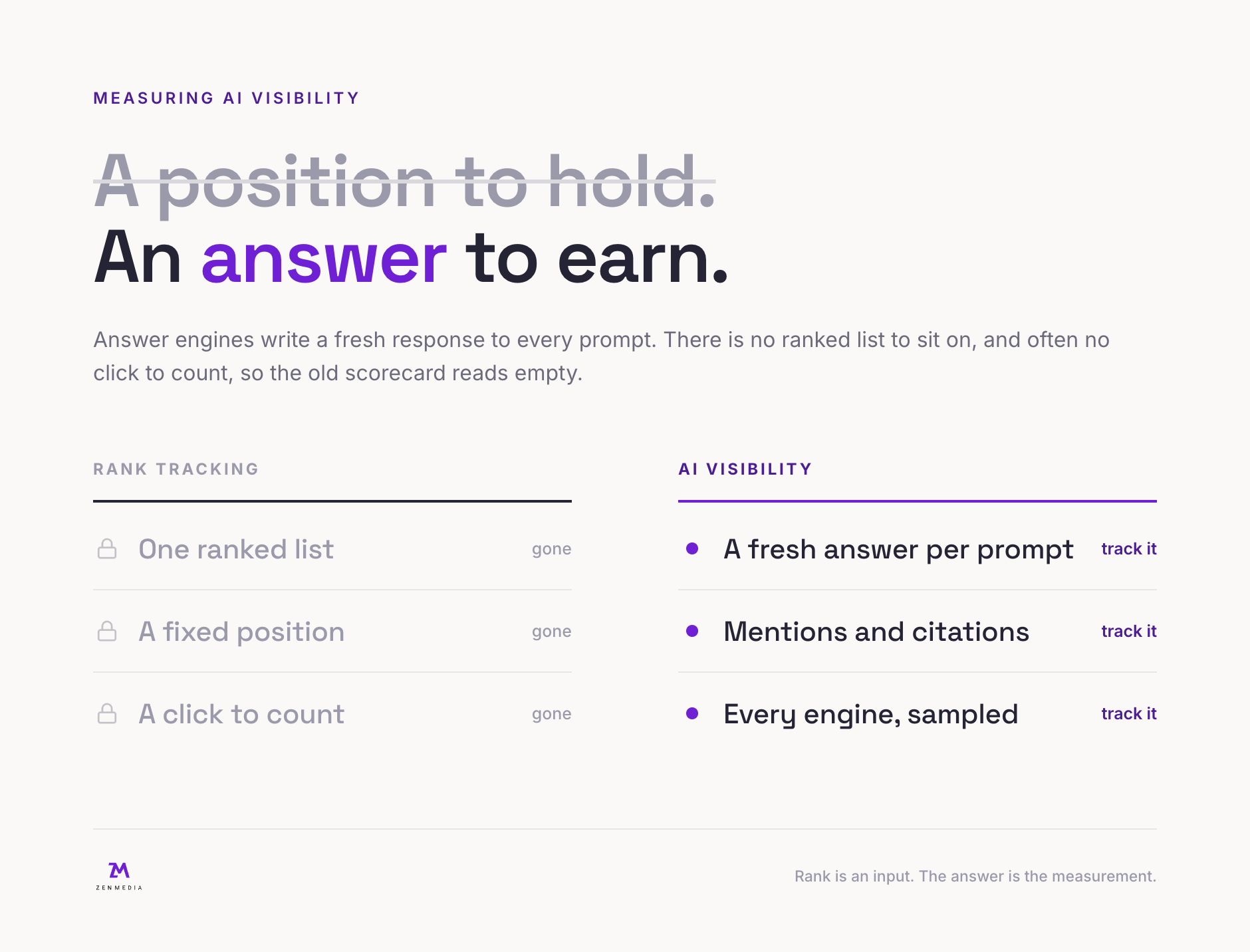
Rank tracking rests on one assumption: for a given keyword there is a single ranked list, and your job is to record where you sit on it. That assumption is gone. An answer engine composes a fresh response every time someone asks, the wording changes from one run to the next, and there is no tenth blue link to occupy. The unit of visibility is no longer a position. It is now the model naming you, citing you, and how prominently it does so, inside an answer assembled on the spot.
The instinct to fall back on Google rankings as a proxy fails, because a top Google ranking no longer guarantees the brand appears in the AI answer at all. Answer engines assemble responses from sources well outside the top ten, and often from pages that never ranked, so a strong position in classic search can sit right next to total absence from the AI answer for the same query. Rank feeds AI visibility as one input; it no longer decides the outcome.
There is also no reliable click to count. When an answer engine resolves the question in the response, the buyer often never visits a site, so the referral line in your analytics stays near zero even while your brand is being recommended thousands of times inside answers you cannot see. Measuring AI visibility means measuring the answer itself, which is a different discipline built on different inputs. Understanding how AI crawlers shape brand visibility is the starting point, because what the crawlers collect is what the answer is built from.
Part 2 · What to Measure
The Metrics That Define AI Visibility
Five metrics turn AI visibility into something you can score, and none of them appears in a traditional analytics dashboard. Track all five, per engine, and you have a complete picture. Track one in isolation and you will misread your own position.
| Metric | What it measures | The question it answers |
|---|---|---|
| Mention rate | Share of prompts where the answer names your brand in its text. | Does the engine recommend us at all? |
| Citation rate | Share of prompts where your domain is used as a linked source. | Does the engine trust our content as evidence? |
| Share of voice | Your proportion of all brand mentions in your category’s prompts. | How do we compare to named competitors? |
| Sentiment | The tone the answer uses when it describes your brand. | Are we described the way we want to be? |
| Answer position | Where in the answer you appear, first choice or footnote. | Are we the recommendation or an afterthought? |
Mention and citation are the two metrics teams confuse, and the gap between them is wide. A Semrush study of AI citations in June 2026 found that 61.7% of AI citations never name the brand they link to. On Gemini, brands were named in 83.7% of cases but domains were cited as sources only 21.4% of the time. On ChatGPT the pattern inverted, with a 20.7% mention rate against an 87% citation rate. A brand tracking only mentions would call Gemini a success and ChatGPT a failure, when in fact each engine rewards a different signal.
Share of voice is the metric a leadership team understands fastest, because it is comparative and it maps to the competitive framing they already use. Tools typically roll the five metrics into a single AI visibility score, a weighted blend of mention, citation, and position that is useful only when you can see the parts behind it and the baseline it moves against. Zen Media tracks a composite version we call Answer Share, which rolls per-engine mention and citation data into one figure for a category, so a brand can watch its slice of the AI conversation grow against named rivals. The related discipline of generative engine optimization is what moves these numbers; the metrics here are how you know it worked.
Why One AI Answer Tells You Almost Nothing
Here is the trap that sinks a first attempt at AI visibility tracking. Someone asks ChatGPT the money question, the brand does not appear, and the screenshot becomes a fire drill. The next morning the same prompt names the brand first. So which reading do you take to the board? Neither answer is the truth, because a single answer is mostly noise. This is the part the tool marketing skips, and it is the difference between a number you can defend and a number that embarrasses you in the room.
A 2026 study by researcher Dmitrij Zatuchin, Where Does the Noise Come From?, decomposed what actually moves a brand’s score in LLM answers. The finding is blunt: a single AI answer carries almost no brand-discriminating signal, with a reliability near 0.01. Brand identity itself accounted for only 1.5% of the variance in the answers studied. The bulk of the movement came from resampling the same prompt (34.8%) and from the language the query was written in (26.5%). When 98.5% of what moves your score traces to something other than your brand, one check tells you almost nothing.
Share of variance in LLM brand answers. Source: Zatuchin, Where Does the Noise Come From?, 2026.
The answer is to sample widely, because repeating one prompt does not help. The same study found that reliability past the fifth repeat of a prompt improves by 0.0003, effectively nothing. Reliability comes instead from spreading measurement across a broad prompt set, several phrasings, and multiple engines. A full crossed design, sampled for breadth, reached a reliability of about 0.36, more than thirty times what a single answer delivers. AI visibility is a sampling problem before it is a tooling problem, and every credible number downstream depends on getting the sampling right.
“The screenshot someone panics over is one draw from a noisy distribution. The number I will stand behind in front of a board is hundreds of draws, across engines and phrasings, watched over months. One is anecdote, the other is measurement, and confusing them is the fastest way to make a bad call.”
Part 3 · Measuring Across the Engines
How AI Visibility Differs Across ChatGPT, Gemini, Perplexity, Claude, and Google AI
A single blended AI visibility score is convenient and misleading. The engines build answers from different sources, weight evidence differently, and cite at wildly different rates, so the same brand and the same prompt set produce genuinely different results on each one. Semrush found that ChatGPT cites an average of 15 sources per response while Gemini cites an average of 3, and that there was almost no overlap between the brands ChatGPT cited and the brands Gemini named for the same prompts. You are measuring six surfaces that happen to share a category, and each behaves on its own terms.
Each engine runs on a different index and rewards different signals, so only a sliver of cited domains overlap between them. Here is how each surface behaves, what earns a citation, and what to measure on it.

 ChatGPT
ChatGPT is the largest answer surface, at roughly a billion weekly users, and it sources like an encyclopedia crossed with a forum. It draws on Bing’s index and its own crawl, cites around fifteen sources per response by Semrush’s count, and leans on consensus references and communities, with Wikipedia and Reddit heavy among the sources it pulls. Its citation rate runs high while plain-text brand mentions run lower, so a brand often sits behind an answer as evidence without being named in it, and it leans toward recent coverage.
How to win it: earn coverage on the reference and community sources it trusts, keep a current and well-structured page on each core topic, and track the domains it cites as closely as the mentions.
 Google AI Overviews and AI Mode
Google’s AI Overviews reach the widest audience of any surface, appearing on billions of searches a month, with AI Mode adding a deeper conversational layer on top. Google grounds both in its own index and fans a single query into a cluster of sub-queries, then assembles the answer from citations pulled across the whole cluster. A page can therefore be cited for a question it never targeted, and classic rank only partly predicts inclusion. Established publishers appear alongside forums like Reddit and Quora.
How to win it: cover the whole sub-query cluster around a topic, keep entity and Organization signals clean, and read citation straight from the answer, since rank alone will not show it.
 Gemini
Gemini runs on the same Google index and knowledge graph and reaches hundreds of millions of users through its app and Google Workspace, so entity clarity and Google-indexed coverage carry real weight, and multimodal sources like YouTube surface more than elsewhere. On the two core metrics it is the reverse of ChatGPT: it names brands in the large majority of answers, over 80% by Semrush’s count, yet cites source domains far less often, so a brand can look dominant on mention rate and be nearly absent as a cited source.
How to win it: strengthen your entity footprint across Google’s ecosystem, add structured content and YouTube coverage, and treat a high mention rate with a low citation rate as the gap to close.
 Perplexity
Perplexity is the citation-first engine and the easiest to audit, handling hundreds of millions of queries a month from its own large web index. It attaches sources to nearly every claim, so citation and answer position read straight off the response, and it is the hungriest of the group for freshness, favoring content updated within the month. Community sources, Reddit chief among them, dominate what it pulls.
How to win it: keep your key pages fresh, make every claim quotable with a clear source, and use Perplexity’s visible citations to see exactly which competitor is winning a prompt you want.
 Claude
Claude is the cautious namer and the surface where new or lesser-known brands start lowest, now reaching tens of millions of consumers and hundreds of thousands of businesses. It runs on Brave Search, favors clear, verifiable, well-structured sources, and is far more likely than ChatGPT to cite content that is a few weeks old, rewarding durable coverage over the newest post. It is slow to name a brand it cannot confidently identify, so entity legibility matters here more than anywhere.
How to win it: make your brand unmistakable as an entity, publish clear, well-structured, well-sourced pages, and track the climb from a low base, as the oncology program did in taking Claude from near zero to the front of the answer.
 Microsoft Copilot
Microsoft Copilot is built on Bing’s index and lives inside Edge, Windows, and Microsoft 365, giving it a distinct, enterprise-leaning audience the other engines miss. It favors established, authoritative sources, so a solid Bing presence and clean organizational information feed what it can surface.
How to win it: shore up your Bing footprint and structured business details, and track Copilot separately, because a brand strong on ChatGPT can be thin here when its Bing presence lags.
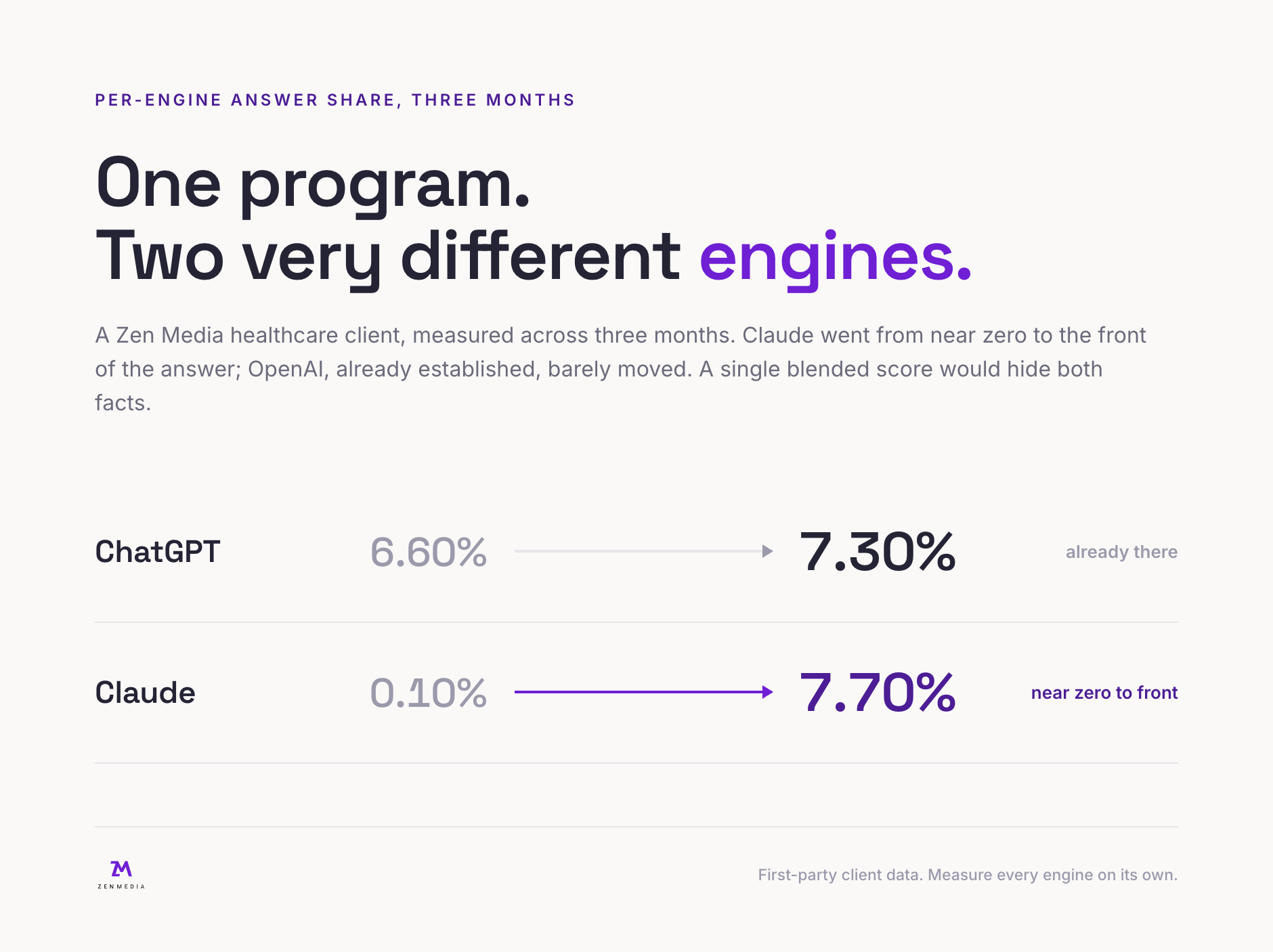
The case for per-engine tracking is concrete. In a Zen Media engagement with an oncology care navigation platform, we baselined 1,000 prompts across two engines and then ran a visibility program for three months. Answer Share on Claude climbed from 0.10% to 7.70%, close to a standing start, while on ChatGPT it moved only from 6.60% to 7.30% because the brand already held ground there. A blended score would have shown modest overall movement and buried the real story: the program had opened an engine where the brand had been effectively invisible. Different engines carry different baselines and respond to different work, and a per-engine view is the only one that shows you where to push.
This is also why the sourcing question changes by engine. ChatGPT’s reliance on community and reference platforms rewards a different earned-media footprint than Perplexity’s per-claim citation model, a divergence explored in more depth in Zen’s look at how AI citations work in 2026. Measure each engine on its own terms and the reporting stops contradicting itself.
Part 4 · Build the System
How to Build a Prompt Set You Can Trust
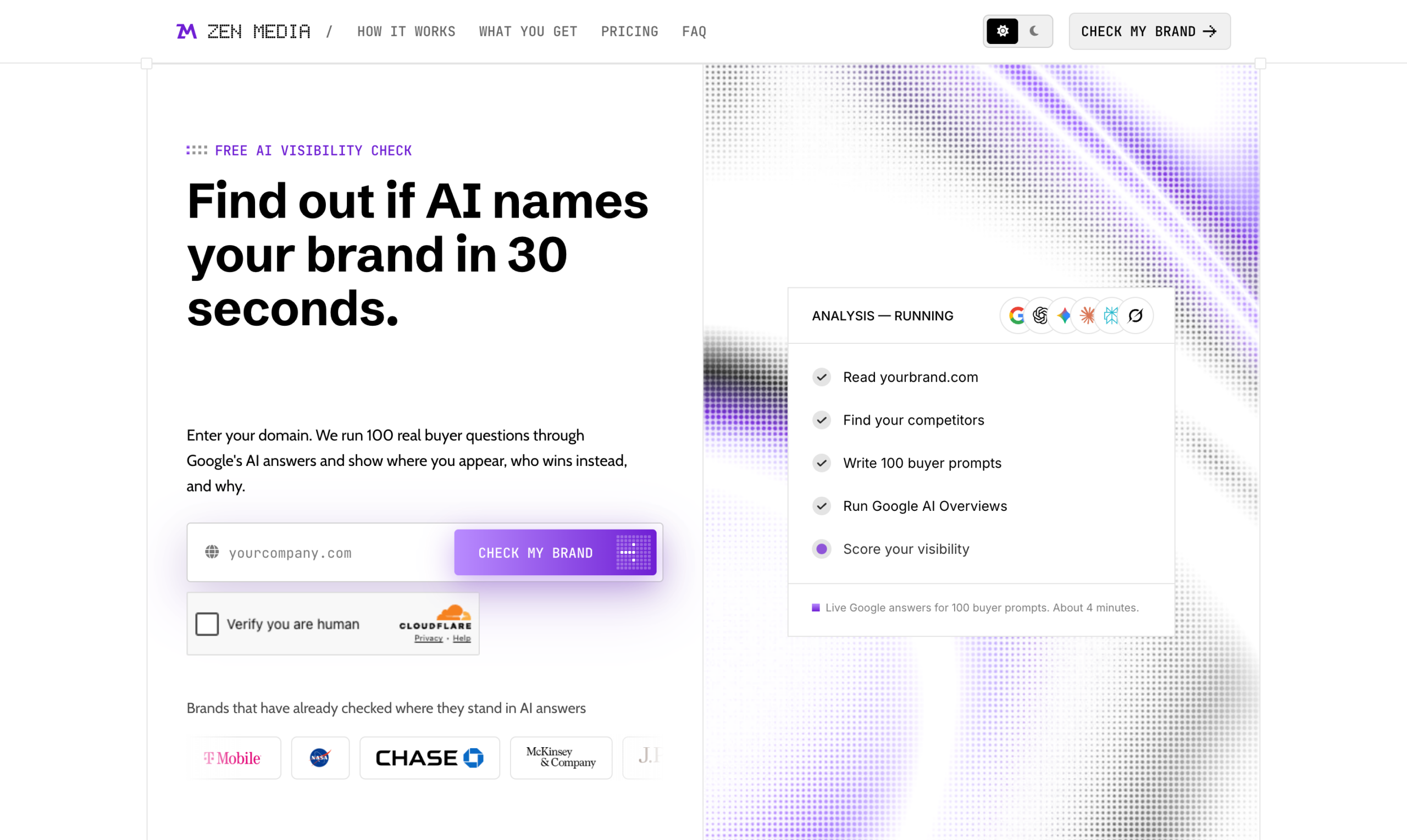
Every number in AI visibility tracking is only as good as the prompts behind it. Zen Media builds that set through the Prompt Discovery Index, its method for mapping a category’s Core 1,000 Prompt Universe: the actual questions buyers put to AI, segmented by intent and persona and expandable to 10,000. It scores Prompt Share, how often you surface against competitors, and flags the white space where no brand has claimed the answer yet. You can watch the method run in Zen Media’s free AI Visibility Check shown above, which writes 100 real buyer prompts for any domain and runs them live through Google’s AI answers. Four principles keep that set honest.
Map prompts to real buyer intent, using your buyers’ words. Buyers do not ask AI engines about your brand; they ask about their problem. Start from the questions each persona actually types, from early category research to late-stage vendor comparison, and write prompts in their language. SpecialistID’s AI visibility program began with 100 test prompts drawn from four distinct buyer segments, because a badge-holder buyer in healthcare asks differently than one in government.
Cover the full funnel and the full category. A prompt set weighted toward branded or bottom-funnel questions flatters you. Include the broad, unbranded, high-intent prompts where competitors currently win, because those are the ones worth moving. This is where the Prompt Discovery Index earns its keep, surfacing the prompts that carry real demand in a category, the ones where buyers actually ask and competitors actually win.
Include competitor and comparison prompts. Share of voice is meaningless without a field to compare against. Prompts like “best options for X” and “alternatives to Y” are where displacement happens, and tracking them is how you prove you took ground. SpecialistID’s program replaced Amazon, Staples, and Office Depot across specific AI Overview results, which was only visible because the competitive prompts were in the set.
Size the set for coverage, then sample it widely. Coverage beats depth. Because reliability comes from spreading across prompts, phrasings, and engines, a broader set sampled at a sensible cadence produces a more trustworthy number than a narrow set hammered repeatedly. A category read often needs several hundred to a thousand prompts once you multiply personas, funnel stages, and engines together.
AI Visibility Tracking Tools and Platforms
The tools that measure AI visibility fall into three groups, and the right mix depends on how deep you need to go.
| Tool type | What it tracks | Best for |
|---|---|---|
| General SEO suites | AI modules on large first-party datasets, like the Semrush AI toolkit and Ahrefs Brand Radar. | A first look with data you already run. |
| Dedicated AI monitors | Mention, citation, sentiment, and source domains, with alerts when they move. | Continuous AI brand monitoring. |
| Free checks and first-party | Buyer prompts run through live AI answers, with competitor benchmarking and per-engine scoring. | Zen’s free Check for a fast read, or ZAVI for a managed program. |
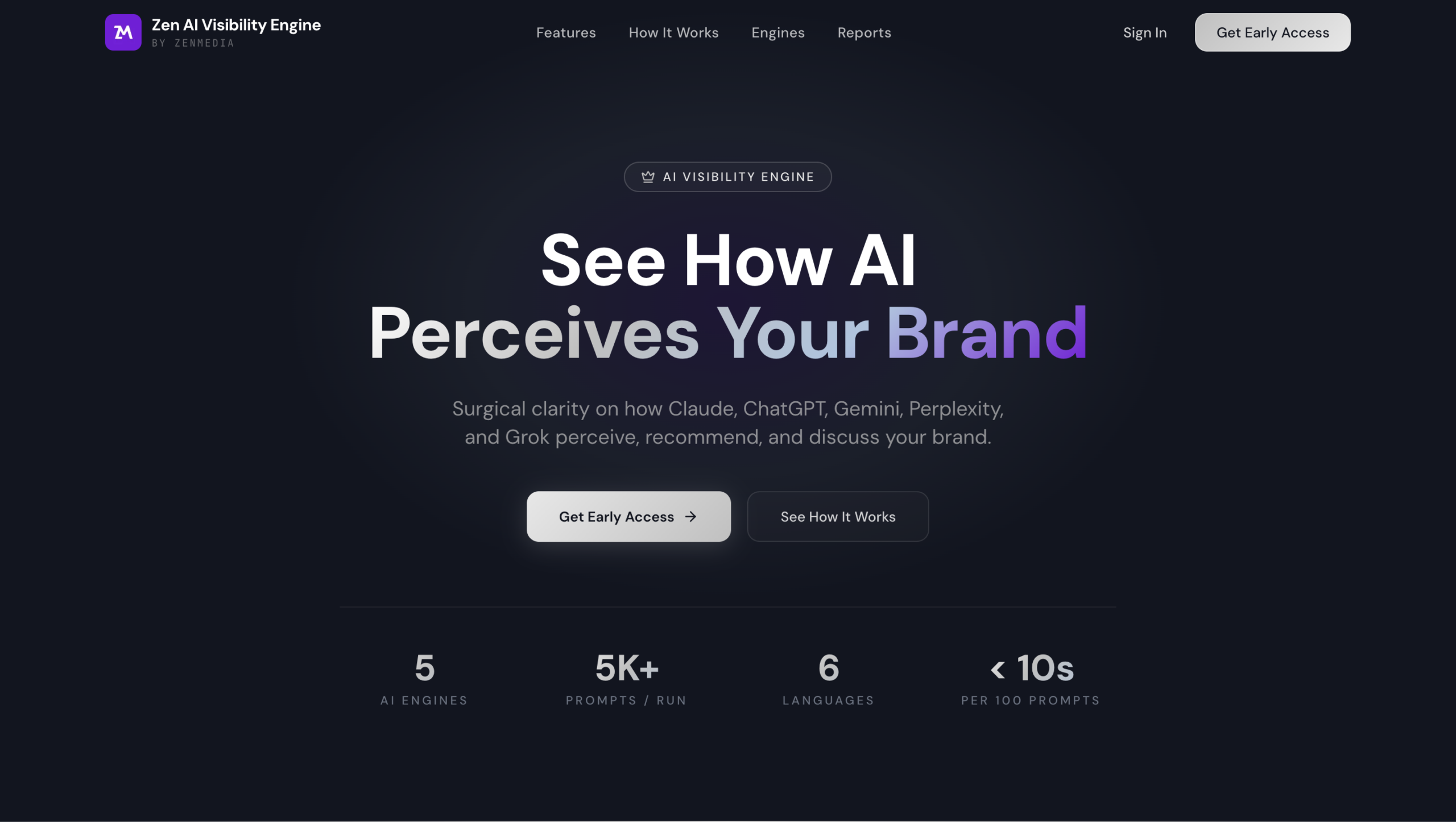
The deepest read comes from a dedicated platform. Zen Media’s Zen AI Visibility Engine, or ZAVI, shown above, runs up to 5,000 prompts per brand across Claude, ChatGPT, Gemini, Perplexity, and Grok, scores mention, citation, and Answer Share per engine against a fixed baseline and a named competitive field, and tracks the trend on a recurring schedule. For a fast first read, the free AI Visibility Check writes 100 buyer prompts for any domain and runs them through Google’s AI answers in minutes. Brands from Chase to McKinsey have used them to see where they stand in AI answers.
How to Build an AI Visibility Tracking System
A tracking system turns the pieces above into a repeatable process. The shape is the same for a bought platform or an in-house build: define the prompts, sample them across engines on a schedule, score the results into your metrics, and report the trend. Each stage has a decision that determines how trustworthy the output is.
Hold the prompt set and the baseline steady once the system is running. The usual way teams corrupt their own data is to keep changing what they measure, which resets the trend line every time and leaves nothing to compare. Lock the design, let the cadence run, and change the set only on a deliberate schedule.
A number you can defend comes from a fixed prompt set, sampled on a schedule, scored per engine, and read against a baseline you hold steady. Change the design and you reset the trend; hold it and every window becomes comparable.
Part 5 · From Measurement to Results
Common AI Visibility Tracking Mistakes
The same errors show up in almost every stalled AI visibility program. Each one produces a number that looks precise and means nothing.
How to Improve the Numbers You Track
Measurement earns its budget only when it points at action. The good news is that the levers are known, and they are disciplines your team already understands. Google states plainly in its own guidance that optimizing for AI features in Search is still SEO: there is no separate trick, no special markup, and no benefit to writing AI-only pages. The work that raises a real ranking raises AI visibility with it.
Earn citations from sources the engines already trust. Answer engines assemble responses from third-party coverage, so being cited across the publications, reference sites, and communities the models pull from is the strongest lever. A single feature in a publication a model already reads can flip a prompt from a competitor’s name to yours. This is where digital PR and earned media do the heavy lifting, and it is why AI visibility sits closer to communications than to technical SEO. The OCTG campaign later in this guide moved on exactly this mechanism.
Add the evidence AI answers reward. A Princeton study of generative engines, GEO: Generative Engine Optimization, found that adding citations, quotations, and statistics to a page can lift its visibility in AI answers by up to 40%. Concrete, sourced, quotable content is easier for a model to lift into an answer, so lead each section with a direct answer, a specific number, and a named example.
Make your brand legible as an entity. Engines recommend brands they can confidently identify, so reinforce one consistent description of who you are, what you do, and who you serve across your site, your profiles, and the reference sources the models read, backed by clear Organization markup. The steadier that entity signal, the more reliably an engine ties your brand to the prompts you want to win.
Aim at the gaps your measurement found, engine by engine. The tracking data shows which prompts you lose and on which engine, so the work gets specific: earn community and reference coverage where ChatGPT leans, tighten per-claim sourcing where Perplexity looks, and rebuild the pages Google fans its sub-queries across. Fixing the named gap beats a generic content push.
Improvement and measurement run as one loop: the prompt set shows which answers you are losing, digital PR and content win them back, and the next window confirms the movement. For the full method, see Zen Media’s guide to staying visible in the answer layer.
How to Report AI Visibility to Your Leadership
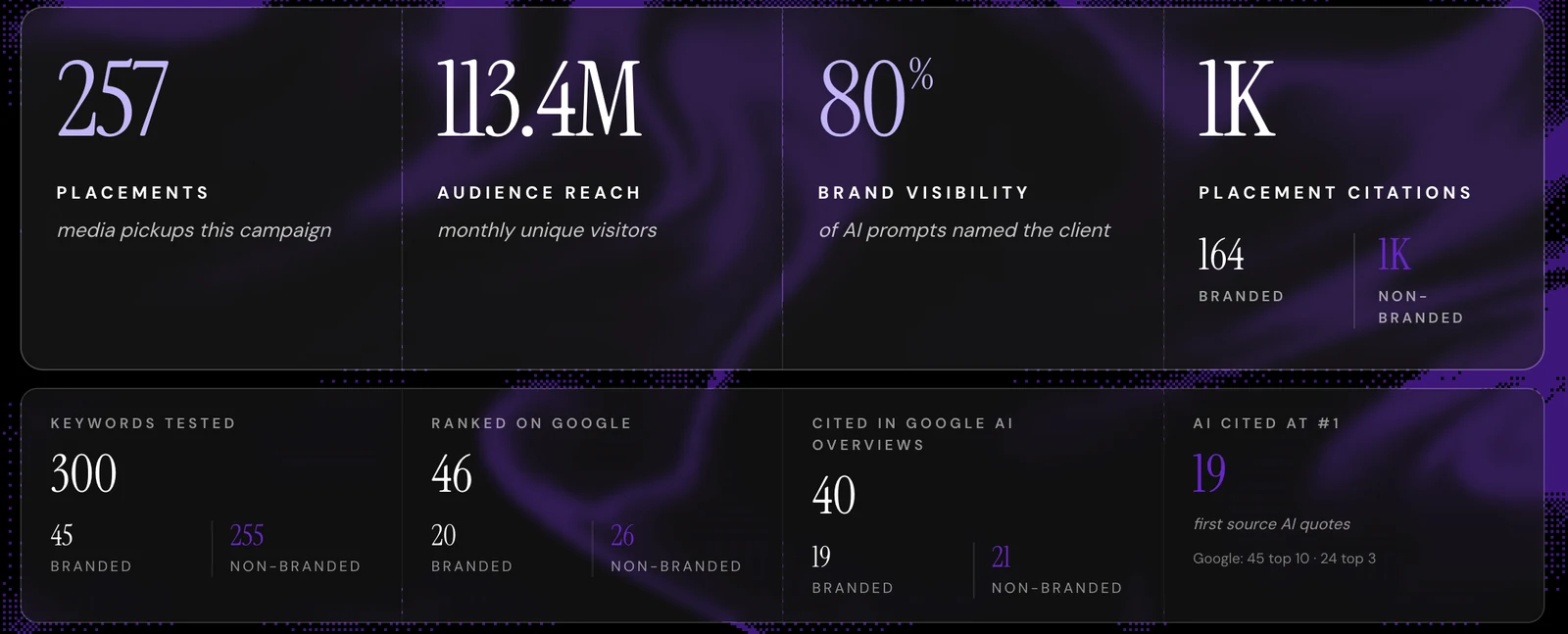
A finished AI visibility report looks like the Zen Media campaign summary above. For one certified OCTG supply client, a single campaign drove 257 media placements reaching 113.4 million people and roughly 1,000 placement citations. Across a 300-prompt test the brand was named in 80% of AI answers, cited 40 times in Google AI Overviews and quoted first in 19. Reach, prompt coverage, and citations sit on one page, in the language a board already understands.
Leadership does not want a screenshot of ChatGPT naming the brand; they want to know if the investment is moving a number that connects to revenue, and how the brand sits against its rivals. A strong report answers four questions on one page.
Are we trending up against a fixed baseline? Lead with the share of voice or Answer Share trend, per engine, measured against the starting point. A rising line against a stable baseline is the clearest proof that the program is working.
Where do we stand against named competitors? Show the competitive field in the prompt set and the gap you are closing or opening. SpecialistID’s report could point to specific competitors it displaced across AI Overview results, which is a story a leadership team acts on.
Are we named, cited, or both, on each engine? Break out mention rate and citation rate by engine, because the fix differs. A high mention rate with a low citation rate is an evidence problem; the reverse is a positioning problem.
What is this connected to? Tie the visibility trend to downstream signals where they exist. SpecialistID reached a 72% visibility rate on its high-intent prompts within 90 days, alongside a 54.65% lift in organic traffic on AI-aligned keywords and an 18% rise in sales from AI-originated visits. Not every program will have clean revenue attribution, and the honest report says so plainly.
The same measurement discipline holds across engagements. Two Zen Media AI visibility programs, by the numbers:
The reporting cadence matters as much as the content. Because the sources engines pull from move week to week, report on a monthly rolling window so daily swings settle into the trend, and hold the prompt set and baseline steady so the trend stays comparable. Teams that run AI visibility and traditional search as one connected effort see the payoff: the same Semrush AI Visibility Index found that 81% of organizations with integrated SEO and AI strategies reported traffic or lead gains, against 36% of those managing the two separately. Consistent measurement is what lets a communications team argue for budget in the language leadership already speaks.
Frequently Asked Questions About AI Visibility Tracking
What is AI visibility tracking?
AI visibility tracking measures how often, how prominently, and how accurately AI answer engines name or cite your brand across a set of buyer prompts, sampled repeatedly over time. It replaces rank tracking for answer engines. The core metrics are mention rate, citation rate, share of voice, sentiment, and answer position, read separately for each engine.
How is AI visibility measurement different from SEO rank tracking?
Rank tracking assumes one stable ranked list per keyword. Answer engines generate a fresh response per prompt, it changes from run to run, and there is no fixed position to record. You measure presence inside the answer, and a top ranking no longer guarantees inclusion, because engines pull from sources well outside Google’s top ten.
What is a good AI share of voice?
There is no universal target number. Share of voice is relative to your category and named competitors, so a strong result is a rising trend against a fixed baseline and a growing gap over rivals. Read it per engine, since a brand can lead on one and trail on another, and judge progress against your own starting point.
How big should my AI visibility prompt set be?
Enough to cover your category. A practical starting point is around 100 high-intent prompts mapped across your buyer personas, then sampled repeatedly. Reliability rises faster when you spread prompts across phrasings, engines, and personas than when you repeat one prompt over and over. Zen Media’s baseline audits often run to 1,000 prompts across multiple engines for a full category read.
How often should I track AI visibility?
Continuously, and report on a monthly rolling baseline. The sources AI engines pull from change week to week, so a single check captures noise while the trend only appears across repeated samples. Set a cadence that resamples your prompt set on a schedule and compares the current window to a stable baseline.
Which AI engines should B2B brands track?
Track ChatGPT, Google’s AI Overviews and AI Mode, Gemini, Perplexity, Claude, and Microsoft Copilot, and track each one separately. Engines source and weight evidence differently, so a tactic that wins a citation on one can fail on another. Movement is asymmetric too: in one Zen Media engagement, Answer Share on Claude climbed from 0.10% to 7.70% while ChatGPT barely moved.
What is the difference between an AI mention and an AI citation?
A mention is your brand name appearing in the answer text. A citation is your domain used as a linked source under the answer. They do not track together: Semrush found that 61.7% of AI citations never name the brand they link to, and Gemini names brands often while citing sources less. Measure both, because each fixes a different gap.
What tools track AI visibility?
Three categories exist: general SEO suites with AI modules, dedicated AI-visibility monitors, and free brand checks. Zen Media runs measurement on ZAVI, its prompt-tracking platform, and offers a free AI Visibility Check that runs 100 buyer prompts through Google’s AI answers in under five minutes. Demand transparent sampling and a visible baseline from any tool.
How do I improve my AI visibility?
Earn citations from sources the engines already trust. Google states that optimizing for AI features is still SEO, so entity clarity, structured content, and authoritative coverage all carry over. Princeton research found that adding citations, quotations, and statistics to a page can lift its AI visibility by up to 40%. Digital PR does the heavy lifting.
What is AI brand monitoring?
AI brand monitoring is the continuous version of AI visibility tracking: it watches how AI engines describe your brand over time and flags changes in mention rate, citation rate, sentiment, and the sources being pulled. Because the sources engines rely on change week to week, monitoring catches a drop or a reputation problem while there is still time to act.
Can I use Google Analytics to measure AI visibility?
No. Google Analytics records referral clicks after they happen, and AI answers often resolve the question without sending a click at all. It cannot tell you if your brand was named or cited inside an answer, which is the thing you are trying to measure. AI visibility needs its own measurement layer built on prompt sampling.
About the author: Sarah Evans is Partner and Head of PR at Zen Media, a global B2B PR and marketing agency. With 23+ years in communications, she architects PR strategy, drives earned media initiatives, and helps brands navigate AI-driven visibility. She is a regular contributor to Entrepreneur and has been recognized as a top writer on business and tech.