
A maintenance buyer needs a replacement bearing by Friday. They skip opening three supplier tabs and type the spec straight into ChatGPT to ask where to buy it. When that answer comes back, is your distribution company one of the names in it, or is the buyer already contacting someone else? For a growing share of industrial purchases, the shortlist now forms inside an AI model before a person ever reaches your site.
This is no longer hypothetical. In Semrush’s 2026 survey of B2B buyers, 92% said AI has shaped their vendor shortlist and 83% said it influenced a final vendor decision. For industrial parts and maintenance, repair, and operations (MRO) distributors, an engine’s answer now decides whether a buyer considers you at all.
This guide is written for marketing and ecommerce leaders at industrial and MRO distributors. It explains what AI visibility is, which distributors the major engines surface again and again, and why, how the answers change for specialized parts, and a repeatable way to measure and improve where your company stands. The data comes from a Zen Media study that analyzed 3,000 AI responses across three engines.
What AI Visibility Means for an Industrial Parts Distributor
AI visibility is the share of AI answers that name your company when buyers ask questions in your category. If a thousand buyers ask AI models where to source bearings, cutting tools, or fasteners, your visibility is the share of those answers that include you. It is closer to share of voice than to a search ranking, and it behaves differently from both.
Three ideas are easy to confuse, and keeping them separate is the first step toward measuring anything useful. A traditional search position is where your page lands in a list of blue links. A brand mention is the engine naming your company inside its written answer. A citation is the engine linking your page as the source for a claim. You can earn a mention without a citation, and a citation without ever ranking first in search, so the three move on their own tracks. The study behind this guide measures the first of those: the brand mention, how often each distributor’s name appears in the answers.
The mechanics behind this sit in how answer engine optimization works, and the broader practice of influencing those answers is covered in generative engine optimization. For a distributor, the practical point is simpler: strong local relationships and a loyal customer base do not guarantee the engine knows you exist.
“A distributor can be the first name every buyer in its region would say out loud, and still never surface when that same buyer asks an AI model the question,” said Sarah Evans, CEO of Zen Media. “The engine answers from what it can read and verify about you, and a busy sales counter never enters its calculation.” AI visibility measures the distance between a distributor’s reputation and its readable presence.
Which Industrial and MRO Distributors AI Engines Name Most
Six distributors clear 35% AI visibility, led by Grainger at 67.7%, and the field drops off sharply below them. Zen Media’s ZAVI AI Visibility Engine produced that ranking from 1,000 buyer questions, sent by five buyer types to ChatGPT, Grok, and Gemini across 3,000 answers, scoring each company by how often its name appeared.
AI Visibility by Distributor
Share of answers naming each company across 3,000 AI responses
Caption: visibility concentrates in six names, then drops to a tenth of the field. Source: Zen Media ZAVI study, 2026.
Grainger led at 67.7%, the broadline name engines reach for on general purchasing and consolidation questions. Behind it, two technical distributors sit a percentage point apart: Motion Industries at 45.1% and Applied Industrial Technologies at 44.1%, both tied in the answers to bearings, power transmission, and fluid power. Fastenal at 43.8% owns fasteners and inventory programs, MSC Industrial Supply at 35.8% owns metalworking and cutting tools, and McMaster-Carr at 35.4% is named for fast fulfillment of hard-to-find items.
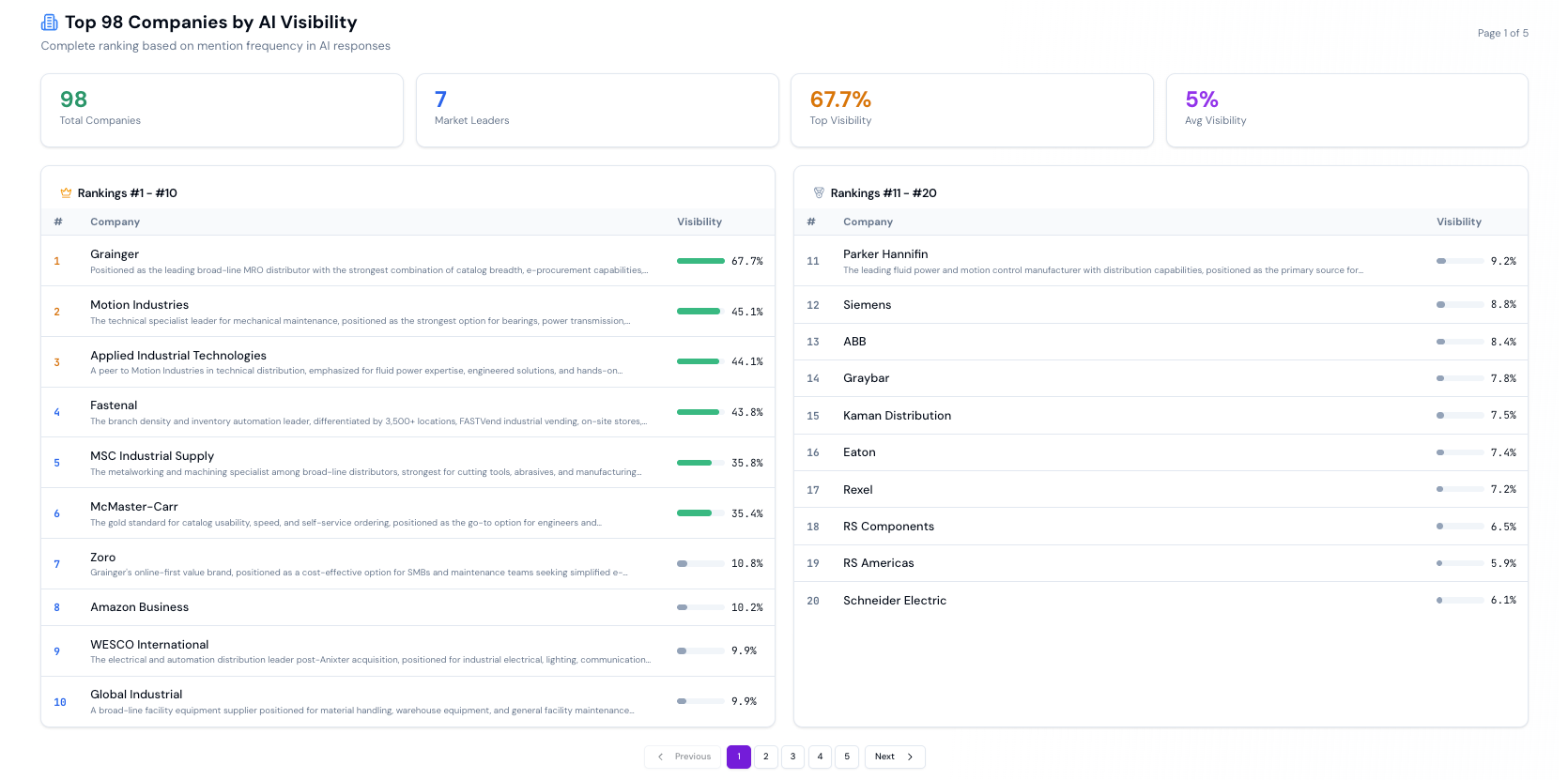
The full ZAVI ranking runs to 98 companies, and visibility collapses almost immediately below the leaders. McMaster-Carr holds sixth at 35.4%; the seventh name, Zoro, reaches only 10.8%. There is a head of the market and a long tail, with very little between them.
Why AI Engines Name Distributors Before Manufacturers
Every one of the top six names is a distributor. The large component manufacturers that make the parts these questions are about appear much lower: in the same ranking, well-known names in motors, drives, and electrical components cluster between roughly 6% and 9% visibility, a fraction of the leaders. On broad purchasing and maintenance questions, buyers ask where to buy, and the engines answer with the sellers who carry the parts.
Why would an engine name a reseller ahead of the company that engineers the part? The outcome rewards something distributors already do, and it is worth naming the reasons directly.
Extractable catalog data. Distributors publish specifications, dimensions, and stock status as structured text on the page, which an engine can read and repeat. Manufacturers often lock the same detail inside spec-sheet PDFs the model cannot parse as cleanly.
Cross-references and substitutions. A distributor’s site maps one part to its equivalents across brands, which is exactly the “what can replace this” logic a buyer brings to an AI model. That mapping is a distributor asset and a manufacturer rarely has a reason to build it.
Breadth and availability. A buyer sourcing a bearing, a fitting, and a cutting tool in one question is answered by the name that carries all three. Breadth and live availability read as usefulness to an engine ranking a single response.
“The distributors winning these answers earn it on substance,” explains Evans. “They publish cross-references, specifications, and availability in a form a model can lift, while component manufacturers too often leave the same detail locked in a PDF.” For a distributor, that is an advantage to defend, because the catalog data that wins AI answers is already yours to structure and surface. The same dynamic shows up across the sector, which is why it recurs in work on AI visibility for industrial B2B ecommerce.
The Same Question, Three Different Answers
Visibility varies by engine. The same company surfaces at very different rates depending on which engine a buyer uses, because each model draws on a different mix of sources. McMaster-Carr appeared in 47.2% of Gemini summaries but only 18.9% of Grok summaries, roughly two and a half times as often in one engine as the other. A distributor that tests only one model sees only one slice of its real standing.
The directory example is a useful tell. Grok named a single online sourcing directory in 7.0% of its answers and ChatGPT in only 2.3%, the same directory appearing three times as often in one engine. Ask instead about procurement and the shape changes again: on questions about punch-out catalogs and ERP integration, Gemini named platforms like SAP Ariba, Coupa, Oracle, and Workday as integration targets, and none of the engines treated those platforms as suppliers. The source mix behind each model is covered in more depth in how AI crawlers shape brand visibility.
How Specialized and Non-Standard Parts Change the Answer
The broadline leaders own the general questions, and the picture opens up as the request gets specific. One study question asked where to find a distributor for specialty bolts, nuts, and threaded fasteners in non-standard sizes. ChatGPT answered with a catalog distributor, a dedicated fastener distributor, an engineered-fastener supplier, and precision thread makers. Grok sent the same buyer to a fastener trade association, an online sourcing directory, and niche fastener houses. The specialized request pulled in names that never appear on the broad questions.
The study’s questions skewed commercial, which is where specialized sourcing lives. Buying intent was the largest question type at 41.2% of the 1,000 questions, and a further 20.4% asked buyers to compare suppliers directly. On that comparison set, the broadline leaders held their ground: at least one engine named Grainger in 143 of the 204 comparison questions and Motion Industries in 64.
Based on 1,000 buyer questions across five buyer types. Source: Zen Media ZAVI study, 2026.
For a specialist distributor, this is the opening. You will rarely outrank a broadline name on “where do I buy MRO supplies,” and you can own the specific questions, the odd thread pitch, the obsolete part number, the application nobody else documents. The narrower the question, the more the engine needs a supplier that has published real detail about it.
How to Measure Your Distributor’s AI Visibility
A distributor can measure its own AI visibility without special tooling: ask the buyer questions across every engine, record who the engines name, and repeat on a schedule so the numbers show a trend. When did you last type your own top product category into ChatGPT to see which suppliers it names? The method below turns that one check into a baseline.
“Checking your name in ChatGPT once tells you almost nothing,” noted Evans. “Watch the direction it moves after you publish, because that is the only proof the work changed what the engine says.” The metric framework behind this, tracking appearance over time, is laid out in Answer Share as a visibility metric.
How Industrial Distributors Improve AI Visibility
Measurement sets the baseline. Moving the number comes from giving the engines more of what they reward and earning the outside signals they read. Four levers carry the results.
This is where a managed program earns its place. Zen Media’s Published Monthly program records which buyer questions name a distributor, which systems or directories appear beside it, and which competitors show up, then re-measures after new content and third-party coverage go live. The point of naming it here is the loop it enforces: a baseline, a round of work, and a fresh measurement against the same questions, so the effect is visible and measured. Distributors running this inside a broader plan can connect it to their industrial marketing strategies, and teams building the capability in-house can start from the groundwork in Zen Media’s B2B marketing services.
Common Mistakes When Tracking AI Visibility
The method is simple, and a few habits quietly undermine it. Each of these turns a useful measurement into a misleading one.
Assuming no news is good news. A distributor left out of an AI answer gets no bounce and no lost-lead trace, so the loss never reaches your analytics. Buyers now build the shortlist from AI answers and community threads before they contact anyone, so your dashboards stay silent even when an engine leaves you off the list.
Mistaking a score for an audit. A single appearance rate is just one number. A useful AI visibility audit records your rate per engine, whether the answers describe the parts you sell, and which competitors and platforms sit beside you, which gives you something to act on and re-measure.
Treating a mention as a click. Being named in an answer shapes the shortlist; it does not show up as site traffic the way a search click does. Measuring AI visibility by analytics sessions misses the thing you are trying to track.
Frequently Asked Questions
What is AI visibility for industrial and MRO distributors?
AI visibility is how often an AI engine names your company when buyers ask questions in your category. It counts how frequently you appear in answers from ChatGPT, Gemini, and Grok, separate from your search ranking or whether the engine links to your site. A distributor can be well known locally and still rarely appear.
How do you measure AI visibility for an industrial distributor?
Build a fixed set of 20 to 40 real buyer questions about the parts, applications, and locations you serve, then run them through each engine several times, since answers vary between runs. Record whether your name appears and whether your page is cited, note who else shows up, and repeat monthly to track the trend.
Which industrial distributors do ChatGPT, Grok, and Gemini recommend most?
In a Zen Media study of 3,000 AI responses, Grainger appeared in the largest share of answers at 67.7% visibility, followed by Motion Industries at 45.1% and Applied Industrial Technologies at 44.1%. Fastenal, MSC Industrial Supply, and McMaster-Carr complete the top six, each above 35%. Visibility then drops sharply, with the seventh name at 10.8%.
How can a distributor check if ChatGPT recommends its company?
Ask ChatGPT the questions your buyers ask, phrased the way they would type them, about the specific parts, brands, and regions you serve. Run each a few times, since answers change between attempts, and note whether you are named or cited. Repeat across Gemini and Grok, which often name different suppliers for the same request.
Why do AI engines recommend different distributors for the same question?
Each engine draws on a different mix of sources. Gemini is grounded in Google Search, Grok pulls live web and social discussion, and ChatGPT synthesizes structured web content and community threads. McMaster-Carr appeared in 47.2% of Gemini summaries but only 18.9% of Grok summaries, so one engine gives an incomplete picture.
Do AI engines name distributors or manufacturers more often for MRO questions?
For broad purchasing and maintenance questions, distributors dominate the answers. All six of the top-ranked names in the Zen Media study were distributors, while large component manufacturers appeared far less often, mostly between 6% and 9% visibility. Distributors tend to publish structured catalog data, cross-references, and availability that engines can read, while manufacturers often keep that detail inside PDFs.
How often should a distributor track its AI visibility?
Track it monthly against the same fixed question set. A single check is only a snapshot, and AI answers change as the engines update and as new content is published. A regular schedule shows whether your visibility is rising or falling after you make changes, the only reliable proof the work is landing.
What is an AI visibility audit for a distributor?
An AI visibility audit measures how often, and how accurately, AI engines name your company across a set of buyer questions. It records your appearance rate per engine, whether answers describe the parts you support, and which competitors and platforms surface alongside you. The baseline pairs well with work on staying visible in the answer layer.
About the author: Sarah Evans is the CEO of Zen Media, a global B2B PR and marketing agency. With 23+ years in communications, she architects PR strategy, drives earned media initiatives, and helps brands navigate AI-driven visibility. She is a regular contributor to Entrepreneur and has been recognized as a top writer on business and tech.