By the time an industrial buyer submits an RFQ, the shortlist has usually been taking shape for months. Trade articles, technical videos, peer recommendations, third-party validation, spec pages, and AI-generated answers have already shaped which suppliers feel credible in the category.
A prospect studies the category for weeks, compares technical claims, asks peers for names, watches how equipment performs, and asks an AI system which suppliers are recognized, all before anyone fills out a form or talks to sales. By the time the company finally appears in the CRM, the buyer already trusts another name more.
Strong industrial companies lose deals they were built to win when a competitor shows up earlier in that research window. The competitor does not need a better product. They were present while the buyer was still learning the category, comparing options, and deciding which names deserved attention.
Industrial buying moves slower than B2C or short-cycle software because the risk is heavier, the proof burden is higher, and more people have to approve the decision. An engineer evaluating a heat exchanger supplier is not clicking a retargeted ad and converting in 48 hours. They are checking material specs, reading trade coverage, watching installation footage, consulting people they trust, and looking for proof that the supplier performs under real operating conditions.
For most of that journey, sales cannot reach the buyer directly. The buyer is still being influenced by what they read, watch, save, ask, and hear from people they trust.
The 10 strategies below focus on that quiet research window, before the buyer reaches out and before the shortlist hardens.
1. Build AI Visibility for Industrial Search Queries
When a plant manager asks an AI assistant which companies are recognized leaders in industrial heat exchangers, the answer shapes the shortlist before the buyer ever reaches a supplier’s website. The brands that appear in those answers have something their competitors lack: a visible body of earned media, technical content, third-party citations, and clear category language that AI systems can understand and reuse.
AI visibility is built before the prompt is ever typed. Answer engines rely on the proof already available across the web: trade coverage, technical explainers, analyst mentions, case studies, schema, and consistent category language. Industrial brands that build those signals early give AI systems more reliable material to reference when buyers ask who belongs in the category.
Buyers don’t phrase these searches like keyword queries. Instead, they ask specific questions like “which suppliers are trusted for custom fabrication in food-grade stainless” or “what are the most reliable brands for explosion-proof enclosures in Class I areas.” The buyer is already using those answers to compare suppliers, check risk, and decide which names belong in the next round before a vendor knows the evaluation has started.
A brand has to give answer engines enough consistent proof to understand what it sells, who it serves, and why it belongs in the recommendation set. Industrial buyers already look for that proof in technical content, trade media, structured product information, case studies, and third-party validation. AI systems pull from the same evidence trail.
Worth reading
Industrial buyers are already using AI to compare suppliers, documentation, availability, and risk. Read more about AI visibility for industrial B2B eCommerce.
SpecialistID shows what happens when AI answers favor better-known retailers over a specialized B2B supplier. The company sells ID badge holders and credentialing products, a specific B2B category where larger retailers like Amazon, Staples, and Office Depot were dominating many AI Overview results. Zen Media mapped their buyer segments, rewrote category content using the language real buyers search, deployed structured data and FAQ schema across products, and seeded content across the sources AI systems reference. Within 90 days, SpecialistID appeared in 72% of high-intent AI prompts in their category, displacing those larger competitors across dozens of queries.
2. Earn Coverage in Trade Publications Before You Need a Launch
Industrial buyers pay attention to the names that keep appearing in the publications they already read. A plant manager reading Control Engineering or Manufacturing Engineering is watching which suppliers understand technical constraints, which engineers explain problems clearly, and which companies contribute something useful to the category before they have anything to sell.
The companies that benefit most from trade media build that presence long before a launch. They contribute technical analysis, make engineers available for expert commentary, share real operational data, and help editors cover the changes happening inside the market. By the time a product announcement arrives, the company is no longer a stranger asking for attention.
Trade coverage is earned by being useful before being promotional. Editors need sources who can explain what is changing in the market, where buyers are struggling, and which technical decisions carry real operational risk. A company that can provide that perspective becomes easier to quote, easier to feature, and easier to remember when a relevant story develops.
Coverage changes the way a supplier enters the buyer’s mind. Instead of arriving as a sales page, the company arrives as a useful voice inside the category. That makes the later sales conversation easier to believe, especially when the buyer has to defend the vendor internally to engineering, operations, finance, and procurement.
Companies that invest in these relationships before they need coverage have an easier time when news finally comes. Editors know whether they are useful. Buyers have seen their name attached to serious industry conversations. The launch becomes another proof point in a reputation that already exists.
For brands that need visibility across the outlets buyers already consult, our B2B media relations and press coverage program builds the relationships, messaging, and publication strategy behind sustained earned visibility.
3. Optimize for Specification-Level Search Queries
Nobody in a purchasing department searches “best heat exchanger.” They search “shell and tube heat exchanger 316L stainless 150 PSIG ASME code.” The buying criteria are already inside the search: material, pressure rating, compliance requirement, and application fit. A page built for that query has to respond with the same level of technical precision.
Specification-level SEO works when the page is built around the way technical buyers narrow options. A broad product overview will miss the query. A useful page answers the details hidden inside it: supported materials, operating conditions, certifications, drawings, compatibility limits, lead times, and the questions an engineer or procurement manager has to clear before the request moves forward.
Worth reading
The same spec-level specificity that attracts industrial buyers through search also determines which brands appear in AI answers. For a deeper look at how this plays out in an industrial category: AI Visibility for the Robotics Industry.
4. Turn Technical Experts Into Visible Category Voices
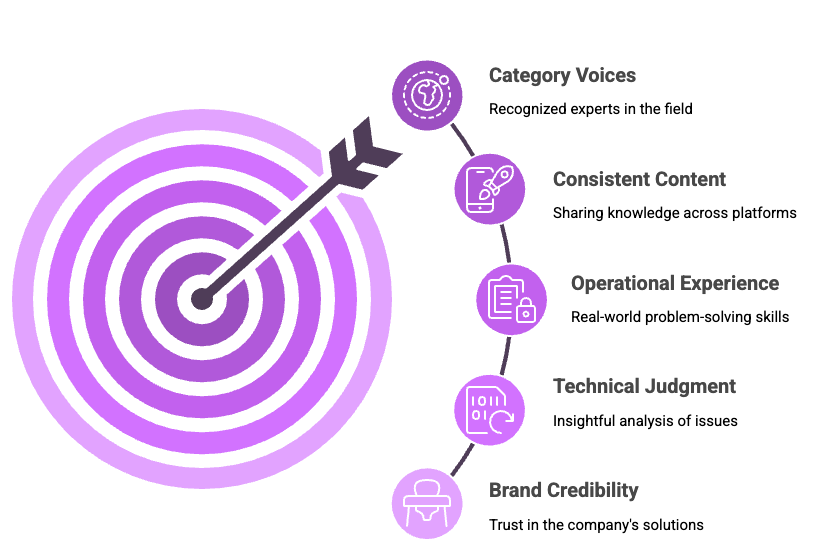
Industrial buyers often trust the person explaining the problem before they trust the brand selling the solution. An applications engineer who explains why a specific bearing configuration fails under certain load conditions gives the buyer something a product page cannot: judgment. That judgment, shared consistently across LinkedIn posts, talks, and trade commentary, is what turns a practitioner into a recognized voice in the category.
Buyers in industrial categories have enough technical depth to recognize the difference between a polished announcement and real operational experience. A brand page accurately describes what a company sells, but it can’t demonstrate that the engineers behind it have actually solved the problem the product claims to solve. That proof comes from people, and it accumulates through content that teaches rather than promotes.
When Zen Media built a practitioner-led strategy for Object Edge around their manufacturing digital summit, LinkedIn engagement grew by 1,261% and impressions increased by 469% over the campaign period. Practitioners carried the message as visible experts in the space, giving the campaign more credibility than a corporate account could create on its own.
Worth reading
Content that teaches rather than promotes earns attention differently from category to category. For deeper knowledge on what this looks like in practice: 17 B2B Content Marketing Examples That Prove Utility Is the New Authority.
5. Use Process Videos to Show the Proof Buyers Cannot Get From a Brochure
Industrial buyers want to see how things work before they commit. A polished product photo answers almost none of their questions. A video showing the fabrication process, a technical design choice being explained on camera, or an installation running in production answers many of them.
The assumption that industrial buyers don’t engage with video content on platforms like TikTok or YouTube tends to collapse when you look at actual behavior data. Engineers and procurement managers use the same platforms as everyone else. When they find content there that treats them as technically literate, they engage with it seriously.
Industrial buyers don’t need another polished product montage. They need to see the work clearly enough to trust the people behind it. Show the build, the failure points, the installation details, and the decisions your team makes when the equipment has to perform in the real world.
Evertrak proved that industrial process content can travel when the footage respects the buyer’s intelligence. Zen Media built their TikTok strategy around manufacturing process footage, giving industrial buyers a clear view of how the product was built and why it performed the way it did. The platform distributed that proof directly to the right audience.
6. Build a Trade Show Follow-Up System Before the Show

Most of a trade show’s value evaporates in the follow-up. A “great meeting you” email two weeks later doesn’t land. The context is gone, the specific conversation is gone, and the message reads as a mass send regardless of how personalized the subject line is.
The companies that convert trade show contacts build the follow-up system before the show. They decide how booth conversations get tagged by interest and intent, who follows up with each contact, how quickly the first message goes out, and what content each segment receives based on the problem they discussed in person.
A strong trade show follow-up system has to be designed before anyone scans a badge. The work breaks into 3 parts: create recognition before the event, capture the right context during the booth conversation, and follow up while the buyer still remembers why they stopped.
Lab0 faced that exact challenge at ProMat 2025. The company came into the event emerging from two years of stealth mode, with pressure to generate qualified leads, establish press coverage, and build brand credibility inside a single trade show. Zen Media used pre-event PR to create awareness, booth conversations to capture intent, and post-show follow-up to keep momentum alive after the floor closed.
7. Create Technical Assets Buyers Can Use Internally
An industrial buyer identifying a potential supplier rarely does it alone. The selection has to survive a cross-functional review: procurement evaluating vendor risk and payment terms, operations assessing maintenance burden and integration complexity, and finance modeling total cost over the equipment’s expected lifespan. A useful technical asset gives the evaluating engineer something they can pass across that room without translating the entire case from scratch.
The strongest assets answer the questions each stakeholder brings into approval. Procurement looks for vendor risk, terms, warranty structure, and reliability. Operations looks for maintenance burden, integration impact, and service expectations. Finance looks at cost over time. Engineering looks for specifications, compatibility limits, performance data, and proof that the solution fits the operating environment.
Total cost comparisons, specification checklists, compliance documentation, and reference installation data work better than generic gated content because they help the buyer move the decision internally. They are useful enough to justify lead capture, but their deeper value comes after the download. The asset keeps doing evaluation work inside the buyer’s company before sales is invited into the conversation.
| Asset Type | Primary Reader | Key Question It Answers |
|---|---|---|
| Total cost of ownership comparison | Finance, Procurement | What does this cost over the equipment’s full lifespan? |
| Specification checklist | Engineer | Does this meet our technical requirements and operating conditions? |
| Compliance and certification documentation | Procurement | Is this vendor approved for our facility and regulatory standards? |
| Reference installation data | Operations | Has this performed in conditions like ours, and what did maintenance look like? |
| Competitive differentiation guide | Engineer, Management | Why this supplier over the alternatives being evaluated? |
8. Build Case Studies Around Exact Industrial Metrics
“A leading manufacturer improved efficiency” tells procurement exactly nothing. Which industry? What equipment? What was the baseline, what was the measured result, and over what timeframe? Without those specifics, the document reads as marketing, which means it doesn’t function as proof.
Strong industrial case study libraries are organized by application and outcome. When a food processing prospect finds a case study about a food processing line, with actual throughput numbers and documented downtime reduction, the credibility is immediate because the context matches. A case study that could describe any client in any industry doesn’t convince a buyer who’s seen dozens of them.
The best industrial case studies also mirror the buyer’s internal approval path. They give the engineer enough technical context to trust the solution, the operations lead enough performance data to defend the change, and procurement enough business impact to justify the vendor. Specificity gives the case study enough weight to move from one stakeholder to the next.
9. Turn Certifications and Standards Into Buyer Confidence Signals
ISO 9001, ASME compliance, UL listings, API ratings, CE marking, and ATEX certification answer questions procurement and engineering have to clear before a supplier advances in an evaluation. A buyer sourcing pressure vessels needs ASME Section VIII documentation. A buyer specifying electrical enclosures for hazardous locations needs to verify UL and ATEX listings before price becomes relevant.
Certifications also shape how confidently a buyer can defend the supplier internally. The compliance language has to be visible on product pages, spec sheets, case studies, sales materials, and technical documentation; it should not be buried in a PDF nobody finds until late in the process. When the right standard appears at the right moment, the review moves faster and the buyer does not have to chase proof.
Participation in standards bodies, association committees, and certification-driven events adds another layer of credibility. It shows the company is active inside the systems that define trust for the category. For industrial buyers, that kind of standing reduces perceived risk before the commercial conversation gets serious.
Worth reading
See how industrial machinery and automation brands currently rank in AI-generated category answers. View the Q4 2025 AI visibility report for industrial machinery brands.
10. Measure Industrial Marketing by Shortlist Movement
Most industrial marketing dashboards reward visible activity instead of meaningful evaluation movement. Those activity signals help teams see motion, but they miss the harder question: are the right buyers leaving signs that they are moving closer to evaluation?
Shortlist movement shows up in more specific signals. Named accounts spend time on specification pages. Target companies download technical assets tied to real evaluation work. Trade publication referrals bring buyers who arrive with context already attached. AI mention tracking shows whether the brand is appearing in category-level answers. A single signal rarely proves intent on its own, but several signals from the same account in a compressed window deserve attention from sales.
Specification Page Engagement
Named accounts spending time on technical docs, product specs, or drawings, not just browsing the homepage.
Technical Asset Downloads
Target companies requesting guides, checklists, compliance docs, or installation data.
Trade and Association Referrals
Visitors arriving from publications, associations, or standards bodies.
AI Mention Tracking
Brand visibility inside category-level AI answers and cited sources.
Multi-Channel Account Engagement
Named accounts engaging across trade media, product pages, and technical assets.
This gives industrial marketing a better target than activity alone. The program is working when the right buyers spend more time with technical pages, arrive through stronger referral sources, use case studies in evaluation, and move from research into conversation with more context already built.
Worth reading
AI citations are starting to influence which suppliers industrial buyers see first in answer-driven research. Start with what we know about ChatGPT ads and AI citations in 2026, then go deeper into How Does Answer Engine Optimization (AEO) Work? and why certain sources get cited while others stay invisible.
If your industrial brand isn’t showing up in the places where buyers research and compare suppliers, those buyers are building their shortlist without you. The signals that shape who makes that list have to be in place before the buyer starts looking: earned media, technical content, third-party credibility, and AI-era visibility. Zen Media helps B2B and industrial brands build that foundation. Contact us to understand where your brand currently stands and what needs to be built.
FAQ
What makes industrial marketing different from other B2B marketing?
Industrial buyers operate in long sales cycles that often run 3 to 12 months, involve multiple stakeholders including engineers, procurement managers, and operations leads, and rely heavily on technical credibility and third-party validation. Tactics designed for shorter software buying cycles don’t translate. Industrial marketing has to reach buyers earlier in the evaluation process and sustain credibility across a much longer timeline before any sales conversation begins.
How do industrial companies generate leads without relying on trade shows?
Industrial companies generate leads by showing up before buyers contact sales: AI visibility for category prompts, specification-level SEO, earned media in trade publications, practitioner-led expert content, process videos, technical assets buyers can use internally, case studies with exact metrics, and visible compliance proof. Trade shows still matter, but they work better when connected to the same proof system before and after the event.
Why is AI visibility becoming important for industrial brands?
When buyers use AI assistants to research vendors, the brands that appear in those answers have an advantage before any sales conversation begins. AI visibility comes from the same inputs that build traditional credibility: earned media, technical content, third-party citations, and consistent brand narrative. When those signals are coherent and sustained, AI systems have stronger material to reference in buyer-facing answers.
How long does it take for industrial marketing strategies to generate results?
The timeline varies by channel. Trade show follow-up systems can generate qualified leads within weeks when the capture and follow-up process is built before the event. Technical SEO typically shows meaningful results in 3 to 9 months. Earned media in trade publications, practitioner-led expert visibility, certification-driven credibility, and AI visibility are longer-cycle investments that compound over 12 to 24 months. The most effective programs combine short-cycle conversion systems with long-cycle credibility infrastructure so that pipeline stays consistent rather than peaking around events.
Which of these 10 strategies should an industrial company prioritize first?
Start with the gap closest to the buying decision. If buyers cannot find technical proof, fix specification-level SEO and internal-use assets first. If the brand lacks credibility in the category, prioritize trade coverage, expert visibility, and third-party validation. If target accounts are already engaging but not converting, improve trade show follow-up systems and case study proof. AI visibility should be built early because it depends on the same evidence base created by the rest of the program.
About the author: Sarah Evans is Partner and Head of PR at Zen Media, a global B2B PR and marketing agency. With 23+ years in communications, she architects PR strategy, drives earned media initiatives, and helps brands navigate AI-driven visibility. She is a regular contributor to Entrepreneur and has been recognized as a top writer on business and tech.