A couple planning a tenth-anniversary trip opens ChatGPT before they open a booking site. They ask which Florida Keys resorts are adults-only and genuinely secluded, which ones have private dining, and what a realistic nightly budget looks like in shoulder season. Ninety seconds of AI travel planning later, they have three named properties and a plan to verify each one. If you run marketing at a hotel or resort, here is the uncomfortable question: was your property one of those three names, or did the answer send them to a competitor and an OTA search?
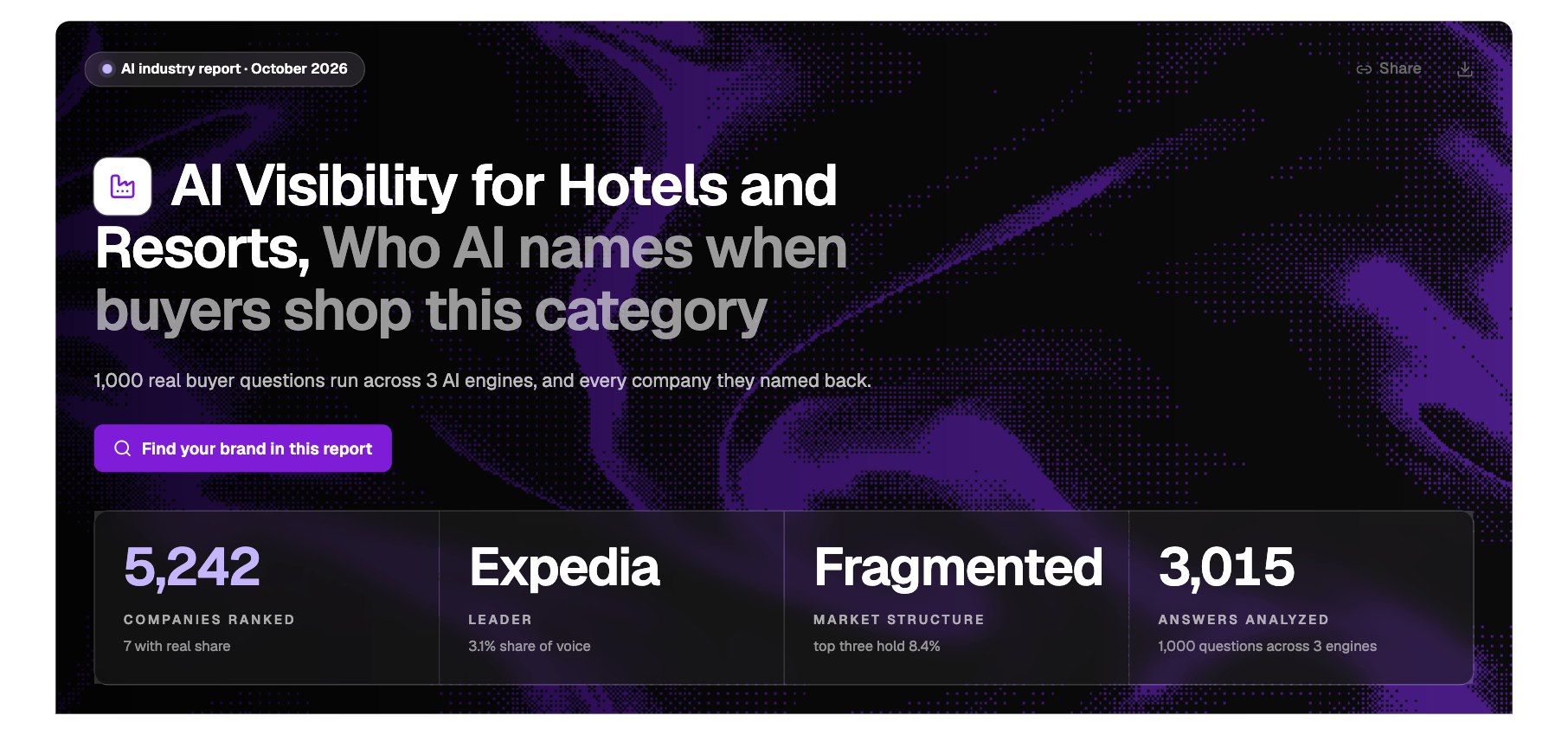
For every property outside the seven names the report counts as real contenders, it was the second one, and the reason is stranger than a rigged game. When Zen Media ran 1,000 real traveler questions through ChatGPT, Gemini, and Grok and analyzed the 3,015 answers that came back, the assistants named 5,242 distinct companies, and no one controlled the conversation. The leader across every answer is Expedia, a booking platform, at 3.1% share of voice. The top three names together hold 8.4%. Of the 5,242 companies named at all, 3,581 were named exactly once and never again.
The pattern I keep seeing in hospitality marketing is that visibility gets treated as an OTA-placement and ad-spend problem when it has become an answer-layer problem, and the answer layer is sitting there unclaimed. AI visibility for hotels and resorts is the layer that decides which properties a traveler even considers, and right now it runs on evidence nobody has bothered to supply. Here is what the data shows, and what it takes to get your property named.
How AI Builds the Hotel Shortlist Before Travelers Reach Your Booking Engine
AI visibility decides which hotels and resorts get named when a traveler asks an AI assistant for help, and it now happens upstream of your website and your OTA listings. When a guest asks ChatGPT which family resorts in Florida have real water parks, or asks Gemini for a wellness retreat within driving distance of Phoenix, the assistant returns a synthesized answer built from whatever evidence it can find. That answer is the new front door to a booking, and almost no property has measured its place in it.
The same idea goes by other names, LLM visibility, AI brand visibility, or AEO for hotels, and it now shapes how travelers discover and screen properties. This matters because trips start with research, and the research has moved. A growing share of travelers open an AI assistant before a search engine or an OTA when they plan a stay, and a single answer replaces an hour of tab-hopping across booking sites, review pages, and map views. The assistant weighs the evidence it has and hands back a filtered set of named properties and next steps. Whoever is missing from that set never enters the consideration, no matter how strong the property’s product is.
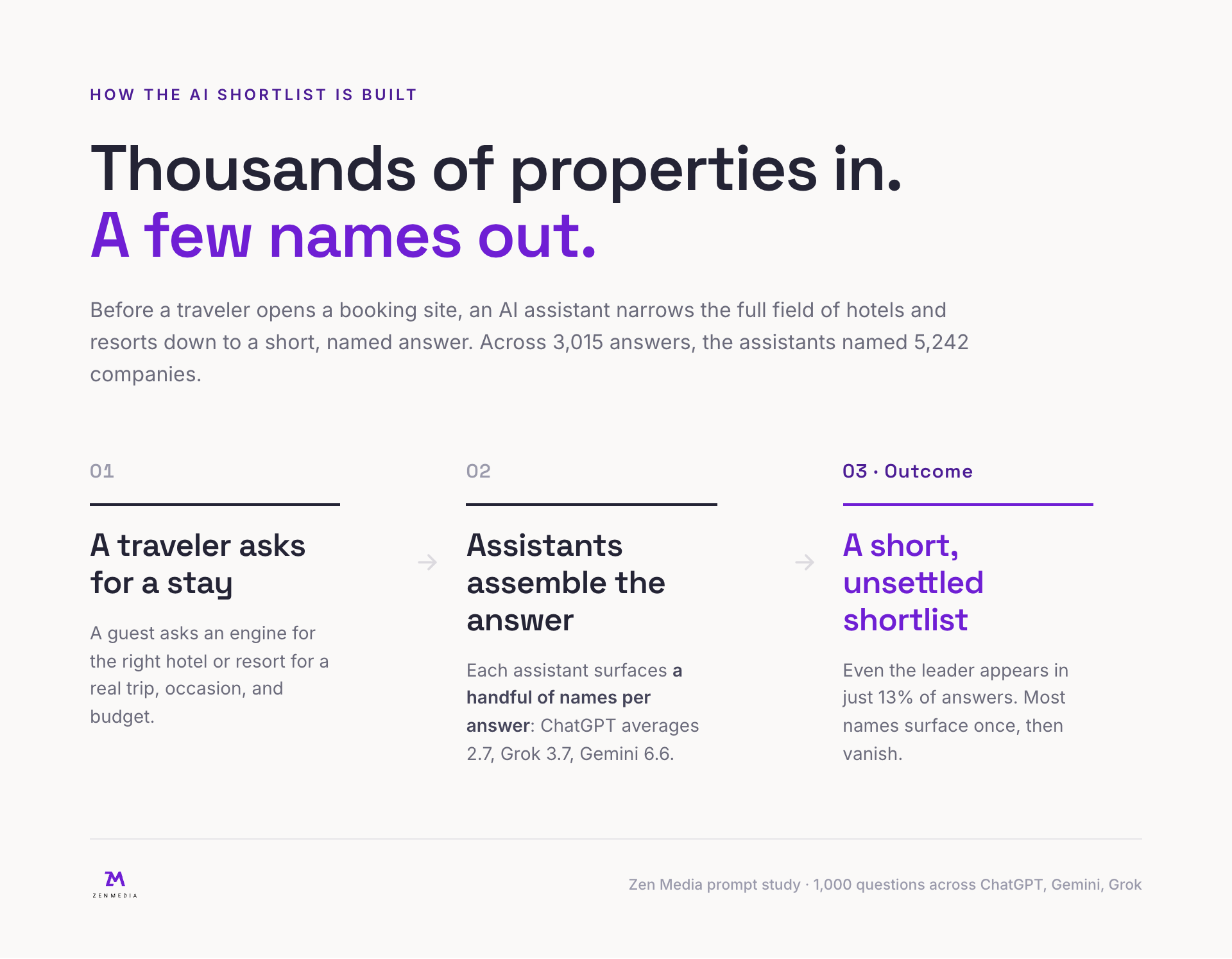
Zen Media set out to measure this layer directly for hospitality. The study ran 1,000 questions written the way real travelers phrase them, spanning nine territories of the decision, from a family comparing beach resorts and a road warrior weighing loyalty value to a bride sourcing a wedding block and a guest checking resort fees. Each question ran across ChatGPT, Gemini, and Grok, producing 3,015 answers that named 5,242 distinct companies across the U.S. market, collected as a snapshot on October 28, 2026. The numbers below come from that dataset, published in full as Zen Media’s AI visibility report for hotels and resorts.
Why No Single Brand Owns the Hotel Answer Layer
The hotel answer layer is fragmented to a degree almost no other marketing channel is. Expedia leads the entire category with 3.1% share of voice, reaching 13.4% of answers, followed by Marriott at 2.8% and Hilton at 2.6%. Hyatt sits at 1.5%, with Airbnb at 1.4%, VRBO at 1.3%, and IHG at 1.1%. The top ten names combined hold 16% of all mentions, and 3,581 of the 5,242 companies named appeared exactly once. The first thing the leaderboard tells a hotel marketer is that the leader is a booking platform, and no hotel brand owns the hotel answer.
Share of voice across all hotel answers
Share of every company mention across 3,015 AI answers
Caption: the top three names together hold 8.4% of mentions, and 3,581 companies were named exactly once. Zen Media prompt study.
Fragmentation this deep cuts two ways. For the chains, it means the brand equity that dominates search results and loyalty databases buys far less here: Marriott’s multi-brand portfolio earns it 2.8% of the conversation. For every other property, it means the race has not been run. Share of voice sums to 100 across the field, so one name rising means another falling, and right now the names rising need very little evidence to move, because the assistants are working from almost none. The report’s own summary puts it plainly: “The conversation is spread thin across many names. Nobody has been established as the answer.”
What Travelers Ask AI When They Are Choosing a Hotel
Travelers come to AI at the decision point. Of the 3,015 answers in the dataset, 1,230 responded to direct buy-intent questions, 41% of the total, with comparison at 20%, informational at 20%, and problem-solving and best-practices questions making up the rest. That buy weight is the tell. A family comparing two named beach resorts for spring break is days from a deposit, and the property that surfaces in that comparison has an enormous advantage.
Question intent across 3,015 hotel answers
Answers by question type
Caption: buy and comparison questions together drive 61% of answers. Zen Media prompt study.
The questions themselves read like a traveler thinking out loud. These four are representative examples in the style of the dataset, each tagged to one of the study’s highest-volume personas, and each one an answer where a named property wins or loses a booking.
The spread of who is asking runs wider than any hotel marketing persona deck. Business travelers drove 111 answers and family vacation planners 102, followed by leisure travelers at 96 and budget travelers at 93, but the long tail is the story: family reunion organizers, group trip organizers, wedding planners, dog owners, travelers with disabilities, solo wellness travelers, and dozens more, each asking in their own language. A single generic property-overview page cannot surface across that spread, which is why the territory structure in Part 3 is a sharper targeting unit than any single keyword.
Getting Listed and Getting Recommended Are Two Different Races
The report separates two numbers a hotel marketer should never blend: reach, the share of answers that name a company, and conviction, how strongly those answers push it, where a top pick counts fully and a passing mention barely counts. Plotting 40 companies on those two axes shows the category’s defining imbalance: only 2 companies sit above average on both measures, and average reach across the field is just 3%. The brands everyone can name get listed; the properties nobody expects get recommended.
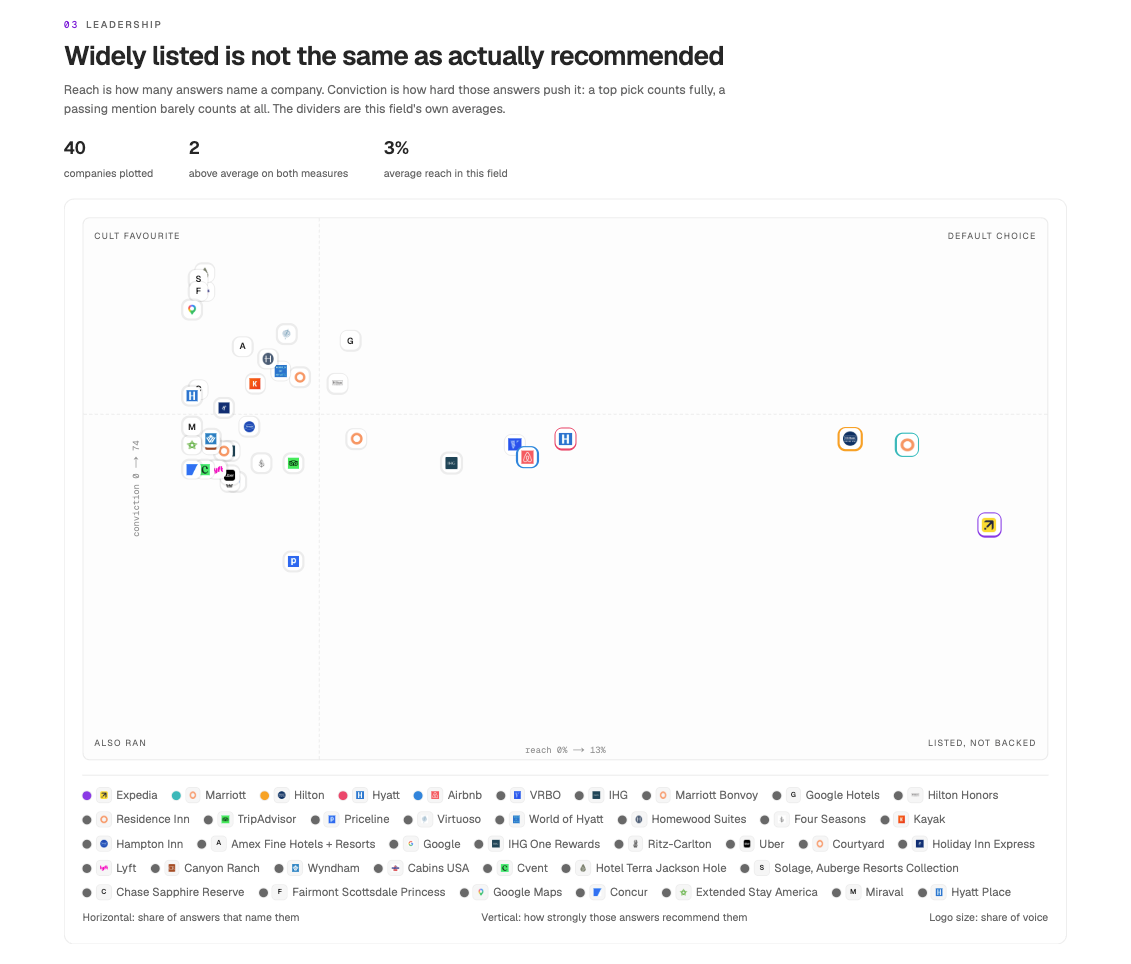
Read the corners and the strategy writes itself. Expedia holds the field’s best reach at 13.4% but a conviction score of 33, and Priceline sits at 27: the assistants list them constantly and recommend them weakly, the way an answer mentions a booking tool. Now look at the opposite corner. Hotel Terra Jackson Hole carries a conviction of 74, Cabins USA 71, Solage 73, and Fairmont Scottsdale Princess 71: when the assistants name them, it is as a top pick, with language a traveler acts on. Google Hotels at 63 and Virtuoso at 64 show the same pattern among platforms. For an independent property, this is the realistic prize. You will not out-reach Marriott this year, and you do not need to: you need the assistants to recommend you with conviction on the questions you deserve to win, and the data shows small, sharply defined properties already earning exactly that.


The Language AI Uses in Hotel and Resort Answers
The assistants answer hotel questions in a measurable vocabulary, and owning a term means being the brand an answer associates with it. Free breakfast appeared 99 times across the answers, tied closest to Amex Fine Hotels + Resorts, late checkout 90 times to Marriott Bonvoy, and room upgrades 87 times to Virtuoso. The pattern runs through the whole list: the terms are operational amenity and policy facts, and the brands that own them are the ones that publish them as concrete benefits a traveler can hold them to.
The category’s vocabulary, and who owns each term
Times used across 3,015 answers · closest brand association
Caption: Best Rate Guarantee, member rates, room blocks, free parking, and kitchenettes fill out the top of the list. Zen Media prompt study.
This list is a content brief hiding in a dataset, the raw material of generative engine optimization for a hotel. Every term the assistants reach for, free breakfast, late checkout, room blocks, free parking, kitchenettes, member rates, is a fact a property either publishes in extractable form or leaves to a competitor. The ownership column is the sharper lesson: a credit-card travel program owns “free breakfast” and a travel-advisor network owns “room upgrades,” because those organizations state the benefit as a guarantee. A property that writes complimentary hot breakfast for every rate, 4 p.m. late checkout for direct bookings, and measured 200 Mbps Wi-Fi in every room is speaking the exact language the answers are built from.
Where AI Pulls Its Evidence for Hotel Answers
Here is the number that should change a hotel PR plan: across 3,015 answers, the assistants logged just 59 citations, and only two domains, google.com and resortfeechecker.com, were cited more than once. Everything else appeared a single time: property websites such as enchantmentresort.com, canyonranch.com, and aman.com, government pages including ada.gov and state attorney general sites, destination tourism sites like explorebranson.com, booking platforms, and niche tools such as BringFido for pet travel. The citation layer behind hotel answers is close to empty, and no publisher owns it.
An empty citation layer is an open door. In categories where AI answers lean on entrenched sources, a brand has to earn its way into someone else’s database; in hospitality, the assistants are already citing individual property websites directly, which means a hotel’s own accessibility page, fee page, or wedding-block page can become the source an answer stands on. The report’s source breakdown makes the same point from the other side: 80% of citations fall outside both institutional and competitor content, scattered across exactly the kinds of pages a property and its PR team can create or earn, destination guides, specialty directories, and the property’s own domain. This is where public relations and answer-engine strategy converge, and our walkthrough of how answer engine optimization works covers the mechanics behind it.
AI Visibility Across Nine Hotel Question Territories
Visibility does not work the same way across the market, so AI visibility measurement has to run per question territory. The study split its 1,000 questions across nine of them, and the strongest hold anywhere is Expedia’s 6.8% share of voice on fee, policy, and accessibility questions, with its 6.1% among value and loyalty bookers behind it. Marriott leads business and bleisure at 5%, VRBO leads outdoor and national park travel at 4.9%, and the remaining territories, events, family and pet, luxury, and wellness, have leaders at roughly 3%, which is to say they have no leader at all.
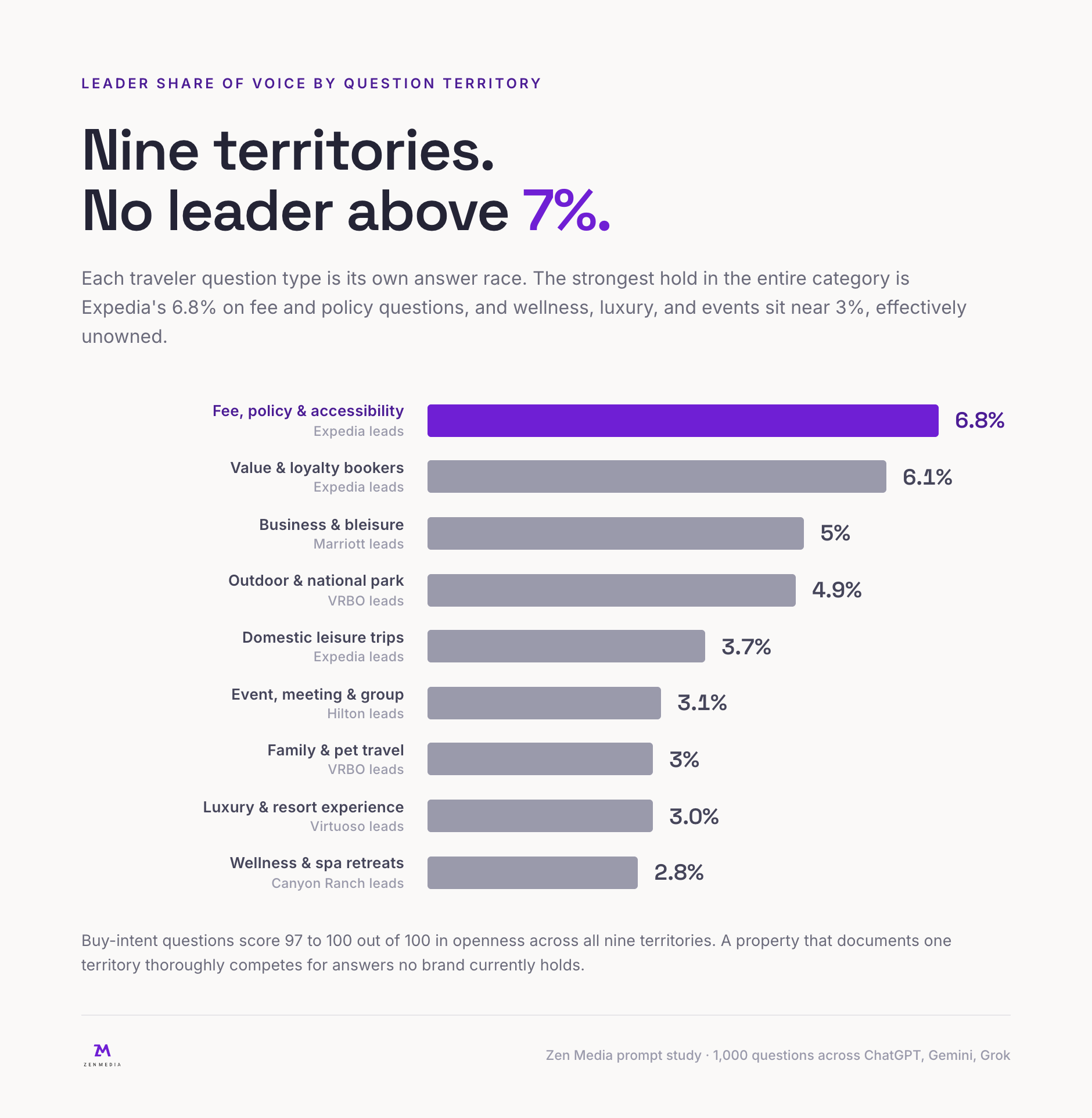
Two readings of that chart matter for a hotel. The first is who the leaders are: an OTA owns the policy questions about your property, vacation-rental platforms own family, pet, and outdoor trips, and a travel-advisor network leads luxury. Hotels lead only two of the nine territories. The second is how weak every hold is. Wellness, the report’s weakest leadership position, has Canyon Ranch at 2.8% across 634 companies; group and event planning is the most dispersed answer set in the study; and domestic leisure, the broadest territory at 944 companies named, has Expedia in front at just 3.7%. On buy-intent questions, openness scores run 97 to 100 out of 100 in every territory, and within the category map the same pattern repeats at the brand level: Enchantment Resort leads luxury-resort mentions at 3%, boutique mentions are led by Zero George at 3%, and ski mentions by Palisades Tahoe at 10%. Named leadership is available at every scale.

| Kind of company | Mentions | Leads it | Leader’s share |
|---|---|---|---|
| Hotel loyalty programs | 457 | Marriott Bonvoy | 17% |
| Hotel chains | 420 | Hilton | 25% |
| Luxury resorts | 362 | Enchantment Resort | 3% |
| Extended-stay hotels | 255 | Residence Inn | 13% |
| Online travel agencies | 180 | Expedia | 68% |
| Vacation rentals | 171 | VRBO | 43% |
| Wellness resorts | 112 | Canyon Ranch | 7% |
| Boutique hotels | 210 | Zero George | 3% |
How Each AI Assistant Behaves Toward Hotels and Resorts
The three assistants answer travel questions in three different styles, and they disagree about which brands deserve the answer by 11 points out of 100. ChatGPT is the selective one: it used 1,911 names at just 2.7 per answer, the tightest shortlist of the three, which makes a ChatGPT mention the hardest to earn and the most valuable to hold. Gemini is the expansive one, naming 3,386 companies at 6.6 per answer, and it is the only assistant whose leader is Marriott instead of Expedia. Grok sits between at 3.7 per answer and consistently rates the major brands higher than the other two, with ChatGPT rating them lowest.
| Assistant | How it answers | What to give it |
|---|---|---|
| ChatGPT | Tightest shortlists at 2.7 names per answer across 1,911 companies; rates the big brands lowest of the three. | Sharp occasion fit and claim-level facts that make you the obvious pick on a two-name shortlist. |
| Gemini | Widest field at 6.6 names per answer across 3,386 companies; the one assistant whose leader is Marriott. | A complete, consistent presence across your listings and profiles so you make its long lists reliably. |
| Grok | Middle density at 3.7 names per answer across 1,706 companies; rates major brands highest of the three. | Defensible differentiation and transparent pricing it can state as a confident top pick. |
The practical takeaway is that one strong asset will not carry you across all three. ChatGPT’s two-or-three-name answers reward the sharpest fit, Gemini’s long lists reward complete and consistent data, and Grok’s confident picks reward differentiation it can defend. The metric that ties them together is answer share, and our breakdown of answer share as a visibility-to-revenue metric explains how to track it per assistant, because an 11-point disagreement means your position on one tells you little about your position on the others.
AI Visibility vs Hotel SEO and Traditional Marketing
Properties already invest in hotel SEO, OTA placement, metasearch bids, and paid social, and that work keeps earning its budget. AI visibility is a different contest: a property can run polished hotel digital marketing and strong listings and still be absent from the AI answer that forms first. Traditional marketing competes for attention and clicks across a ranked list of links and listings you rent. AI visibility competes for a named place inside the synthesized answer itself, which forms before the traveler opens any of those channels, and it is measured in share of voice and conviction, the answer-layer counterparts of rankings and impressions.
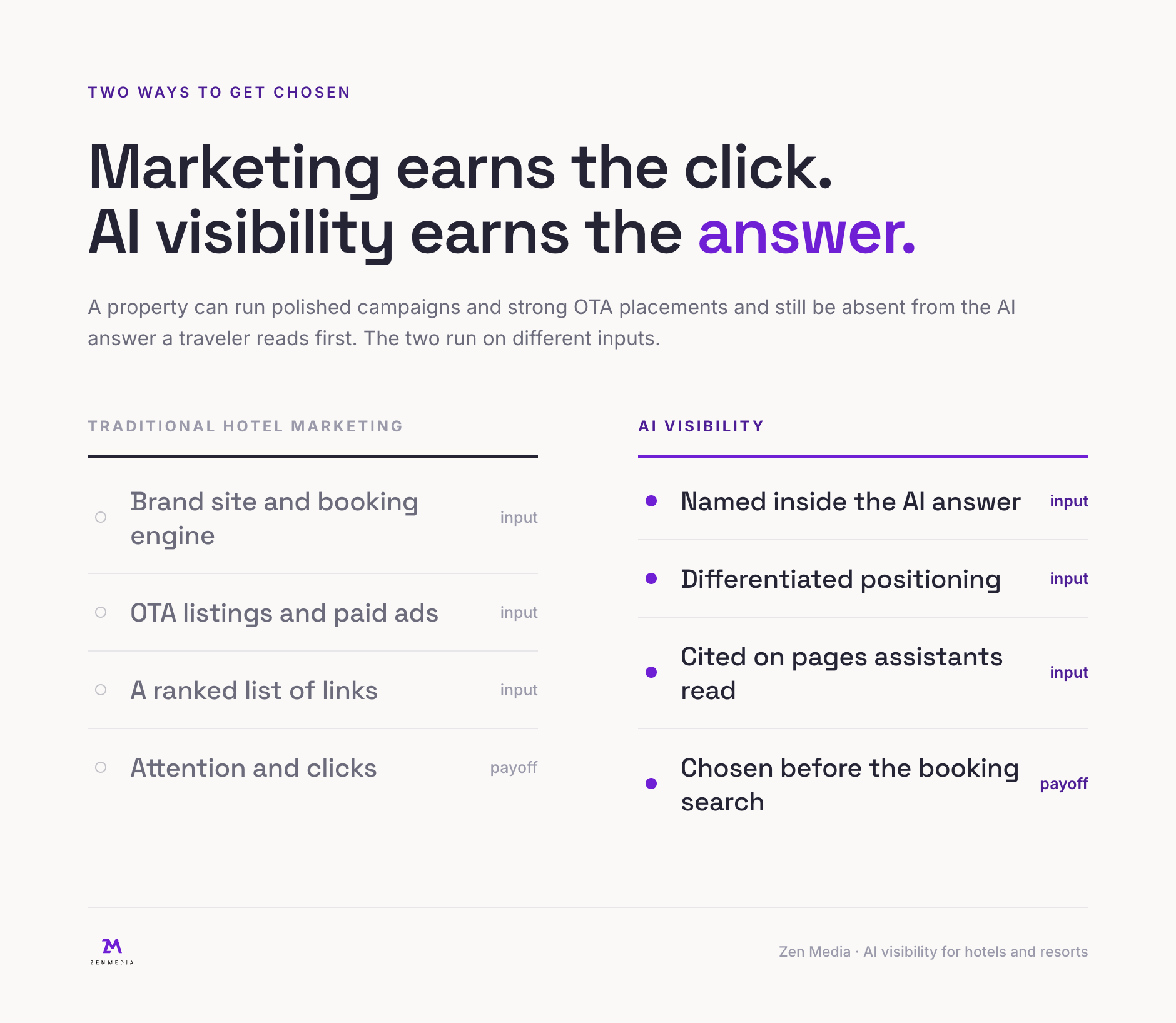
There is also a revenue distinction the data makes sharper than any commission debate. The assistants themselves have taken a side in direct bookings vs OTA value: they describe Marriott and Hilton around direct booking, loyalty points, and member rates, they note that Hilton Honors waives resort fees on full point-redemption stays, and they attach to Expedia the caution that it cannot issue a refund without the hotel’s explicit permission. The answer layer is predisposed to send loyalty-minded travelers direct, and a property only collects on that predisposition if it is named and its direct-booking benefits are published where an assistant can quote them. The two disciplines reinforce each other, because the structured, well-cited evidence that earns AI mentions is the same evidence that converts a comparison-shopping guest, and our guide to how AI crawlers shape brand visibility connects the content to the crawl.
The Disclosure Gaps That Cost Hotels AI Recommendations
The territory data exposes a finding that standard hotel-marketing checklists skip: the questions where travelers need operational facts, fees, policies, accessibility, are the questions an OTA currently answers for you. Expedia’s 6.8% hold on fee, policy, and accessibility questions is the strongest lead in the entire study, built on a cancellation filter and an accessibility filter, while the assistants cite ada.gov, state attorney general pages, and resortfeechecker.com to fill in what properties leave unstated. Every gap below is a question your front desk answers by phone every day, and an answer layer that cannot find the fact either hedges the recommendation or hands it to a platform.
The pattern across all four gaps is the same: the information travelers have to call to confirm is the information an assistant cannot verify, and an assistant that cannot verify either hedges or defers to a platform with a filter. Disclosure completeness is the cheapest AI visibility work a property can do, because it requires no new budget, only publishing the operational facts the property already knows.
The 5-Step AI Visibility Playbook for Hotels and Resorts
The climb from unmeasured to defended runs as a five-step sequence. The steps move a property from an unknown position in the answer layer to a measured, defended one, and they map directly to what the prompt data rewards. Start with measurement, because a change you cannot see is a change you cannot prove to a general manager or an ownership group.
Does this move bookings, or just mentions? The method has a track record. When Zen Media applied this same sequence for SpecialistID, a specialist B2B supplier that was absent from AI answers dominated by national giants, the company rebuilt its content around real buyer prompts, structured its evidence, and seeded validation on trusted sources. The mechanics that moved a specialist past far larger competitors are the same ones that move a focused property into an unclaimed territory, and the result panel below shows what that produced.
How to Measure Your Property’s AI Visibility
Visibility only becomes a program once it is a number, and this category hands you four. Share of voice is your slice of every company mention the assistants make; reach is the share of answers that name you at all; average position is where you land when named; and conviction is how strongly the answer pushes you, from a passing mention to a top pick. Build the prompt set the way guests ask, spanning your destination, occasions, and traveler types, run it across ChatGPT, Gemini, and Grok on a fixed schedule, and record all four. The metric that makes them comparable over time is answer share, and our guide to answer share as a visibility-to-revenue metric walks through how to calculate and report it.
Two measurement habits matter for a hotel specifically. First, read reach and conviction together, because the scatter data shows they diverge: a property listed often but recommended weakly has a different problem from one recommended strongly but rarely surfaced, and the fix is different content in each case. Second, measure by territory and season, since a resort can hold real share on wellness questions and none on the group-planning questions next door, and the prompt set you build is what makes those gaps visible before a competitor claims them.
AI Visibility Scorecard for Hotels and Resorts
Use this checklist to find your gaps before a competitor does. Each item maps to a signal the prompt data showed the assistants reward. If you cannot tick these boxes, you have found the reason a rival property keeps getting named in your destination.
The properties that will own the hospitality answer layer over the next few years are the ones treating a fragmented category as claimable ground. If you want the baseline done for you, Zen Media runs this analysis as a service; you can talk to our team about measuring where your property stands today. For how brands hold that position over time, see our guide on staying visible in the answer layer, and our look at AI visibility for private equity firms shows how the same playbook plays out in a concentrated category, the opposite market structure from this one.
Frequently Asked Questions
What is AI visibility for hotels and resorts?
AI visibility for hotels and resorts is how often, and how strongly, a property gets named when a traveler asks an AI assistant like ChatGPT, Gemini, or Grok to recommend a place to stay, compare options, or plan a trip. It is measured as share of voice, reach, and conviction across a large set of real traveler questions, by destination, occasion, and traveler type.
What is AEO for hotels?
AEO for hotels, answer engine optimization, is the work of earning a named place inside AI assistant answers: publishing the amenity, fee, policy, and accessibility facts assistants extract, building citable pages, and earning third-party coverage the engines trust. It extends hotel SEO from ranking a link to being the answer itself, and it is measured in answer share, the AI-era counterpart of rankings.
Who leads AI visibility in the hotel industry?
Nobody holds the category. Across 3,015 AI answers to 1,000 traveler questions, Expedia led with just 3.1% share of voice, followed by Marriott at 2.8% and Hilton at 2.6%, so the top three together hold 8.4% of mentions. The assistants named 5,242 companies, and 3,581 of them appeared exactly once. The leader is an OTA, and no hotel brand owns the answer.
How do I get my hotel recommended by ChatGPT?
ChatGPT names only 2.7 companies per hotel answer, the tightest shortlist of the three assistants, so it rewards sharp, verifiable fit. Publish claim-level facts for the occasions you serve, keep your own site citable since assistants cite property domains directly, state your direct-booking benefits, and earn third-party coverage. Then measure your appearance rate on the buyer questions that match your property.
How is AI visibility different from hotel SEO and traditional marketing?
Hotel SEO and hotel digital marketing earn a ranked link, a listing position, or a paid impression that a traveler still has to click. AI visibility earns a named place inside the synthesized answer itself, which forms before the traveler opens a booking site. It is measured in share of voice and conviction, the answer-layer counterparts of rankings, and it rewards published, extractable facts and citable third-party coverage.
Which AI assistants matter for hotel visibility?
The study ran ChatGPT, Gemini, and Grok, and they behave differently. ChatGPT gives the tightest answers at 2.7 names each, so a mention there is hardest to win. Gemini names 6.6 per answer across the widest field. Grok sits between at 3.7 and rates the major brands highest. They disagree about who matters by 11 points out of 100, so a property has to earn each one separately.
Can an independent or boutique hotel get named in AI answers?
Yes, and the data shows independents winning on conviction. Hotel Terra Jackson Hole scored 74 and Cabins USA 71, against 33 for Expedia, meaning when assistants name them it is as a top pick. Enchantment Resort leads luxury-resort mentions, Zero George leads boutique mentions, and Canyon Ranch leads the wellness territory. A sharply documented identity earns strong recommendations without chain scale.
What sources do AI assistants cite when recommending hotels?
Very few, which is the opportunity. The study logged just 59 citations across 3,015 answers, and only google.com and resortfeechecker.com appeared twice. The rest were cited once each: property websites like enchantmentresort.com and canyonranch.com, government pages like ada.gov and state attorney general sites, destination tourism sites, and niche tools like BringFido. A hotel’s own pages can be the source.
Does AI visibility help hotels win direct bookings?
It does, because the assistants themselves frame the trade-off in hotels’ favor. Marriott and Hilton are described around direct booking, loyalty points, and member rates, while Expedia carries the caution that it cannot issue a refund without the hotel’s permission. A property that is named in the answer, with its direct-booking benefits stated, captures the stay before an OTA search starts.
What information should a hotel publish for AI assistants?
The vocabulary the assistants already use. Free breakfast appeared 99 times in the study’s answers, late checkout 90, room upgrades 87, spa 72, full kitchens 52, Wi-Fi 48, and elite status 45, alongside pet policies, accessibility features, and resort fees. Publish each as a specific, extractable fact per room type and rate, because the consensus pattern is that assistants tell buyers to confirm exactly these details.
How do I measure my hotel’s AI visibility?
Build a representative set of traveler questions across your destination, occasions, and guest types, run it across ChatGPT, Gemini, and Grok on a fixed schedule, and record four numbers: share of voice, the portion of all mentions you hold; reach, the share of answers that name you; average position; and conviction, how strongly you are recommended when named. That answer share is the baseline every initiative should move.
How long does it take to improve a hotel’s AI visibility?
Retrieval-grounded assistants such as Gemini can begin reflecting updated listings, fresh citable pages, and new coverage within four to eight weeks. Training-based models update on a longer cycle, so citation there builds over several months as third-party sources accumulate. Because the category is this fragmented, small evidence gains move share quickly, and snapshots should run quarterly, timed ahead of booking seasons.
About the author: Sarah Evans is Partner and Head of PR at Zen Media, a global B2B PR and marketing agency. With 23+ years in communications, she architects PR strategy, drives earned media initiatives, and helps brands navigate AI-driven visibility. She is a regular contributor to Entrepreneur and has been recognized as a top writer on business and tech.