Choosing a dentist starts with practical details. Patients check which practices accept their insurance, offer the treatment they need and have appointments that fit their schedule. AI assistants give them a way to compare those details while they narrow down their options.
Someone looking for a dentist in Houston might begin by asking which practices accept their insurance, then follow up about evening appointments or experience with a specific procedure. As the questions become more specific, AI answers can introduce practices the patient has never heard of and give them the information they need to decide which ones to contact.
For dental practices, those answers become another place where patients meet their names and judge their services. A practice’s website, directory profiles and other public information all shape how AI describes it. AI visibility for dentists measures how often practices appear when patients ask about dental care, and Zen Media analyzed 3,000 AI responses to show the organizations with the highest visibility, where dental practices appear in the ranking and what those findings mean for how patients find care.
The Top Dental Provider Records 2.8% Visibility
A practice owner who asks ChatGPT for a dentist in their own city may read a full answer without seeing their own name. In the ZAVI ranking, only two dental providers pass 1% visibility, Aspen Dental at rank 14 with 2.8% and Gentle Dental at rank 21 with 1.9%, and no local practice or individual dentist exceeds 0.4% across the national sample.
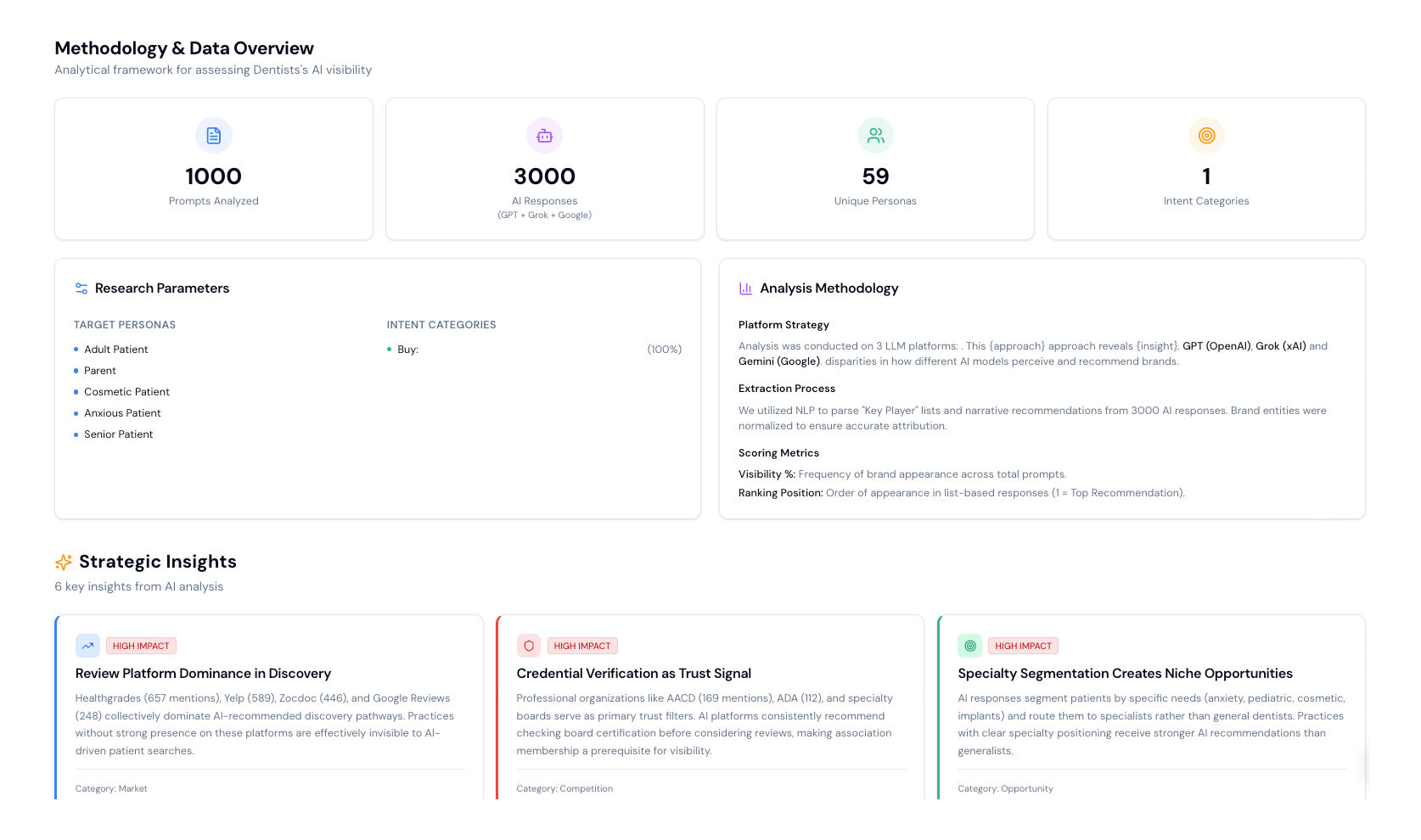
The November 2026 study ran on Zen Media’s ZAVI AI Visibility Engine and sent 1,000 patient prompts to ChatGPT, Grok and Gemini. Each engine answered every prompt, so the study produced 3,000 responses. The report ranks 101 names by visibility, the share of responses that name each one, and the scores count name mentions only. No company, practice or dentist knew about the study before the analysis.
Every prompt in the study asks for dental care in a named U.S. city. Chicago appears in 38 prompts, Houston in 32 and Miami in 30, while Newark appears in five. A practice in Miami has no reason to show up in a Chicago answer, so a 0.4% national score says little about how often AI names that practice at home. A practice therefore competes for AI visibility with the providers in its own city, on the questions patients there ask. Before those providers come into view, however, the patient meets a layer of platforms and organizations that rank above every dentist.
Review Platforms, Associations and Insurers Fill 30 of the Top 32 Ranks
Before patients call a dentist, they read reviews, confirm credentials and check whether their plan is accepted. AI answers point them to the places that hold that information. Healthgrades leads the ranking with 21.9% visibility, followed by Yelp at 19.6% and Zocdoc at 14.9%. Of the top 32 names, 30 belong to platforms, associations, insurers, financing companies or a treatment brand, and dental providers hold the other two ranks.
The wording of the prompts points the same way. Of the 1,000 prompts, 455 ask for the best, top-rated or highly rated dentist, such as “Which dental office in Columbus Ohio has the best reviews for crowns and bridges?” A question about quality needs a quality signal, and patient reviews give the engines one.
Each of these groups answers a different patient question, and each one keeps its own record of the practice. That record has to match the practice website, because the patient reads it first.
Where AI answers send patients before a practice
Each group keeps a record of the practice that patients check.
Professional associations and specialty boards form the largest group, with 11 names, one more than the review platforms. A similar pattern appeared in Zen Media’s research on AI visibility for plastic surgeons, where certification boards and review platforms filled the first 11 places.
Specialists Meet a Second Layer of Credentials
A patient looking for a periodontist or an orthodontist checks one more record than a patient who books a cleaning, the specialist’s own board or academy. Eight of the associations and boards in the top 32 cover a single specialty, starting with cosmetic dentistry at rank 9.
A specialist’s profile should name the training, board certification and academy memberships in the same words those organizations use, and a general practice that places implants or treats children can name that training too. Beyond this credential layer, the dental providers that reach the ranking are chains first, then lower-cost care.
Dental Schools and Health Centers Appear Before Private Practices
A patient without dental insurance who asks AI for affordable care in their city wants to know where they can be seen at a lower cost. The ranking reflects that question. After the two chains, Willamette Dental Group, a regional group, holds rank 33. Five dental school clinics follow at ranks 34 through 38, and five community health centers hold ranks 39 through 43. The first local private practice, Kids Dentistry of Houston, appears at rank 47, and the first individual dentist appears at rank 58.
Dental school clinics and community health centers typically offer reduced fees, and the prompt set includes 87 prompts from uninsured or budget-conscious patients. When a patient asks for affordable care, a provider known for reduced fees gives the engine an easy answer. A private practice that accepts Medicaid, offers a payment plan or works with a financing company can compete for the same questions once its website states those options plainly. Cost, however, is only one of the needs patients bring to AI.
Who Asks AI for a Dentist, and What Each Patient Needs to Read
A parent, an anxious adult and a patient with a cracked tooth ask AI very different questions. The study’s 1,000 prompts come from 59 patient types, led by adult patients with 307 prompts, parents with 139 and cosmetic patients with 99, followed by anxious patients with 57 and seniors with 53.
Each patient type brings its own detail into the question. Parents ask for a dentist who sees young children, anxious patients ask about sedation, and emergency patients ask who can see them the same day. Across the set, the prompts mention children 119 times, sedation or anxiety 53 times and emergencies 37 times, so these details sit at the center of the questions.
A practice page answers those questions only when it states the detail itself, such as the ages the practice treats, the sedation options it offers or its emergency hours. Those details also have to hold up on the platforms where patients check a practice, because the engines lean heavily on those platforms when they build an answer.
Why Review Platforms Shape What AI Says About a Practice
A practice can put months of work into its website and still reach a patient through a best-of list. A November 2026 Geotoolbox test shows how that happens. It tracked the pages the engines read before they answer. In 60 dentist answers in Phoenix, Charlotte and Minneapolis, ChatGPT drew 45 of its 97 source links from best-of lists and 27 from health directories and referral services. It cited a practice’s own website only twice.
Google AI Mode leaned on a different record. In the same test, 107 of its 132 references pointed to Google place listings, the profiles that carry a practice’s hours, photos and reviews. Reviews also track with AI mentions on their own. An August 2026 Insites analysis of 10,000 U.S. local businesses found that businesses named by both ChatGPT and Perplexity averaged 133 Google reviews, compared with 11 for businesses that neither platform named. Put together, the ranking and the source tests describe a path that passes several outside pages before it reaches the practice.
How to Improve AI Visibility for a Dental Practice
A practice builds AI visibility the same way it builds a reputation, with details that patients and engines can check. Start with the questions patients ask in your city, then fix what the answers get wrong, such as a missing insurance plan, an old address or a specialist credential that no profile mentions.
Answer engine optimization turns those fixes into a routine. It puts the information patients ask about on the practice website and on the profiles the engines already rely on, in a form the engines can find, read and repeat. The work runs in four steps, from a baseline of real patient questions to a monthly check of what changed.
Run the Questions Patients Ask in Your City
Write 20 to 30 patient questions that pair your city with a real need, such as a specific insurance plan, a child’s first visit, sedation for an anxious patient or a same-day emergency. Run each one in ChatGPT, Grok and Gemini without naming the practice, and save the full answers with the date. Use a fresh session outside any logged-in account, because saved chats, memory and location change what the engine returns. Each engine also needs its own record, since the Geotoolbox test found that ChatGPT and Google AI Mode built their answers from different sources. Record the practice and each dentist separately, along with the platforms, associations and competing practices the answers name.
The baseline then becomes a work list. An answer that names a competitor for Medicaid questions points to a missing insurance page, and an answer that repeats an old address points to a stale profile.
Put the Details Patients Ask About on the Practice Website
Each service page should state the details patients bring to AI, in page text that AI crawlers can reach. Check the site against this list.
Match Every Profile and Build Third-Party Coverage
Next, bring every outside record in line with the website. Update the Google Business Profile, the Healthgrades, Yelp and Zocdoc profiles, each association directory and each insurer’s provider directory, so a patient who checks any of them reads the same hours, plans and services. Steady patient reviews on those platforms add the third-party signal that the Insites data links to AI visibility.
Third-party coverage carries the record past directories. A dentist who explains a sedation protocol in a local health story, or answers insurance questions for a community publication, gives the engines another credible source about the practice. A physician-led hormone therapy clinic took the same approach with one Anchor Article and one AI Notice, and its results show how AI answers change once patient questions start naming the practice.
Repeat the Same Questions Every Month
In AI visibility tracking, one answer says little on its own, because the same question can name a practice one day and leave it out the next. Rerun the same questions on the same engines each month, and compare every round with the baseline, engine by engine.
Read past the name count as well. Check that each answer describes the right plans, hours and services, and note which sources it links, since those sources show what the engine relied on. Answer Share turns those monthly rounds into one trend line the practice can report on. Publishing on a steady schedule keeps the record the engines read current and consistent between those checks.
No dental practice owns these answers yet. The leading provider records 2.8%, and the profiles on the platforms ahead of it are records a practice can update. A practice that starts with its own city, its own patient questions and the same details on every profile has room to move ahead of the providers around it. Talk with the Zen Media team about building that baseline and the content and coverage that follow through Published Monthly.
Frequently Asked Questions About AI Visibility for Dentists
What is AI visibility for dentists?
AI visibility for dentists measures how often AI assistants such as ChatGPT, Grok and Gemini name a dental practice when patients ask for care. A study should state its questions, engines and response count, as Zen Media’s ZAVI report does with 1,000 prompts and 3,000 responses. Name appearances, description accuracy and source links each need their own record.
Why doesn’t my dental practice show up when patients ask ChatGPT for a dentist?
In Zen Media’s study of 3,000 AI responses, ChatGPT, Grok and Gemini named review platforms, dental associations and insurers far more often than dental practices, and only two of the top 32 names were dental providers. No local practice exceeded 0.4% visibility across the national sample, but every prompt named a specific city, so that figure does not show how often a practice appears in its own market. Testing the questions patients ask in the practice’s own city gives a clearer picture.
Which platforms do AI assistants mention when patients look for a dentist?
The websites an AI assistant mentions can change with the question, the city and the details a patient adds, but review platforms came first in Zen Media’s study. Healthgrades, Yelp and Zocdoc held the top three ranks with 21.9%, 19.6% and 14.9% visibility. These platforms let patients compare dentists and read reviews.
Do online reviews affect whether AI recommends a dental practice?
Yes, online reviews are linked to both a practice’s AI visibility and its reputation, because review platforms are third-party sources that sit outside the practice’s own website. In Zen Media’s study, review, search and social platforms filled 10 of the top 32 ranks, including all of the top three. In addition, an August 2026 Insites analysis of 10,000 U.S. local businesses found that businesses named by both ChatGPT and Perplexity averaged 133 Google reviews, compared with 11 for businesses that neither platform named.
How can a dental practice check if ChatGPT recommends it?
Ask ChatGPT the questions your patients ask, with your city and a specific need such as an insurance plan or evening hours, and leave the practice name out. Run each question a few times and repeat it in Grok and Gemini, since answers change between runs and between engines. Record whether the practice appears, how the answer describes it and which sources it links.
Does appearing in an AI answer establish a dentist’s quality?
No, a visibility score only records how often a name appears in a defined set of AI answers. It does not evaluate clinical quality, safety or whether a dentist suits a particular patient. A practice should check AI descriptions for factual accuracy and leave clinical judgment to qualified professionals.
About the author: Sarah Evans is CEO of Zen Media, a global B2B PR and marketing agency. With 23+ years in communications, she architects PR strategy, drives earned media initiatives, and helps brands navigate AI-driven visibility. She is a regular contributor to Entrepreneur and has been recognized as a top writer on business and tech.