I still hear founders describe digital PR as social media plus a press release, and that shorthand costs them the coverage they are paying for. So what is digital PR, exactly, once the buzzword gets stripped away?
It is the practice of earning attention across every online channel a story can travel through: press outlets, social platforms, video, live events, and influencer networks. Traditional PR built its reputation on the printed page and the evening news; digital PR does the same relationship-building work, then routes the result through channels that compound instead of expire.
The stakes changed again in the last few years. One Zen Media client went from largely invisible in AI Overviews to appearing in 72% of high-intent AI answers within 90 days, without adding a single backlink. Digital PR did not have to answer this question in 2019, when this guide first published: whether an AI assistant recommends the brand at all. Now it does.
Digital PR Earns Visibility Traditional PR Can’t Reach
Digital PR earns visibility traditional PR cannot reach because it works across channels a print placement or broadcast segment never touches: search results, social feeds, video platforms, and now AI-generated answers. A journalist’s article, an influencer’s post, and a founder’s LinkedIn thread all count as digital PR when the goal is the same: earning a third party’s attention instead of buying it.

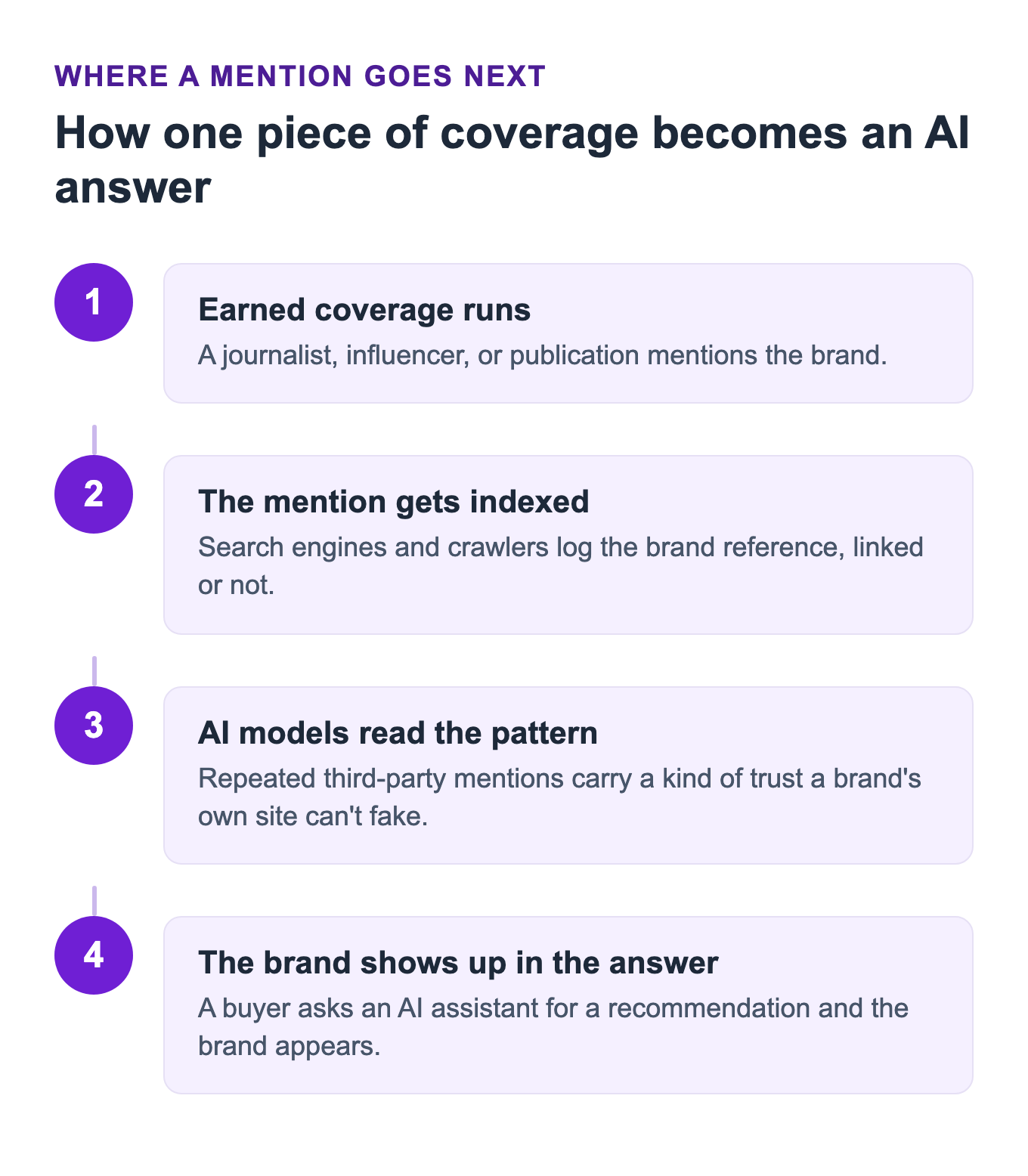
Search engines and AI models both read repeated brand mentions as a trust signal, even when the mention carries no hyperlink at all. Industry writers called this an implied link years before AI Overviews existed, and the concept only got more valuable once generative answers started citing sources instead of just ranking pages.
Digital PR and Link Building Solve Different Problems
Link building sets out to acquire backlinks, often through outreach built around the link itself: guest posts, resource-page pitches, broken-link swaps. Digital PR earns a story a journalist, creator, or industry publication would cover regardless of any link. A link is one possible outcome among several, alongside brand mentions, social shares, and interview requests a pure link-building campaign would never generate. Confusing the two leads teams to chase links from irrelevant sites instead of building the coverage AI models and readers trust.
The Six Types of Digital PR Work Worth Knowing
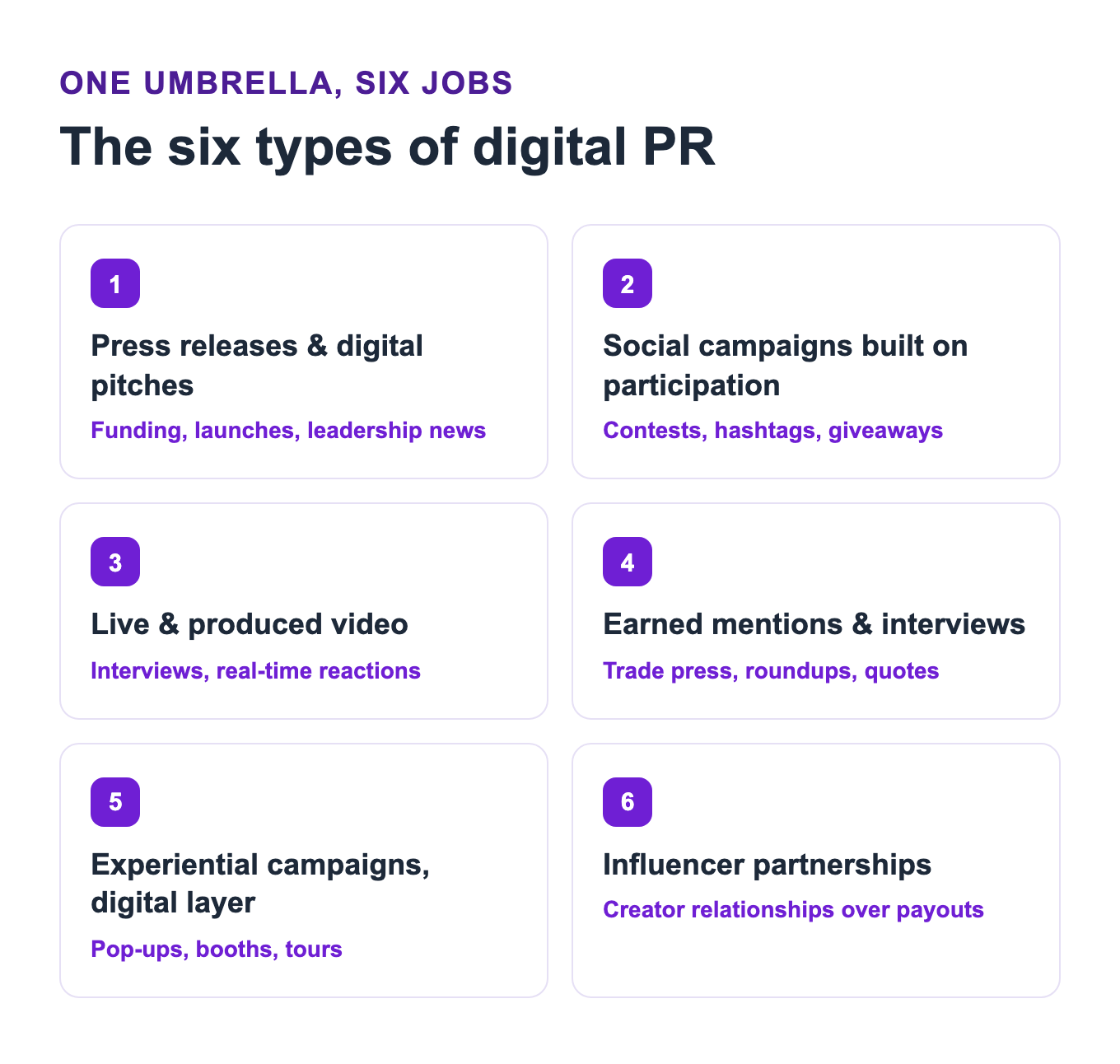
Six distinct activities fall under the digital PR umbrella, and treating them as interchangeable is why some campaigns underperform. Does a brand need all six running at once, or just the one or two that fit the story it has to tell? Each type below does a different job, and together they cover the bulk of what a modern earned-media program needs.
1. Press Releases and Digital Pitches
A press release distributed to online-only outlets still works when a company has something genuinely new to announce: funding, a product launch, a leadership change. What is different in digital PR is who gets pitched alongside the reporter. A niche blogger with 4,000 engaged readers in a specific vertical often converts better than a broad-audience journalist, and the pitch should treat both the same way: personalized, with a real reason to cover it, sent to a direct contact instead of a generic inbox.
2. Social Campaigns Built Around Participation
Contests, hashtag challenges, and giveaways that require a public mention turn an audience into free distribution. Every entry becomes a branded post amplifying reach the brand did not pay for directly, and Zen Media treats the resulting spike in unlinked mentions as real distribution, worth tracking the same way a media placement gets tracked.
3. Live and Produced Video
Live video and produced interviews let an audience watch leadership react in real time, which a press release cannot fake during a launch or a crisis. Zen Media used exactly this format for Navy Exchange, producing a short documentary-style video about a military family and distributing it across Navy social channels; a movie studio partnership later extended the story into a real homecoming event.
4. Earned Mentions and Interviews
Trade publications quoting a founder, or a roundup mentioning a product, build the same unlinked, credible, and durable reference this guide already covered. When Dippin’ Dots turned a viral Twitter jab into an open letter, brand mentions of the company jumped 8,000% in a single news cycle, the kind of spike no paid placement can buy.
5. Experiential Campaigns With a Digital Layer
Pop-ups, mobile consultations, and trade show booths only reach the people standing in front of them, until someone points a camera at it. Pairing the physical activation with a coordinated social push, a dedicated landing page, and press outreach turns a few hundred in-person visitors into a story an entire industry sees online.
6. Influencer Partnerships
Modern audiences discount brand copy and read creator recommendations instead, so outreach has to build a real relationship with the creator first. Elation Lighting’s product launch leaned on this directly, pitching industry influencers ahead of a trade show to earn organic shares from creators speaking to audiences that already trusted them. A personalized note explaining the mutual benefit converts more often than a flat payment offer for one post, and the relationship outlasts the single campaign it started from.
Turning These Tactics Into a Strategy
None of the six types above work in isolation forever. A press pitch without a follow-up video, or a viral moment without a plan to sustain it, burns attention instead of compounding it. Building a real program means sequencing tactics against a calendar instead of running them as isolated experiments.
A working digital PR calendar starts with four decisions:
The full framework for that calendar, positioning, target lists, campaign sequencing, measurement, lives in how to build a B2B PR strategy that earns tier-one coverage. Zen Media’s own operating system for coordinating these tactics across dozens of clients at once is detailed in Narrative OS, built because spreadsheets stopped scaling once a program passed three active narratives.
What Digital PR Costs in 2026
Most digital PR programs run $3,000 to $10,000 a month, with the market-average retainer landing at $5,458, according to BuzzStream’s 2026 survey of the industry. Agencies average $6,357 a month; independent consultants average $4,200. The gap mostly reflects bench depth and account management overhead.
How Digital PR Budgets Shifted in 2026
Year-over-year budget tier changes, BuzzStream survey
Caption: smaller budgets are shrinking, larger ones are growing. BuzzStream, 2026.
| Option | Typical Monthly Cost | Best Fit |
|---|---|---|
| In-house hire | 1 salary plus benefits | Daily, embedded execution |
| Freelance consultant | ~$4,200/mo average | Narrow scope, lean teams |
| Agency | ~$6,357/mo average | Multi-channel programs, bench depth |
Why Digital PR Now Decides AI Search Visibility
Ask ChatGPT, Claude, or Gemini for a recommendation and none of them have opinions of their own, because each cites what other people already said about a brand. Google now shows an AI Overview on 25.11% of searches, per Conductor’s July 2026 analysis of 21.9 million queries, and every one of those overviews names a brand without ever sending a click to its site.
What Predicts AI Overview Visibility
Correlation strength across 75,000 brands analyzed
Caption: brand mentions predict AI visibility roughly 3x more strongly than backlinks. Ahrefs, 2025.
“In 2026, brand reputation will be increasingly shaped not by what people search for, but by what AI answers.”
Melanie Klausner, EVP of Consumer, Havas Red, via PR Daily
Digital PR is how a brand supplies the mentions those models need without controlling the outlet, the wording, or the platform, which is precisely why it carries more weight than owned content ever could. Prompt visibility, tracking how often a brand appears across a fixed set of buyer questions, has become the measurement digital PR teams now report alongside impressions and placements. The crawling and indexing mechanics behind this are covered in how AI crawlers read a website, and the citation logic behind direct AI answers is the subject of Zen Media’s answer engine optimization guide.
AI search rerouted where discovery happens in the first place, a change covered end to end in the end of PR as we knew it.
Real Digital PR Campaign Examples
The clearest way to judge a digital PR tactic is by what it produced for a real company. Two Zen Media campaigns show the range: one built category authority for a fintech brand almost nobody was mentioning, the other turned two routine announcements into a measurable audience of 103 million.
For a broader survey of what separates a headline from a cultural moment, from participatory marketing to decades-long brand consistency, see 9 successful PR campaigns worth studying.
How to Choose a Digital PR Agency
The agency that wins the pitch meeting is not always the agency that fits the brand. Fit depends more on industry expertise and existing media relationships in the brand’s specific vertical than on the size of the client roster on the agency’s homepage.
A quick litmus test: ask for two or three case studies in the brand’s exact industry instead of a slide of impressive logos, then ask how the agency measures a campaign after the coverage runs. The full evaluation scorecard, covering industry expertise, crisis readiness, and a boutique-versus-large-firm comparison, is in the 14 best PR firms.
Some brands need a narrower mandate: visibility inside AI-generated answers specifically. That’s a distinct category from a general PR agency, covered in what an AI visibility agency does. For the broader vetting process, including five questions worth asking before any retainer starts, see the 7-step guide to outsourcing marketing.
A Digital PR Campaign Fails Before the Pitch Goes Out
Failure starts before the first pitch even sends, when a mass list stands in for a real relationship. BuzzStream’s 2026 survey of 150-plus digital PR professionals found 75% say the work has gotten harder this year, and the top reason, cited by 26.4% of respondents, is simply getting coverage in the first place. Newsroom layoffs are part of it: fewer reporters means more competition for the same attention.
Crises compress this entire timeline to hours instead of weeks. 10 ways to handle a PR crisis and the best crisis communication examples cover that scenario in depth. Executives fielding more interviews as coverage grows also benefit from formal media training before the first camera turns on, and the fuller case for treating digital PR as a standing budget line instead of a one-off project lives in why brands need digital PR in the first place.
Common Questions About Digital PR
What is digital PR in simple terms?
Digital PR is public relations conducted through online channels instead of exclusively print and broadcast: earning coverage in digital publications, social platforms, video, and influencer networks. It shares traditional PR’s goal of earning credible third-party attention, but every mention lives somewhere search engines and AI models can find and reuse it.
How is digital PR different from traditional PR?
Traditional PR centers on press conferences, print placements, and broadcast segments that reach a broad audience once. Digital PR uses the same relationship-building skills but targets online publications, bloggers, and creators directly, producing coverage that keeps generating search visibility and social shares long after the initial placement runs.
Is digital PR the same as link building?
No. Link building focuses narrowly on acquiring backlinks, often through outreach built around the link itself. Digital PR earns coverage because the story is genuinely newsworthy, and a link is one possible outcome among several, alongside brand mentions, social shares, and interview opportunities a pure link-building campaign would not pursue.
Does digital PR affect whether AI tools recommend a brand?
Yes. AI models cite earned, third-party coverage far more often than brand-owned content, and independent analysis of tens of thousands of brands found brand mentions correlate far more strongly with AI Overview visibility than backlinks do. A brand absent from press coverage and industry mentions is largely absent from AI-generated recommendations too.
How much does digital PR cost?
Most digital PR programs run $3,000 to $10,000 a month, with the market-average retainer around $5,458, though a single strong campaign can generate more equivalent advertising value than a full year of that spend. Agencies typically cost more than freelance consultants, reflecting bench depth and account management overhead.
How do you choose a digital PR agency?
Prioritize industry-specific case studies and existing media relationships over the size of an agency’s client roster or portfolio of logos. Ask how a prospective agency measures success after coverage runs, before agreeing to anything. A boutique specialist in the brand’s exact vertical often outperforms a large generalist firm on relevant placements.
How long does it take to see results from digital PR?
Early press pickups can appear within the first 30 to 60 days of a coordinated campaign, but search and AI visibility gains build over 90 days and beyond as mentions accumulate and get indexed. Programs measured only against day-30 results usually get cancelled before the compounding effect the strategy is built on has a chance to show up.
Ready to turn earned coverage into the kind of mention AI models keep citing? Talk to Zen Media’s PR team.
About the author: Sarah Evans is Partner and Head of PR at Zen Media, a global B2B PR and marketing agency. With 23+ years in communications, she architects PR strategy, drives earned media initiatives, and helps brands navigate AI-driven visibility. She is a regular contributor to Entrepreneur and has been recognized as a top writer on business and tech.