
Inside most enterprise communications teams, the stack is already crowded. Monitoring happens in one platform, drafting in another, approvals move through email, collaboration lives in chat, and distribution depends on whatever system comes next.
The trouble starts when one narrative has to move through all of them.
Most of the time, the breakdown does not arrive as a dramatic collapse. It builds in quieter ways. A press release sits in review for 72 hours while the market keeps moving. A manageable issue turns into a reputational problem because the right signal never reached the right person in time. Years of judgment, messaging context, and crisis experience disappear when a communications leader leaves because nothing in the surrounding system was built to hold onto them.
After six months of conversations with communications directors at more than 40 enterprise organizations, the pattern was hard to miss. Teams were surrounded by software yet still working inside conditions that made speed fragile, visibility incomplete, and accountability harder than it should have been. Each platform handled one part of the work, but the work itself never stayed whole for very long.
So we built NarrativeOS. This is the story of what we found, what we built, and what we learned.
TL;DR: In six months of interviews with communications directors at more than 40 enterprise companies, the same breakdown surfaced every time: teams running 8 to 12 disconnected tools, approvals happening over email with no SLA tracking, and critical brand signals buried in alert noise. The tools were never built to share data, and the seams between them are where brand reputation breaks down. NarrativeOS is an enterprise communications platform and operating system: a single system where content, approvals, signals, and analytics stay connected and where the rest of your stack plugs in. This post walks through what it does, how each part works, and the five lessons we learned building it.
4 Enterprise Communications Problems PR Teams Face
Those conversations surfaced four problems that came up in organization after organization.
1. Tool Fragmentation
Enterprise communications teams run a patchwork of purpose-built tools: one for media monitoring, one for writing, one for approvals, and another for distribution. None of them shares data. Every handoff between tools is a failure point. Nobody has a unified view of what is happening across their content, their channels, and their brand reputation at the same time.
2. Approval Paralysis
Enterprise content requires sign-off. But at most companies, the approval process is a black hole. Content goes in, time passes, and something eventually comes out. There is no visibility into where things are stuck, no enforcement of deadlines, and no escalation when a review is overdue. The news cycle does not wait for an email thread.
3. Signal Overload
Modern monitoring tools generate thousands of alerts. The one that matters, the one that will become a crisis if ignored, gets lost in the volume. Teams either ignore alerts entirely or spend hours manually triaging what a machine should handle automatically.
4. No Institutional Memory
When a senior PR director leaves, their context leaves with them. The playbooks, the relationships, and the history of how the company handled similar situations in the past. The next person starts from scratch. There is no record of what worked and what did not.
The tools were never built to work together because none of them were built around the way enterprise communications actually operates. Each one solves a specific problem while creating friction everywhere it connects with another tool. As a result, enterprise teams often look for more integrated operating models and documented playbooks that create continuity across workflows, decisions, and teams.
How NarrativeOS Works: One Platform for Enterprise PR
NarrativeOS is an operating system for enterprise communications. Most tools handle one task well and then break the moment the work has to move. NarrativeOS connects content creation, approval workflows, brand monitoring, and performance analytics into one system, then acts as the hub that the rest of the communications stack plugs into.
You can see the whole picture from the dashboard in a single view: which storylines are active, which assets are in production, what is still waiting for approval, and which signals need immediate attention. Instead of piecing that picture together across five different tools before a team standup, the team starts with clarity in one place.

But the dashboard is only the visible layer. The bigger improvement comes when content creation, approvals, monitoring, and analytics stop operating in separate systems and start working together inside the same workflow.
Storylines: Structured PR Content Workflows With Real-Time Status
In NarrativeOS, every piece of work starts as a storyline. It can be a campaign, an announcement, or any other communications initiative that needs to move through a clear process from draft to publication. Each one follows the same structured path: Draft, In Review, Approved, Published.
That structure gives the team immediate context. Every storyline has an owner, attached assets, a comment thread for feedback, and a visible record of when it was last updated. Instead of content disappearing into folders or scattered conversations, everything stays tied to a defined status so the team can quickly see what is moving forward and what is starting to stall.
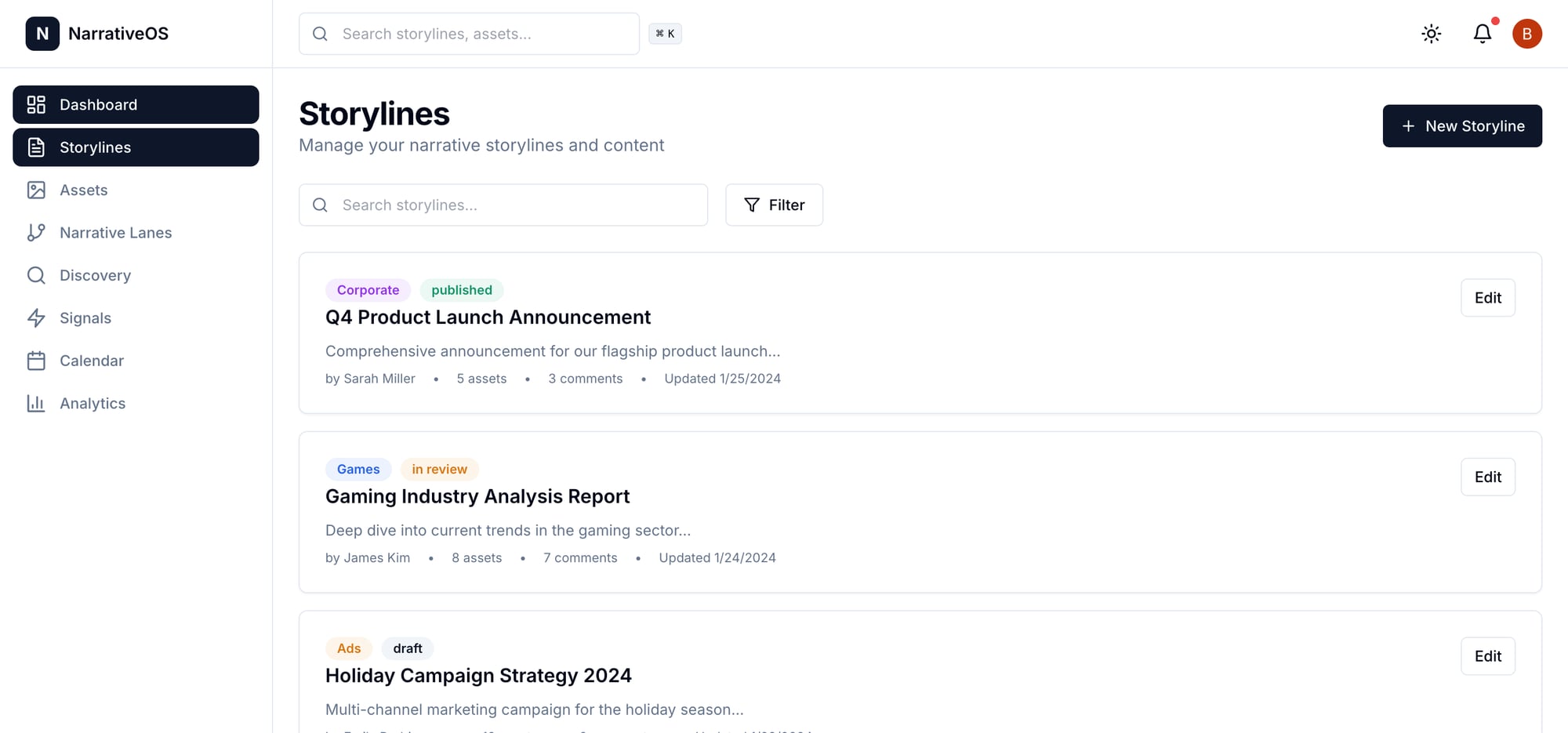
The workflow itself is intentionally simple. Draft is where the work takes shape. “Review” is where the right people weigh in; “approved” means it is ready to move, and “published” means it is live and being tracked.
That simplicity matters more than it sounds. Most content reviews do not break down because people are careless. They break down because visibility disappears. Reviewers lose track of what is waiting, when it needs a decision, and who else is part of the process.
PR Approval Workflow: Deadline Visibility for Faster Sign-Offs
NarrativeOS’s PR approval workflow gives every reviewer and approver real-time visibility into content status. The Pending Approvals panel shows every piece of content waiting for a decision, who submitted it, and when the deadline is. Overdue items are flagged automatically.
In most enterprise teams, approvals do not move through a clear system. A Google Doc gets shared in Slack, a reviewer is tagged, and the discussion gets buried inside an already busy thread. A few days later, someone asks whether the piece was approved, and no one can say for certain where the decision stands.
When everyone can see where a piece stands, who needs to act, and when a decision is due, the process moves very differently. Content that might otherwise sit in an email thread for three days can get reviewed in two hours simply because the deadline is clear and ownership is visible.
Brand Signal Intelligence: Prioritizing Critical PR Alerts Automatically
By the time a communications team notices a real problem, they are often already behind. The challenge is not getting alerts; it is knowing which one matters before everything starts piling up.
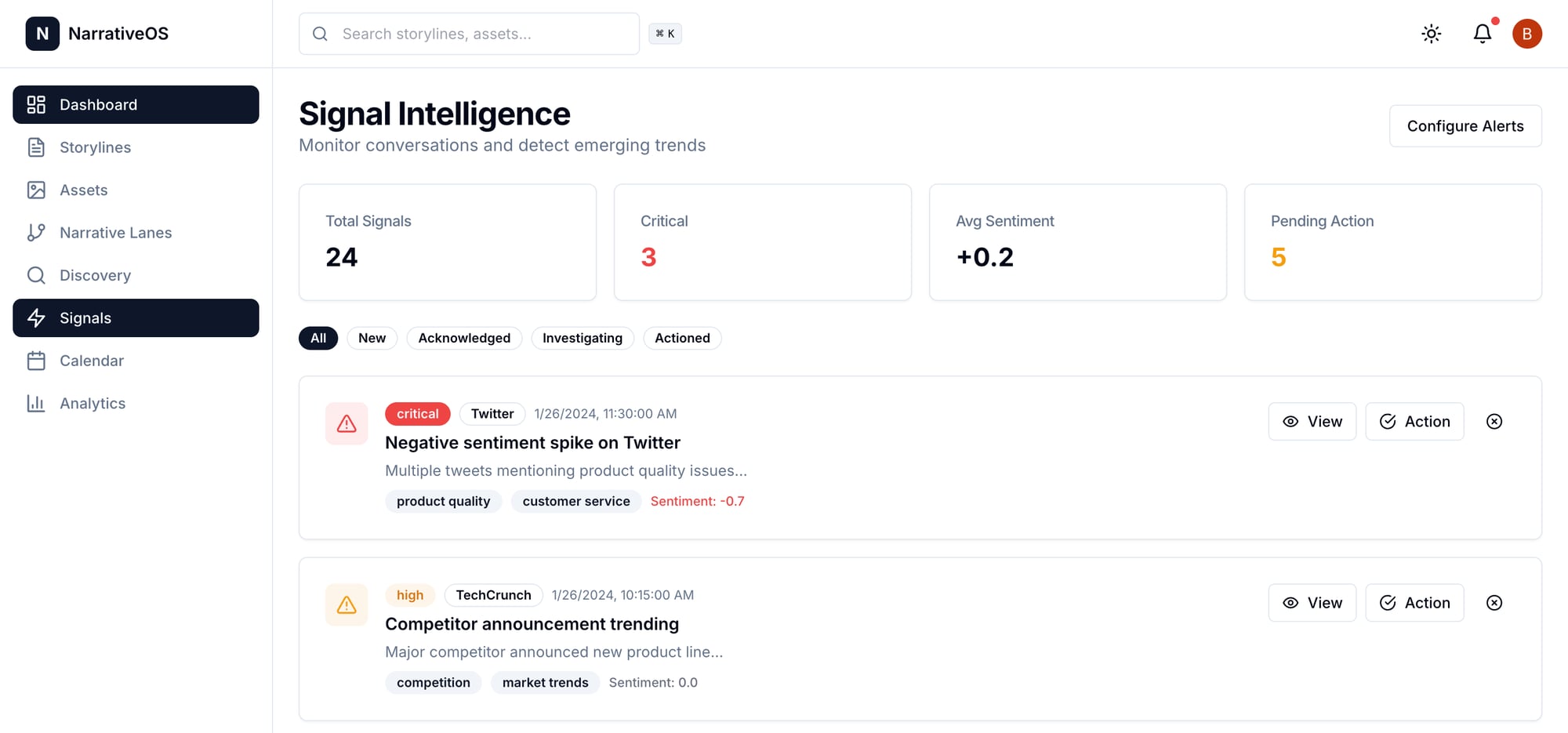
NarrativeOS monitors brand signals in real time across major platforms and publications, then tags each one by source, priority level, and sentiment. That context is what makes the stream usable. A negative spike on X from a verified source can be marked as critical, while a favorable mention in an industry report may register as low priority. The team does not have to sort through hundreds of notifications to figure out what deserves attention first, because the most urgent signal rises to the top.
Action happens in the same place. As soon as a signal appears, the team can assign a response, escalate it, or acknowledge it and move on. There is no need to bounce into another tool just to decide what happens next.
That changes the early minutes of a crisis. Instead of spending the first half hour trying to understand what is happening, the team can see the signal, understand its weight, and start responding within minutes.
Behind that prioritization is a scoring model built on five factors: how fast the signal is spreading, the sentiment around it, the authority of the source, its potential reach, and any escalation history tied to it. The combined score then maps the signal to a recommended path: ignore, monitor, respond, or escalate.
Narrative Lanes: How Enterprise PR Teams Organize Content at Scale
Narrative Lanes are how you organize storylines by category or business area. Out of the box, NarrativeOS comes with four: Games, Ads, Industry, and Corporate. You can add your own.
Each lane shows how many active storylines it contains. When you click into a lane, you see only the content that belongs there. A global brand with teams across multiple divisions can set up lanes by region, by product line, or by audience type. Everyone works on the same platform but sees the content that is relevant to them.

This approach sounds like basic organization, but the lack of it is one of the primary reasons content gets duplicated, reviewed twice by different teams, or published without the right people knowing it exists.
Brand Discovery: Finding Opportunities Before They Disappear
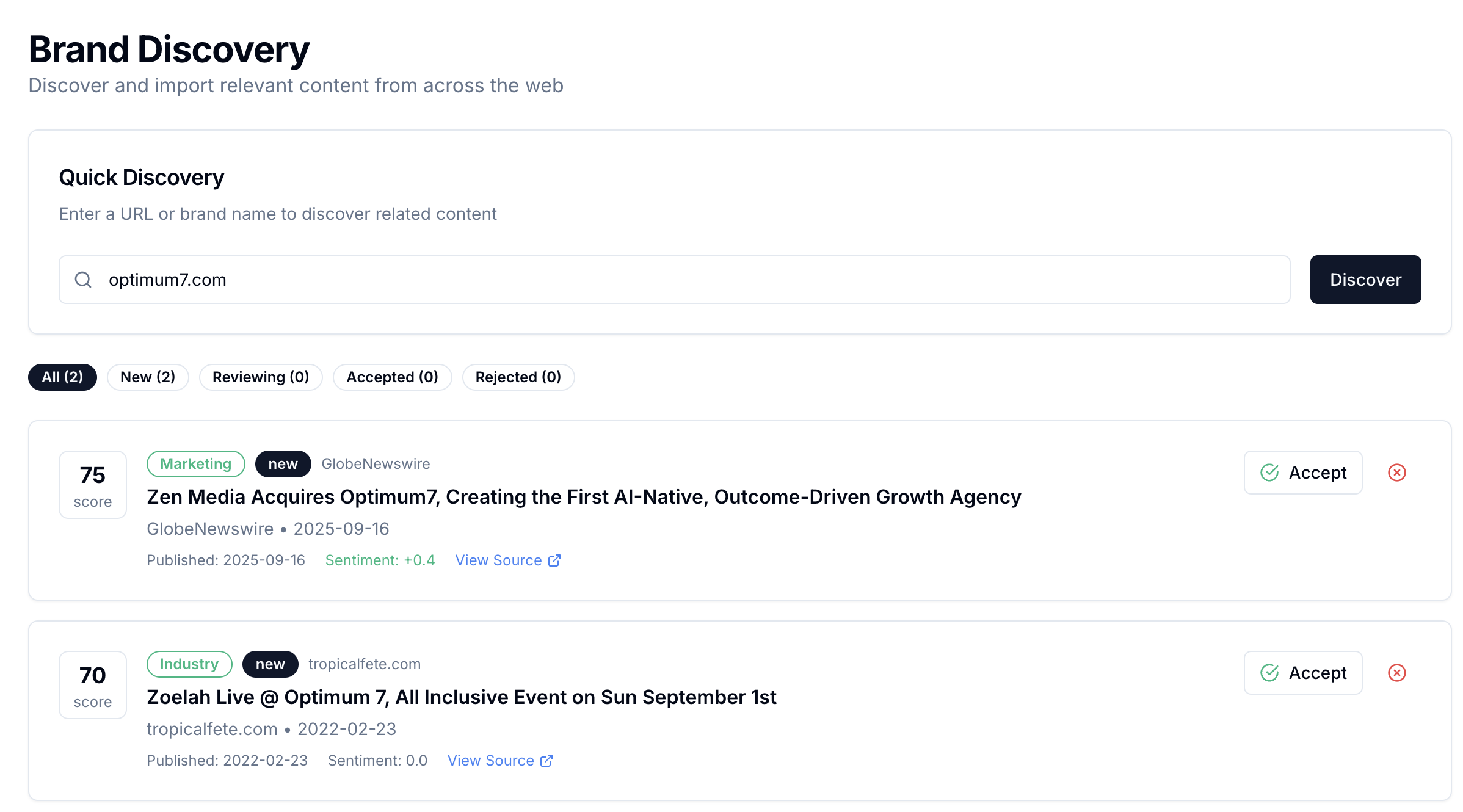
The Discovery section lets you enter a brand name or URL and pull related content from across the web.
That becomes useful the moment a PR team needs context fast. Before responding to a news story, drafting a statement, or publishing a reactive piece, they need to understand what is already circulating. Discovery gives them that starting point in seconds instead of forcing a manual search across multiple sources.
It is also valuable for competitive monitoring. A team can enter a competitor’s name and quickly see what content is gaining traction around them. If there is an active conversation where the brand has a credible reason to participate, Discovery helps surface it before the opportunity is gone.
Analytics: Measuring What Actually Moved
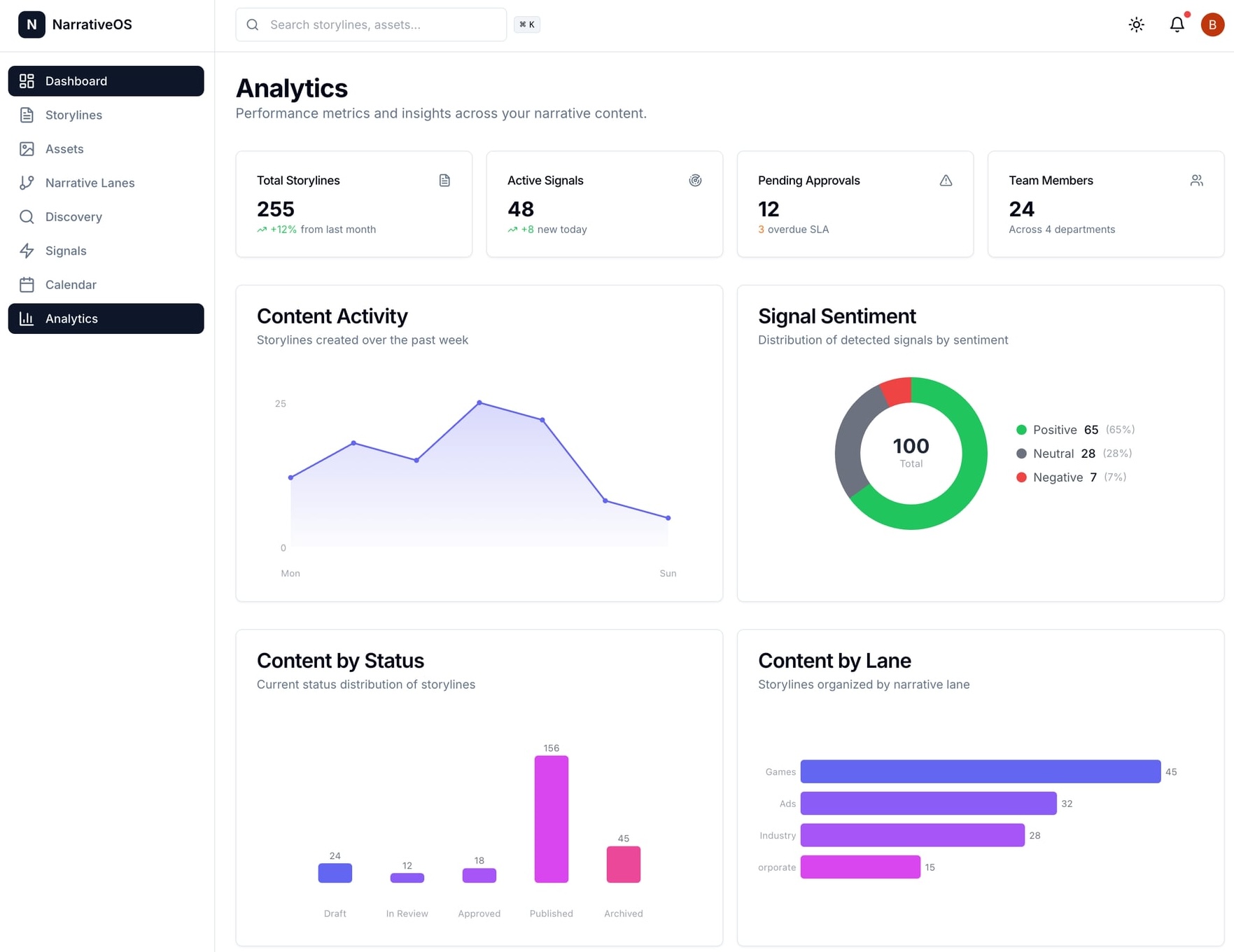
The Analytics section tracks content performance over time with four views: storylines created by week, signal sentiment distribution, content by status, and content by narrative lane.
The sentiment donut gives communications directors a single number for board reporting. At a glance: 65% of signals about your brand are positive, 28% are neutral, and 7% are negative. That is a number you can put in a slide deck. It is also a number that tells you whether your communications program is actually moving opinion in the right direction over time.
The content by status breakdown (Draft, In Review, Approved, Published, Archived) shows where your production pipeline is healthy and where it is bottlenecked. If 40% of your storylines are sitting in In Review for more than a week, that is a workflow problem, not a content problem.
Integrations: Connecting NarrativeOS to Your Existing PR Stack
Nobody on your team is going to rip out Slack or replace their CRM. NarrativeOS provides communications workflow automation that connects to your existing stack.
Every meaningful event in the system generates a webhook: a storyline published, a critical signal detected, an approval overdue, or a sentiment threshold crossed. Each event is signed, tracked, and retried automatically on failure. A Slack notification fires when a crisis signal is flagged. A CRM workflow triggers when a storyline moves to approved. A distribution tool receives published content without anyone manually moving it. After five consecutive failures, the webhook pauses automatically, and the owner gets notified, so a dead endpoint does not become a silent data gap. NarrativeOS does not ask your team to live inside it. It asks the rest of your stack to connect to it.
What Security Features Does Enterprise PR Software Need?
Enterprise procurement includes security questionnaires with hundreds of line items. NarrativeOS was built to answer those questions before they are asked.
Single sign-on. Every enterprise has an identity provider. Okta, Azure AD, Google Workspace, PingIdentity. NarrativeOS supports both SAML 2.0 and OpenID Connect, with pre-configured templates for major providers. When SSO enforcement is on, password login is completely blocked, with a break-glass bypass available for IT admins if the identity provider goes down.
Audit logging. Every action in NarrativeOS is logged. The user’s email and the content title are preserved even if the user later leaves the company or the content is deleted. When a CISO asks who made a change six months ago, the answer is in the log. Audit records are immutable, retained for a minimum of 90 days, and available for real-time SIEM streaming on Enterprise plans.
Session management. Users can see all active sessions: device, browser, IP address, and last active time. Sessions can be revoked individually or all at once. Timeouts are configurable per company. Sensitive actions require re-authentication.
Scoped API keys. External integrations get exactly the permissions they need. An integration that reads analytics cannot modify content. Keys are hashed immediately after generation and displayed only once.
Five Lessons We Learned Building Enterprise Software
1. Enterprise buyers evaluate configuration before they evaluate features.
Most enterprise buyers wanted to understand the same thing before anything else: how much control they would have once the system was in place. They asked about settings, permission structures, and whether the platform could reflect the way their organization was already set up. In many cases, those questions came before features, because if the system could not fit their structure, the feature set almost did not matter.
That changed how we built the product. It was not enough to make NarrativeOS useful on the surface. It also had to support the complexity underneath, the layers of control, structure, and configuration enterprise teams expect long before everyday users ever see them.
2. Audit everything from day one.
Comprehensive activity logging was added in the second month of building NarrativeOS. It should have been day one. Every “can you tell me who changed this” request is trivial with a proper audit trail and impossible without one. Log more than you think you need. Storage is cheap. Lost trust is not recoverable.
3. Permissions complexity grows with company size.
Role-based access control breaks down at enterprise scale. Assign a role and grant it permissions: simple in theory, but enterprise organizations operate under conditions. An editor might need to modify content in her lane but only view others, while a regional manager gets elevated publishing rights during a crisis, and a compliance team needs read-only access across all lanes, regardless of department. Roles alone cannot express that.
A 12-person startup can usually run on broad access and trust. A 400-person enterprise works differently. Permissions start to depend on region, ownership, and situation. Someone may need to view every lane, edit only the ones they own, and gain broader publishing rights only during a crisis.
4. Treat webhooks and integrations like core infrastructure.
Enterprise teams send data into Slack, trigger workflows in their CRM, and push approved content into distribution tools without handling each step manually. When those connections become part of the workflow, they stop feeling like secondary features. If they are fragile or poorly documented, they create more operational friction than value and often generate more support burden than not having them at all.
5. Enterprise-first design is not a feature you add later.
NarrativeOS was designed for enterprise from the first line of code. Every data query, every permission check, and every API response is scoped to the correct organization. There is no code path that can return data across tenants, because the architecture never allowed for one. Teams that try to add enterprise isolation later usually find it reaches much further than expected. It affects queries, APIs, background jobs, and UI components.
Frequently Asked Questions
What is NarrativeOS designed for?
NarrativeOS is enterprise PR software designed for communications teams that need structured approval workflows, unified brand monitoring, and narrative performance analytics in a single system.
How does crisis mode work?
When a critical signal is detected, the team activates a crisis response path from the Signals view. Approval SLAs are suspended, a designated lead can publish directly, and all actions are logged with crisis context for post-incident review.
What platforms does Signal Intelligence monitor?
X (Twitter), Reddit, TechCrunch, and Gartner by default. Additional sources are configurable based on industry and brand.
How does the permission system work for large teams?
NarrativeOS uses attribute-based access control. Permissions are set based on role, department, location, content status, and narrative lane. Rules can be layered without conflicts.
What does implementation look like?
Enterprise deployments typically complete in two to four weeks: SSO and user provisioning in week one, workflow and lane setup in week two, and integrations and go-live in weeks three and four. The Enterprise tier includes a 99.9% uptime SLA. Dedicated implementation support is provided throughout.
Can we use our own AI provider keys?
Yes. Enterprise customers can configure their own OpenAI, Anthropic, or Google API keys. AI calls route through their keys, their usage limits, and their cost center.
How does NarrativeOS handle compliance requirements?
For data residency, isolated instances keep EU data in the EU and US data in the US. For GDPR, personal data is deleted or anonymized within 30 days of a verified request, with a full export provided before deletion.
What Enterprise Teams Need Now
The conditions that make enterprise communications fragile are structural. When your stack is scattered, deadlines get harder to track, important signals get buried, and institutional knowledge leaves with every departing leader. None of these problems are impossible to solve, but the longer you wait, the more they begin to feed into each other.
NarrativeOS was built to close those gaps in one place: approval status visible to everyone, signals prioritized automatically, and institutional context embedded in the system itself. The teams using NarrativeOS today are protecting billions of dollars in brand value, and that kind of responsibility demands tools that can keep up.
See what your team can do when the whole system runs together. Inquire about this custom Narrative PR Operating System here.
About the author: Sarah Evans is a PR strategist and digital communications expert at Zen Media, specializing in B2B campaign development, earned media, and brand storytelling.