Here is the question I ask every B2B founder who tells me their PR is not working: when your best-fit buyer opens ChatGPT and asks it to recommend a vendor in your category, does your company come up? For a growing share of B2B purchases, that answer is decided before a buyer visits a single website, and earned coverage is what decides it.
That is the piece B2B PR advice still tends to miss. The mechanics of good public relations have held steady: earn trust, tell a sharp category story, get credible people to say credible things in credible places. The difference now is where that trust gets spent. A single earned placement reaches your buying committee through the reader who sees it and again through the model that cites it. This guide is built for that reality: it covers PR for B2B companies end to end and lays out a complete B2B PR strategy from foundations to measurement.
What Is B2B PR?
B2B public relations exists to make a company the obvious, credible choice inside a long and skeptical buying process. It works through earned attention: coverage in publications buyers read, commentary from executives buyers respect, analyst validation buyers cite internally, and citations inside the AI tools buyers use to build a shortlist. None of it is bought, which is precisely why it carries weight. A vendor claiming to lead a category convinces no one; a respected journalist or a neutral model saying it changes the shortlist.
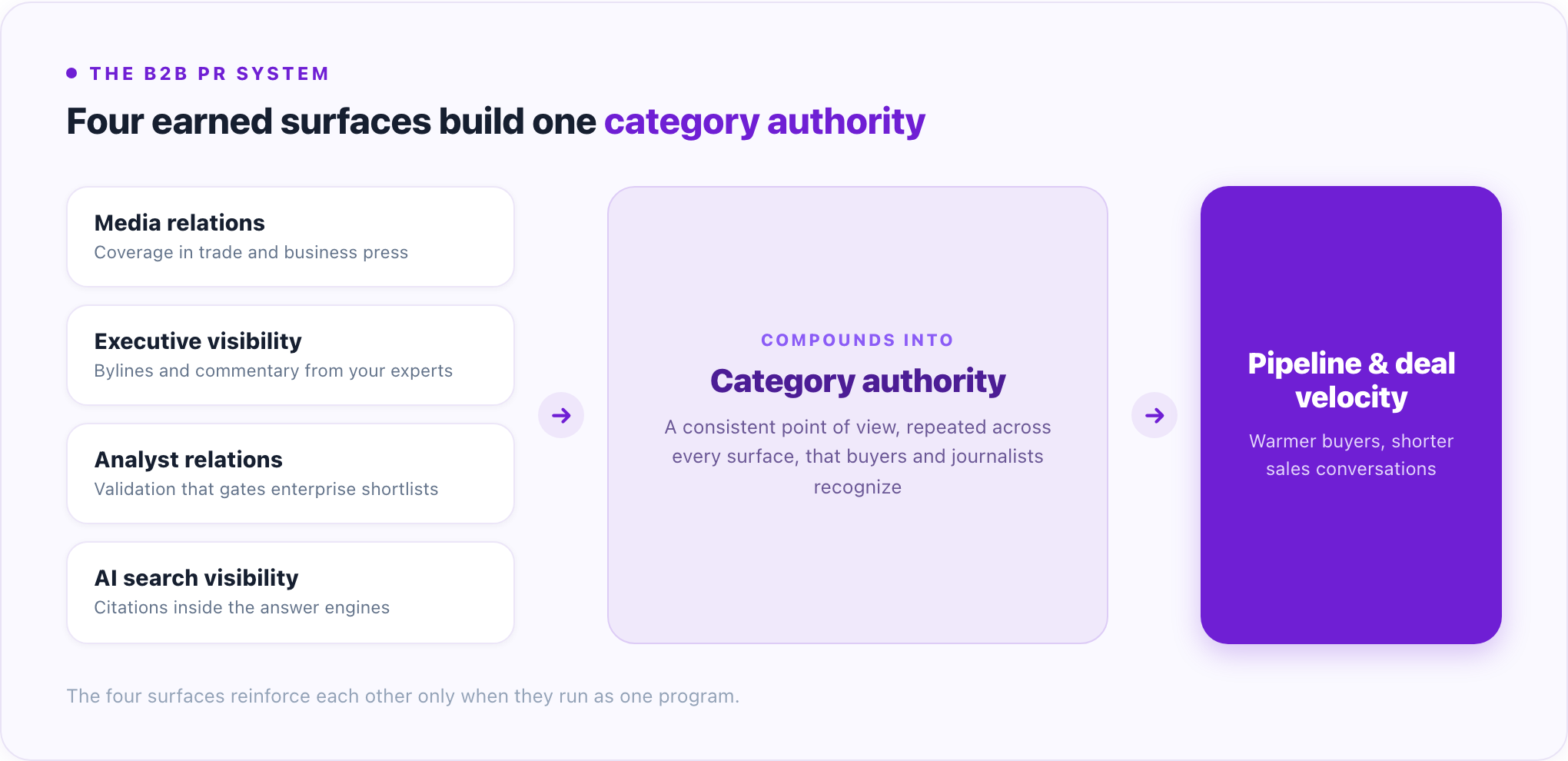
The audience is the reason the discipline looks different from consumer PR. B2B PR speaks to procurement leads, technical evaluators, finance approvers, and the executive sponsor, each of whom needs a different proof point before signing off. That is why earned media, executive visibility, analyst relations, and media relations all belong to a single strategy; run as separate campaigns, they stop reinforcing each other across the same long buying cycle.
How B2B PR Differs From B2C PR
The instinct to borrow consumer PR tactics is where B2B programs most often go wrong. Consumer PR optimizes for reach and speed; a great hit can move sales the same week. B2B PR optimizes for trust across a committee and a cycle measured in months, where the payoff is a shorter sales conversation and a warmer pipeline. The table below maps where the two diverge.
| Dimension | B2B PR | B2C PR |
|---|---|---|
| Audience | A buying group of five to 16 people in different roles | A broad individual consumer audience |
| Buying cycle | Months to over a year, multiple touchpoints | Minutes to days, often impulse |
| Trusted channels | Trade press, business media, analysts, LinkedIn, AI answers | Consumer press, lifestyle media, influencers |
| Message | Expertise, category authority, proof of outcomes | Emotion, brand affinity, lifestyle fit |
| Success metric | Pipeline influenced, share of voice, deal velocity | Reach, sales lift, sentiment |
One line in that table matters more than the rest: the trusted channels now include AI answers. A B2B PR strategy that treats generative engine visibility as a separate project has already split the work that buyers experience as one moment of discovery.
Reaching Buyers Before They Enter the Buying Cycle
The most expensive mistake in B2B PR is aiming everything at the small slice of buyers ready to purchase today. At any given moment, up to 95% of your potential B2B buyers are not in the market. They have no active vendor need, no budget line open, no shortlist forming. A program that only speaks to the 5% in-market is fighting over a sliver of demand while ceding the memory that decides tomorrow’s shortlist.
The 95-5 rule of B2B buying. Ehrenberg-Bass Institute (Prof. John Dawes), 2021. source
Earned media is the most efficient way to reach the 95%, because it reaches them where they already are and in a voice they already trust. A prospect who reads your VP quoted intelligently in a trade outlet twice a quarter for a year is not a lead yet. When budget opens, that prospect starts the process already believing you belong on the list. PR is how you get remembered before the buyer is ready to be sold to.
Mapping PR Coverage to the Buying Committee
A B2B purchase is a negotiation among people who rarely agree. Gartner’s 2026 buyer research puts the typical buying group at five to 16 people, each consulting an average of seven information sources, and 45% now use generative AI to research vendors and products before talking to anyone. A PR strategy that produces one story for one persona reaches one seat at a crowded table.
The fix is to map coverage to roles the way you would map content to a funnel. Each stakeholder reads different outlets and needs a different proof point, so the media plan should name the publication and the angle that lands with each one.
Building a B2B Category Narrative
Programs that earn tier-one coverage start with a category narrative, not a pitch list. A category narrative is the point of view your company owns about where the market is heading and why it matters now. It gives journalists a reason to call you the expert and gives every executive a consistent story to tell. Without it, PR is a series of unrelated announcements that no one strings into authority.
A durable narrative names a real market problem, stakes out a differentiated position on it, and gets repeated with discipline for a year or more. When Zen Media positioned Cheetah Digital as the definitive voice on zero-party data ahead of the cookie deprecation, the work was narrative before it was outreach: define the category, arm the executives, then earn the coverage that made the position stick.
The lift from third-tier trade coverage to the Wall Street Journal, Harvard Business Review, and Forbes did not come from a better pitch. It came from a category story consistent enough that top-tier editors saw Cheetah as the obvious source. For the deeper mechanics of owning a position like this, our guide to building B2B executive authority breaks down how to build the point of view first.
B2B PR for SaaS and Tech Companies
SaaS and technology PR carries an extra layer other categories skip: analyst relations. Enterprise buyers treat a mention in Gartner or Forrester as a gate before a vendor makes the shortlist, so a tech program briefs industry analysts on the same cadence it pitches journalists. The two reinforce each other, because a credible analyst position gives reporters a reason to take your category view seriously and gives buyers the third-party proof their procurement process demands.
The audience mix is the second difference. One tech company has to reach developers in specialist outlets, economic buyers in business media, and technical evaluators in the trade press, and each reads a different story. Product launches, funding rounds, and technical explainers all become PR moments, and they land only when the pitch is shaped for the reader on the other end. Inscribe’s Series B coverage worked because each pitch met a specific audience where it already paid attention. Our guide to digital PR covers how those channels connect for a technical brand.
Tech categories also move fast enough that the story itself needs upkeep. A position that was sharp a year ago can read as dated once the market catches up, so the strongest SaaS programs revisit their category narrative every few quarters and refresh the proof points behind it. Category creation, the move that turns an unknown product into a named market, is a multi-year PR effort measured in consistency, and it is where an outside team earns its keep.
B2B Media Relations in a Shrinking Press
Media relations is harder than it was five years ago for a structural reason: there are far fewer journalists to pitch. Since 2005, roughly 3,500 newspapers have closed and more than 270,000 news jobs have vanished, a loss of over 75% of the field, according to Northwestern’s Medill School. Fewer reporters cover more beats, which means every pitch competes against a fuller inbox and a thinner newsroom.
The takeaway is that relevance now decides everything in media relations. The reporters who remain are protective of their inboxes and their beats. Earning their attention means understanding what they cover, why their readers care, and how your expert makes their next story better. Volume pitching to a bought media list is the fastest way to get filtered out. Precise, useful, well-timed outreach is what still lands. The reporters who are left cover more beats than they did five years ago, so a pitch that hands them a ready angle, a credible source, and a clear reason their readers care is doing part of their job for them, and that is the outreach that earns a reply.
How to Pitch B2B Journalists at Tier-One Publications
The pitches that earn tier-one coverage connect to a story the journalist is already chasing. B2B reporters do not want your announcement; they want a sharper angle, a credible source, and a reason their readers should care today. Zen Media used exactly this approach for Inscribe, a technical fintech startup with no celebrity founder, aligning pitches to trending fraud and automation stories instead of product news.
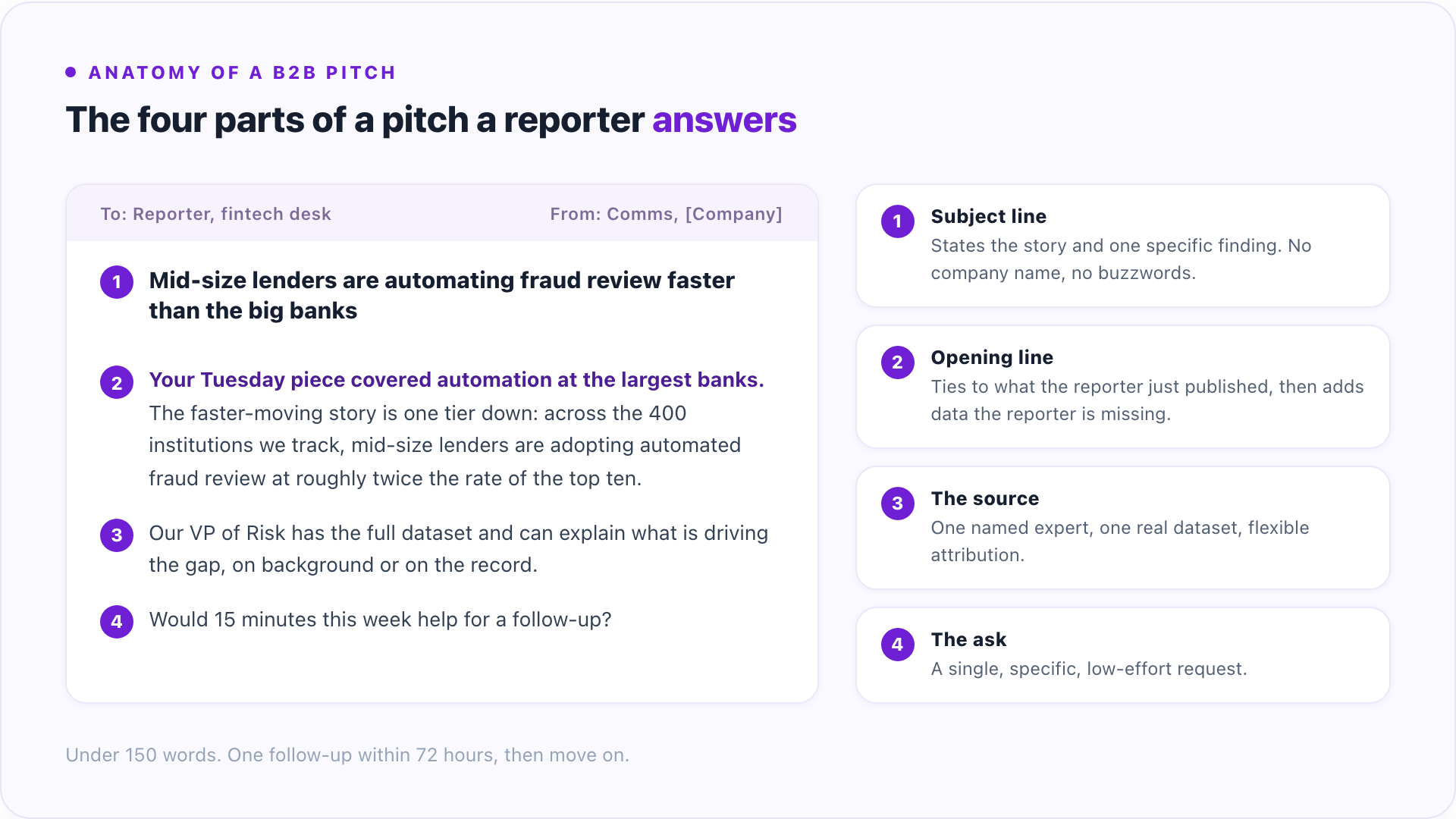
Aligning every pitch to a story the press was already chasing is exactly what turned a hard-to-pitch technical company into a widely covered one. For a closer look at the outreach errors that sink B2B programs, our breakdown of the most common B2B media pitching mistakes pairs well with the steps above.
Scaling Executive Visibility Across Your Team
Getting your experts published and quoted is the play that most changes how buyers evaluate you before a sales conversation starts. In the Edelman-LinkedIn research, 75% of decision-makers and C-suite executives said a single expert article led them to research a product they were not previously considering, and 70% said it made them question an existing supplier. That caliber of insight comes from your own experts, briefed and given a real point of view.
The programs that compound are the ones that scale beyond a single founder. When authority rests on one executive, a single point of failure limits the whole brand. Training three to five internal experts to publish and speak turns executive visibility into a durable engine, and it reaches every seat on the buying committee at once. Zen Media saw this directly with John Burns Real Estate Consulting, where the founder had a strong LinkedIn presence but the broader team did not.
The three-times lift in qualified leads came from training alone, with no paid media and no content produced on the team’s behalf. That is the quiet economics of executive visibility: it scales with people you already employ. Getting there safely takes preparation, which is why media training for spokespeople belongs in the plan before the first executive goes on the record.
Amplifying Earned Media Across Owned and Social Channels
Earning coverage is half the work; the return comes from what you do with it. A placement left on the publisher’s site reaches a fraction of its potential audience. Amplifying it across LinkedIn, executive profiles, owned channels, and sales outreach multiplies that reach several times over, and it is why 56% of PR professionals now rank LinkedIn as their most valuable platform for B2B communications.
Practical amplification is a repeatable sequence: the executive shares the piece with a personal take, the company account reposts with the key stat pulled out, sales sends it to open opportunities as proof, and the PR team pitches a follow-on angle to a second outlet. One article becomes weeks of presence with the committee. Our guide to share of voice measurement shows how to track your share of the conversation against competitors.
B2B PR in AI Search: How to Get Cited by Answer Engines
The biggest change to B2B PR in a decade is that your buyers now ask a machine first. In Forrester’s 2025 research, 94% of business buyers reported using AI in their buying process, up from 89% a year earlier, and a rising share now name generative and conversational search as their most meaningful source. When a buyer asks ChatGPT or Perplexity to name the leaders in your category, the answer is assembled from published sources, and your PR footprint decides if you appear at all.
Here is why this puts PR at the center of AI visibility: AI answer engines are built overwhelmingly from earned media. Muck Rack’s analysis of more than 25 million citations across ChatGPT, Claude, and Gemini found that earned media accounts for the vast majority of what these models cite, while paid and advertorial content barely registers. The coverage you earn is the raw material an AI uses to describe your market, which means a placement now works twice: once for the human reader, and again for the model that summarizes it.

The platforms do not behave identically, and a serious generative engine optimization plan accounts for the differences. The same Muck Rack analysis found ChatGPT cites sources in nearly every answer but leans on only a handful, while Gemini and Claude cite less often but pull from wider or more specialized pools. A brand that only optimizes for one engine is invisible in the others.
How often each AI engine cites sources
Share of answers that include citations, by platform
Citation frequency differs sharply by engine. Muck Rack, 2026.
The practical work is what Zen Media calls AI visibility: shaping the earned coverage, structured content, and third-party signals that make a brand the answer a model returns. When SpecialistID was absent from AI-generated recommendations while Amazon and Staples dominated, that gap was closable with a deliberate program.
A 72% AI Overview visibility rate on high-intent prompts in 90 days, and an 18% sales uplift from AI-originated visits, is what happens when PR and AI visibility run as one program. For the full framework, our B2B playbook for AI answer engines goes deep on the mechanics, and how AI search rewrote visibility and reputation covers what it means for the discipline.
How to Make B2B Coverage Citable by AI
Earning the coverage is step one; making it the kind of source a model will quote is step two. AI engines favor content with clear structure, specific numbers, and direct quotes from named experts, and they reward pages that answer a question cleanly. A placement built around a quotable stat and a sharp expert line gets pulled into answers far more often than a vague announcement does.
The SpecialistID program is the working template. Map the exact prompts your buyers type, rewrite your own pages in the language of those questions, add structured data and question-and-answer content, and seed the third-party sources models already trust. Pairing that groundwork with earned coverage is how a specialist brand displaced Amazon and Staples inside AI answers on high-intent queries.
None of this replaces media relations; it compounds it. The same placement that builds trust with a human reader becomes a signal the model learns from, so the work you already do to earn tier-one coverage is the work that earns AI citations. Brief your experts to hand reporters the specific, quotable lines that models reward, and measure both audiences at once, which is where the final part of this guide begins.
Measuring B2B PR and Tying It to Revenue
PR earns its budget when it reports on revenue impact instead of activity. The metrics that got PR dismissed as unaccountable, advertising value equivalency and raw impressions, were abandoned by the industry under the Barcelona Principles for a reason: they count activity that no buyer ever feels. A modern B2B PR program reports on signals a CFO recognizes, and the JBREC and SpecialistID results above are proof that earned work can be tied to leads, traffic, and revenue directly.

The change is from counting outputs to tracking influence. Swap each vanity metric for the outcome it was pretending to represent, and the report starts answering the only question leadership asks: is this driving the business?
| Stop reporting | Start reporting |
|---|---|
| Impressions and reach | Share of voice against named competitors on your core topics |
| Clip counts | Organic traffic and conversions sourced from earned coverage |
| Advertising value equivalency | Qualified leads and pipeline influenced by PR content |
| Follower growth | Citation share in AI answers and inbound journalist requests |
Two of those outcomes are new to the report. Citation share, meaning how often AI engines name you when buyers ask category questions, is now a leading indicator of pipeline, and inbound journalist and analyst requests signal that your category authority has reached the point where the market comes to you. For the full menu of what to track, our overview of how earned media works pairs the metrics with the tactics that move them.
B2B PR Timeline: Your First 90 Days
A realistic B2B PR timeline sets expectations that survive contact with a board. First placements typically land within 30 to 60 days once messaging and a target media list are ready; share of voice, analyst pickup, and pipeline influence build over six to 12 months. The work below is the sequence that gets a program from kickoff to compounding coverage.
The through-line of every section here is that B2B PR now compounds across two audiences at once. A well-run program tells one category story consistently, earns coverage the buying committee trusts, and makes that coverage citable by the AI engines your buyers ask first. That combination is what separates a program that fills pipeline from one that just fills a clip book. If you want help building it, Zen Media’s B2B PR services exist to run exactly this playbook, or you can speak with our team about your program.
Frequently Asked Questions About B2B PR Strategy
What is B2B PR?
B2B public relations is the practice of building a company’s credibility with other businesses by earning coverage, commentary, and citations in the sources decision-makers trust. It covers media relations, executive commentary, analyst relations, and, increasingly, presence inside AI answer engines. The goal is trust with a buying committee, not consumer awareness.
What is the difference between B2B PR and B2C PR?
B2C PR chases mass reach and short buying cycles. B2B PR persuades a buying group of five to 16 people over months, using trade and business media, analyst validation, and executive commentary. B2B success shows up as pipeline and deal velocity, not viral impressions or same-day sales.
How long does a B2B PR strategy take to show results?
First placements usually land within 30 to 60 days once messaging and a media list are ready. Meaningful share of voice, analyst pickup, and pipeline influence build over six to 12 months. B2B PR compounds: a category narrative repeated consistently for a year outperforms a burst of coverage that fades.
How do you measure ROI from a B2B PR campaign?
Tie PR to revenue signals: share of voice against competitors, organic traffic sourced from coverage, qualified leads influenced by earned content, inbound journalist and analyst requests, and citation share inside AI answers. Retire advertising value equivalency and raw impressions, which the industry abandoned under the Barcelona Principles.
What publications should a B2B brand target for earned media?
Target the trade and business outlets your buying committee reads, plus the tier-one business press that signals category leadership. Prioritize publications that AI engines cite most often, since those placements now reach buyers twice: once through the reader and again through the model summarizing the answer.
Does B2B PR strategy include LinkedIn and social media?
Yes. LinkedIn is where B2B earned media gets amplified and where executive commentary compounds. Coverage that stays on a publisher’s site reaches a fraction of its potential audience. Reposting placements, executive commentary, and employee distribution turn a single article into weeks of visibility with the buying committee.
How does AI search change B2B PR strategy?
Buyers now ask ChatGPT, Perplexity, and Google AI Overviews to shortlist vendors before they visit a website. Those engines build answers overwhelmingly from earned media, so PR is now the primary lever for AI visibility. A B2B PR strategy in 2026 has to earn coverage that both a journalist and a model will cite.
About the author: Sarah Evans is Partner and Head of PR at Zen Media, a global B2B PR and marketing agency. With 23+ years in communications, she architects PR strategy, drives earned media initiatives, and helps brands navigate AI-driven visibility. She is a regular contributor to Entrepreneur and has been recognized as a top writer on business and tech.