Email is the oldest tool in the B2B stack, and it still outperforms the newer ones on cost and control. You own the list, you own the timing, and no algorithm sits between you and the inbox. That last part changed in 2024, when Google and Yahoo started enforcing sender rules that quietly decide whether your campaign reaches a buyer or lands in spam. Are your emails clearing that bar, or are you measuring opens on messages nobody received?
After 23 years watching B2B programs succeed and stall, the pattern I see again and again is teams pouring effort into copy while ignoring the plumbing underneath it. A clever subject line cannot save an unauthenticated domain or a bloated list. These best practices for B2B email are ordered the way I would build a program from scratch: get the list and the infrastructure right, then earn the open, then measure what moved.
B2B Email Marketing in One Paragraph
B2B email marketing is the practice of sending targeted, permission-based emails to business contacts to build relationships, nurture leads, and drive revenue across a long buying cycle. It differs from B2C in audience and intent: you are writing to a buying committee making a considered purchase, so the job is education and trust built over months. The tactics below apply whether you run a monthly newsletter, a product-launch sequence, or a full lifecycle program.
This post is the how-to-do-it-well guide. For the show-me version, our roundup of 50 B2B email marketing examples breaks down real campaigns from Stripe, Notion, and HubSpot by the tactic behind each one. Read that alongside this guide when you want a template to model.
Segment Your List Before You Write a Word
List segmentation is the single highest-return habit in B2B email, and the gap it opens is wide. In Mailchimp’s analysis of roughly 11,000 segmented campaigns sent to nearly nine million recipients, segmented sends earned 100.95% more clicks than unsegmented ones, with lower bounces and fewer unsubscribes. Doubling clicks by grouping your list is a better use of an afternoon than any subject-line tweak.
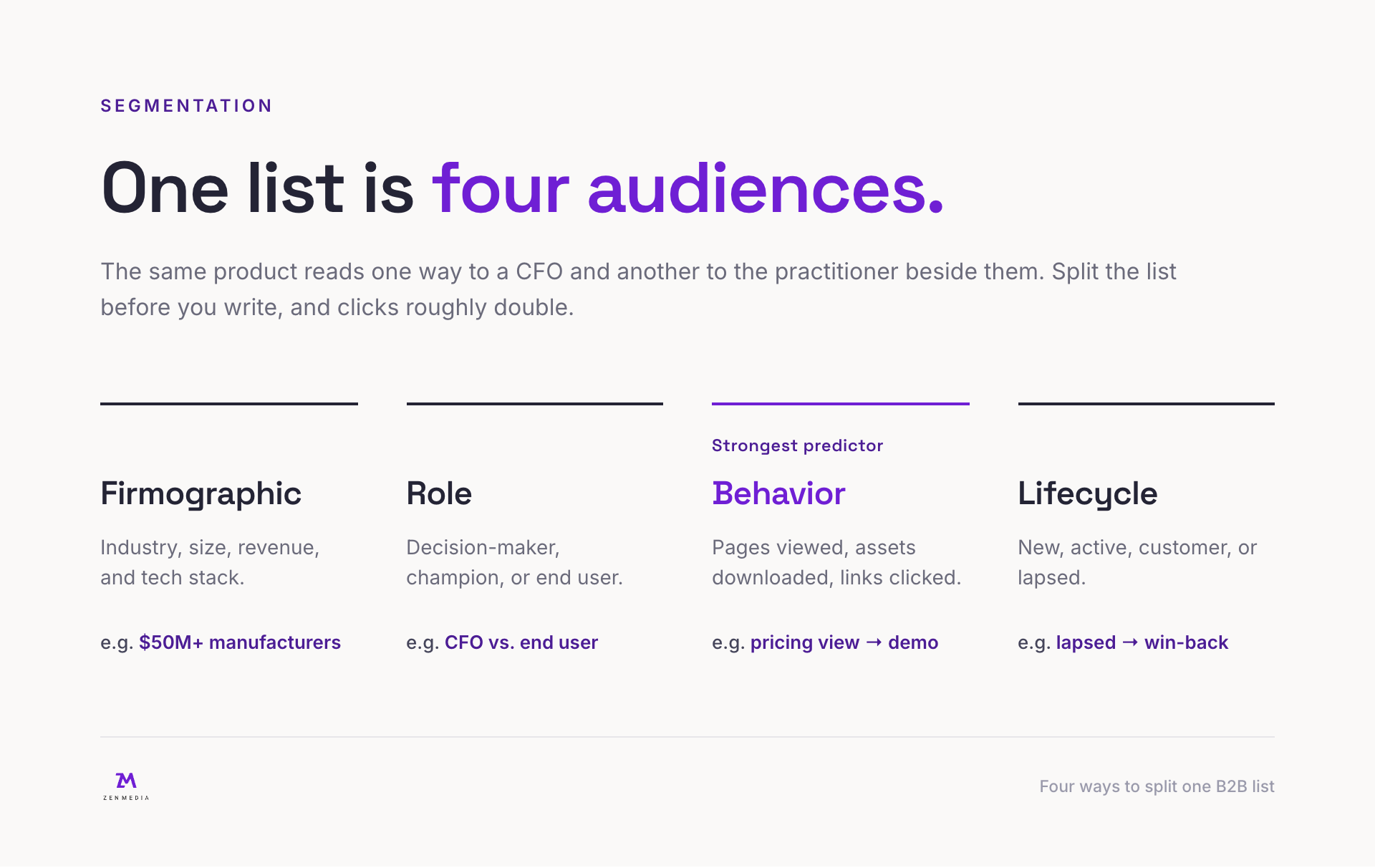
Start with segments you can act on. When you send your next campaign, does a first-time subscriber get the same email as a lead who already sat through a demo? Industry, company size, role in the buying committee, and behavior (what someone downloaded, viewed, or clicked) each change what a contact needs to hear next. A CFO evaluating cost and a practitioner evaluating features belong in different tracks even when they work at the same account. The same click data that powers segmentation is what Mailchimp found produced the largest lift, so tag behavior from day one.
Segmentation also protects your sender reputation, which matters more than it used to. Sending relevant mail to a tight cohort produces higher engagement and fewer spam complaints, and complaints are now a hard threshold you cannot cross (more on that in the deliverability section). Practitioners on B2B forums put it bluntly: three sends to fifty of the right people beat one blast to five thousand.
Click lift by segmentation type
Higher clicks vs non-segmented sends, by how the list was split
Mailchimp, analysis of segmented vs non-segmented campaigns.
Split your list by role and behavior before your next campaign. If you only have time for one segmentation move, separate people who have clicked in the last 90 days from those who have not, and send the two groups different mail.
Personalization That Goes Past the First Name
Dropping a first name into a subject line stopped impressing anyone a decade ago. Real personalization in B2B means the content matches where the reader sits in the buying process and what their role cares about. A merge tag is table stakes; relevance is the differentiator. Mailchimp’s data showed merge-field and interest-group segmentation driving the biggest click gains precisely because they change the message itself.
Tie personalization to something you can observe: role, plan, and behavior, far more than a first-name field. Someone who downloaded a pricing sheet is signaling late-stage intent and should get a case study or a demo offer to match it. The B2B buying committee averages six to ten people, so the same account often needs a technical track for the practitioner and an ROI track for the executive at once.
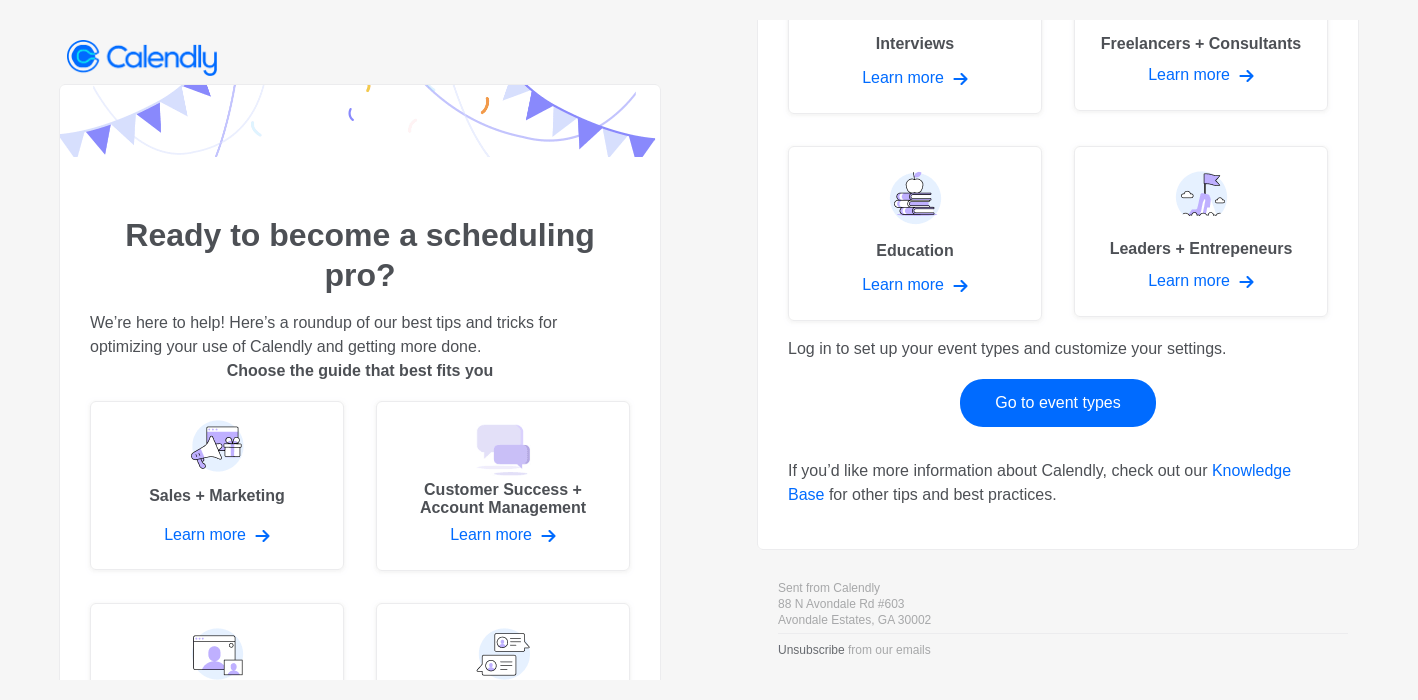
Look at how Calendly handles a mixed audience in a single send. Instead of one generic guide, the email asks the reader to pick the track that fits their job (sales and marketing, customer success, education, or leadership) and points each one to different resources. One build reaches four roles, because dynamic content blocks swap sections based on a subscriber field.
AI has made this easier and riskier at once. Generative tools can draft role-specific variants in minutes, and that speed is worth having. The risk is volume: the same tools make it trivial to send more, and more is the opposite of what a considered B2B audience wants. Use AI to make each email more relevant, and hold the volume down.
Writing Emails People Reply To
The best B2B emails read like a person wrote them. They open with the reader’s problem, make one point, and ask for one action. A B2B buyer is at work, scanning on a phone between meetings, so the email that respects that reality wins. The subject line earns the open, the first line earns the scroll, and a single clear call to action earns the click.
Loom’s onboarding email is a clean example of the human-voice principle. It comes signed by a founder, opens with the proof that millions of professionals already use the product, and drives to a single button back into the app. One sender, one proof point, one ask.
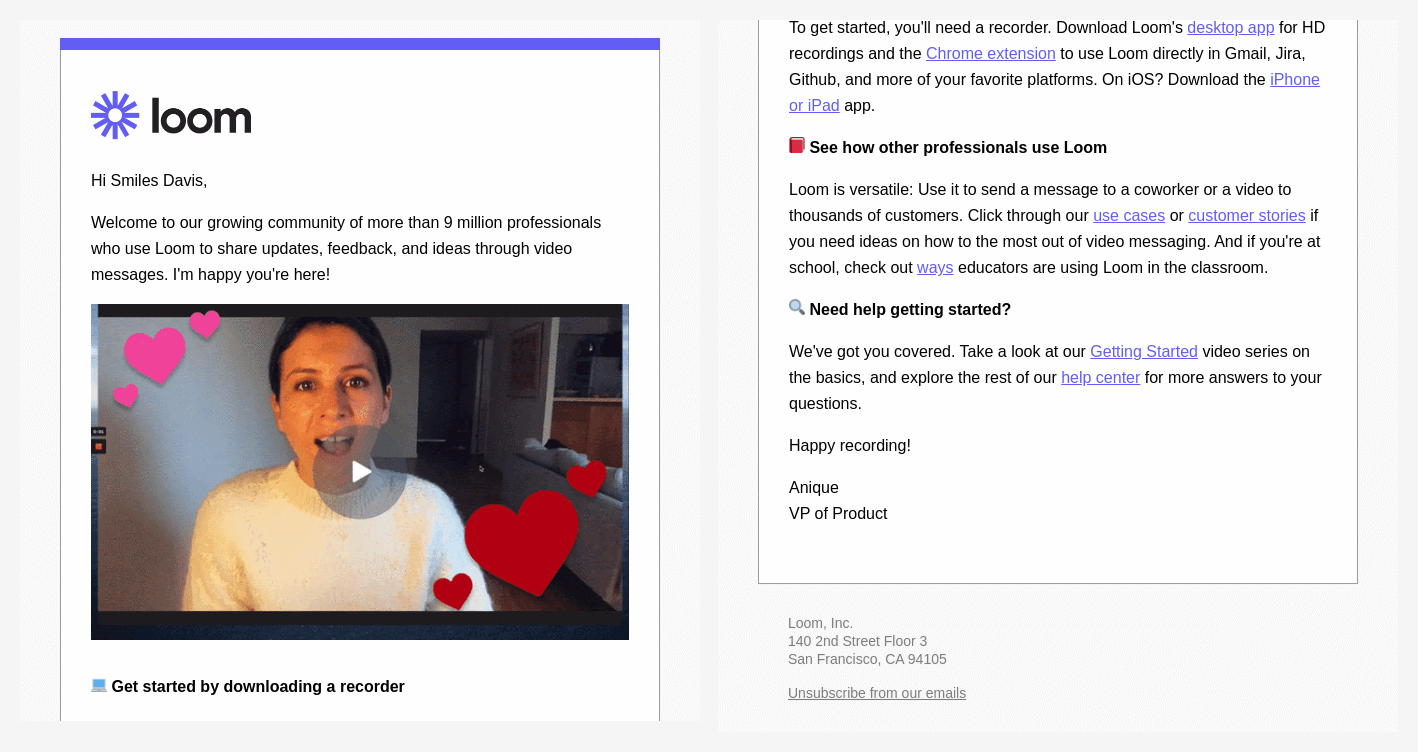
What makes it land is restraint. A new subscriber’s guard is highest on the first email, and a note that reads like a person wrote it lowers it fast.
A few habits separate copy that gets replies from copy that gets deleted. Keep the subject line under about 50 characters so it survives mobile truncation. Write the preview text on purpose so the client shows the words you chose. Use one call to action; a second link splits attention and lowers clicks. And write short, because a 90-word email that makes one point outperforms a 400-word email that makes five.
- Subject line: specific and honest beats clever. Name the value the reader gets by opening, and front-load the important words in case the line is cut off.
- Preview text: the second subject line teams forget to write. Compose it to extend the subject and add a reason to open.
- One call to action: decide the single action the email exists to drive, then cut every link that competes with it.
Email Design and Mobile Rendering
More than half of email opens happen on a phone, so a B2B email that only looks right on a desktop is broken for over half its audience. Design for a single column, large tap targets, and text that stays legible without pinching. Aim for a message that renders cleanly across Gmail, Outlook, and Apple Mail and reads in five seconds.
Stripe’s Climate welcome is a clean model: a gradient header, then one idea per block in live text, each with a short heading and a single link. Nothing competes for attention, and every line survives on a small screen.
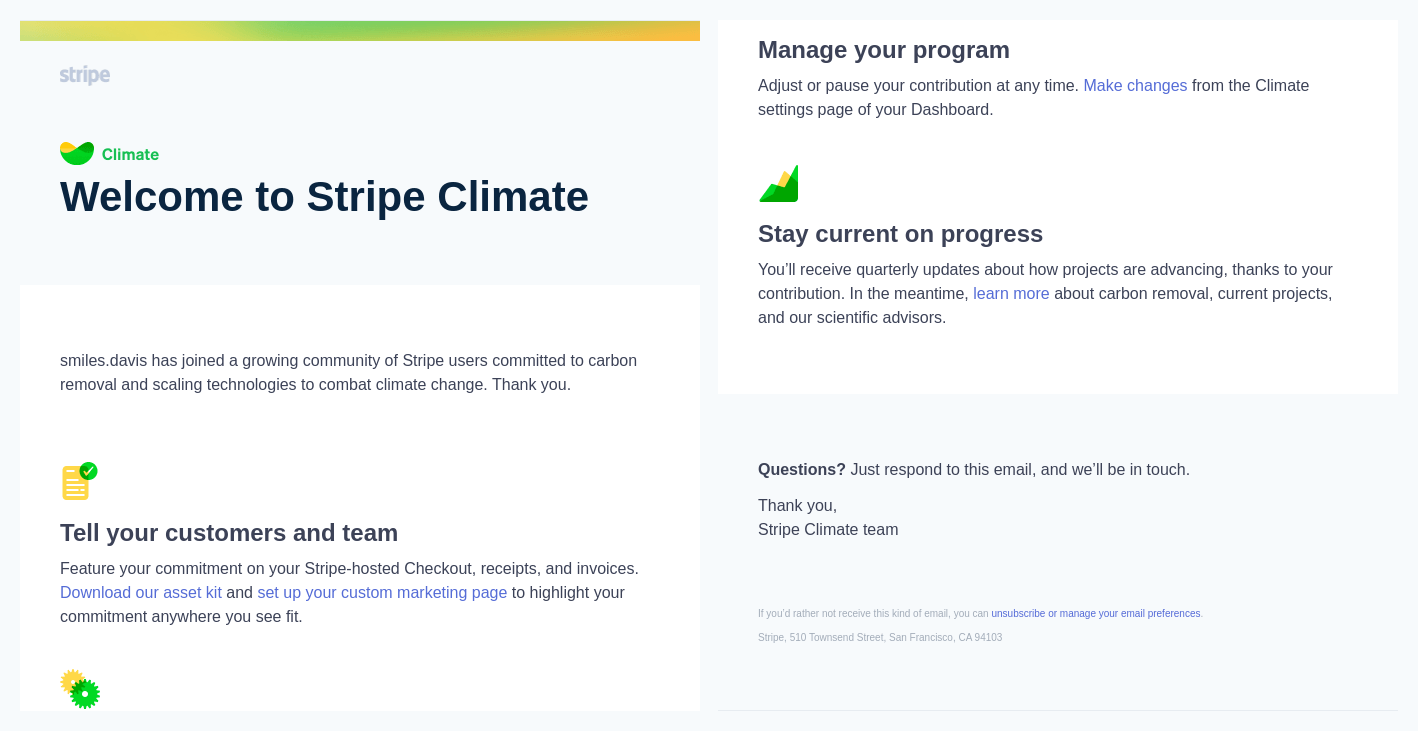
Notice what it leaves out: no dense multi-column grid, and no message trapped inside one big graphic.
Test before you send. A quick render check across the three or four clients your audience uses catches the broken layouts that no amount of good copy survives. Accessibility counts too: real text, sufficient contrast, and descriptive alt text make the email work for screen readers and for the image-blocked inbox at the same time. This is one of the terms readers search for directly, and email design best practices come down to legibility under the worst rendering conditions a reader might hit.
How Often to Send B2B Email
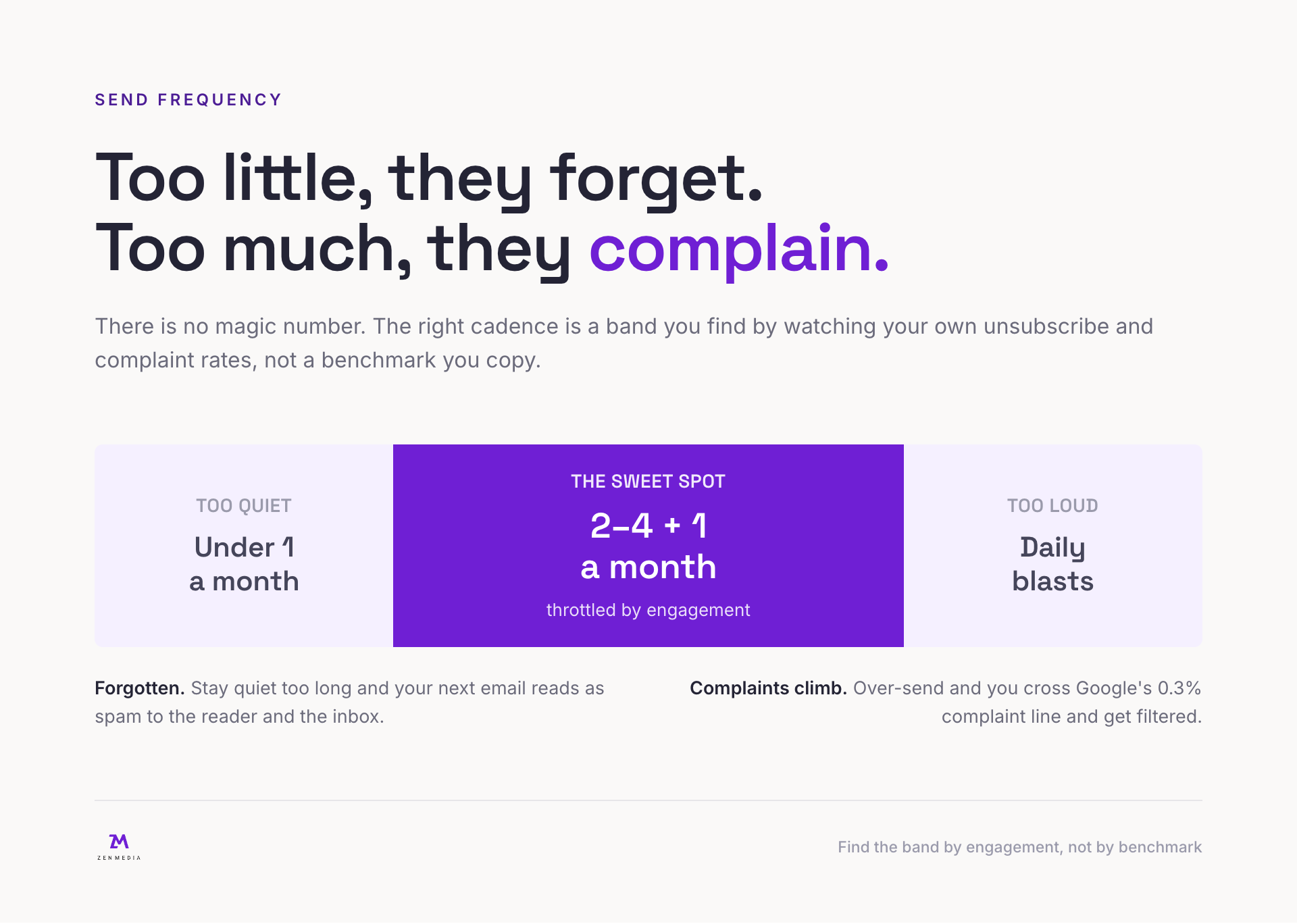
There is no universal number, and any guide that gives you one is guessing. A common landing point is one consistent newsletter plus two to four nurture or campaign emails a month, then adjustment by engagement. The right cadence is the one your specific audience tolerates while staying engaged, and you find it by watching your own unsubscribe and complaint rates over time.
Frequency is where deliverability and respect meet. Send too little and subscribers forget who you are, so your next email looks like spam to them and to their inbox provider. Send too much and complaints climb, which now carries a direct penalty under the Google and Yahoo rules. The safe path is consistency at a pace you can sustain with genuinely useful content, throttled by how each segment responds.
Let engagement set the pace
Treat frequency as a per-segment dial. People who open and click can handle more; people who have gone quiet should get less until they re-engage or exit. This engagement-based throttling is what keeps a list healthy as it grows, and it is the practice teams tend to skip because it takes setup. Two-thirds of specialists say they cut frequency to a segment that stops engaging, and that instinct is correct.
A sane starting cadence by email type
If you are building a program from zero, this is a defensible starting point. Treat it as a hypothesis to test against your own numbers over the first quarter, then adjust each line by what your engagement data tells you.
| Email type | Suggested cadence | Adjust when |
|---|---|---|
| Newsletter | Weekly to monthly, on a fixed day | Open rate falls or the content pipeline thins |
| Lead nurture | 2 to 4 per month, spaced by intent | A contact advances a stage or goes cold |
| Product / feature | Tied to real releases, 1 to 2 per month | You have nothing genuinely new to say |
| Re-engagement | A short 2 to 3 email series, then stop | A quiet contact ignores the whole series |
One control makes all of this easier: give subscribers a preference center. Letting people choose topics and frequency turns a would-be unsubscribe into a lighter subscription, keeps them on the list, and hands you a clean signal about what they want. The best day and time still matter (Tuesday and Wednesday mornings remain reliable for B2B), but a preference center beats any send-time guess because it replaces your assumption with their answer.
Pick a sustainable cadence, publish a preference center, and throttle by engagement. Rising unsubscribes or spam complaints are the signal to send less, and under the current sender rules that signal is no longer optional to watch.
Getting Into the Inbox, Not the Spam Folder
Deliverability is the practice teams discover only after a campaign underperforms for reasons the copy cannot explain. Since February 2024, Google and Yahoo require bulk senders to authenticate their mail with SPF, DKIM, and DMARC, and to keep spam complaints below 0.3%. These rules are mandatory, and mail that fails them gets rejected or filtered before a reader ever sees it.

Authentication is the foundation, and it is a one-time setup with ongoing hygiene. SPF tells receiving servers which servers may send for your domain, DKIM signs each message so it cannot be tampered with, and DMARC ties the two together and tells inboxes what to do when a message fails. Get these records right once, then monitor them, because a broken DKIM signature can quietly tank an entire campaign.
List hygiene does the rest. Verify addresses and remove hard bounces before every campaign, because a bounce rate above 2% damages sender reputation, and prune disengaged contacts before they push your complaint rate toward that 0.3% line. Reputation is earned by engagement, which closes the loop with everything above: segmented lists, relevant copy, and controlled frequency all raise engagement and lower complaints, and high engagement is the strongest signal that tells Gmail your mail belongs in the inbox. Deliverability is the reward for doing the rest well.
Compliance: CAN-SPAM, GDPR, and the 2024 Sender Rules
Compliance protects your program from fines and your domain from blocklists, and the rules differ by where your recipients sit. In the United States, CAN-SPAM lets you email business contacts without prior opt-in, provided you identify yourself, avoid deceptive subject lines, include a physical address, and honor unsubscribe requests promptly. In the EU and UK, GDPR is stricter and generally requires a lawful basis, often consent or legitimate interest, before you email a business contact.
The 2024 Google and Yahoo requirements added an operational rule that overlays both laws: bulk senders must include a one-click unsubscribe in the message header, and they must process opt-outs within two days. This is a header-level technical requirement, and reputable email platforms handle it automatically once you enable it. If yours does not, that is a reason to switch platforms before your next campaign.
Buying or scraping a list breaks GDPR consent rules, drives complaint rates up, and poisons your sender reputation in one move. Every contact you email should have a traceable reason for being on the list.
Practically, compliance and good marketing point the same direction. Permission-based lists, honest subject lines, easy unsubscribes, and prompt opt-out processing keep you legal and keep your engagement high. The teams that treat compliance as a floor to clear end up with cleaner lists and better numbers.
Automated Sequences That Do the Follow-Up
Automation is how a small team runs a program that feels personal at scale. Instead of manually sending one-off blasts, you build sequences triggered by what a contact does: a welcome series when someone subscribes, a nurture or drip sequence after a download, a win-back series when engagement drops. Triggered flows consistently outperform batch campaigns because they arrive when the contact is already paying attention.
Framer’s onboarding email shows the payoff of a behavioral trigger. It fires when a new user has started setting up a workspace but stalled, greets them by name, shows a 25% complete progress ring, and lists the exact steps left with one button to finish. A batch email cannot do this, because it does not know where each person stopped.
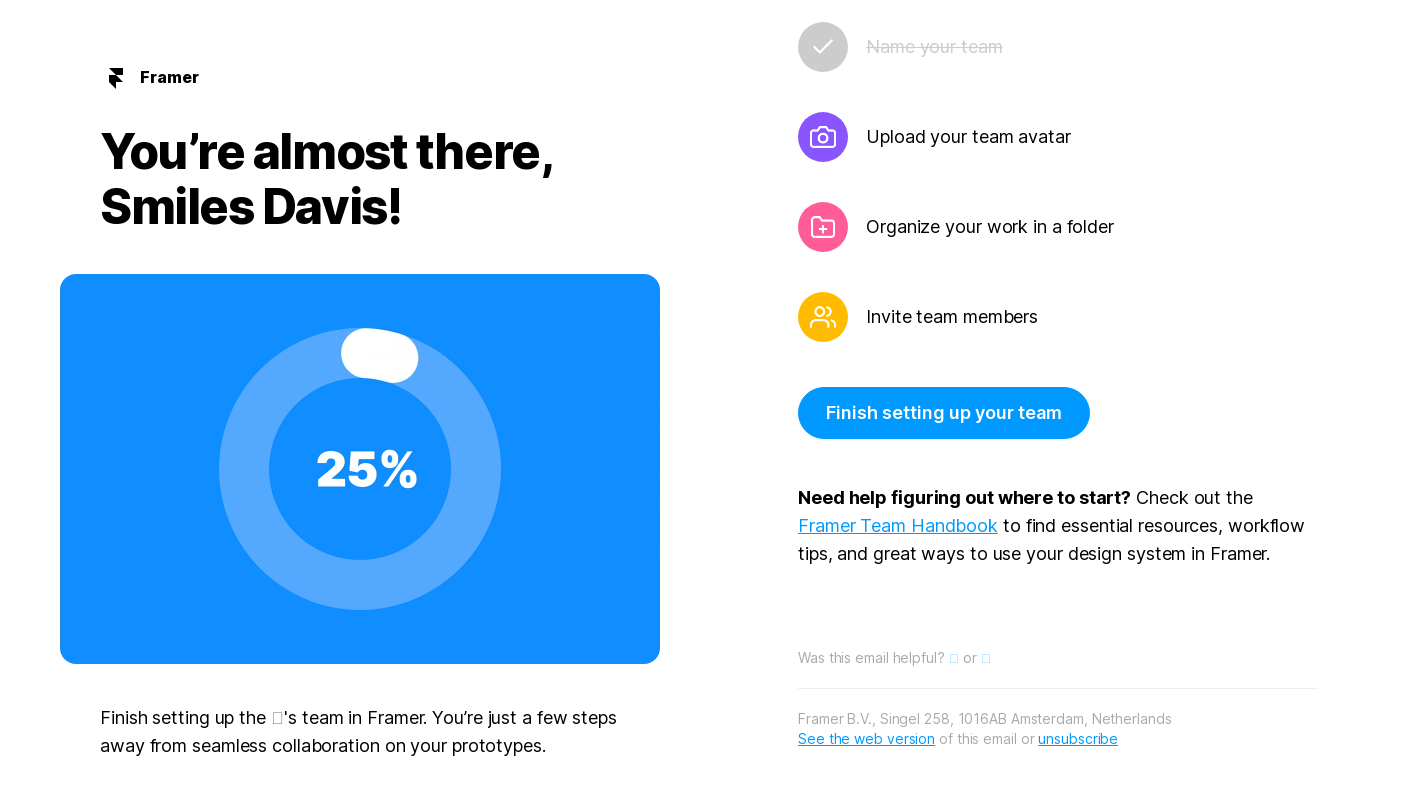
Start with the three sequences that pay for themselves fastest, then expand. A welcome series sets expectations and earns early engagement while interest is highest. A lead-nurture flow moves contacts toward a demo with content matched to their stage. A re-engagement flow gives quiet subscribers a reason to stay or a clean exit, which protects the deliverability of everyone who remains.
- Welcome series: two to four emails that introduce the brand, set expectations, and deliver quick value while a new subscriber’s interest is highest.
- Lead nurture: a behavior-triggered track that sends the next logical asset based on what the contact last engaged with, pacing them toward a conversation.
- Re-engagement: a short series aimed at quiet contacts. If they do not respond, suppress them, so your reputation reflects people who want your mail.
The content that feeds these sequences is your library of blog posts, guides, and case studies, which is why email and content strategy are one system. Our guide to B2B content marketing covers how to build that library so your nurture flows never run dry, and pairing the two is where email starts compounding.
The Metrics That Tell You What’s Working
Measure clicks, not opens. Open tracking stopped being trustworthy after Apple’s Mail Privacy Protection began pre-loading tracking pixels for Apple Mail users, which registers opens that never happened. A large share of your list now shows a phantom open the moment mail is delivered, so any decision based on open rate is built on inflated data.
Judge campaigns on what a reader chose to do. Click-through rate and click-to-open rate show whether the content earned action. Reply rate matters more in B2B than dashboards usually admit, because a reply is a conversation starting. And the metric that funds the program is pipeline: leads, meetings booked, and revenue influenced by email. Tie sends back to those outcomes and you can defend the channel to a CFO.
Then test one variable at a time. A/B testing works when you change a single element (subject line, call to action, send time) and let the winner inform the next send. Testing everything at once tells you nothing, because you cannot attribute the result. The programs that improve quarter over quarter are the ones running a steady queue of small, clean experiments and feeding the wins back into their segments and sequences. Strong email measurement also feeds your wider funnel; our B2B SEO guide shows how the same content that fills nurtures also earns the search traffic that grows the list.
Putting the Nine Practices Together
Treat these as the core of your B2B email marketing strategy, not a list of one-off tips. The practices reinforce each other, which is why treating email as a system beats chasing any single tactic. Segmentation raises engagement, engagement protects deliverability, deliverability gets your compliant mail seen, and clean measurement tells you where to tune next. Fix the foundation first, because a great email sent from an unauthenticated domain to an unsegmented list is a great email nobody reads.
If you want the channel working as part of a wider program, that is the work we do every day. Zen Media builds integrated B2B marketing that connects email to content, search, and earned media, so each channel feeds the others. When you are ready to make email pull its weight, talk to our team.
Frequently Asked Questions
How often should you send B2B marketing emails?
B2B programs generally land between two and four sends per month for nurture plus one consistent newsletter, then adjust by engagement. Send more to people who open and click, less to people who go quiet. Consistency and relevance protect deliverability more than any fixed number does.
What is a good open rate for B2B email in 2026?
A healthy B2B open rate sits in the high 30s to low 40s percent, with B2B services near 39.48 percent in 2025 benchmarks. Apple Mail Privacy Protection inflates the number, so treat opens as directional and judge campaigns on click-through rate, replies, and pipeline instead.
Do B2B emails need explicit opt-in consent?
In the United States, CAN-SPAM allows sending to business contacts without prior opt-in as long as you identify yourself, avoid deceptive subject lines, and honor unsubscribes. GDPR in the EU and UK is stricter and generally requires a lawful basis such as consent or legitimate interest for B2B contacts.
What are the Google and Yahoo sender requirements?
Since February 2024, bulk senders must authenticate mail with SPF, DKIM, and DMARC, include a one-click unsubscribe in the message header, and keep spam complaints below 0.3 percent. The rules apply to anyone sending more than 5,000 messages a day to Gmail or Yahoo addresses.
Should you measure email opens or clicks?
Measure clicks. Open tracking became unreliable after Apple began pre-loading pixels for Mail Privacy Protection users, which registers opens that never happened. Click-through rate, click-to-open rate, reply rate, and downstream pipeline are the metrics that reflect real interest.
About the author: Sarah Evans is Partner and Head of PR at Zen Media, a global B2B PR and marketing agency. With 23+ years in communications, she architects PR strategy, drives earned media initiatives, and helps brands navigate AI-driven visibility. She is a regular contributor to Entrepreneur and has been recognized as a top writer on business and tech.