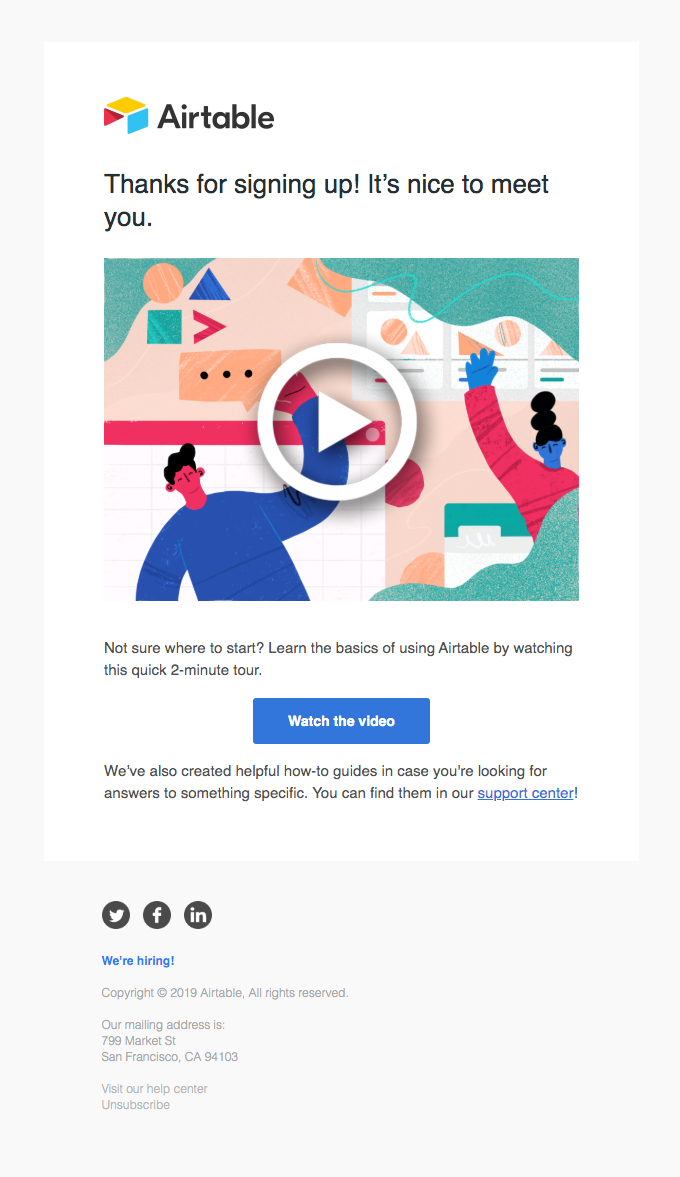
TL;DR: Email marketing delivers $36 for every $1 spent, according to Litmus’s 2025 State of Email Survey, making it the highest-ROI channel in B2B. Yet most B2B companies treat it as an afterthought. This guide breaks down 51 real examples across eight strategy categories: welcome and onboarding, product updates, educational content, events and demos, reengagement, personalized and behavioral, seasonal and milestone, and brand-building. Each example includes the specific tactic and why it works.
B2B email marketing gets underestimated. Compared to paid search, social media, and content marketing, email rarely receives the creative investment it deserves. That is a strategic error.
With 376.4 billion emails sent globally every day and 73% of B2B buyers naming email as their preferred outreach channel, the channel is not the problem. The problem is standing out in a crowded inbox with something worth reading.
The 51 examples in this guide do exactly that. They are organized by strategy category so you can find what applies to your current campaign challenge, whether you are onboarding new customers, reactivating dormant ones, or building long-term brand credibility through content.
What Is B2B Email Marketing?
B2B email marketing is a channel strategy for reaching business decision-makers with targeted messaging that generates leads, builds relationships, and drives revenue. Unlike B2C email, where the goal is often a fast emotional response, B2B email operates on longer cycles. Buyers take more time, involve more stakeholders, and require more evidence before acting.
That means the best B2B emails rarely look like traditional marketing. They look more like useful information arriving at the right moment: a product education sequence that anticipates a user’s confusion, a content email that delivers a report a prospect actually needs, or a personalized reengagement sequence that references what a contact has already done. The goal is to be worth opening, not just worth sending.
B2B email also operates differently from B2C in one critical way: the decision-maker receiving the email is often not the only person whose approval matters. A strong B2B email campaign accounts for the full buying committee, delivering different messages to different roles within the same target account.
Why Email Still Dominates B2B Outreach
The numbers make a clear case. Email marketing delivers an average ROI of $36 for every $1 spent, according to Litmus’s 2025 State of Email Survey. That is more than 12 times the average return from social media advertising and more than five times the return from direct mail. The global email marketing market reached $12.84 billion in 2025 and is projected to grow to $22.93 billion by 2031, according to Mordor Intelligence, as automation, AI personalization, and improved deliverability tools expand what the channel can do.
Despite those numbers, 81% of B2B marketers incorporate email into their core strategy while a meaningful portion still treats it as a broadcast channel rather than a precision tool. The gap between companies using email well and companies using it poorly is wide, and the examples below show exactly what the gap looks like in practice.
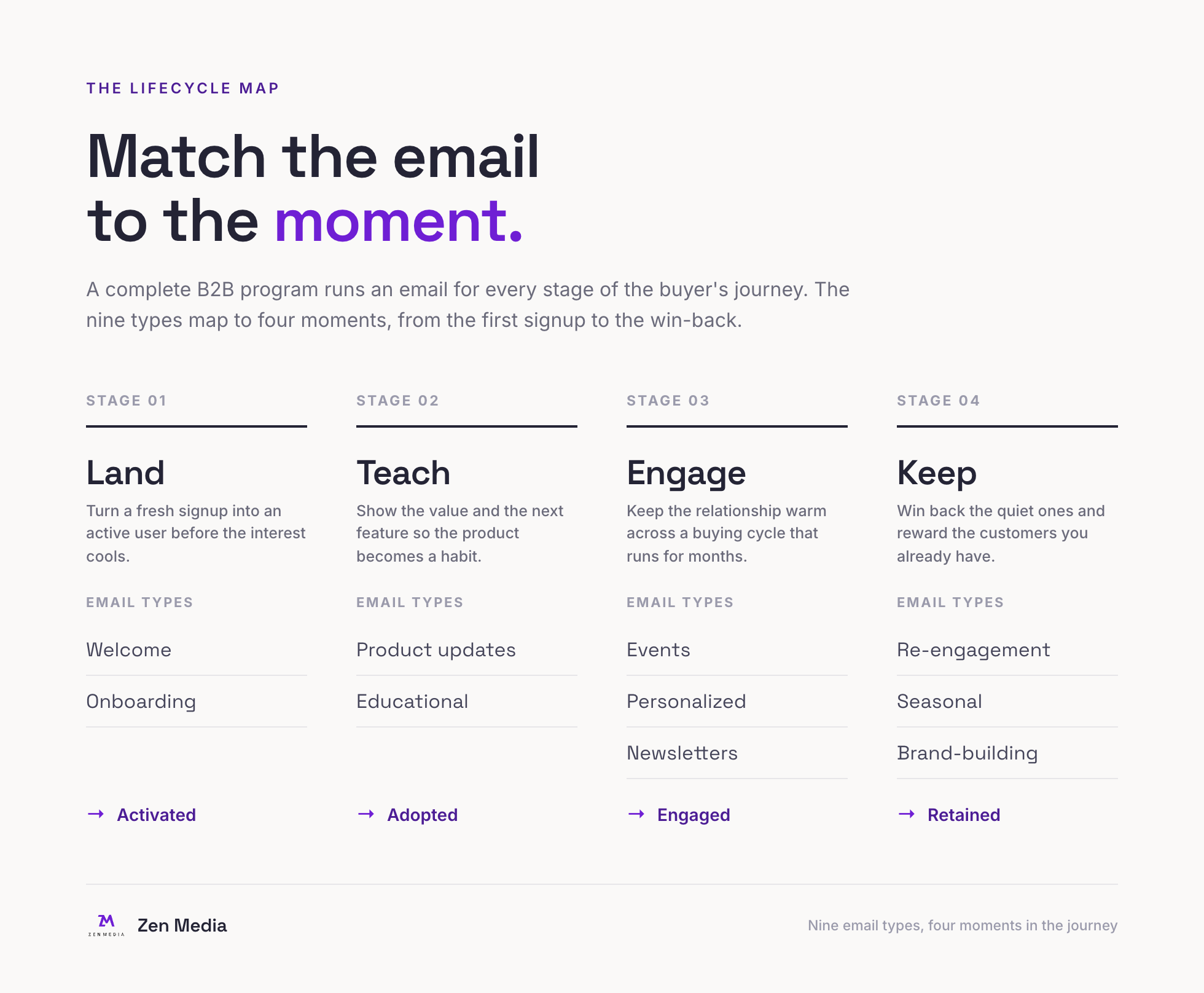
Welcome and Onboarding Email Examples
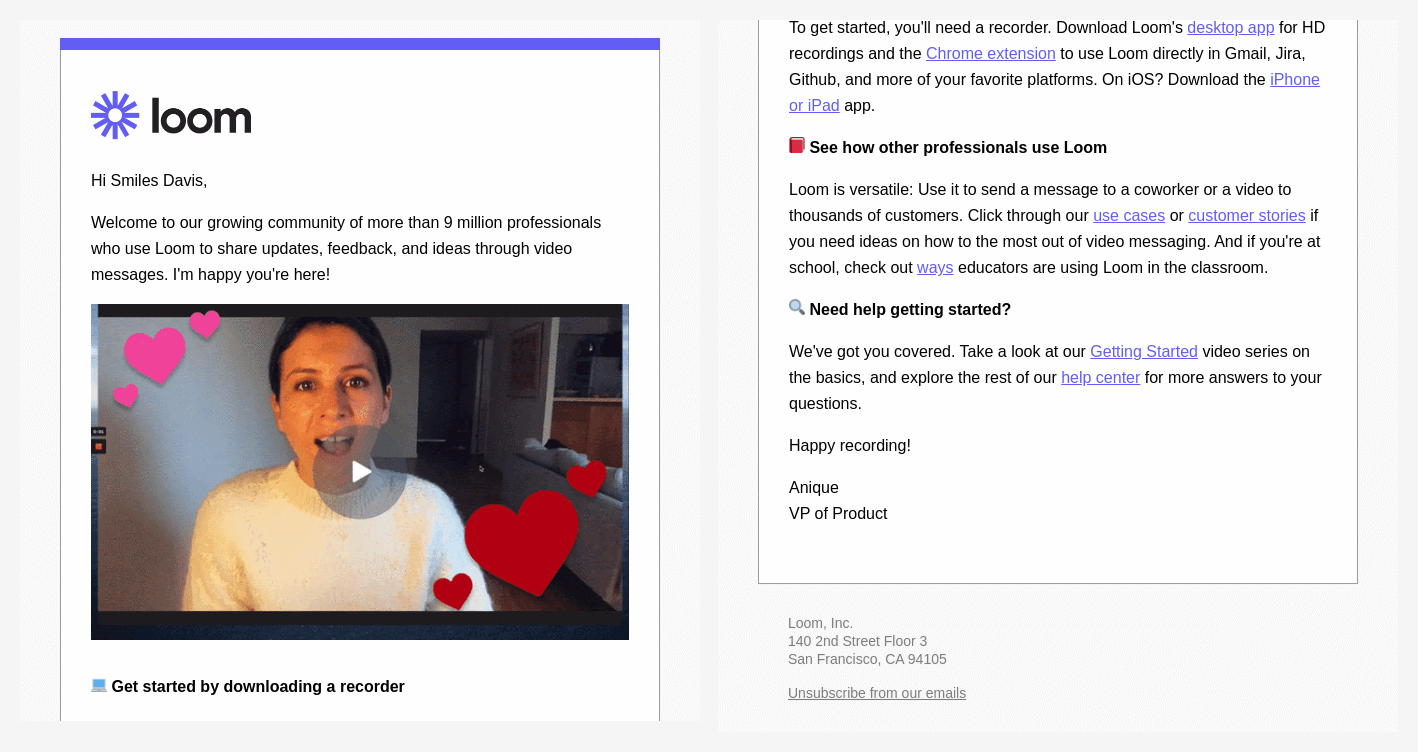
The welcome email is the highest-read message a B2B company will ever send. Open rates for welcome emails run 50 to 80% above the list average because the recipient just opted in and the brand is top of mind. Companies that use this moment to build a relationship, rather than immediately pitch a product, set up better long-term retention.
1. Buffer’s Welcome Email

Buffer uses its welcome email to do something most onboarding sequences skip: establish a human relationship before asking for anything. The email introduces the team, suggests the browser extension as a low-friction first step, and makes clear that users can write back about anything, including just saying hello. That permission to reach out changes the dynamic from vendor to partner. Companies that signal openness to direct communication in their welcome email see higher engagement across subsequent sequences because the relationship starts on the right foot.
2. Campaign Monitor’s Getting Started Email

Campaign Monitor’s behavior-triggered email targets users who signed up but have not yet built a campaign, sending a nudge at exactly the moment when inertia risks losing them. The email guides users directly into the template builder with a single link, removing the friction between intent and action. What makes it effective is the specificity: it does not send a generic reminder, it identifies a behavior gap and closes it. Monitoring subscriber behavior to trigger relevant follow-ups is the foundational tactic behind any high-performing onboarding sequence.
3. Google’s How-To Email for New Google Ads Users
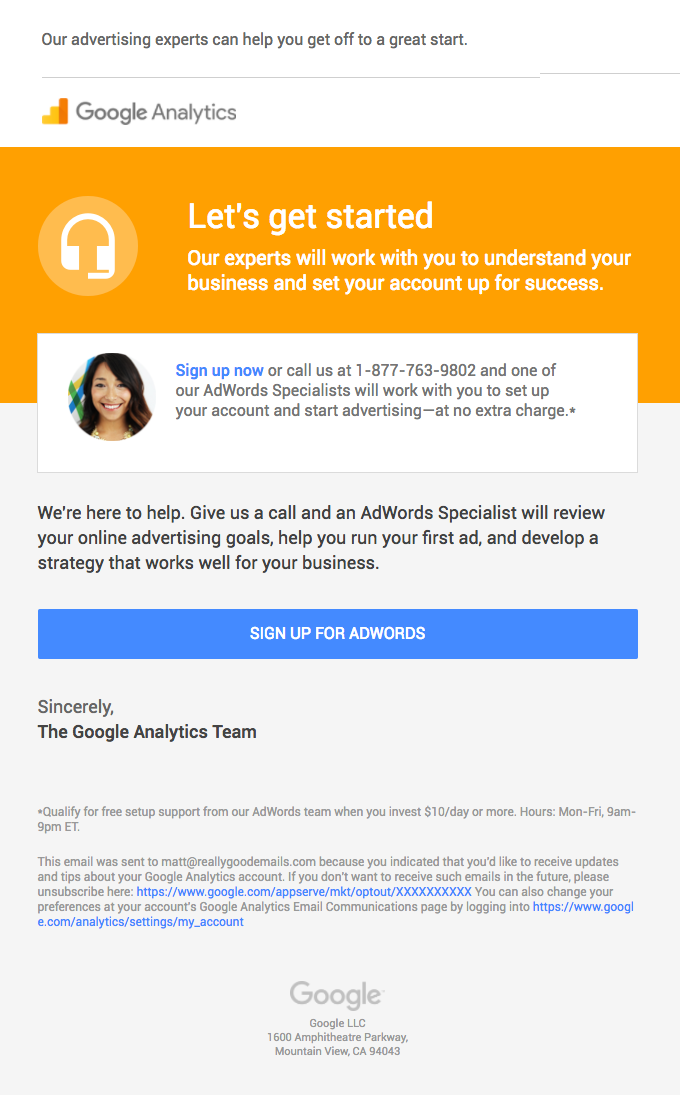
New product users are frequently lost in the first 48 hours. Google addresses this with a practical getting-started email for Google Ads that provides numbered steps and direct links to the most common first actions. The email positions Google as a supportive partner rather than a product vendor, which reduces churn that originates from confusion rather than dissatisfaction. For B2B companies with complex products or lengthy setup flows, a structured how-to email in the first week converts signups into active users at a meaningfully higher rate.
4. Xero’s Welcome and Onboarding Walkthrough

Xero’s welcome email functions as a compact orientation guide, combining recommended first steps, training material links, and direct contact information for the support team in a single message. The structure serves users with different starting points: some want to explore independently, others want guided instruction, and some need to know that help is available. Addressing all three needs in one email reduces the support volume that typically follows new account creation. The format communicates competence and confidence rather than excitement.
5. Evernote’s Post-Signup Follow-Up Email
Evernote’s follow-up email catches users who created an account but have not downloaded the app, continuing the onboarding conversation rather than treating signup as completion. The email emphasizes cross-device access and surfaces the specific value the user signed up for in concrete terms. Following up on partial completions is one of the highest-ROI email tactics available because the intent is already present. The ask is low-friction: one click to extend a commitment the user has already made.
Product Feature and Update Email Examples
Product announcement emails fail when they lead with what was built instead of why it matters to the reader. The best examples below use announcements to advance a relationship, not just report a feature ship. Each one demonstrates a specific approach to earning attention in a context where every competitor is also announcing something.
6. Atlassian’s New Features Announcement

Atlassian’s feature announcement uses a clean white background and prominent blue CTAs to ensure new capabilities are visible without competing with design noise. Each feature gets a short description followed by a direct link to explore it in context, respecting that B2B buyers need to evaluate features in practice, not just read about them. The email informs and invites without overselling, which is why product announcement emails from Atlassian have a reputation for being worth opening. Restraint in copy is a strategic choice, not a limitation.
7. Moo’s GIF Animation Email

GIF animations are more common in consumer campaigns, but Moo proves they work in B2B when used with purpose. Rather than using animation as decoration, Moo uses it to show a product in motion, communicating tactile quality that static images cannot replicate. The GIF creates a moment of delight in an otherwise functional product category, and delight drives sharing and repeat engagement. If your product has a visual or physical dimension, motion assets differentiate your email from every competitor sending flat images.
8. Sign Up Genius’s New Designs Announcement

Sign Up Genius sends a new designs announcement that functions simultaneously as a product update and a retention tool. The email acknowledges that volunteer coordination is difficult and frames new design options as a tool that makes signups more visually appealing and easier to complete. Connecting a product feature to a known user frustration makes the announcement feel relevant rather than self-promotional. This is the right template for announcing any product improvement: name the problem first, then show how the feature addresses it.
9. MailChimp’s Product Upgrade Email

MailChimp leads its upgrade announcement with a single graphic showing Pro features on mobile rather than opening with explanatory text, letting the visual communicate the value proposition. The economy of copy is deliberate: when a product upgrade speaks clearly through a screenshot or diagram, additional words reduce rather than increase conversion. For B2B companies announcing software improvements, the test is whether a visual can replace three paragraphs. In most cases, it can, and performance improves when you make that trade.
10. Uber’s Product Announcement Email
Uber’s announcement email is designed around clarity: smooth content flow, images that preview the upcoming feature, and copy that focuses on the “what” without overloading the reader with justification. The restraint makes the email feel confident. B2B companies often over-explain product announcements out of concern that the value will not be self-evident. Uber’s approach assumes the reader can draw their own conclusions from a clear description, which is usually the correct assumption for a technically literate audience.
11. Netlify’s Out-of-Beta Features Announcement

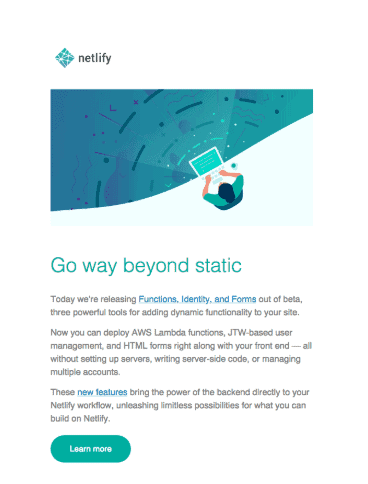
Netlify’s email announcing three tools moving out of beta carries a specific signal that resonates with developer audiences: these features have been tested rigorously and are now production-ready. That framing matters to technical buyers who evaluate infrastructure before deploying it to their systems. The announcement does not just introduce features, it communicates quality control and organizational discipline. For B2B companies with technical audiences, product emails that convey stability and testing history outperform generic “new features” blasts.
12. Sprout Social’s New Feature Walkthrough

Sprout Social pairs brief how-to copy with an explainer graphic that walks users through the new feature in the email itself, without requiring a click to a landing page. Reducing the distance between announcement and understanding is a meaningful conversion lever: users who grasp the value immediately are more likely to try the feature the same day. The visual-text pairing also accommodates different learning styles within the same audience. Whenever a feature requires more than one sentence to explain, this format typically outperforms a link-to-landing-page approach.
13. Shopify’s Multi-Solution Email

Shopify’s email covers multiple topics but organizes everything around a single underlying theme: helping merchants find more ways to sell. The visual hierarchy guides the reader through different solutions without creating cognitive overload. Multi-topic emails typically underperform focused ones, but Shopify avoids that trap by treating every section as a variation on the same central promise. The lesson is that diverse topics and a single message are not mutually exclusive if the framing is disciplined and the design creates clear visual entry points for each section.
Educational and Content Email Examples
In B2B, the brands that educate before they sell earn more trust and shorter sales cycles. According to Edelman and LinkedIn’s 2025 B2B Thought Leadership Impact Report, over half of B2B decision-makers use thought leadership content to vet vendors before engaging a sales team. Educational email sequences build that credibility systematically, positioning the sender as a resource before they are ever perceived as a vendor.
14. Docusign’s e-Signature Security Email

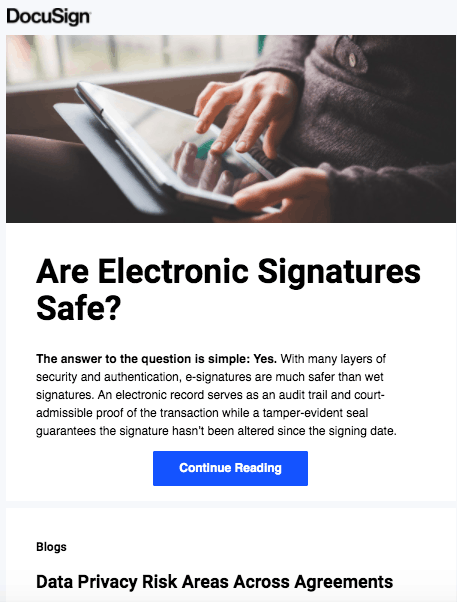
Docusign’s email addresses a specific objection that delays adoption: whether digital signatures are as secure as wet signatures. Rather than dismissing the concern, Docusign responds with an informative article framed as objective guidance. The approach works because it treats the prospect as a rational evaluator rather than a marketing target. Providing content that directly resolves hesitation is one of the most effective ways email can shorten a B2B sales cycle, because it removes friction from the evaluation stage before a sales conversation begins.
15. SuperOffice’s Whitepaper Promotion

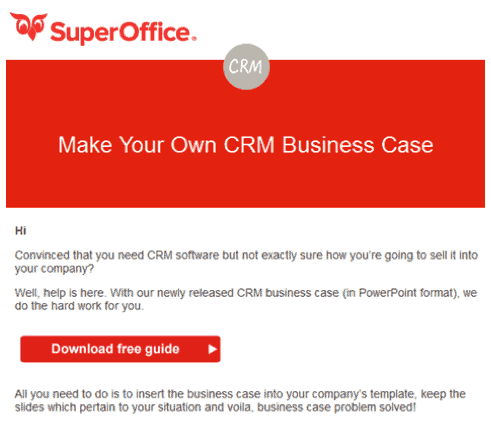
SuperOffice uses email to deliver a whitepaper to contacts who have expressed interest in related topics, treating the channel as a content distribution vehicle rather than a sales funnel. The email positions SuperOffice as a knowledge resource before it positions them as a vendor. In B2B, buyers who consume a company’s thought leadership arrive at sales conversations with vendor preference already partially formed. Content-first email sequences build that preference systematically before the competitor even starts the conversation.
16. Heroku’s Product Education Email

Heroku’s email explains product differentiation through feature education rather than marketing language, walking users through specific capabilities they may not know exist and explaining the development problems each one solves. The email ends with a CTA to explore the feature hands-on, completing the move from education to action in one message. For developer tools and technical products, education-first emails consistently outperform benefits-focused ones because the audience values precision over persuasion and will dismiss copy that feels oversimplified.
17. Salesforce’s Blog Highlights Email

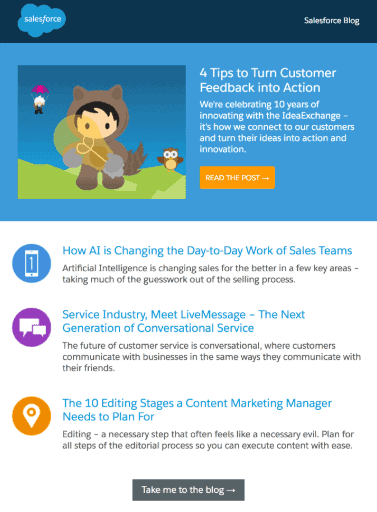
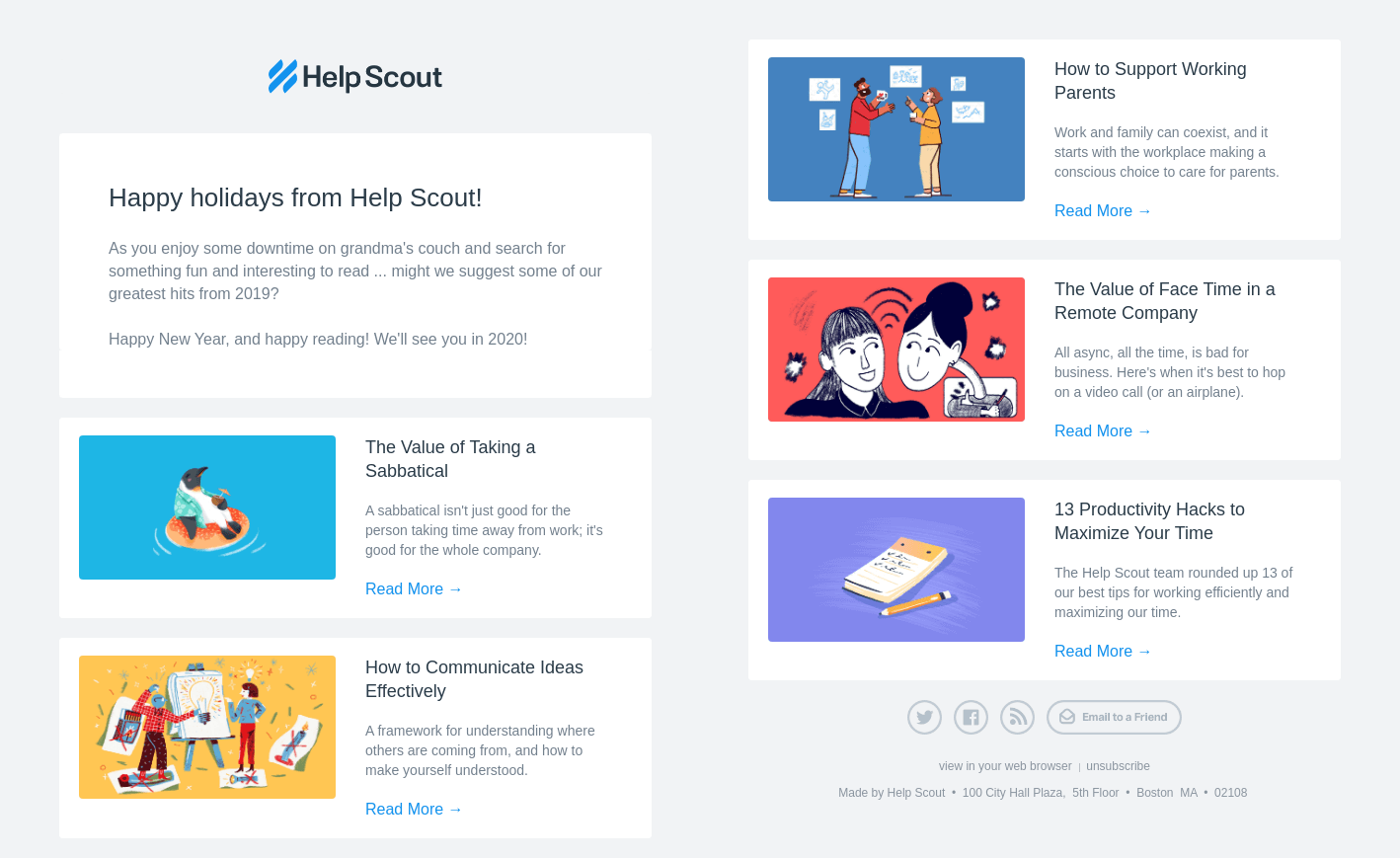
Salesforce’s content digest takes a format most companies default to, a grid of images and post excerpts, and strips it back to something more scannable: one main image, strong post titles, and minimal supporting copy. The result is a digest that reads in under 10 seconds compared to a visually dense layout that requires active navigation. For B2B companies with active content programs, testing a stripped-back format against a standard image-grid digest often reveals that simpler performs better, particularly for mobile readers.
18. Salesforce’s Content Package Email

Rather than sharing individual content pieces, Salesforce curates a full content collection in a single email, positioning itself as the go-to resource for a specific topic area. The compilation format signals expertise and investment in the subject matter. For B2B companies with significant content volume, packaging content thematically in one email can outperform sending five separate piece announcements because the aggregate signals depth, not just output. The reader perceives a library, which is more impressive than an article.
19. General Assembly’s Curated Content Email
General Assembly pulls from multiple external sources rather than limiting the email to its own content, demonstrating that offering competitor-adjacent material does not undermine authority. The curation approach positions General Assembly as a trusted filter in a noisy information environment, which is a more valuable position than being simply a content producer. For B2B companies that want to build audience trust without requiring a large content operation, curating external content thoughtfully is a legitimate and underused email strategy.
20. Unbounce’s Thank-You and Resource Email

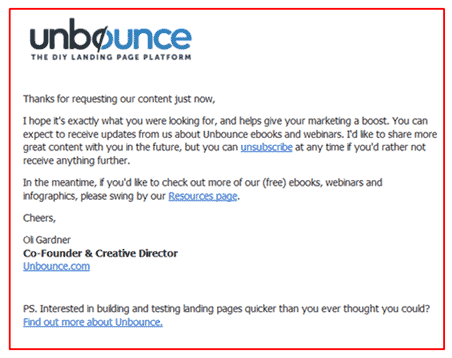
Unbounce follows up on content downloads with additional related resources rather than immediately transitioning to a product pitch, extending the value exchange and reinforcing their positioning as a conversion expertise hub. The email connects the downloaded piece to material the reader would logically want next, creating a natural content progression. Sequencing content delivery across multiple emails builds credibility progressively, and that accumulated credibility does more conversion work than any single product email placed too early in the relationship.
21. LogMeIn’s IT Apocalypse Email

LogMeIn uses a dramatically framed subject line (the IT Apocalypse) paired with hard-hitting security statistics and a video component to create an email that functions more like a content experience than a product pitch. The emotional hook earns attention; the data justifies the claim; the video provides evidence in a format the statistics alone cannot convey. In B2B categories where security, compliance, or risk are genuine purchase drivers, this emotional-then-rational structure is highly effective and consistently outperforms purely informational approaches.
22. Freelancer’s Union Educational Tips Email

Freelancer’s Union uses a curiosity-driven subject line to earn the open, then delivers practical business guidance that has nothing to do with a direct product sell. The email builds community identity and association value: recipients feel they are part of a network that provides them with useful tools and looks out for their interests. For organizations that serve professional communities, emails that strengthen community belonging consistently outperform transactional product promotions because belonging is a stronger motivator than any feature benefit.
Event, Webinar, and Demo Email Examples
Registration-based campaigns in B2B rely on a clear answer to one question: what will I get from attending that I cannot get anywhere else? The three examples below each answer that question differently, and each one demonstrates a distinct mechanism for converting an email reader into a live attendee or demo participant.
23. Litmus’s Event Announcement Email

Litmus built engagement into its event announcement by revealing two of its conference cities while keeping the third a secret until the campaign reached 500 social shares. The mechanic links email and social distribution in a single campaign, extending reach without additional media spend. Participation in the reveal process creates ownership and anticipation that standard countdown timers rarely achieve. For B2B event marketers, giving the audience a role in building toward the announcement is a significantly more powerful engagement mechanic than urgency messaging alone.
24. HubSpot’s Webinar Invitation

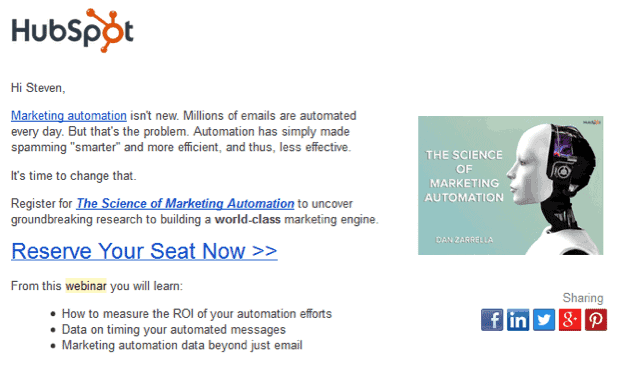
HubSpot’s webinar invitation previews the specific insights attendees will take away, framing registration as an investment in useful knowledge rather than a commitment to sit through a vendor presentation. The email makes the value concrete before the ask. For B2B companies that use webinars as lead generation, the registration barrier drops significantly when prospects know what they will receive. The lesson is to write webinar invitation copy around the three most specific and actionable takeaways, not around speaker bios or company credibility signals.
25. Kissmetrics’s Demo Offer Email
Kissmetrics makes demo scheduling frictionless by explaining what the demo will cover directly in the email, so prospects arrive with calibrated expectations rather than uncertainty about what they are agreeing to. The email sets the agenda upfront, which filters out poor-fit leads while making the process more comfortable for serious buyers. Clear demo framing reduces no-shows and increases conversation quality. If your demo-to-close rate is lower than expected, the problem is often in the invitation copy, not the demo itself.
Reengagement and Retention Email Examples
Retaining a customer costs a fraction of acquiring one, yet reengagement emails receive less creative investment than acquisition campaigns in most B2B organizations. The examples below demonstrate why that is a mistake, and each one shows a specific technique for recovering value from contacts that have gone quiet or inactive.
26. Asana’s Reactivation Email

Asana targets users who have created accounts but stopped using the platform, prompting a specific action: creating or resuming a task list. The message is conversational rather than alarm-driven, treating inactivity as an oversight rather than a problem to solve. Reactivation emails that approach users with empathy rather than urgency typically see higher click-through rates because they do not create defensive responses. A single re-engaged active user generates more lifetime value than the cost of a well-timed reactivation sequence.
27. EyeQuant’s Reintroduction Email

EyeQuant sends its reintroduction email to users who have tested the product but have not converted, arriving at the critical moment when a trial’s value is still fresh but the urgency to act has faded. The email surfaces the specific value the user already experienced, reducing the cognitive distance between trial and purchase decision. For B2B companies with free trials, the window immediately after trial completion is the highest-leverage period for reengagement, and most companies either miss it entirely or send generic upgrade prompts that do not reference what the user already did.
28. Buffer’s Behavior-Triggered Reengagement Email

Buffer’s automated email fires when a user has been registered for one week without sharing a social post, catching the gap between signup and meaningful usage before inertia becomes permanent. The email acknowledges the specific behavior directly, which creates the feeling of a personal nudge rather than a batch send. Triggered emails based on behavior gaps consistently outperform time-based nurture sequences because they address the actual barrier the user has encountered. The more precisely you can name what a user has not done, the more relevant and effective the reengagement message becomes.
29. Trint’s Upgrade Email with Positive Reinforcement

Trint’s upgrade prompt opens by acknowledging and celebrating the number of transcriptions a user has completed, using positive reinforcement before presenting the upgrade ask. The sequence, compliment first and upgrade offer second, softens the commercial message and makes the upgrade feel like a natural next step rather than a pressure tactic. For B2B SaaS products with freemium models, milestone-triggered upgrade emails that open with a reflection of what the user has already achieved consistently outperform generic upgrade prompts that open with feature lists.
30. Sprout Social’s Trial Extension with Industry Report
Sprout Social layers a trial extension offer with a valuable industry report, creating a compound incentive that addresses both the “I have not had time to evaluate this” objection and the “I am not sure about the value” objection simultaneously. Users who extend the trial to access the report are more likely to complete the evaluation because they have a concrete deliverable tied to it. Layering a content upgrade onto a retention offer is a proven technique for increasing trial completion rates in B2B SaaS, and it is underused relative to how well it performs.
31. Zoom’s Use-Case Expansion Email

Zoom addresses users who have plateaued in their usage by surfacing applications beyond core video meetings, expanding the product’s perceived value without requiring a new product purchase or plan upgrade. The email repositions Zoom in the reader’s mind, from a meetings tool to a versatile communication platform. For B2B products that are typically adopted for a narrow initial use case, use-case expansion emails create retention by creating new habits. The goal is not to sell more features. It is to make the product indispensable enough that cancellation becomes unthinkable.
Personalized and Behavioral Email Examples
According to Campaign Monitor, emails with personalized subject lines are 26% more likely to be opened. But the real leverage in personalization is not in subject lines. It is in sending emails that reference what the specific recipient has done, not just who they are. These five examples show what that looks like in practice.
32. Grammarly’s Personalized Insights Email

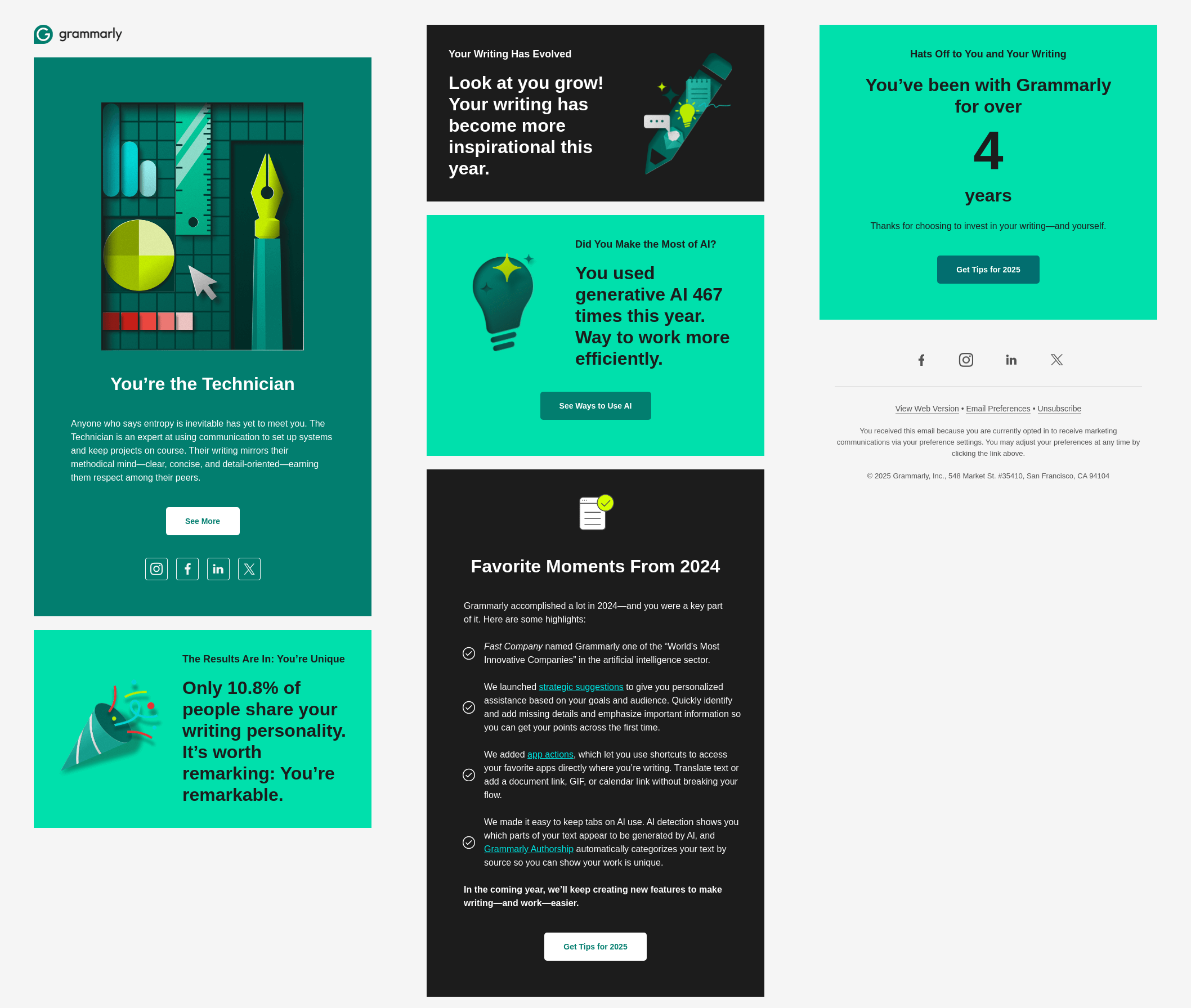
Grammarly sends each user a weekly snapshot of their personal writing activity, showing word counts, accuracy rates, and comparative rankings against Grammarly’s full user base. The email delivers data the user cannot access anywhere else, making it genuinely worth opening every week. Personalized performance data as a recurring email format creates an open habit that builds brand touchpoints without feeling like marketing. For B2B products that generate user-level data, turning that data into a personalized weekly summary is one of the highest-engagement recurring email formats available and requires no additional product development once the data pipeline is in place.
33. Adobe’s Personalized and Automated Campaigns
Adobe operates its email marketing through a full personalization stack: segmentation by user type and product, lead scoring to prioritize high-value contacts, targeted messaging per product line, A/B testing on subject lines and content, and behavior-triggered sequences that respond to actions within the Adobe ecosystem. The result is an email program that feels individually tailored at scale. For B2B companies with large customer databases, the right approach is to build this infrastructure incrementally, starting with behavioral triggers before moving to lead scoring, since each layer compounds the lift from the previous one.
34. Twitter’s Curiosity-Driven Engagement Email

Twitter’s email opens with a specific data point: how many times the recipient’s account was mentioned during a recent period. The curiosity hook is personal and precise, driving opens because the subject line implies information the reader cannot access without clicking. For B2B companies that track any kind of engagement data for their users, surfacing a specific personal metric in the subject line reliably lifts open rates relative to generic performance summaries. The key is making the data feel exclusive and individually relevant rather than a batch stat applied to everyone.
35. Clara CFO Group’s PPP Loan Information Email

Clara CFO Group sent a time-sensitive email containing specific PPP loan guidance that their small business audience could not easily find in one place elsewhere, positioning the firm as a trusted advisor at a high-stakes moment for their clients. The email converts expertise into relationship capital without a sales ask, knowing that trust established during a moment of genuine need pays dividends in future conversions. For B2B professional services firms, sending actionable guidance during industry moments of urgency or uncertainty is among the most effective relationship-building tactics available.
36. Mint’s Service Reminder Email

Mint uses a minimalist design and a single-focus message to remind users about credit score monitoring, with visuals that reinforce the email’s purpose without adding distraction or competing calls to action. The restraint is the strategy: a single-focus email on a single-benefit topic converts better than a multi-topic message because it does not split the reader’s attention. For B2B companies with multiple products or services, sending separate focused emails for each capability consistently outperforms omnibus newsletters that aggregate everything and ask the reader to self-sort.
Seasonal, Timely, and Milestone Email Examples
Timing transforms relevance. An email that arrives at the exact moment its content is useful outperforms the same email sent two weeks later by a factor that no amount of copywriting can close. These seven examples use calendar timing, product milestones, and seasonal relevance to make the same message land harder than it would on any random Tuesday.
37. Meltwater’s End-of-Year Recap Email

Meltwater’s year-end email surveys the company’s most significant accomplishments and links to content marketing resources clients can use for their own end-of-year reporting. The format serves two purposes simultaneously: it reinforces Meltwater’s value as a partner and delivers tangible tools with immediate utility. Year-end recap emails that frame company achievements in terms of client benefit outperform those that simply celebrate internal milestones, because they answer the reader’s implicit question: “So what does this mean for me?”
38. Mutual of Omaha’s Holiday Greetings Email

Mutual of Omaha’s holiday email contains no product promotion, pricing, or call to action. It exists entirely to maintain the relationship, which makes it highly effective at exactly that. Holiday emails that stay free of sales language stand out in a crowded inbox because virtually every other message arriving the same week is trying to close something. Sending something with no agenda communicates confidence in the relationship and creates goodwill that translates into lower churn and warmer reception for the next commercial message.
39. Writer’s Co-Op Season Launch and Promo Email

Writer’s Co-Op combines a season-two announcement with a 50% off promo code, creating both a narrative event and a financial incentive in a single email. The structure gives the message forward momentum: the announcement creates context, and the promo code creates urgency. For B2B communities or subscription products with content cycles, pairing content news with an economic incentive is an effective mechanism for driving signups from a warm list that already has affinity for the brand.
40. Flywheel’s Year-in-Review Email

Flywheel’s annual recap presents the company’s biggest moments over 12 months as a shared celebration rather than a marketing report. The email reminds clients of the relationship they have invested in and reinforces their confidence in the partnership. Year-in-review emails build retention by making clients feel like stakeholders in the company’s success rather than recipients of a service. The emotional resonance of “look what we built together this year” is consistently underestimated as a retention mechanism in B2B.
41. TurboTax’s Tax Season Educational Email

TurboTax sends educational financial content specifically timed to the tax preparation period, delivering actionable guidance when clients are actively thinking about the problem TurboTax solves. The product connection is present but secondary: the email leads with value and follows with the product as the solution. For B2B companies in any category with predictable seasonal peaks, building an editorial calendar around those moments with genuinely useful content is one of the highest-return email strategies available because the timing does work no amount of copy can replicate.
42. Trello’s Milestone Celebration with Feature Update

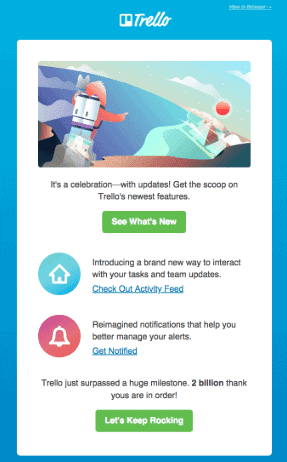
Trello’s email celebrates a specific company milestone while integrating a product feature announcement into what begins as a brand story. The milestone creates emotional context; the product update creates forward momentum. Using company news as the frame for a product announcement positions the update as earned rather than promotional, because the milestone establishes that the company has been busy building something worth celebrating. Goodwill generated by a celebration landing on a product announcement consistently outperforms a standalone feature email.
43. Dropbox’s Tax Season Relevance Email
Dropbox connects the seasonal stress of tax document organization to its file storage capabilities, expanding how clients perceive the product beyond its most common use case. The seasonal framing creates relevance at exactly the moment the described problem is most acute. For B2B companies whose products solve problems that intensify at specific times of year, seasonal emails that name the problem directly before presenting the product as a solution consistently outperform evergreen product messaging. Timing is a force multiplier on relevance.
Brand-Building, Offer, and Support Email Examples
Not every email in a B2B sequence needs to advance a sale. Some of the most effective campaigns in this category build brand equity, establish community, and lower the barrier to first contact by leading with value rather than an ask. These eight examples show what that looks like across different categories and company sizes.
44. eROI’s Company Values Email

eROI’s “Dare to Be Kind” campaign dedicates an entire email to brand values rather than product promotion, inviting clients to join a movement around kinder and more purposeful email communication. The message works because it is differentiated: most B2B emails are transactional, and an email that asks nothing in return while making a clear brand statement stands apart in any inbox. For companies whose values are genuinely distinct from competitors, expressing them directly through email builds the kind of brand affinity that advertising cannot manufacture at any budget.
45. Obviouslee’s Free Client Services Offer

Obviouslee captures attention by offering real monetary value upfront, free PR agency services for small businesses, delivered with a playful tone that references the Fresh Prince of Bel Air. The offer is substantive enough to cut through inbox noise, and the tone ensures it does not read like a standard contractor pitch. Offers that provide genuine value without asking for anything in return work because they reverse the typical power dynamic of a B2B sales email. The company takes a risk to build trust, and that risk-taking is itself a differentiator in a category full of safe messaging.
46. Dulles Designs’ Custom Stationery Walkthrough

Dulles Designs translates a physical customization process into an email experience by laying out the steps clearly and keeping the message focused and brief. The email communicates the premium nature of the product while respecting the reader’s time, demonstrating that high-end positioning does not require long-form copy. For B2B companies selling customizable or complex offerings, step-by-step process emails reduce pre-purchase uncertainty, which is one of the most common barriers between a qualified lead and a first conversion.
47. Squarespace’s Training and Support Email

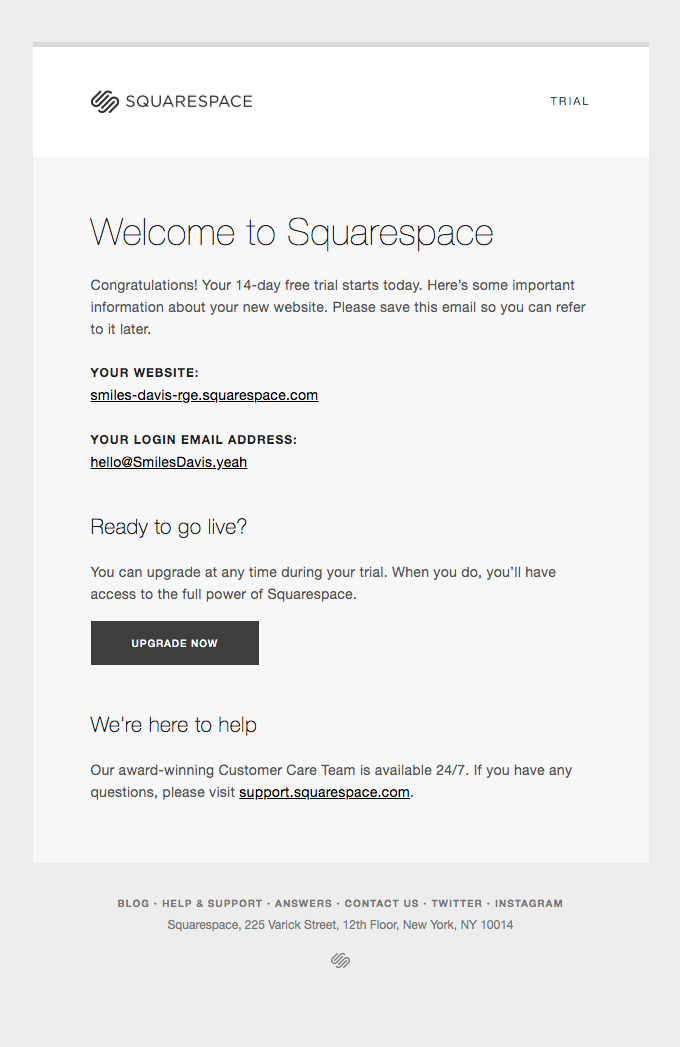
Squarespace’s email demonstrates commitment to customer success by making training webinars, getting-started guides, and direct support team contact all available in a single message. The email communicates that the company will remain a resource after the sale, which is a meaningful signal for B2B buyers who evaluate vendors partly on their post-purchase reputation. Relationship-focused emails that surface support resources at the right moment in the customer lifecycle reduce churn by reinforcing the value of the relationship already established.
48. Tailor Brands’ Survey Request with Incentive

Tailor Brands improves standard survey response rates by specifying exactly how long completion takes and offering an explicit incentive for participation, addressing the two most common objections to survey engagement: time cost and perceived value of participation. Both elements lower the decision friction before the ask lands. For B2B companies that rely on customer feedback for product development or NPS tracking, adding a time estimate and a concrete incentive to survey emails significantly increases response rates and improves the quality of the data collected.
49. BounceX’s Partnership Announcement

BounceX announces a new collaboration by leading with the visual identity of the partnership before explaining the content value, creating recognition before explanation. The announcement demonstrates that BounceX operates at the partnership level with companies the reader already respects. Partnership announcement emails work because they transfer credibility: being associated with a trusted brand signals that you belong in that same tier. The email generates both awareness and association value in a single send.
50. Slack’s Team Growth Email

Slack uses its core product mechanic, team collaboration, as the premise for an email that encourages existing users to invite colleagues and grow their workspace. The copy is brief and the CTA is singular: invite your team. For B2B products with network effects, reactivating growth through existing users is more efficient than acquisition campaigns, and a single-CTA email focused entirely on the invitation mechanic is the cleanest execution of that strategy. Every additional CTA would split attention and reduce the invitation conversion rate.
51. Clear’s Free Guest Pass Email

Clear combines a free guest pass offer with a seasonal hook, arriving at a time when its audience is actively thinking about travel and security line friction. The offer removes the financial barrier to trial entirely, relying on the product experience to convert new users to paid subscribers. For B2B companies with strong products that suffer from adoption friction, an unconditional free trial or guest access email removes the last objection standing between awareness and action, and the conversion from trial to paid is determined by the product, not the email.
What Makes a B2B Email Campaign Effective?
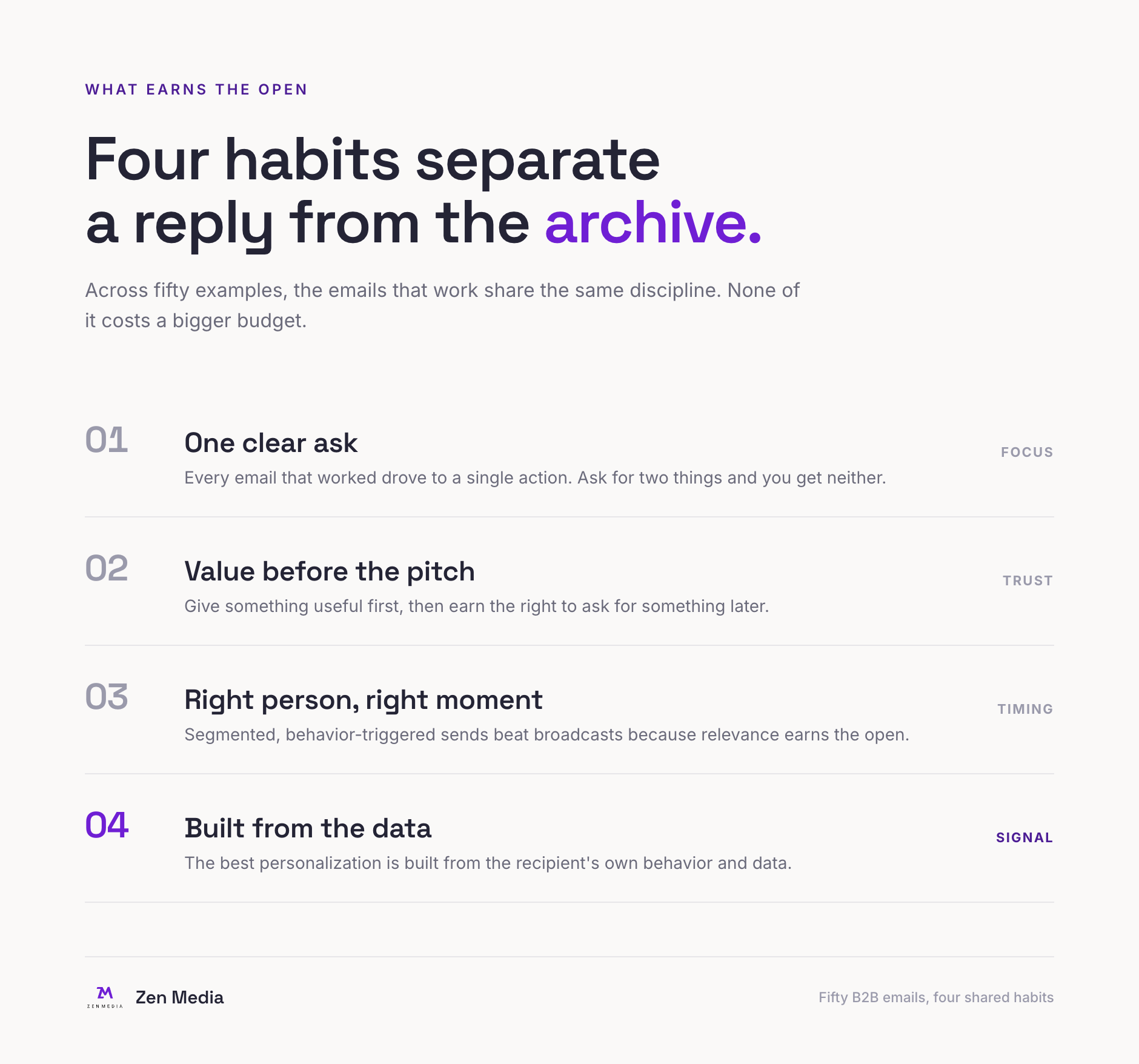
Every example in this guide demonstrates at least one of the following principles. The strongest ones demonstrate several simultaneously. The pattern is consistent across categories, company sizes, and campaign types.
- Timing over frequency. The emails that perform best arrive when the recipient most needs them. Behavior-triggered sequences based on what users have or have not done outperform scheduled send cadences, because relevance is a function of timing, not just message quality.
- One clear ask. B2B emails with a single CTA consistently outperform emails with multiple competing actions. Every additional CTA splits reader attention and reduces the probability that any single action gets taken.
- Value before ask. The highest-converting sequences offer something genuinely useful before requesting action. The offer does not need to be large. It needs to be relevant and immediately useful to the reader’s current situation.
- Specificity in subject lines. “Your weekly writing insights” outperforms “Check out your Grammarly stats.” The subject line is the only variable that determines open rate, and specificity creates anticipation in a way that generic phrasing never does.
- Personalization through behavior, not just name. Most of the lift from personalization comes not from inserting first names but from sending emails that reference what the specific recipient has done or not done. Behavioral triggers deliver the majority of personalization value with a fraction of the data infrastructure.
Frequently Asked Questions
What is B2B email marketing?
B2B email marketing is a digital strategy in which businesses communicate with other businesses through targeted email campaigns to generate leads, nurture prospects through long purchase cycles, educate existing customers, and retain accounts. Unlike B2C email, B2B campaigns address multiple stakeholders within the same organization, require more evidence-based messaging, and operate on longer conversion timelines where a single email rarely drives a decision but a well-sequenced program builds the trust that eventually does.
How effective is email marketing for B2B companies?
Email is consistently the highest-ROI digital channel in B2B. According to Litmus’s 2025 State of Email Survey, email delivers an average return of $36 for every $1 spent, higher than paid search, display, or social media. 81% of B2B marketers incorporate email into their core marketing strategy, and 73% of B2B buyers name email as their preferred channel for business outreach, more than double the preference for phone (39%) and events (31%).
What types of emails work best in B2B?
The most effective B2B email types are behavior-triggered sequences (based on specific user actions or inaction), educational content emails, event and webinar invitations, personalized product updates, and reengagement campaigns for lapsed users. High-performing welcome sequences rank as the single highest-converting email type for B2B companies with free trial or onboarding models. The 51 examples in this guide demonstrate all of these categories across real campaigns from companies including Buffer, HubSpot, Atlassian, Salesforce, Grammarly, and Adobe.
How do you personalize B2B email campaigns?
Start with behavioral triggers: send emails based on what contacts have or have not done, such as signing up but not logging in, or downloading a whitepaper but not requesting a demo. Then add segmentation by company size, industry, or product usage tier. Finally, layer in dynamic content that references the recipient’s specific account data. Each step compounds the lift from the previous one, and behavioral triggers alone deliver most of the personalization benefit without requiring a complex CRM or data infrastructure to get started.
What is a good open rate for B2B email marketing?
According to MailerLite’s benchmark analysis of 3.6 million campaigns, average open rates for B2B-adjacent sectors in 2025 are Consulting (45.96%), Business and Finance (43.34%), Legal (42.58%), and Software (39.31%). Note that all industry open rate figures since 2021 are partially inflated by Apple Mail Privacy Protection, which automatically pre-loads email images for users who opt in. Treat open rate as a directional signal rather than an absolute performance metric, and use click-to-open rate and conversion rate as the primary measures of email effectiveness.
How often should B2B companies send marketing emails?
Frequency depends on content quality and audience expectation. For content newsletters, one to two times per week works well for opted-in B2B audiences who have specifically requested educational content. For product updates, behavior-triggered sends outperform scheduled sends because they arrive when the information is most relevant. For prospecting sequences, research suggests four to seven touchpoints over three to four weeks before pausing outreach. The consistent principle across all categories is that quality drives results more than frequency, and sending less with higher relevance always outperforms sending more with lower relevance.
Building a B2B email program that performs at the level of the examples above requires strategy, segmentation, and the kind of creative discipline that treats every send as an opportunity to either strengthen or weaken a relationship.
Want email that actually converts?
Zen Media builds B2B email programs from the ground up: welcome sequences, behavioral triggers, reengagement campaigns, and content nurture tracks designed to shorten sales cycles and retain accounts.
Related: How to Build a Successful B2B PR Strategy | 20 Best Digital Marketing Campaigns and What Made Them Work
About the author: Sarah Evans is Partner and Head of PR at Zen Media, a global B2B PR and marketing agency. With 23+ years in communications, she architects PR strategy, drives earned media initiatives, and helps brands navigate AI-driven visibility. She is a regular contributor to Entrepreneur and has been recognized as a top writer on business and tech.