A decade ago, outsourcing marketing meant covering a headcount gap. ManpowerGroup’s 2026 Global Talent Shortage Survey makes the current reality plain: 72% of employers worldwide cannot fill the skilled roles they need, and sales and marketing ranks fourth among the hardest-to-hire specializations globally, behind only AI development and engineering. If the function you need requires three years of practitioner experience to execute well, what is the realistic timeline for building that capability from scratch?
The range of functions being outsourced has expanded alongside that talent reality. Marketing now requires dedicated expertise in earned media, AI visibility, content architecture, and paid optimization: specializations that generalist teams take years to develop. An agency running your content or PR program shapes your brand visibility, pipeline, and market position. That scope requires a more rigorous selection process than standard vendor procurement typically delivers.
Why B2B Companies Outsource Marketing in 2026

The ManpowerGroup data reflects a structural change in how organizations view specialized labor. B2B teams have already extracted what they can from headcount-based optimization. The remaining gains come from accessing capabilities that are genuinely scarce in the hiring market: AI visibility strategy, high-volume earned media programs, and account-based content at scale. Building those capabilities in-house requires recruiting from a narrow talent pool that specialized agencies are already employing full-time.
Marketing is a growth function being delegated to specialists who produce outcomes at a pace and depth that in-house generalist teams cannot match at comparable cost. When an agency shapes how your brand appears in Google searches, AI-generated summaries, and tier-one press, the evaluation needs to reflect that scope. Their work participates directly in your brand’s public presence, and the selection process should require evidence of specific outcomes.
Employers Unable to Fill Skilled Roles (2026)
Share reporting hiring difficulty (%) / ManpowerGroup 2026 Global Talent Shortage Survey
83%
74%
73%
69%
48%
Percentage of employers reporting difficulty finding qualified candidates. ManpowerGroup 2026 Global Talent Shortage Survey.
Signs It’s Time to Outsource B2B Marketing
Outsourcing at the right moment for the right reason produces compounding returns; treated as a reaction to team exhaustion without defined success criteria, it produces activity and invoices. Three specific signals help identify when the conditions are right.
B2B Marketing Functions Worth Outsourcing First
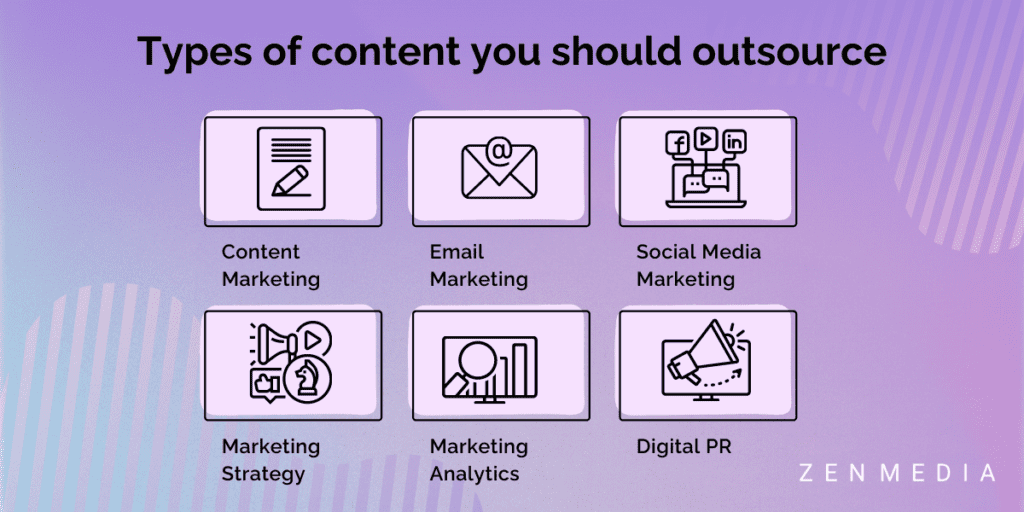
The functions below share a common characteristic: each requires either a specialized tool stack, an existing network of relationships, or years of hands-on execution to perform at a level that moves pipeline. Starting with the channel where your current results are furthest below your market typically produces the fastest visible return.
PR and Earned Media
Earned media programs depend on journalist relationships, editorial calendars, and institutional credibility that takes years to build. An agency running 20 to 50 active campaigns simultaneously has the pitch history, source database, and outlet knowledge that makes a placement in a tier-one publication reachable on a defined timeline. For B2B brands, earned media also feeds AI-generated summaries: publications that cite your brand and link to your content are a direct input into how AI answer engines position you relative to competitors.
Content Marketing
Content at the volume and quality needed to build organic authority requires full-time writers, editors, SEO practitioners, and a structured production system. Outsourcing to a specialist content and SEO agency or a combination of a strategist plus freelance writers typically produces faster ranking movement than an in-house team building its process from the ground up. The critical handoff to get right: brand voice documentation before any external team writes a single word. See Zen Media’s B2B content marketing strategy guide for a framework on setting this up.
Social Media
Platform algorithm management, content production cadence, and community engagement each require dedicated attention to stay current. B2B brands that limit social to scheduled posts, skipping active engagement management, miss the algorithmic signals that drive reach. The value of a specialist social media partner is the combination of content production, posting infrastructure, and platform-specific optimization: elements that a part-time in-house role covers inconsistently.
Outbound Email
Enterprise-volume cold outbound requires dedicated sending infrastructure, domain management, deliverability monitoring, and response handling workflows. Building this internally from scratch carries real technical risk: a misconfigured SPF record or an aggressive initial send volume can damage domain reputation permanently. Agencies running outbound email programs at scale have the infrastructure already in place and the pattern recognition to avoid deliverability failures before they occur.
SEO and AI Visibility
Technical SEO, content architecture, and AI visibility optimization are three distinct specializations that increasingly need to function as one program. AI answer engines pull from authoritative, well-structured content to generate responses to search queries; the brands cited in those responses build compounding visibility advantages. An agency focused on this combination produces outcomes a general SEO contractor working alone cannot replicate. For a detailed breakdown of tools that support this, see Zen Media’s B2B AI marketing tools guide or the SEO and content optimization service overview.
Paid Media
Paid search, paid social, and programmatic each require active management to avoid budget waste from poor targeting, creative fatigue, and bidding inefficiencies. An agency managing multiple B2B accounts simultaneously accumulates bidding data and creative performance patterns that a single in-house account does not generate fast enough to act on. The compounding advantage here is in optimization speed: more data, more frequently applied. Zen Media’s paid media and SEM service brings that cross-account pattern recognition to each client program.
Zen Media runs outsourced programs across all six functions above for B2B brands at different growth stages. Three examples from the agency’s work in social media, PR, and outbound email show what that infrastructure delivers in practice:
A Seven-Step Process for Outsourced B2B Marketing
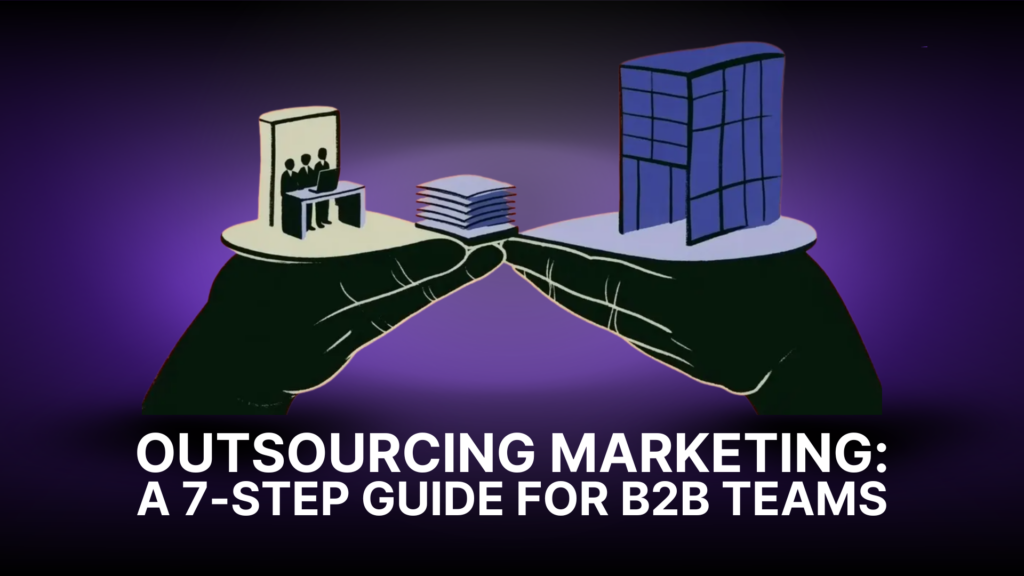
How many agency retainers have started with a polished pitch deck and ended with a 90-day invoice for deliverables that never touched pipeline? The most expensive outsourcing mistakes happen in the first 90 days. An agency without a clear brief produces work that needs to be rebuilt. A client without defined success metrics has no basis for evaluating whether a program needs adjustment or just needs time. The following seven steps address the structural problems that cause those failures.
| Attribute | Full-Service Agency | Specialist Firm | Freelancer |
|---|---|---|---|
| Best for | Multi-channel integrated programs | Deep expertise in one channel | Project-based or fractional work |
| Billing | Monthly retainer | Monthly retainer | Hourly or project |
| Account ownership | Dedicated team lead | Lead + support staff | Direct with individual |
| Scalability | High | Moderate | Low |
| Typical cost | $8K–$25K/month | $3K–$10K/month | $75–$250/hour |
Five Questions to Ask Any Agency Before the Retainer Starts
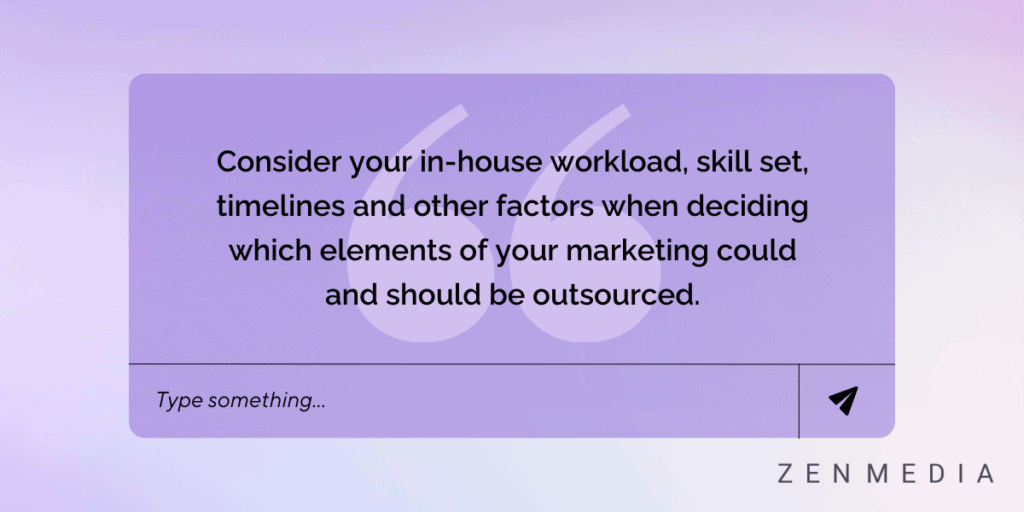
B2B agency evaluations consistently stop at the pitch deck: logos, summaries, and proposed deliverables. Team structure, reporting depth, adaptive process, and crisis response protocols go unexamined. These five questions close all four gaps.
1. Can you show me three clients in our vertical who have been with you for at least 12 months? A portfolio of logos tells you who an agency has worked with. References from long-term clients tell you whether the agency maintains performance quality after the initial engagement. Ask those references specifically: what changed between month 3 and month 12, and what did the agency do when the program needed adjustment?
2. Who runs our account day-to-day, and what is your ratio of senior to junior staff? A common agency practice is to pitch with senior practitioners and deliver day-to-day work via junior staff. Ask to meet the person who will manage your account before signing. Understand whether that person is shared across multiple accounts and what their capacity looks like. The seniority of your day-to-day contact correlates directly with the quality of strategic judgment on your account.
3. Can I see a sample report from an active client? Request an example of the reporting format they use. Look for: metric specificity (qualified leads, conversion rates, and pipeline contribution), trend data across multiple reporting periods, and analytical commentary that draws conclusions from the numbers. Reporting that lists metrics without interpretation signals an agency without a consistent analytical process.
4. What is your process when a campaign underperforms in the first 60 days? Every program runs into early obstacles. Agencies with a defined adaptive process: a specific trigger for review, a defined escalation path, and a documented protocol for testing alternatives, handle underperformance better than agencies that respond reactively. An agency that does not have a clear answer to this question has not built the systems to manage it.
5. Do you document your process and return materials if the engagement ends? Agencies that withhold process documentation, brand assets, or contact data at the end of an engagement create a dependency risk. Before signing, confirm in writing: all content, creative, contact lists, and process documentation belong to your company. This protects your program regardless of how the relationship ends.
Working with the right outsourced partner for your current stage produces results that compound over time: media relationships deepen, content authority builds, and paid programs optimize toward better-fit buyers. If you want to discuss what an outsourced B2B marketing program looks like for your organization, contact Zen Media to start the conversation.
Frequently Asked Questions About Outsourcing Marketing
What does outsourcing marketing mean?
Outsourcing marketing means contracting external specialists to run specific marketing functions, including content creation, PR, paid advertising, social media, and email outreach. The external team operates as an extension of your in-house staff, delivering results that depend on tools, media relationships, and subject matter expertise your team does not currently have.
When should a B2B company outsource marketing?
Three signals warrant outsourcing: your team is at full capacity and adding a full-time hire takes longer than the opportunity window allows; you need a specialized skill such as earned media, technical SEO, or AI visibility that requires years to build internally; or you are preparing for a growth phase that demands speed your current team cannot deliver.
Which marketing functions should you outsource first?
Functions that require specialized tools, media relationships, or deep practitioner experience deliver the fastest return when outsourced. PR and earned media, content marketing, social media, outbound email, technical SEO, and AI visibility optimization are the most commonly outsourced B2B marketing functions. Start with the channel where your current performance is furthest below your market.
How do you choose the right marketing agency?
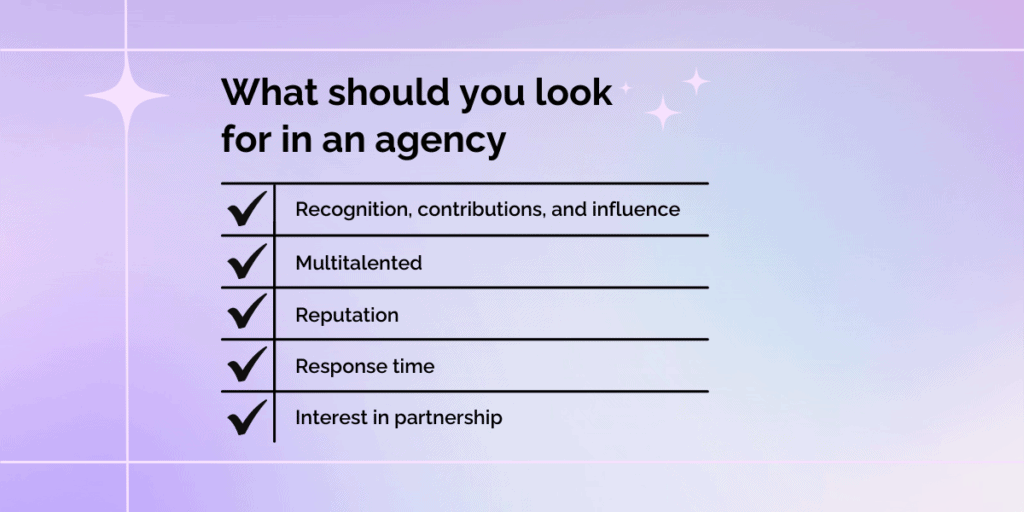
Evaluate agencies on five criteria beyond the pitch deck: documented results in your vertical with specific metrics, transparent team structure showing who runs your account day-to-day, a defined reporting cadence agreed before onboarding begins, a clear process for adjusting campaigns when early performance data arrives, and references from clients at least 12 months into the engagement.
What does outsourcing marketing cost?
Full-service B2B agency retainers typically run $5,000 to $20,000 per month depending on scope and channel mix. Specialist agencies for a single function such as SEO or PR generally start at $3,000 to $8,000 per month. Freelancers charge $75 to $250 per hour for specialized work. The most useful frame is cost per qualified outcome, not cost per hour.
What are the biggest risks of outsourcing marketing?
Brand voice drift, ROI opacity, and vendor dependency are the three most common failure modes. Brand voice drift occurs when the agency writes without deep product knowledge. ROI opacity happens when agencies report vanity metrics instead of pipeline contribution. Vendor dependency develops when agencies withhold process documentation. Contracts with defined metrics, brand voice guidelines, and transparency requirements reduce all three.
How do you measure ROI on outsourced marketing?
Set measurement criteria before signing. For content: organic traffic and keyword rankings at 90 and 180 days. For PR: earned media placements, share of voice, and coverage tier. For paid: cost per qualified lead and pipeline contribution. For email outbound: positive reply rate and qualified conversations per thousand contacts. Agencies that won’t commit to specific metrics before signing are a red flag.
Zen Media is a global B2B PR and marketing agency that has run outsourced programs for B2B brands across technology, financial services, healthcare, and manufacturing since 2004. The agency’s current practice spans earned media, AI-era visibility, social media, and integrated pipeline programs designed to compound over time.
About the author: Sarah Evans is Partner and Head of PR at Zen Media, a global B2B PR and marketing agency. With 23+ years in communications, she architects PR strategy, drives earned media initiatives, and helps brands navigate AI-driven visibility. She is a regular contributor to Entrepreneur and has been recognized as a top writer on business and tech.