Building a Scalable Outbound Acquisition Engine Without Breaking Deliverability, Conversion Efficiency, or Sales Operations
The Business
Pilot operates in one of the most competitive B2B environments in SaaS and financial services, where outbound performance cannot be judged by send volume or reply activity alone. The company needed outbound to function as a scalable acquisition system, one capable of producing qualified conversations consistently while protecting infrastructure stability, deliverability, and visibility across the funnel.
Like many high-growth companies, Pilot faced a problem that often hides behind healthy-looking dashboards. Volume was achievable, but pipeline quality was not guaranteed. Replies could appear valuable in reports without giving sales teams enough qualified intent to convert.
Cold email had also become harder to trust across B2B. Too many outbound programs follow the same pattern: aggressive volume, weak targeting, damaged sender reputation, and poor sales follow-through. As scale increases, the weakest parts of the system usually break first: deliverability, message relevance, data quality, response handling, and attribution visibility.
Pilot needed to prove that outbound could operate under real enterprise pressure without sacrificing conversion quality or damaging long-term infrastructure health.
The Objective
The engagement focused on validating whether outbound could operate as a repeatable and scalable acquisition channel under enterprise conditions.
This meant moving beyond email performance alone. Pilot needed to prove that outbound could support meaningful growth without becoming unstable, noisy, or difficult to measure as sending volume increased.
The primary objectives were to:
- Scale outbound volume without degrading deliverability
- Maintain infrastructure stability under sustained sending pressure
- Improve conversation quality through stronger personalization and audience intelligence
- Give sales teams qualified buying signals instead of noisy inbox activity
- Improve attribution and funnel visibility across the outbound-to-revenue lifecycle
- Build outbound as an operational growth system rather than a collection of disconnected campaigns
Key Business Challenges
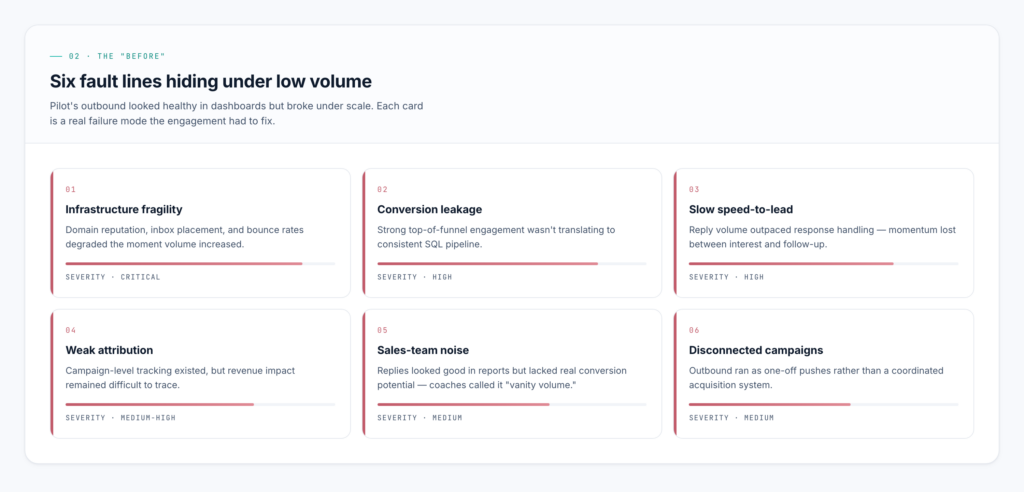
Infrastructure Fragility
At lower sending volumes, outbound infrastructure can appear healthy because the system has not yet experienced enough operational pressure. Once scale increases, weaknesses surface quickly through:
- domain reputation issues
- inbox placement decline
- provider throttling
- rising bounce rates
These problems often compound quietly before leadership realizes the system is deteriorating.
Conversion Leakage
Pilot was already generating meaningful outbound engagement. The deeper issue appeared after those responses entered the funnel. Outbound-to-SQL conversion remained less consistent than inbound performance, which pointed to a gap between early interest and qualified pipeline creation.
Response Handling Pressure
As reply volume increased, speed-to-lead became more important. Positive replies needed to be identified, prioritized, routed, and followed up quickly so high-intent opportunities did not lose momentum inside the handoff process.
Weak Attribution Visibility
Outbound activity was visible at the campaign level. Revenue impact was harder to trace. Fragmented attribution made it difficult to see which audiences, messages, and campaign structures were contributing to downstream pipeline performance.
Sales Team Noise
Outbound needed to create usable buying signals, not just inbox activity. Stronger filtering and routing helped prevent sales teams from being flooded with low-quality responses that looked valuable in reporting, yet had limited conversion potential.
The Strategic Challenge
The challenge was not sending more email. It was building an outbound system that could remain stable, measurable, and commercially useful as complexity increased.
Pilot needed outbound to operate as a coordinated acquisition engine where infrastructure, deliverability, targeting, personalization, response handling, attribution, and sales execution worked together under sustained pressure.
The work became a revenue infrastructure project: deliverability, data, routing, attribution, and sales execution had to perform as one system.
The Strategy
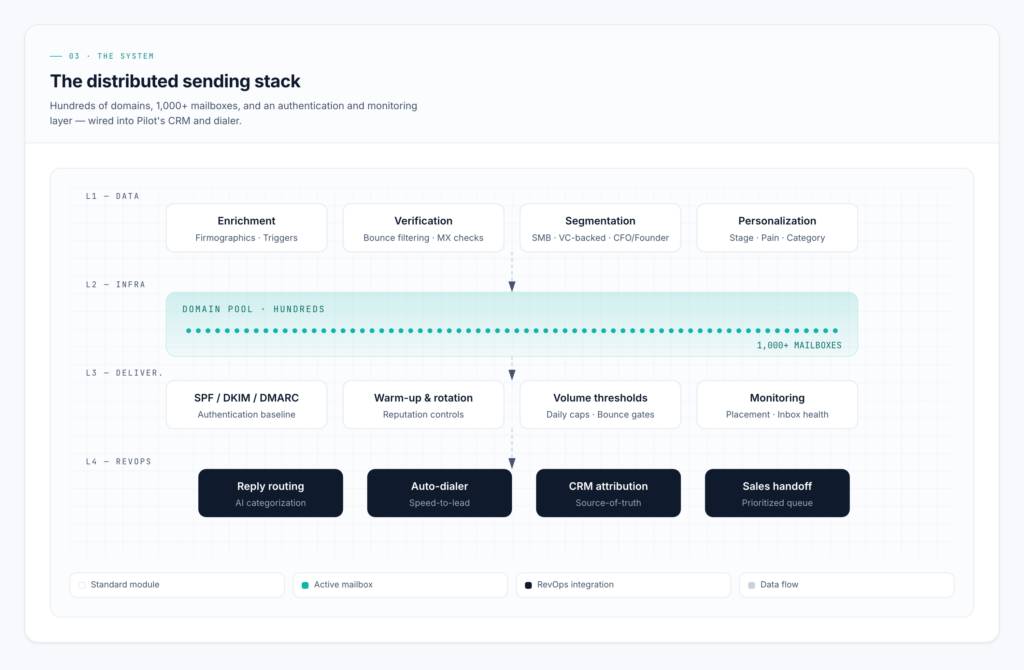
Zen Media approached the engagement as an infrastructure and revenue operations challenge, not a traditional outbound campaign. The goal was to build a system that could support scale while keeping deliverability, targeting, response handling, and sales execution connected.
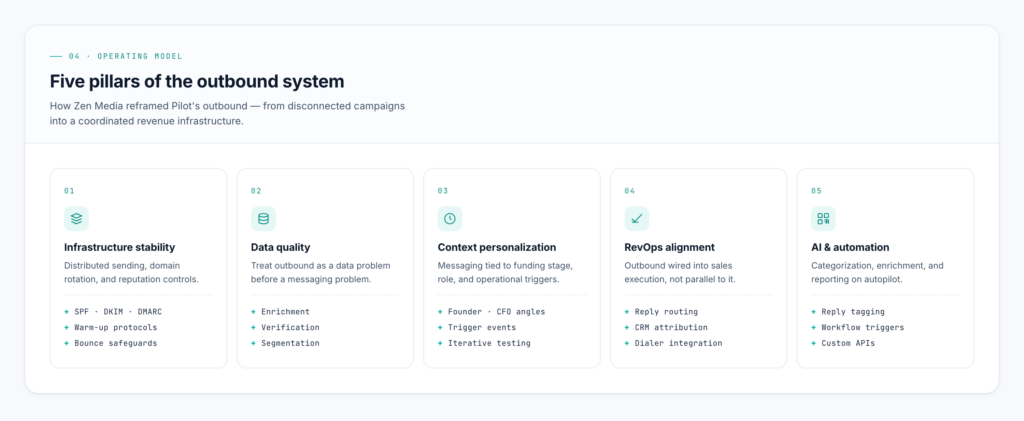
The strategy focused on five core areas:
- Infrastructure stability
- Data integrity
- Contextual personalization
- Operational response handling
- Revenue alignment
Infrastructure Architecture
The outbound environment was engineered as a distributed infrastructure system rather than a traditional campaign setup. The objective was to support sustained outbound scale while protecting deliverability, sender reputation, and long-term infrastructure health.
Zen Media implemented and managed:
- Large-scale domain rotation systems
- Distributed mailbox infrastructure
- SPF, DKIM, and DMARC authentication
- DNS and routing management
- Inbox warm-up protocols
- Sender reputation controls
- Infrastructure monitoring and deliverability protection systems
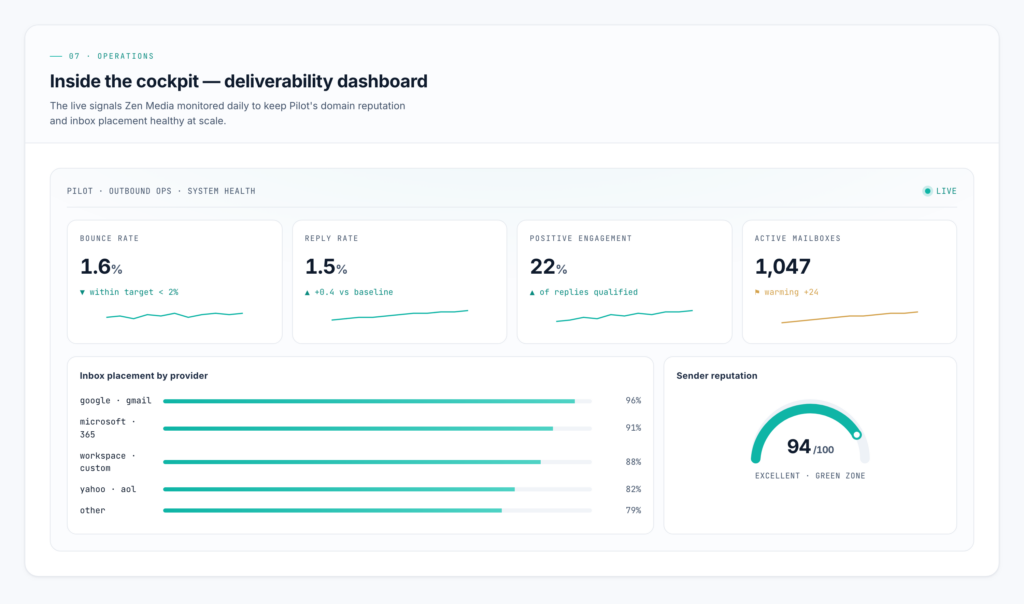
The environment ultimately operated across hundreds of domains and more than 1,000 mailbox endpoints while maintaining controlled sending velocity and operational stability.
To reduce infrastructure risk under scale, strict safeguards were enforced throughout the system, including:
- Controlled daily sending thresholds
- Bounce rate controls
- Plain-text first-touch messaging
- Validated contact requirements
- Continuous monitoring for negative provider signals
These controls were designed to protect long-term domain health while allowing outbound activity to scale under real operating conditions.
Data Quality & Audience Intelligence
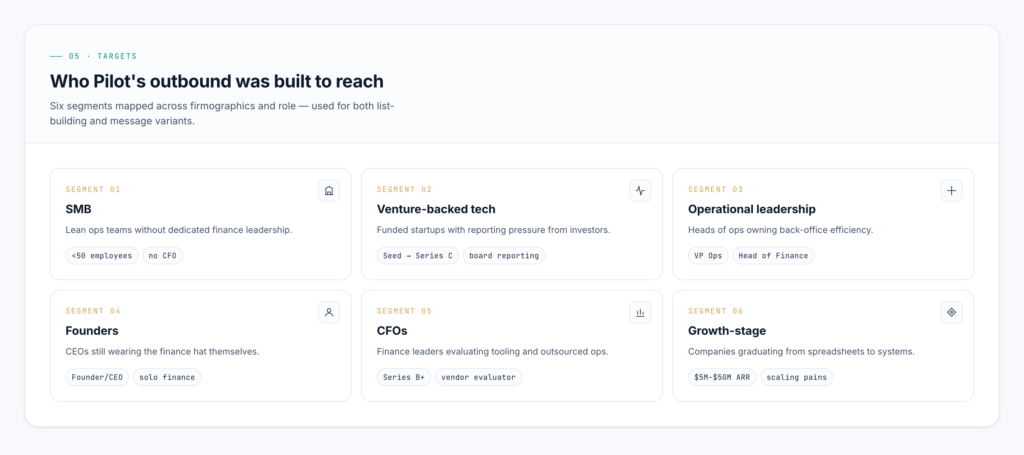
Outbound performance was treated as a data quality problem before it was treated as a messaging problem. Rather than pushing contacts directly into campaigns, Zen Media focused first on improving targeting precision, validation accuracy, and audience segmentation.
Enrichment, filtering, verification, and segmentation workflows were implemented before contacts entered the outbound environment. Company-level and contact-level data passed through multiple validation layers designed to reduce bounce exposure and improve campaign reliability under scale.
Campaigns were segmented across:
- SMB audiences
- Venture-backed technology companies
- Operational leadership roles
- Founders
- CFOs
- Growth-stage organizations
This allowed messaging, positioning, and lead magnets to align more closely with company maturity, operational pain points, and buying intent instead of relying on generalized outreach across broad audiences.
Context-Driven Personalization
The messaging strategy avoided the shallow personalization tactics that weaken many outbound programs. Instead of relying on generic variables or lightly customized industry references, Zen Media built messaging around context that reflected how each audience actually bought, evaluated, and prioritized financial operations support.
Personalization was developed around:
- Company positioning
- Funding stage
- Operational maturity
- Market category
- Financial pain points
- Strategic business triggers
The objective was not simply to increase reply rates. The goal was to create conversations that sales teams could realistically convert into pipeline.
Zen Media also built iterative testing frameworks across:
- Lead magnets
- Audience segmentation
- Funnel positioning
- Founder messaging
- Finance-oriented value propositions
- Operational consulting angles
This turned outbound into a continuously evolving experimentation system, rather than a static set of campaigns that depended on one message or one audience segment to perform.
Revenue Operations Alignment
One of the most important parts of the engagement was connecting outbound activity to downstream sales execution. The system could not stop at generating replies. Positive engagement had to be routed, prioritized, and followed up quickly enough to protect conversion momentum.
The system incorporated:
- Response routing workflows
- Auto-dialer integrations
- CRM attribution planning
- Response prioritization
- Follow-up timing optimization
- Sales handoff visibility
Pilot specifically focused on reducing speed-to-lead delays and improving conversion efficiency between sales stages. Positive replies were prioritized for rapid engagement, helping reduce funnel leakage and improve SQL generation rates.
This moved outbound from a standalone marketing activity into a coordinated revenue operations function.
AI & Automation Layer
The system also incorporated automation and AI-assisted workflows to reduce manual overhead as outbound complexity increased. The goal was not to add automation for its own sake, but to support faster routing, cleaner categorization, stronger enrichment, and more consistent campaign operations.
Automation supported:
- Response categorization
- Contact enrichment
- Workflow triggers
- Routing logic
- Reporting systems
- Campaign experimentation
Custom automations, APIs, enrichment systems, and operational integrations were deployed to help the outbound engine scale without requiring manual effort to increase at the same pace as sending volume.
Results
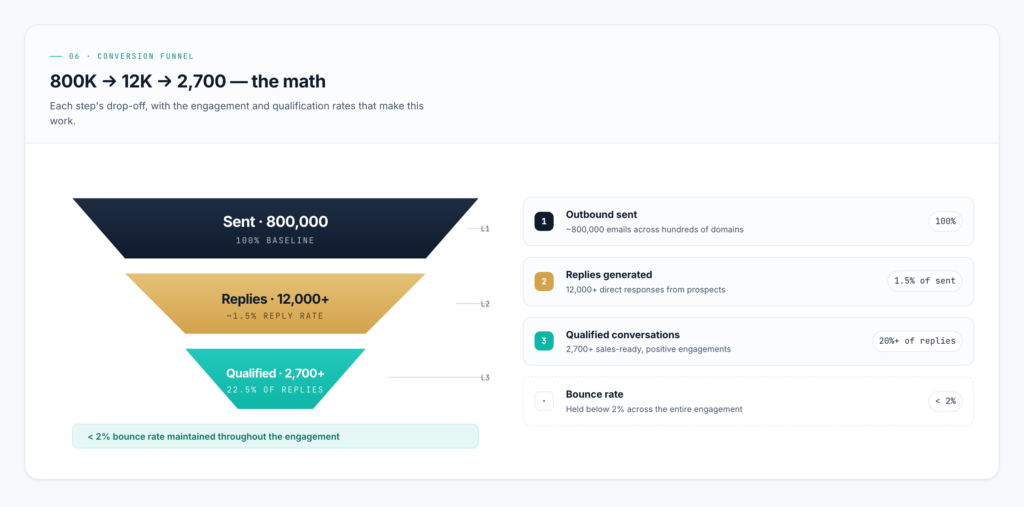
Over the engagement period, Pilot scaled outbound operations across multiple ICPs, campaign types, and market segments while maintaining strong deliverability performance and infrastructure stability.
The system produced measurable performance across both volume and quality.
Key outcomes included:
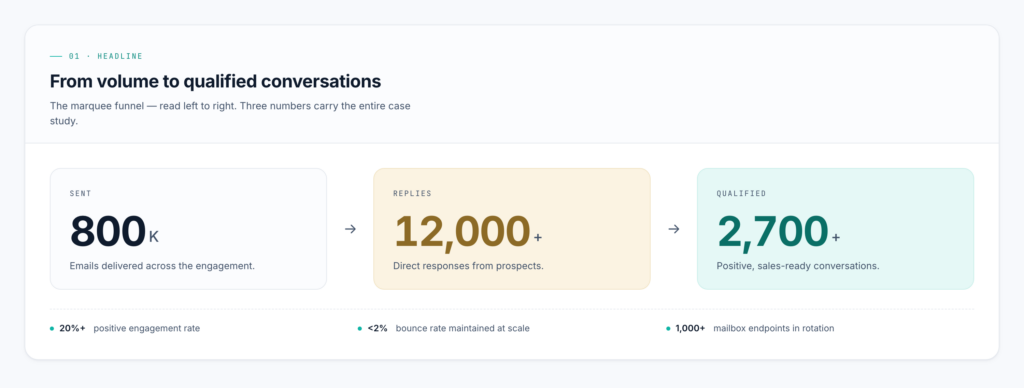
- Nearly 800,000 outbound emails executed across multiple ICPs, campaigns, and targeting angles
- More than 12,000 total replies generated from cold outreach
- More than 2,700 qualified positive conversations with decision-makers
- 20%+ positive engagement across all replies
- Sub-2% bounce rate maintained across high-volume outbound execution
- Hundreds of domains and 1,000+ mailbox endpoints coordinated through the infrastructure layer
- Improved outbound attribution visibility and sales funnel tracking
- Stronger alignment between outbound engagement and sales follow-up workflows
Beyond campaign performance, Pilot also identified a major conversion opportunity inside the funnel. By analyzing the gap between Sales Accepted Leads and downstream SQL conversion rates, the organization gained better visibility into response handling, speed-to-lead, and sales process leakage.
The engagement proved that outbound could operate at scale while protecting infrastructure health, deliverability quality, and sales conversation value.
Strategic Business Impact
Pilot left the engagement with a working outbound operating model, not a temporary campaign win.
Before the initiative, outbound operated largely as a campaign layer. After implementation, it became a measurable, infrastructure-backed acquisition system connected directly to sales operations and conversion optimization.
Pilot gained:
- Stronger visibility into conversion bottlenecks
- Cleaner operational reporting
- Improved outbound attribution
- More reliable sales handoff workflows
- Scalable infrastructure capable of supporting future growth
- Clearer intelligence around audience-level performance
The project also reinforced a broader industry reality: outbound performance rarely breaks because email stops working. It breaks when infrastructure, deliverability, targeting, response handling, and revenue operations are treated as separate functions instead of coordinated systems.
By aligning those layers operationally, Pilot was able to sustain outbound performance under scale while improving deliverability control and sales conversation quality.
The Outcome
Pilot established a scalable outbound operating system capable of supporting long-term acquisition growth without sacrificing infrastructure health, deliverability quality, or conversion visibility.
The engagement gave Pilot a coordinated revenue infrastructure system built around:
- Protected deliverability
- Verified and segmented data
- Context-driven messaging
- Operational automation
- Revenue operations alignment