The Illusion of Visibility: Why Human Metrics Mislead
Most brands believe they are visible because people can find them. They point to press hits, social mentions, analyst quotes, and website traffic as proof that the market knows who they are. The problem begins here, because AI does not see any of this the same way humans do, and today AI is the first filter in how buyers discover and compare solutions.
This creates a quiet but costly gap. The visibility a brand measures is not the visibility AI uses to make decisions.
AI systems do not evaluate reach or sentiment. They do not recognize prestige or familiarity. They rely on structured signals that tell them who a brand is, what category it belongs in, and whether it is safe to include in an answer. When those signals are missing, AI excludes the brand entirely, even if its human-facing visibility looks strong.
Whenever someone asks an AI tool for the top vendors, the leading platforms, or the companies shaping a category, the model returns a shortlist. If your brand is not in that answer, you are not in the consideration set. The buyer does not know you were omitted. They simply move forward with the names they were given.
This is the Illusion of Visibility: believing you are present in the market because humans can see you, while AI, the new gatekeeper, cannot.
Discovery Has Collapsed Into a Single Answer
For years, online discovery meant scrolling through pages of links. Buyers searched, compared, and evaluated across multiple sources. Even brands that ranked lower still had a chance to be noticed. That world has quietly disappeared.
Today most discovery begins with a prompt, not a search query. People ask one question and receive one answer. That answer becomes the entire consideration set. There is no list to scan, no secondary option to explore, and no gradual path from awareness to evaluation. The journey condenses into a single response.
This matters because it rewrites how influence works. Visibility used to mean showing up somewhere on a results page. Now it means being included in the only answer a buyer sees. AI has become the front door to every category. It decides which brands enter the room and which remain invisible.
If your brand is not in that answer, there is no second glance. The buyer does not go looking for alternatives. They accept the result and move on. Discovery collapses, opportunities disappear, and the brands that fail to appear never know they were excluded in the first place.
For executives, this is the shift that defines the next decade. The competition is no longer for rankings. It is for inclusion.
The Invisible AI Layer Shaping Every Buying Journey
Many leaders believe they are not affected by AI driven discovery because they do not personally use tools like ChatGPT or Gemini for research. What they overlook is that AI is now embedded inside the platforms they already rely on. Even when someone does not think they are using AI, the AI layer is still shaping what they see.
Search engines surface AI summaries ahead of traditional results. Productivity tools generate suggested answers and recommendations. CRM platforms pull insights from model driven systems. Buyers encounter AI influence long before they ever realize it is present.
Recent industry research supports this shift. According to a 2025 Digital Commerce 360 report, more than half of tech industry buyers, 56%, now rely on generative AI tools and chat interfaces as a primary source for vendor discovery rather than traditional search or manual vendor lists. This is no longer an emerging pattern, it is the new baseline for how early consideration begins.
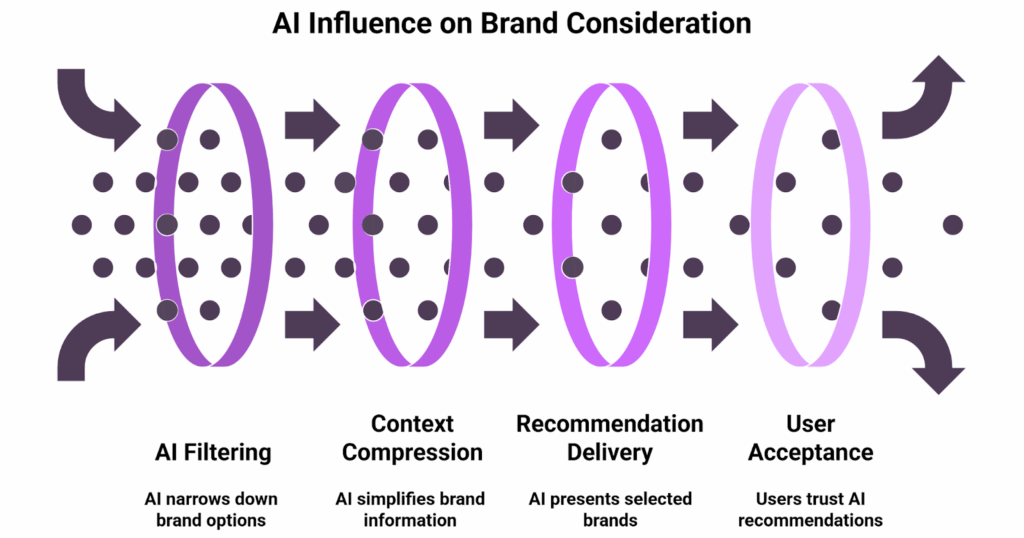
This means AI is already mediating the early stages of consideration for every category. It filters information, compresses context, and presents a narrowed set of options. By the time a human evaluates a brand, the model has already performed its own evaluation.
This layer operates quietly. It does not announce which names it favors or which it excludes. It simply delivers a recommendation with confidence, and most users accept it without questioning the source. Brands that are not recognized by this layer are not competing for second place. They are removed from the field entirely.
Understanding this invisible filter is essential. It explains why strong press coverage, recognizable names, and traditional signals of visibility no longer guarantee presence in the moments that matter. Our deeper breakdown on how GenAI press releases shape brand narratives across AI search and media explores this shift even further.
Why Most Brands Disappear Inside AI Systems
Traditional PR visibility does not translate into AI visibility. A brand can earn strong coverage, appear in respected outlets, and build solid reach, yet remain entirely absent when an AI system answers a category question. The reason is structural, not editorial. AI does not treat all coverage as equal.
To recognize and reuse information, AI systems need signals they can verify. They need structure they can interpret. They need context so they can link back to a stable source of truth. Most earned media does not provide this. A compelling feature may influence human perception, yet offer nothing a model can classify or reference.
Prestige does not solve the problem. Many top tier outlets remove outbound links, convert them to no follow, or publish in formats that fall outside the ingestion pathways models rely on. The article still matters to humans, but for machines it becomes a dead end. It cannot reinforce a brand’s category position or influence how the model evaluates future prompts.
This is why so many brands appear confident on the surface yet invisible inside AI systems. The story is not the issue. The structure is. Without the specific signals AI needs, even the strongest human facing visibility fails at the exact moment the model decides which brands to include.
For executives, this is the uncomfortable truth: If AI cannot use your coverage, it cannot see you. And if it cannot see you, it cannot include you.
GenAI Referenced Media: The Earned Coverage AI Can Use
GenAI Referenced Media is the small subset of earned coverage that AI systems can ingest, interpret, and reuse. Most media does not qualify. To influence machine generated answers, coverage must include the structural elements models rely on for classification.
A publication qualifies as GenAI Referenced Media only when it meets three requirements:
- Ingestion: Its content must flow through the trusted data sources that feed AI knowledge pipelines, including Google News indexation and structured syndication networks.
- Referencability: The article must include a deep do follow link that points directly to an authoritative, brand owned page. Without this link, the model cannot connect the narrative back to the brand.
- Persistence: The outlet’s content must appear, or be likely to appear, in AI summaries, recommendations, contextual results, and reasoning traces across major models.
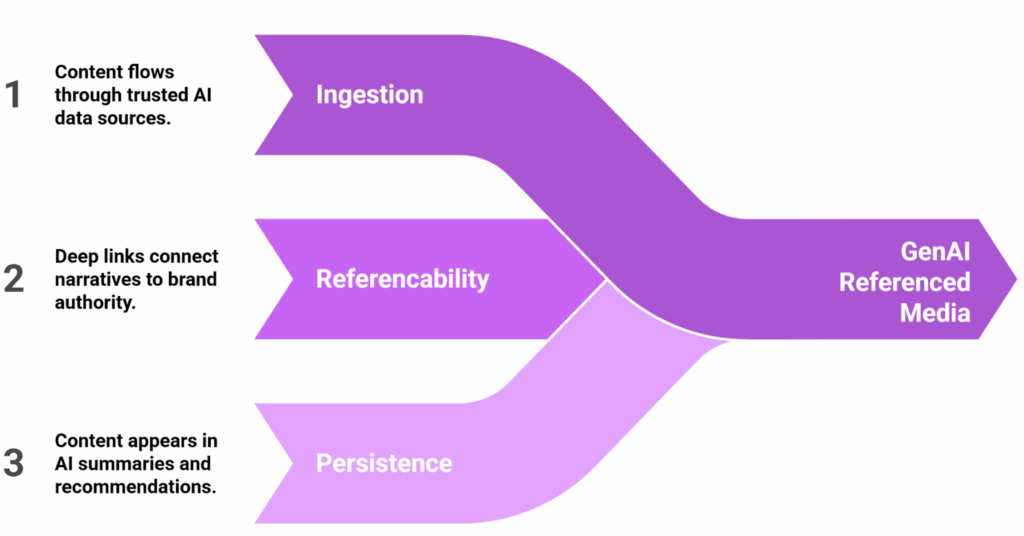
When these conditions align, the placement becomes more than a story. It becomes a machine readable signal that teaches AI who the brand is, which category it belongs in, and when it should be included as an example. This is the foundation of AI era visibility.
Once these signals are in place, the next question is whether they are making a measurable difference. Traditional PR reporting cannot answer this, because impressions and reach do not reveal how AI interprets a brand. New metrics are required to understand whether the brand is gaining visibility inside model driven environments.
Two metrics provide that clarity. Prompt Discovery Index shows whether a brand appears when AI is asked direct category questions. Answer Share shows how consistently the brand is recommended relative to competitors. Together, they reveal what traditional reporting hides: whether the brand is recognized by the systems shaping discovery.
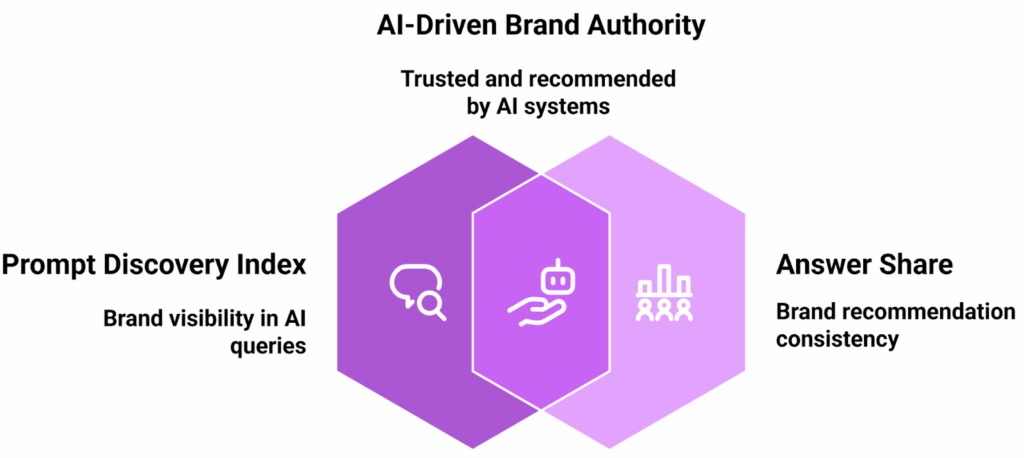
GenAI Referenced Media is not a new version of PR or SEO. It is a classification based on a single outcome: “Does this placement influence what AI says about the brand?”
The Signals AI Needs Before It Can Name Your Brand
GenAI Referenced Media creates the signals AI depends on, but those signals only matter if they help the model answer a simple question: who belongs in this category. To make that determination, AI looks for a specific set of structural cues that allow it to classify a brand with confidence. These cues are straightforward, but most brands do not produce them consistently.
What helps AI understand your category position?
A clear pillar page that defines the category in factual, structured terms. This page acts as the brand’s source of truth. It tells the model what space you operate in, which problem you solve, and how you describe your market.
How does AI connect earned coverage back to your brand?
Through a deep do follow link that points directly to the pillar page. This link is how the model verifies that the narrative in the article matches the definition on your site. Without it, the placement cannot reinforce your category position.
Which outlets influence AI visibility?
Only outlets that AI ingests. These publications feed the structured data pipelines that models use to build and update their internal understanding. Coverage published outside these ecosystems does not reach the model at all.
When these three signals align, AI has enough structure to classify the brand and include it when responding to category level prompts. When even one is missing, the model has no reliable basis for naming the brand, regardless of how strong the human facing visibility may be.
Why Prestige Media No Longer Drives AI Visibility
Prestige coverage influences reputation, but it rarely influences AI reputation. A major publication can feature a brand prominently, and the article can still have no generative impact. The reason is structural, not editorial. AI cannot use coverage that lacks the signals required for ingestion, verification, and classification.
Many top tier outlets remove outbound links, convert them to no follow, or route them through generic landing pages. They also publish in formats that fall outside the ecosystems AI relies on for training and retrieval. The story may resonate with human audiences, but for machines it becomes unusable. It carries no authority for classification and cannot reinforce a brand’s category position.
Mid tier and vertical outlets, on the other hand, often provide what AI needs. They allow deep links, maintain consistent structure, and participate in the syndication networks that feed model knowledge bases. These outlets do not replace prestige media, they serve a different purpose: they shape machine understanding.
Brands that rely solely on flagship coverage often assume they are securing long term visibility, yet their names never reach the systems shaping discovery. Human exposure remains important, but machine recognition now determines whether a brand appears in the moments where decisions begin.
The Closed Loop That Determines Inclusion in AI Answers
Once the right signals are in place, AI begins forming its internal understanding of a category. This happens through a simple but rigid loop. The model ingests the article from an outlet it trusts. It follows the deep link to the pillar page on the brand’s site. It compares the narrative in the article with the information on the page. Together, these inputs allow the model to classify the brand accurately.
As this loop repeats across multiple placements, the model becomes more confident about where the brand belongs. It learns which companies solve which problems, which categories they fit into, and which names are safe to present when a user asks a direct question. No single placement creates this shift. The consistency of signals is what makes the model treat the brand as part of the category.

If the loop is incomplete at any point, the model cannot close the classification process. It may ingest the article but find no authoritative page to confirm the brand’s position. It may reach the page but lack coverage that ties the brand to the category. It may have both assets but lack ingestion from a source it recognizes. In any of these scenarios, the brand remains outside the answer.
This loop determines inclusion. It dictates which companies appear in AI generated shortlists and which remain invisible, regardless of traditional visibility or name recognition. The brands that show up are not always the ones with the most coverage. They are the ones that provide the clearest and most consistent signals for the model to use.
What Brands Must Do to Build AI Visibility Now
Becoming visible inside AI systems does not require a full strategic overhaul. It requires creating the right signals and delivering them consistently. The first step is choosing the category you want to be discovered for. Every downstream action depends on that decision. Once the category is defined, the brand needs a pillar page that explains it clearly, factually, and in language a model can classify.
From there, attention shifts to coverage. The goal is not volume. It is securing placements in outlets that AI ingests and ensuring each placement includes a deep do follow link that points directly to the pillar page. That link allows the model to connect narrative to source and reinforces the category position each time it appears.
Progress is measured by whether these signals begin to influence AI outputs. Prompt Discovery Index shows whether the brand appears when AI is asked direct category questions. Answer Share shows how often it appears relative to competitors. Both metrics confirm whether the brand is entering the model’s internal map.
This is forward only work. Past coverage cannot be retrofitted to influence AI. The structure a brand builds now determines how it will be discovered in the months ahead. In an environment where discovery begins with one answer, appearing in that answer is no longer advantageous, it is necessary.
Many brands understand the shift, yet struggle to operationalize it. The challenge is not intention, it is execution: choosing the right category narrative, building a pillar page that machines can interpret, and securing coverage from outlets that actually move AI visibility. These steps require coordination across PR, content, SEO, and leadership teams, and most organizations are not set up for that alignment.If you want clarity on whether your brand is being recognized by the systems shaping discovery, and what it will take to secure a position inside those answers, contact us, our team at Zen Media can help. We build the pillar pages, narratives, and GenAI Referenced Media signals that give AI the information it needs to identify and classify a brand. The sooner this structure is in place, the sooner AI can see you, and the sooner your brand can appear in the moments where decisions begin.