The Business
The client is a national, publicly traded weight management brand built around a coach-led program, selling to consumers who want structure, accountability and clinical evidence behind the plan they choose. Its program is backed by published clinical trials, and many of its buyers now start their search by asking an AI engine which program to choose. In early 2026 none of that showed up in AI visibility: most of those answers did not name the program at all.
We have worked with the client since February 2026 on two parallel tracks: Published Monthly to build AI visibility on category questions, and Reputation Published Monthly to repair the brand’s reputation in AI answers. Each track opened with an audit of what the answers said. The AI visibility baseline ran 2,000 buying questions on four engines, and the brand appeared by name in 456 of them (23%): Gemini named it in 15% of answers, Claude in 13%, ChatGPT in 9% and Perplexity in 2%.
The reputation baseline in March ran 2,000 skeptical prompts on five engines, and the answers drew on community forums, review sites and other third-party commentary.
The Objective
The engagement ran on one rule: every asset answers a question a real buyer types into an AI engine, including the uncomfortable ones. Both tracks followed it.
Put the brand in the AI answers buyers read before they choose a program, with clear, evidence-based content on the category questions they ask: coaching versus app-only, what clinical evidence exists and how body composition is measured.
Give buyers a complete, sourced answer when they ask AI whether they can trust the brand: publish verifiable evidence for each doubt the answers kept raising, from what doctors and dietitians think of the program and how the coaches are trained to who checks the science and what goes into the products.
Core Challenges
The Buyer Starts From Suspicion
The March reputation baseline asked the questions a skeptical buyer asks: whether the coaches are qualified or just trying to make money, what doctors say about the program, whether the negative reviews hold up, whether the program is a scam. The concerns ran through the answers at scale, with multi-level marketing raised in 1,489 of the 2,000 prompts and coach credentials in 980.
Most Buying Answers Left the Brand Out
In the February baseline the brand was absent from 1,544 of 2,000 buying questions. With AI visibility that thin, buyers comparing programs mostly got shortlists without it, even though the program had published trials to point to.
Third Parties Wrote the Brand’s Description
The May AI reputation rescan on ChatGPT and Gemini found cost, the business model, coach qualifications and weight regain as the recurring concerns. Until the new evidence pages went live, the brand was being described to its own buyers by strangers.
Many Assets, Two Tracks, One Attribution Problem
The program published two owned pages, six independent editorials and six AI Notices between April and July. They needed separate measurement, so the client could tell the pages earning citations apart from the releases earning reach.
The Strategy
The instinct in this situation is to publish positive brand content and hope volume buries the criticism. That approach is unreliable in AI search, where answers are shaped by the sources the engines can retrieve and cite, so the program named each doubt in a headline and answered it with published evidence. We ran the work in five phases, each tied to an AI visibility measurement, moving from a live prompt audit to owned evidence, independent coverage, wire distribution and per-asset reporting.
The February and March baselines set the first content targets. In early May we ran a second audit of 2,000 prompts across Grok, Claude, Gemini, ChatGPT and Perplexity and sorted them into 27 clusters, and the brand or its parent company appeared in 37% of them on at least one engine. We ranked each cluster by its size and its visibility gap. General weight loss program questions (505 prompts, 34% visibility) and sustainable habits (135 prompts, 34%) came out at high priority, and we approved 58 prompts as content targets. Each asset was mapped to a prompt from these audits, so every piece had a buyer question to answer before the first draft.
We published two owned pages to carry the core evidence. A clinical evidence page sets out the program’s published trials and body composition outcomes. The second takes the credibility question head on, gathering what physicians, dietitians and researchers say about the program. It explains what the coaches are trained to do, describes the in-house team of registered dietitians and the scientific advisory board behind the research, and lists the questions a credentialed professional may still have, including long-term adherence, cost and fit for specific medical conditions. Naming those open questions on the brand’s own page gave the engines a source built to meet the doubt directly.
They ran in health, science and lifestyle publications between April and July. On the Published Monthly track we took four category topics from the cluster plan, each built on published research about the program’s approach. For the Reputation track we took two suspicions one at a time, with a scientific advisory board explainer and a guide to the product ingredients and label, both in July. The engines could now find the evidence on domains the client does not own.
Between May and June we distributed six AI Notices on a national newswire. The topics came from the cluster plan and covered five angles: two research claims, a program comparison, a program explainer, a life-stage health topic and a category explainer. Running the angles side by side let the reports compare one kind of release with another.
Every AI Notice got a report of its own, and three content attribution scans tracked the owned pages and editorials URL by URL, two in June and one in August. Every figure in the results below traces back to one of these reports.
Each Doubt, One Answer
Across both tracks, the recurring doubts were paired with one asset per doubt, built to answer it, and the scans then tracked whether the engines used each asset as a source.
AI Visibility Results Across AI Answers and Google AI Overview
Across the program, Zen Media’s AI visibility platform counted 602 brand mentions in five AI engines, and only one of them read negative. The client was named in 89% of category prompts at an average rank of #1.5, with a 90% top-three hit rate, and sentiment read positive on all five engines. In February the brand appeared in 23% of buying questions; in the later scans it was named in 41% of buyer-intent prompts on the same four engines.
Google’s AI Overviews drew on the same evidence. In the Published Monthly scan the tracked content was cited in 13 Google AI Overviews, 12 of them pointing to the clinical evidence page, and the six AI Notices added 25 more across their own keyword tests.
Program totals across all scans. The sections below report each scan on its own.
Published Monthly Content in AI Answers
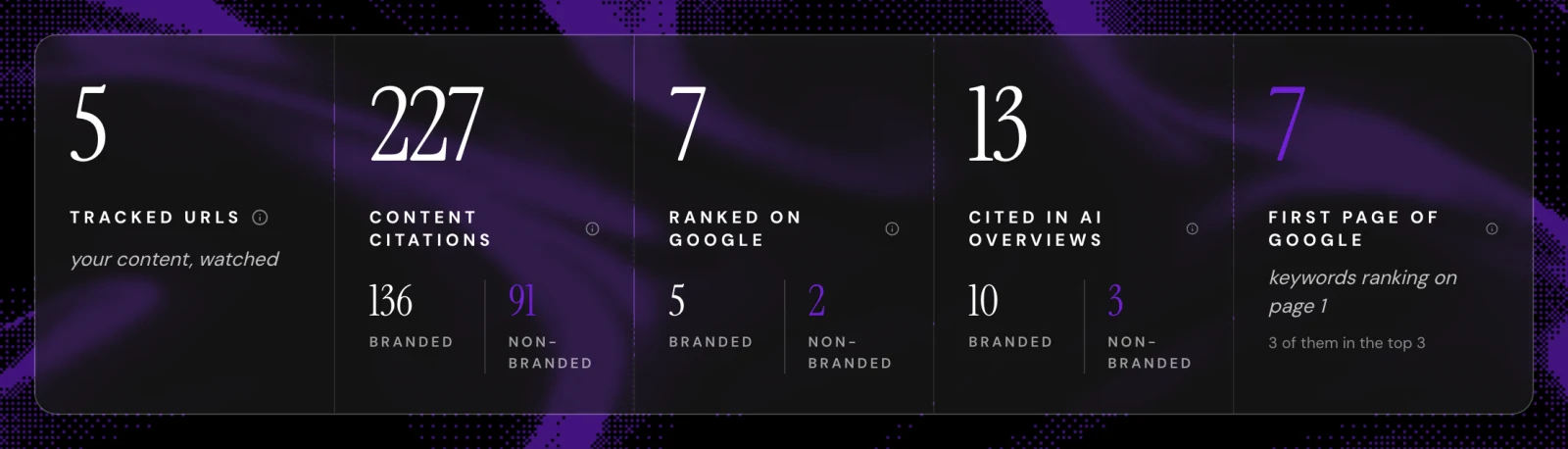
The June Published Monthly scan ran 396 prompts on five engines and tracked five URLs, which together drew 227 content citations, 136 on branded prompts and 91 on non-branded ones. On Google the tracked content ranked for 7 keywords (5 branded, 2 non-branded), all on the first page and 3 in the top 3.
Published Monthly scan summary, June.
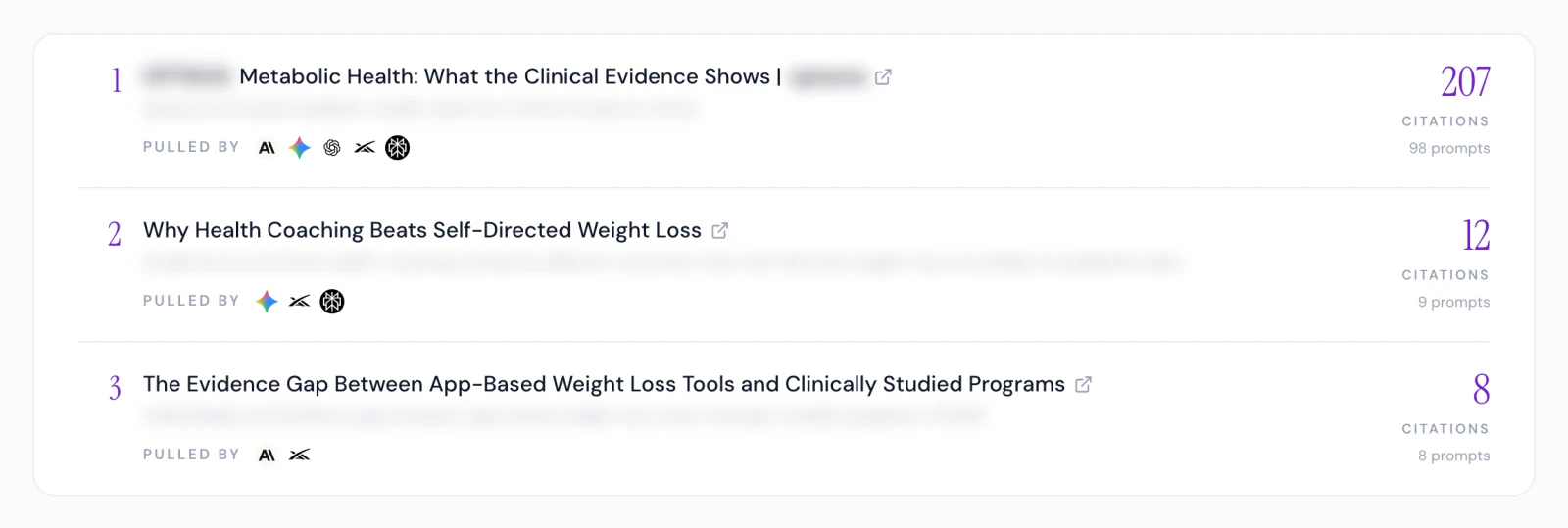
The clinical evidence page drew 207 of those citations in 98 prompts and was the only tracked page cited by all five engines, so when the engines needed a source for the program’s clinical record, they went to the page the client wrote for that question. Of the four editorials, a program comparison piece picked up 12 citations in 9 prompts from Gemini, Grok and Perplexity, and a research piece 8 in 8 prompts from Claude and Grok. The other two had no AI pickup yet, and the report flags both as the next AI visibility gaps to close.
Cited URLs and the engines pulling each one.
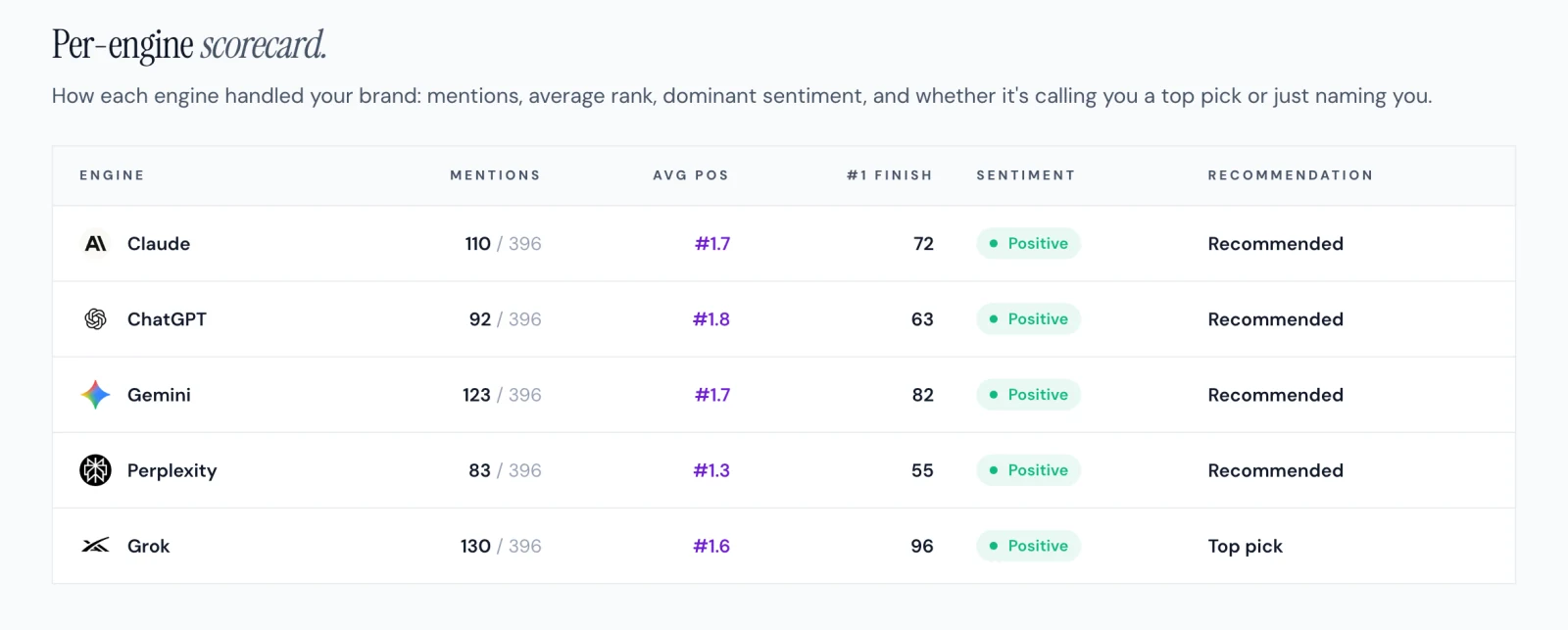
The scorecard puts the client first in 368 of its 538 mentions. Grok mentioned it most, 130 times with 96 first-place finishes, and was the one engine to rate it a top pick. Gemini (123 mentions, 82 first-place), Claude (110, 72), ChatGPT (92, 63) and Perplexity (83, 55) read positive and rated it “Recommended”.
Per-engine scorecard, Published Monthly scan.
Reputation Content in AI Answers
The Reputation scan, also run in June, covered 400 prompts and tracked five URLs, all of them cited at least once, for 130 content citations (93 branded, 37 non-branded). The fact-based reviews page drew 109 citations across 61 prompts from Claude, Gemini, Grok and Perplexity, 83% of the source pulls to the tracked content, leaving 21 for the four editorials beside it.
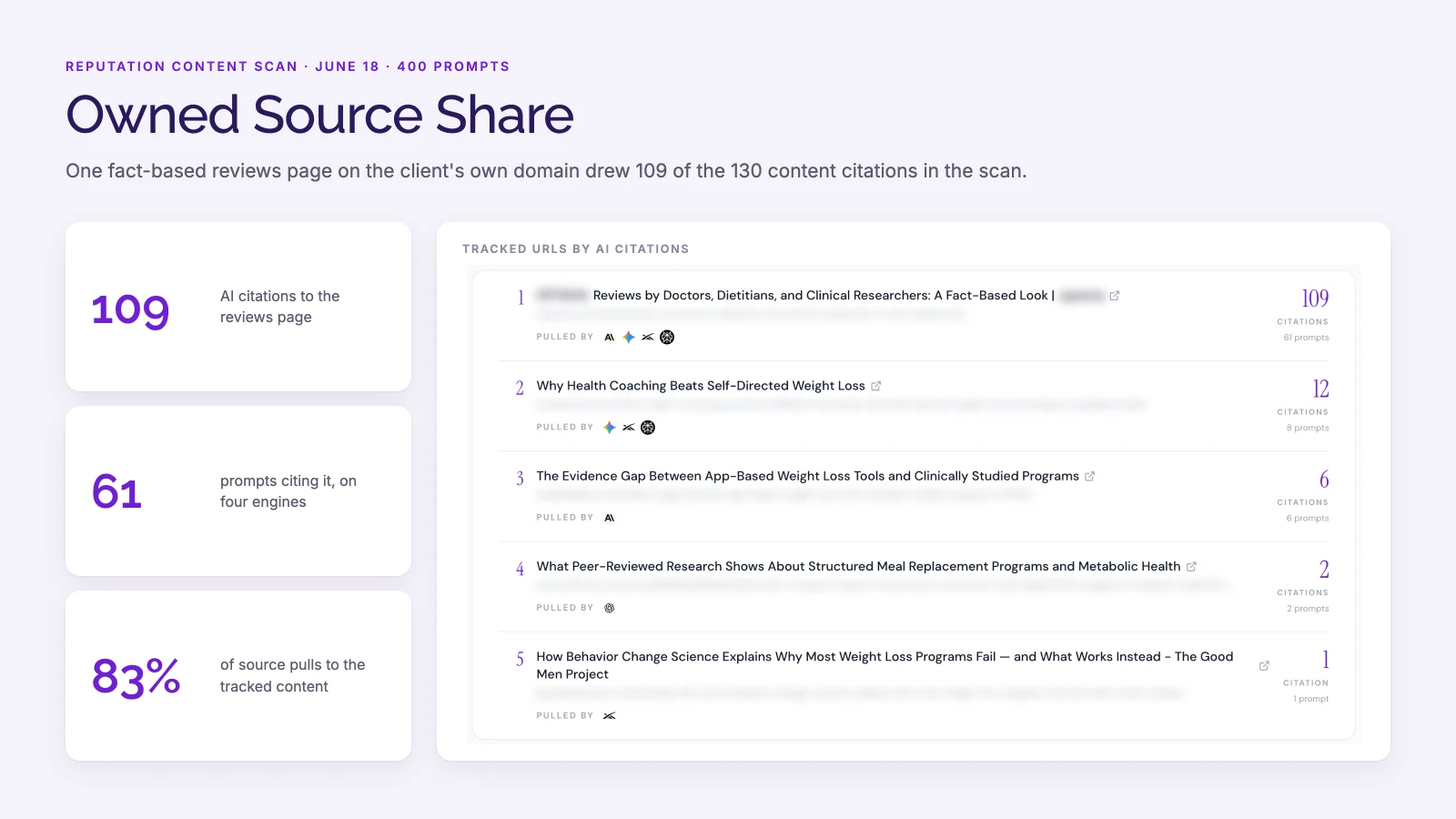
Tracked URLs in the June reputation scan.
The baseline answers had circled doubts about the coaches, the business model and the evidence. Once the reviews page was in place, every engine in the June scan read the client positively and recommended it, and the client finished first in 298 of 447 mentions, with mentions ranging from 110 on Grok to 66 on Perplexity.
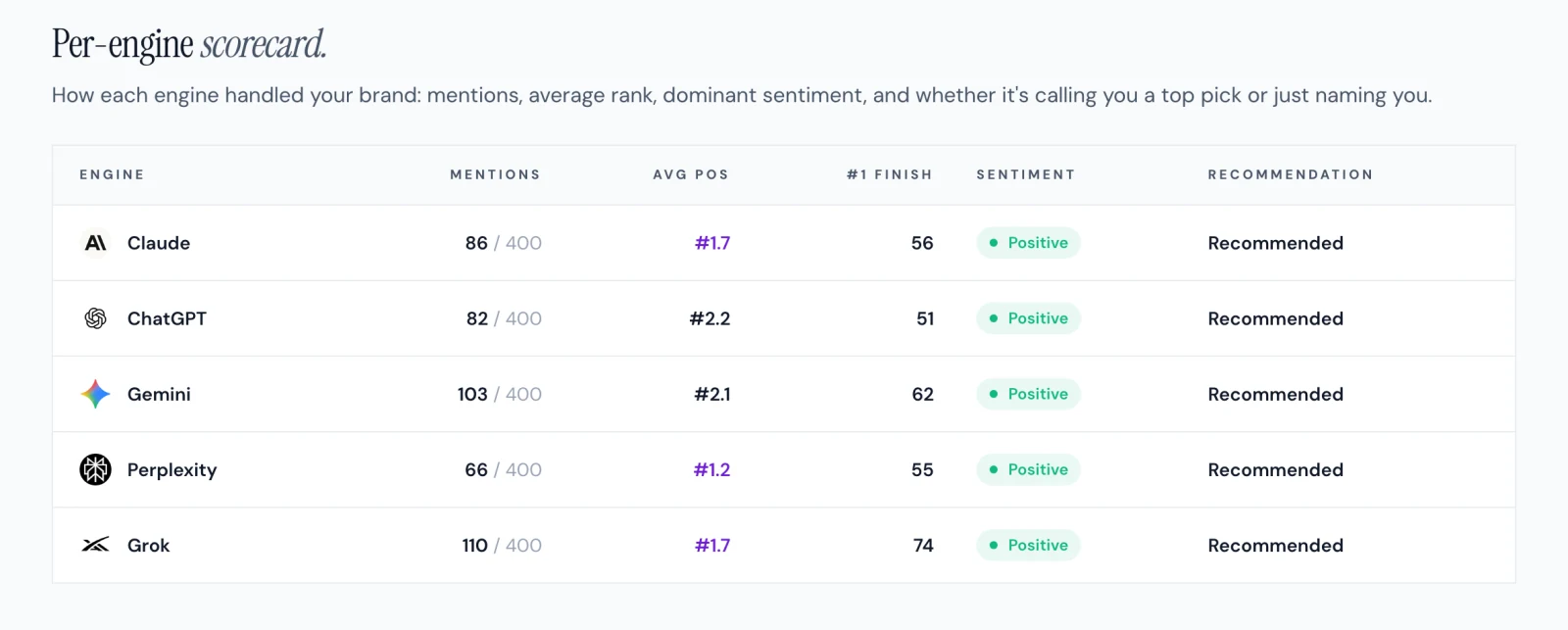
Per-engine scorecard, Reputation scan.
Credibility Editorials in AI Answers
The two Reputation editorials went live in July, and by the August scan they had brought in 45 AI citations between them, from Claude, Grok and Perplexity. The scientific advisory board explainer picked up 31 citations in 17 prompts, and the product and label guide 14 in 9.
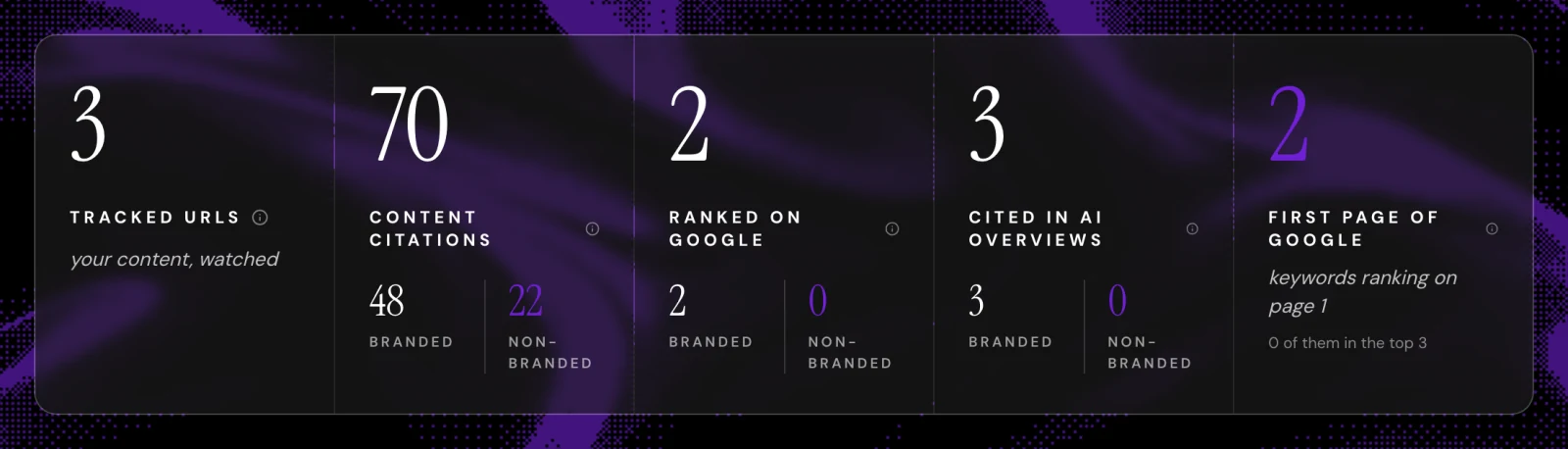
Credibility editorial scan summary, August.
The same scan tracked the reviews page again, on a fresh set of 399 prompts, and Claude cited it 25 more times. That brought the scan to 70 content citations, 48 on branded prompts and 22 on non-branded ones.
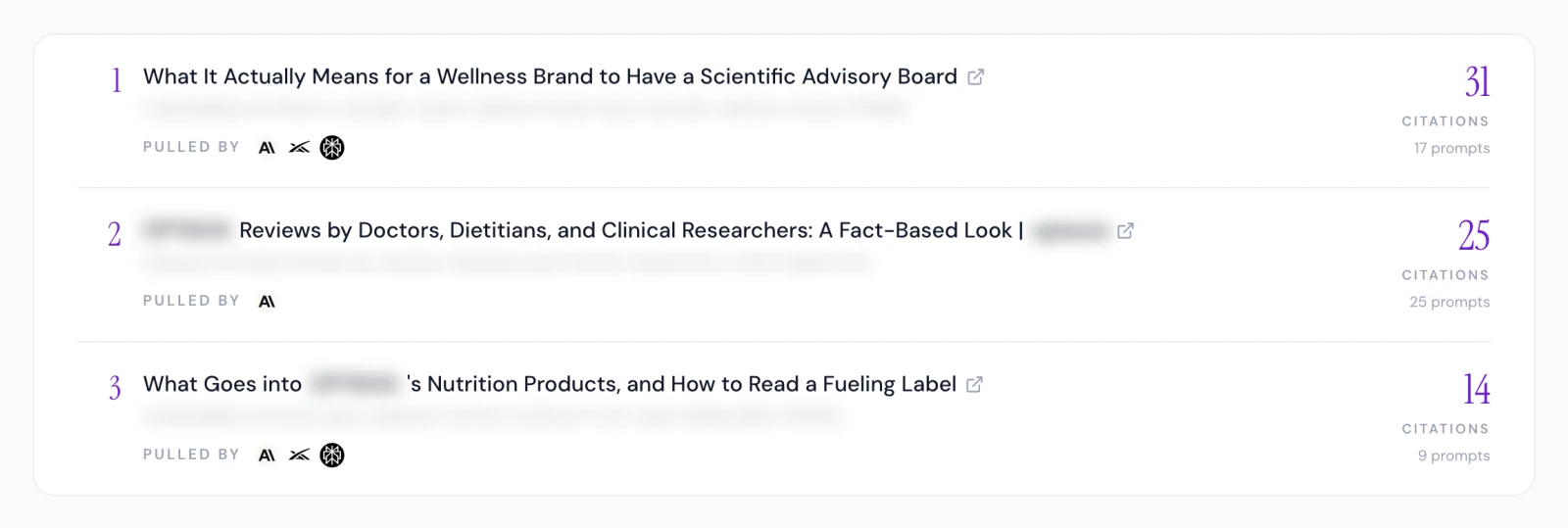
Cited URLs in the August scan.
Positive sentiment and a “Recommended” rating held on every engine in August, and the client finished first in 327 of its 556 mentions.
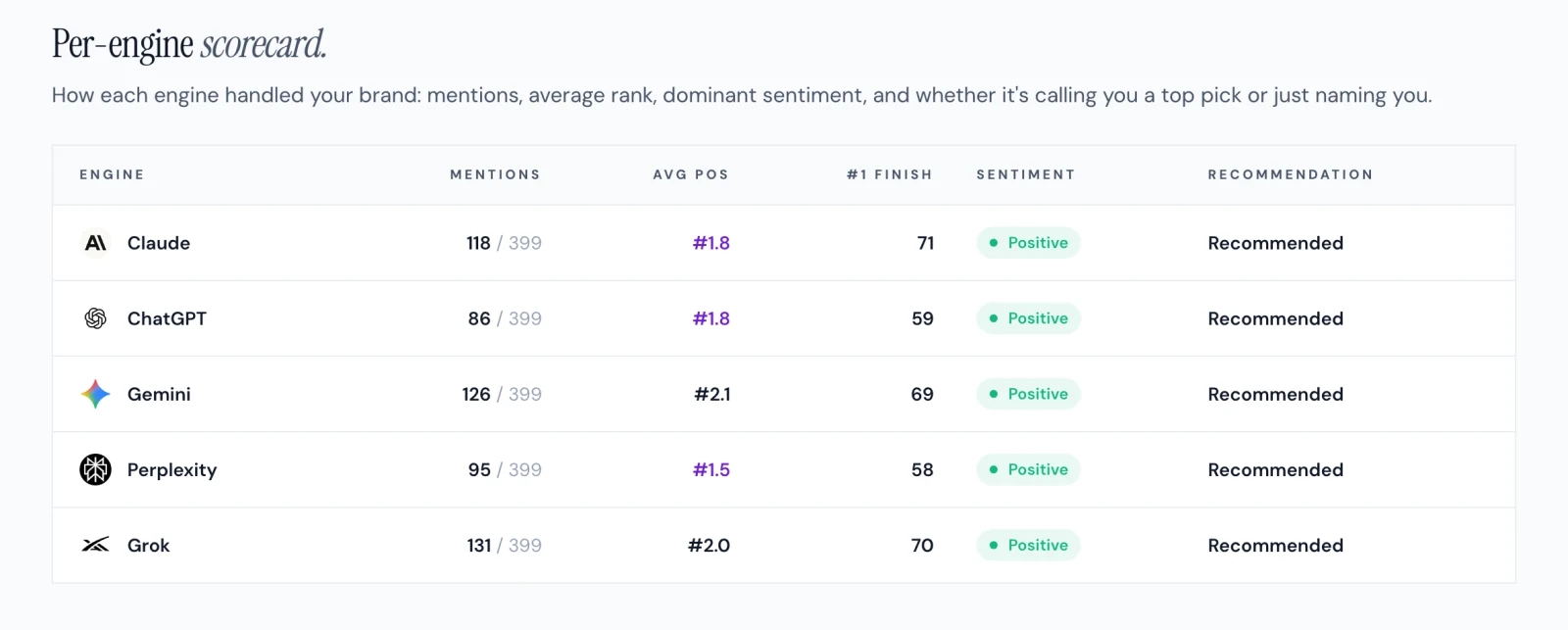
Per-engine scorecard, August scan.
AI Notices on the Wire and in AI Answers
Each release got its own 200-prompt report, on five engines for Releases 1 to 5 and four for Release 6. Together the six releases secured 4,295 media placements and about 1.1 billion in potential reach. Across the six reports the client was named in 698 prompts and was the most-named brand in every report, and Google cited the releases in 25 AI Overviews.
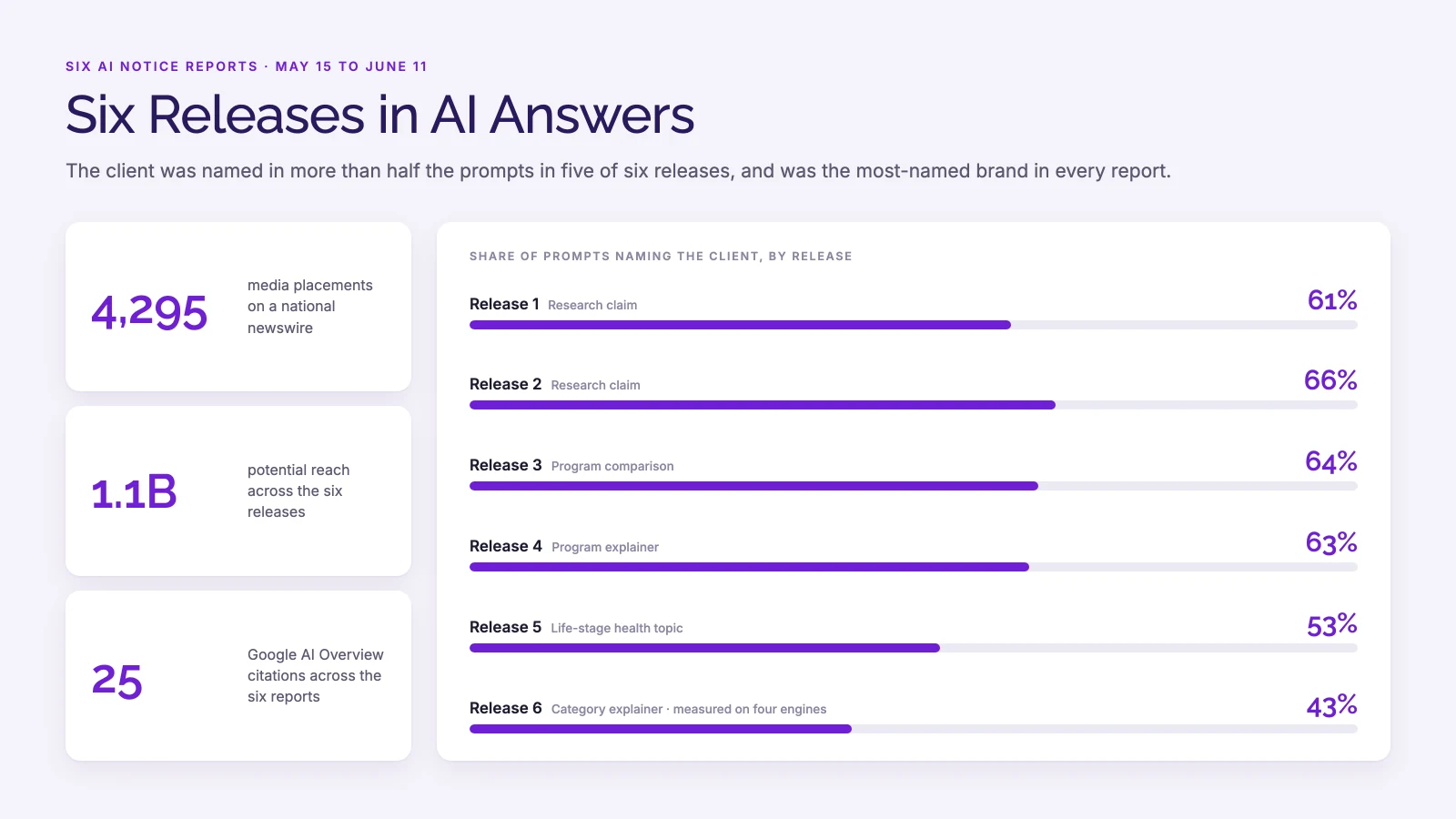
Share of the 200 prompts in each release report that named the client. Release 6 was measured on four engines.
AI visibility held through all six releases. Five of the six releases kept the client in more than half of their prompts, between 53% and 66%, and Release 6, measured without Claude, still reached 43%. The reports recorded 483 placement citations, a total that understates Release 1: its report logged none, while its own answer data shows the release pages cited 81 times in 48 prompts.
Two releases stand out. Release 3, the program comparison, put the client in 127 of 200 prompts, and four of the five engines rated it a top pick. Release 5, the life-stage health topic, was the only release cited by all five engines: it served as a source in 106 of its 200 prompts and earned 196 placement citations.
The Client in Weight Management AI Answers
Four prompts from the scans show how the engines answered weight management buyers who never named the brand, and which sources they cited.
“Which meal replacement programs have scientific advisory boards with actual credentials?” (asked as a medical affairs director)
Grok and Gemini both ranked the client first and classified it as a top pick. Grok described a long-standing scientific advisory board and a clinical research history.
“Compare meal replacement programs with scientific advisory boards” (asked as a medical affairs consultant)
Both engines placed the client first as a top pick. ChatGPT described it as the closest match for a multidisciplinary scientific advisory board combined with coaching.
“Looking for a weight loss solution with human accountability and published research” (asked as a skeptical evidence seeker)
Claude ranked the client first and classified it as a top pick, describing a coaching-based program backed by randomized controlled trials and peer-reviewed publications, ahead of two established alternatives with human support.
“Compare coach-supported weight loss programs to app-only solutions for long-term results” (asked as a corporate wellness director)
Both engines ranked the client first, using it as the example of a coached program with published outcome data from a randomized controlled trial.
None of these four prompts named the brand, yet every engine shown placed it first, and in all four cards at least one engine cited evidence published by or about the program.
How We Measured
The figures on this page come from Zen Media’s AI visibility reports and the client’s own audit files. Most reports put their prompts to Claude, ChatGPT, Gemini, Perplexity and Grok, and where a report covered fewer engines, the text says so.
The engagement opened with two baselines. In February and March a visibility audit put 2,000 buying questions to four engines and a reputation audit put 2,000 skeptical prompts to all five, with a rescan of the reputation set on ChatGPT and Gemini in May. A second audit of 2,000 prompts on five engines followed in early May, sorting the category into 27 clusters and producing the 58 prompts the content was written against.
Results came from two kinds of report. Three content attribution scans of roughly 400 prompts, two in June and one in August, tracked the owned pages and editorials URL by URL and checked 200 Google keywords for rankings and AI Overview citations. The six AI Notice reports ran 200 prompts per release on five engines (four for Release 6) and tested 200 to 400 Google keywords.
Why This Matters
A buyer who asks an AI engine whether a weight management program can be trusted gets an answer either way. In March those answers ran on concerns about the business model and the coaches, with forums among the sources. By June the engines had cited the client’s two evidence pages 316 times, and by August two credibility editorials had added 45 citations on questions such as what a scientific advisory board does. On coaching comparison questions, four of five engines classified the client as a top pick.
The AI Notices carried that AI visibility to scale: across six releases the client was named in 698 prompts and was the most-named brand in every report.
Reputation repair in AI is not sentiment management. It is source control. AI answers are heavily shaped by the sources the engines can retrieve and cite. No brand can argue with an AI engine or outspend one; it can only become the best-sourced answer to the question the engine is asked, including the uncomfortable one.
The same evidence-first approach has worked for brands in oncology care navigation and regulated healthcare. Want to know what AI engines tell your buyers about your brand? Contact Zen Media for an AI visibility strategy built around the questions your buyers ask.