in AI answers
AI prompts naming the client
to published release copies
The Business
The client develops pharmacy management software for independent community pharmacies. Its platform combines prescription dispensing and claims processing with inventory, reporting and patient-facing tools in one system. It serves pharmacy owners, pharmacists-in-charge and operators of multiple locations.
A pharmacy that considers a new system compares workflow fit, vendor support and pricing. It also has to plan how patient, prescription and claims records move to the new platform and how staff learn to use it. The client’s argument is that a conversion that includes data migration and support after go-live makes a switch workable.
The Objective
The AI visibility optimization pilot set out to make the client a source that AI engines cite when independent pharmacies evaluate pharmacy management software before a switch.
- Focus on buyer questions about pharmacy software comparisons, vendor support, conversion planning and data migration
- Publish one Anchor Article on the client’s domain to help pharmacies evaluate software before switching
- Publish one AI Notice on the wire to carry the same conversion and support case into third-party sources
- Track AI visibility on four AI engines with a fixed set of 209 buyer prompts, and measure each asset’s Google visibility separately
- Measure competitive rankings, source citations, organic rankings and Google AI Overview citations for each asset
Core Challenges
Competing With Established Pharmacy Software Vendors
Two established systems were named 351 and 314 times in the AI Notice report’s vendor rankings, ahead of the client. The engines also leaned on pharmacy software guides, vendor websites and software review platforms, all sources the client does not own.
A Software Switch Puts Pharmacy Records at Stake
A conversion hands a pharmacy’s patient, prescription and claims records to a new system, and the prompt set asked about the details: what happens to patient histories and controlled substance logs during a switch, and what makes a conversion take longer than planned.
Vendor Support Terms Complicate Comparisons
The prompt set questioned who stands behind the software: how vendor consolidation affects pricing and support, and whether support comes in the base price or as an add-on.
The Strategy
Prompt Selection Around the Buying Moment
The pilot wrote buyer prompts about the whole evaluation: comparing vendors, judging support, planning a conversion and moving data. Some asked about the product, such as how to judge whether a system is reliable enough for a busy retail counter. Others asked about the switch itself, such as what records transfer before switchover.
One Anchor Article
A long-form guide on the client’s site helps independent pharmacies decide when a switch is overdue, what strong pharmacy management software includes and which questions to ask vendors. It then explains how a conversion works and why timing matters.
One AI Notice
The AI Notice went out on the wire and carried the conversion and support case into third-party media. It explained what a pharmacy software conversion involves, from data migration to the support that follows go-live.
Day-Zero Launch, Day-7 Measurement
Seven days after the AI Notice launched, the pilot ran its buyer prompts across four AI engines and tracked citations to published copies of the AI Notice. Separate Google checks tracked rankings and AI Overview citations for both assets.
AI Visibility Optimization Results
the client
to the AI Notice
a published AI Notice copy
to the Anchor Article
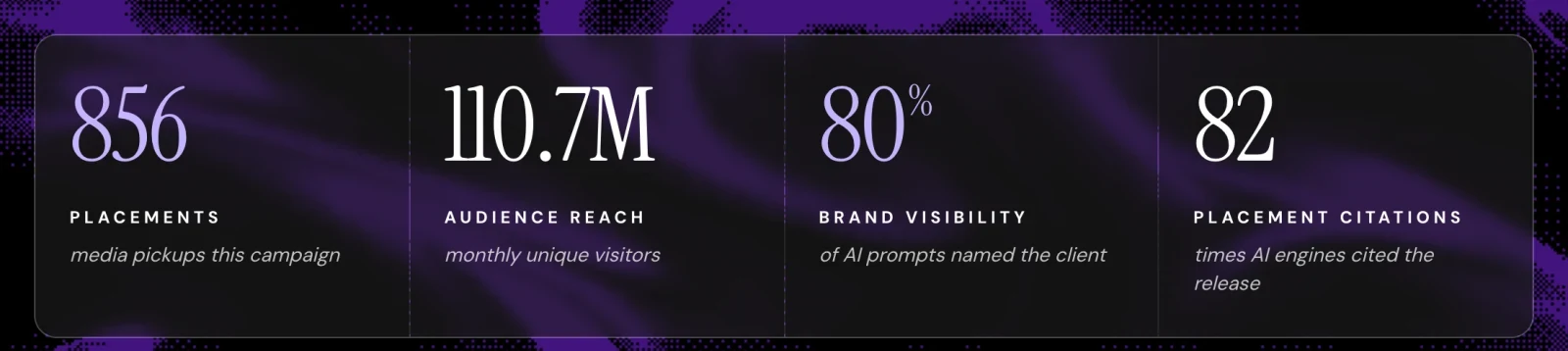
Two tiles come from the 209 buyer prompts run for the AI Notice, and two come from separate Google checks, one on the AI Notice keywords and one on the Anchor Article keywords. The AI Notice’s campaign report adds the media side: where the release ran (856 placements), the audience it could reach (110.7 million monthly unique visitors) and how often AI engines cited it.
Prompt Coverage and First-Named Finishes
None of the 209 buyer prompts named the client, yet AI engines named it in 168 of them, an 80% brand visibility. Within those answers the client finished first 81 times across the four engines. Among the prompt types the report labels, buy prompts drew the most mentions, with the client named in 25 of 29, an 86% coverage rate.
AI Visibility by Engine
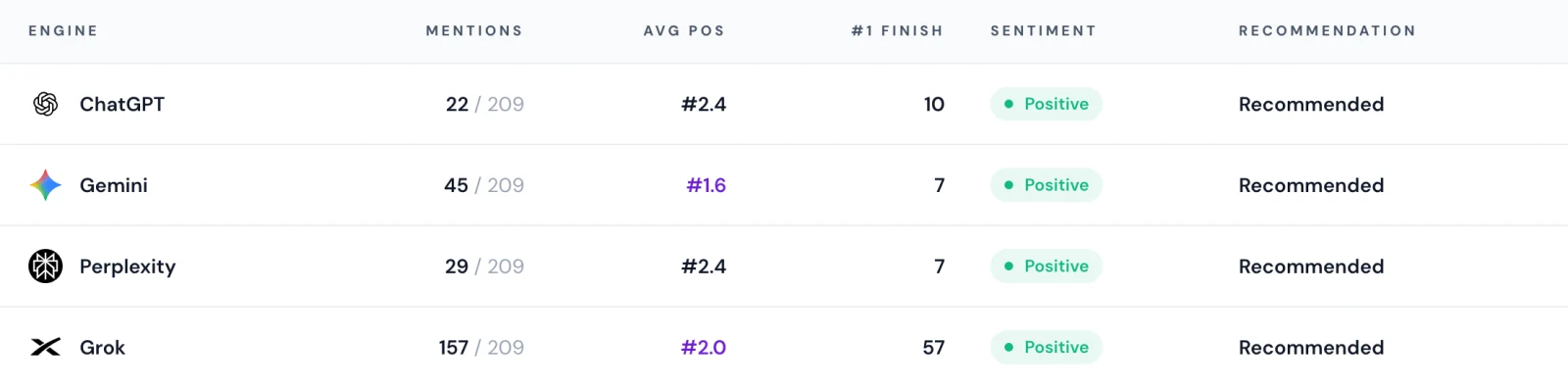
Grok named the client in 157 prompts, followed by Gemini with 45, Perplexity with 29 and ChatGPT with 22. All four AI engines recommended the client and recorded positive sentiment. Grok also produced 57 of the 81 first-place finishes, while Gemini, with far fewer mentions, held the best average position at #1.6. ChatGPT and Perplexity averaged #2.4.
Where the AI Visibility Came From
The AI Notice earned 82 placement citations. Grok and Perplexity cited it most, followed by Gemini, while ChatGPT logged no citations to a published release copy. The citations went to three copies: the wire release drew 5, and two copies on financial news sites drew the other 77, with 40 and 37. Counted by prompt, AI engines used the AI Notice as a source in 58 of the 209 buyer prompts, a 28% source-citation rate. In addition, the client’s own website was the most-cited source in the AI Notice prompt set, with 1,519 citations. The next domain, a pharmacy software guide site, had 434.
Google Rankings and AI Overview Visibility
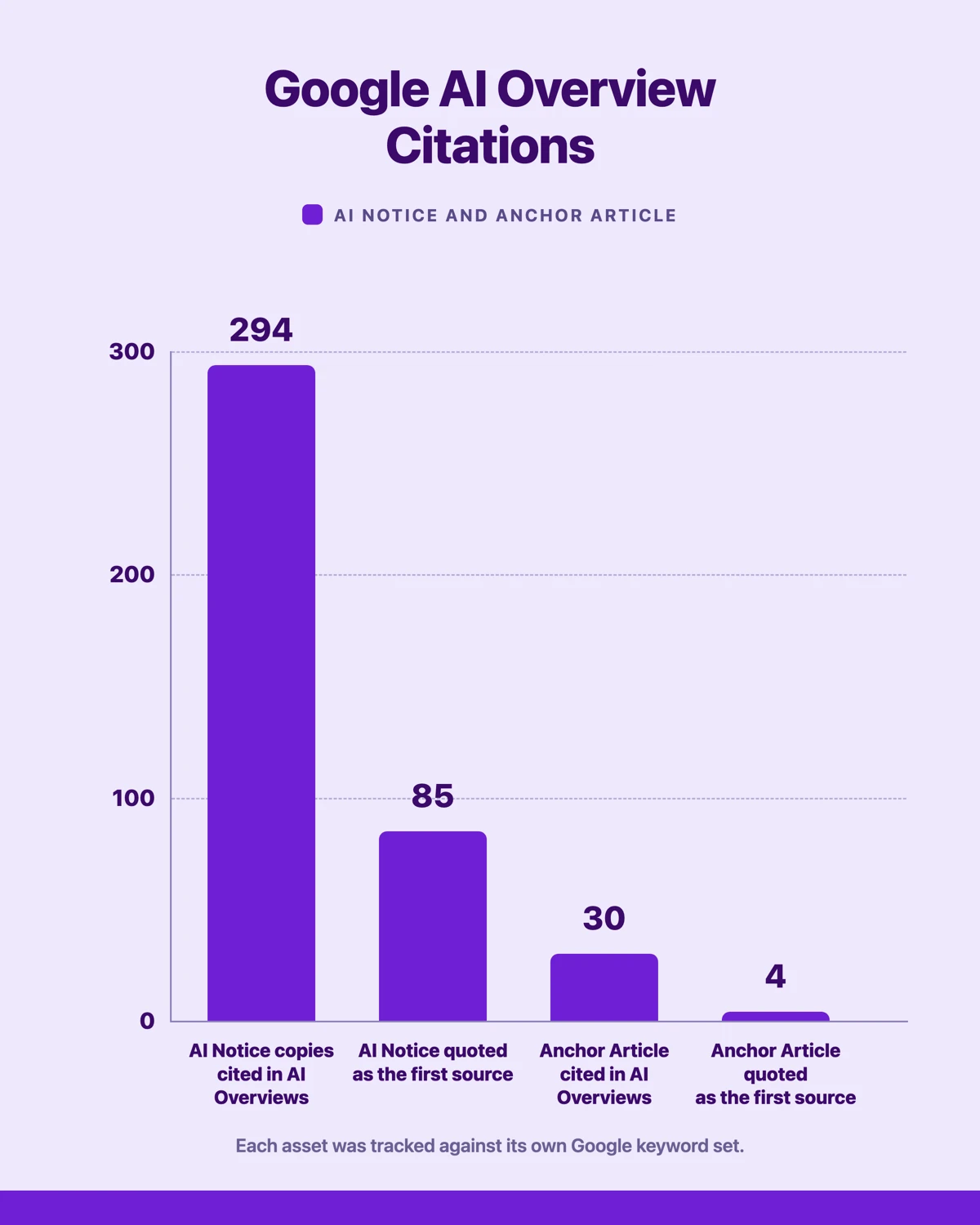
The Google check covered 680 keywords drawn from the AI Notice, all of them non-branded, and Google showed an AI Overview on 678. Copies of the AI Notice ranked for 260 of these keywords, 258 of them in the top 10 and 110 in the top 3. Google AI Overviews cited an AI Notice copy on 294 keywords, more than the 260 where a copy ranked. A copy was the first source quoted in 85 of those answers.
The Anchor Article had a separate keyword list of 789, all non-branded, and Google showed an AI Overview on every one. By contrast, the article ranked on Google’s first page for 148 of them, including 130 in the top 3, while Google AI Overviews cited it on 30 keywords and quoted it first on 4.
Examples From AI Answers
The questions never mentioned the client, and Grok still recommended it in every answer, citing the AI Notice each time.
“What makes a pharmacy software conversion take longer than planned?”
Grok ranked the client first and recommended it while explaining that data cleanup, system integrations, staff training and compliance can extend a conversion. It cited the AI Notice alongside migration guidance and pharmacy technology sources.
“What records transfer during a pharmacy software migration before switchover?”
Among the vendors Grok named for migration help was the client, and the answer described the records and checks involved before a system change. It also drew on pharmacy software guides and industry sources.
“What happens to patient histories and controlled substance logs when a pharmacy switches software?”
On this question about patient and controlled-substance records, Grok ranked the client second and cited the AI Notice while explaining how those records move. It also cited pharmacy migration resources and regulatory references.
How We Measured
The AI visibility optimization pilot tested the two assets separately. The AI Notice was tested with 209 buyer prompts on four AI engines: ChatGPT, Gemini, Perplexity and Grok. The Anchor Article report holds Google keyword results and no buyer-prompt results, so its figures are reported on their own and never combined with the AI Notice figures. A mention counts when an engine names the client in its answer. Brand visibility is the share of prompts in which at least one engine named the client.
Citations were matched by exact URL, so a citation counts only when an engine listed a published copy of the AI Notice itself as a source. A separate Google check recorded organic rankings and which Google AI Overviews cited either asset, across 680 AI Notice keywords and 789 Anchor Article keywords.
Why This Matters
AI engines named the client in 168 of the 209 AI Notice prompts, although no prompt used its name. The prompts asked how to judge a system’s reliability, what records transfer before a switch and what makes a conversion run long.
In its separate Google keyword set, the Anchor Article ranked for 147 of 652 category recommendation keywords and for none in the terminology or buyer-intent groups. More Anchor Articles and AI Notices aimed at those search topics can extend this AI visibility optimization work to them.
Zen Media has applied this AI visibility optimization approach in managed IT support and telehealth platform. Want to see how your brand appears in AI answers to buyer questions? Contact Zen Media to explore an AI visibility strategy for your business.