in AI answers
AI prompts naming the client
AI engines citing the AI Notice
The Business
The client manufactures home medical equipment, including crutches and canes, and sells its ergonomic underarm crutch directly to consumers through its online store. The people who buy or recommend crutches range from recovery patients and their parents to physical therapists and home health agency buyers. The pilot tested what AI engines tell these buyers when they ask which crutches stay comfortable through weeks of recovery. The client competes on measured comfort, and each figure it publishes states what it was measured against.
The Objective
The AI visibility optimization pilot set out to make the client a source that AI engines cite when buyers ask which crutches stay comfortable through a long recovery.
- Focus on buyer questions about underarm and wrist comfort, handle design, fit and how to choose ergonomic crutches
- Publish one Anchor Article on the client’s domain to build its authority on ergonomic crutches
- Publish one AI Notice on the wire to carry the same measured-comfort case into third-party sources
- Track the client’s AI visibility on four AI engines with a fixed set of buyer prompts, and the Anchor Article’s results on Google
- Measure share of voice and prompt coverage against competing crutch brands
Core Challenges
Competing With Established Crutch Brands in AI Answers
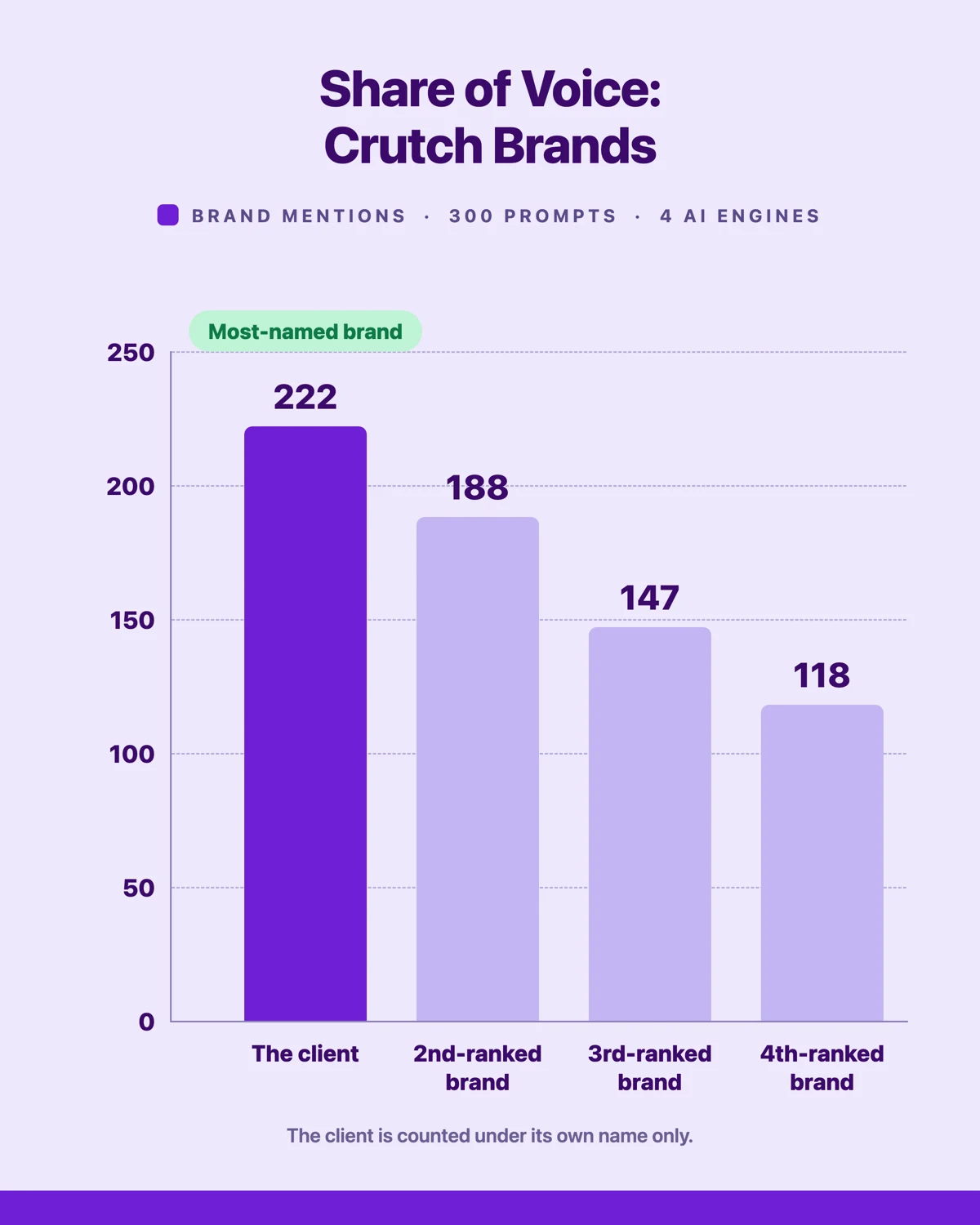
In the AI Notice prompt set, the engines named three rival brands 188, 147 and 118 times, while the sources they cited most were a product-review site, a large online marketplace and a rival manufacturer’s website.
Buyers Ask AI Which Crutches Stay Comfortable
The pilot’s buyer prompts asked exact questions, such as which crutches are most comfortable after Achilles tendon surgery or whether $100 crutches are better than $30 ones.
The Strategy
Prompt Selection Around the Buying Moment
The pilot wrote its buyer prompts in the voices of the people who buy or recommend crutches, from a broken ankle patient to a home health agency buyer. The prompts mixed two kinds of questions: plain shopping questions, such as which crutches are best for athletes, and exact design questions, such as how handle angle affects wrist pressure. Together they followed a buyer from learning what causes crutch pain to choosing a pair.
One Anchor Article
A long-form guide on the client’s site explains what causes underarm and wrist pain on crutches and what to check before buying ergonomic crutches.
One AI Notice
Distributed on the wire, the AI Notice brought the same measured-comfort case to third-party news sites.
Day-Zero Launch, Day-7 Measurement
Seven days after the AI Notice launched, the pilot ran its buyer prompts across four AI engines and tracked citations to the AI Notice’s placements. A separate Google check tracked the Anchor Article and the AI Notice’s keywords.
AI Visibility Optimization Results
222 mentions
AI Notice as a source
the client
naming the client
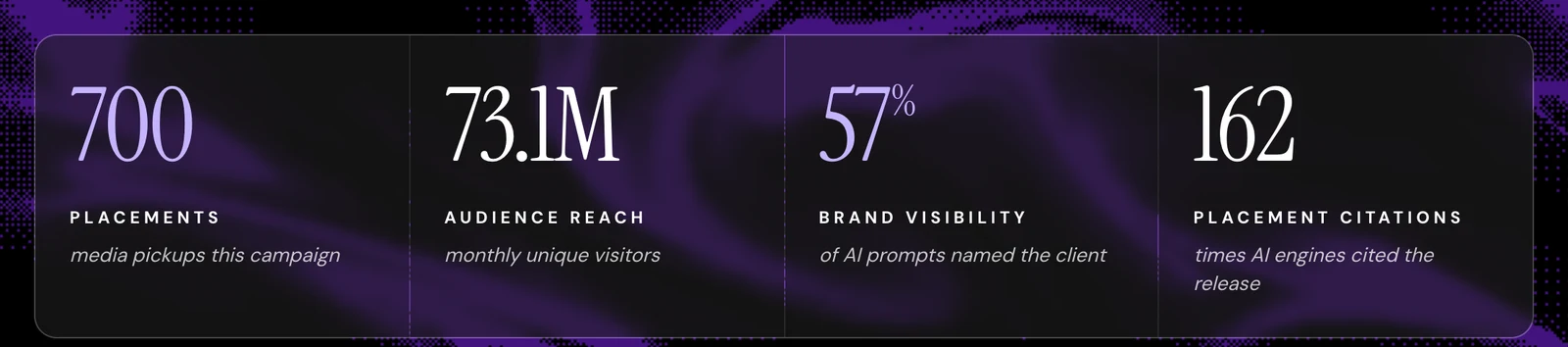
The AI Notice’s campaign report adds the media side: the release ran on 700 placements with a combined audience of 73.1M monthly unique visitors, and AI engines cited it 162 times.
Share of Voice Among Ergonomic Crutch Brands
The report’s brand rankings counted 222 mentions under the client’s own name, making it the most-named brand in the AI Notice prompt set. The next three brands were named 188, 147 and 118 times. The 222 leaves out the client’s crutch line, which the engines named another 98 times, and other forms of its name, so it understates the client’s total. In addition, where an answer named the client and a rival together, the client ranked higher in 56% to 76% of the matchups against its three most frequent rivals.
Prompt Coverage and First-Named Finishes
None of the 300 buyer prompts named the client, yet AI engines named it in 171 of them, a brand visibility of 57%. Within those answers, the client finished first 98 times across the four engines, and the report’s top-three hit rate across all 300 prompts was 39%. Among the prompt types the report labels, Buy prompts named the client most often, followed by Buy Intent, Buyer Intent and Category prompts.
Unprompted Discovery
Of the 171 prompts that named the client, 94 were unprompted: the question carried none of the client’s published figures, product details or the AI Notice’s wording. These prompts covered topics such as comfort after foot surgery, crutches for tall users and traction on wet floors.
The awareness funnel mapped 43 of the 300 prompts to a buyer stage. The client was named in 9 of the 12 Solution-Aware prompts and in 13 of the 27 Product-Aware prompts. By contrast, it was named in none of the four Unaware and Problem-Aware prompts, and no prompt fell in the Most-Aware stage.
| Buyer awareness stage | Coverage | Named the client | Prompts in stage | Avg position |
|---|---|---|---|---|
| Unawarehas not identified the problem | 0% | 0 | 3 | n/a |
| Problem-Awareknows the problem, still scoping solutions | 0% | 0 | 1 | n/a |
| Solution-Awareevaluating solution categories | 75% | 9 | 12 | #2.5 |
| Product-Awarecomparing specific products | 48% | 13 | 27 | #4.3 |
AI Visibility by Engine
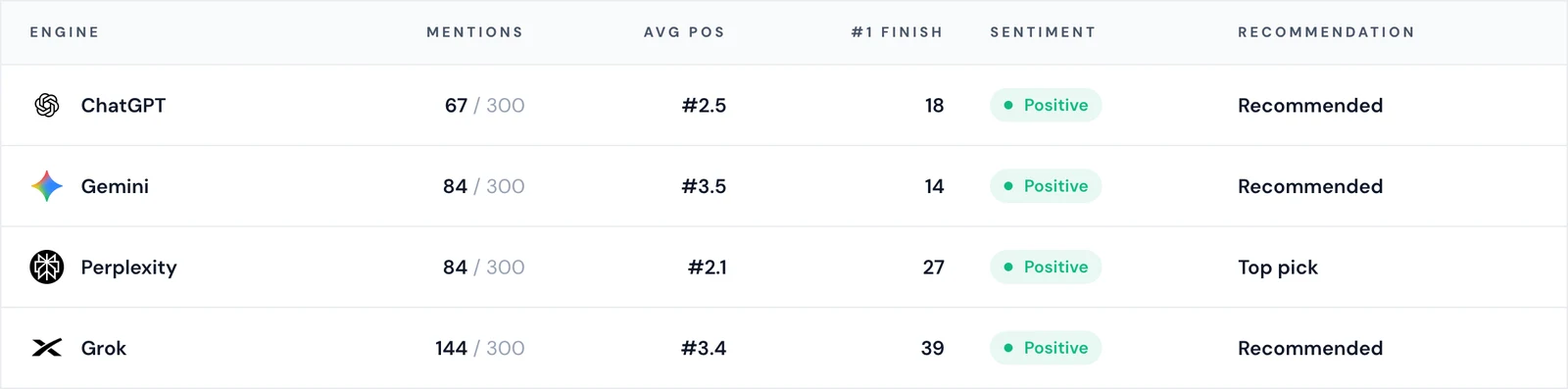
All four engines named the client in the AI Notice prompt set, and none of their mentions was negative. Perplexity rated the client a top pick, while the other three engines recommended it. Grok named the client in 144 prompts and produced 39 of the 98 first-place finishes, whereas Perplexity, with 84 prompts, held the best average position at #2.1. Gemini, also at 84 prompts, averaged #3.5 and finished first 14 times, the fewest, and ChatGPT named the client in 67 prompts at an average of #2.5.
Where the AI Visibility Came From
AI answers cited a published copy of the AI Notice 162 times, more than twice the 75 the program guarantees. Perplexity accounted for 96 of these placement citations, followed by Grok with 55, Gemini with 10 and ChatGPT with 1. The citations went to three copies: the wire release drew 128, a financial news site’s copy drew 33 and a business news site’s copy drew 1. By prompt count, the AI Notice served as a source in 105 of the 300 buyer questions, a rate of 35%.
Google AI Overview Visibility
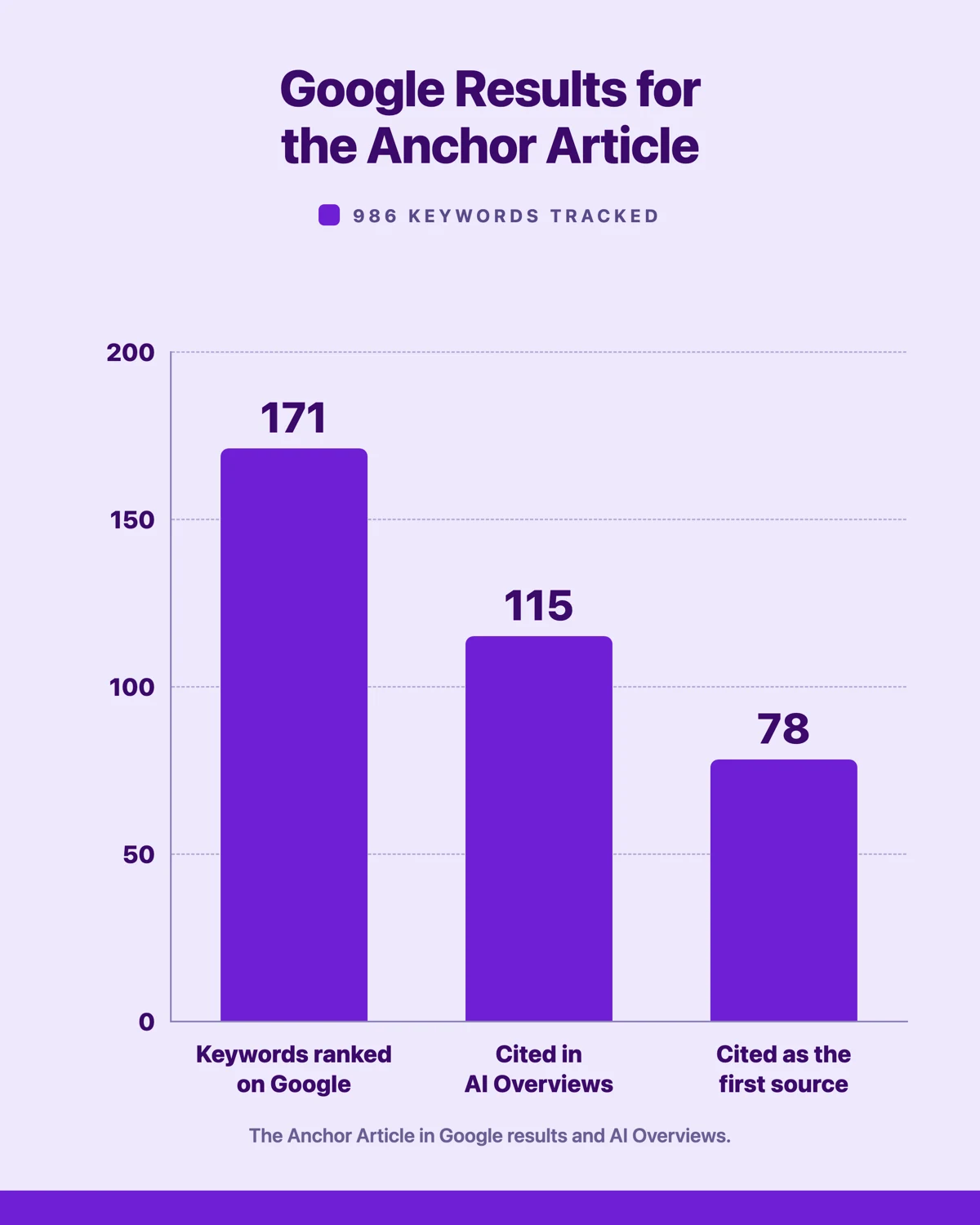
The Google check ran on two keyword sets, one for each asset. The Anchor Article ranked on Google for 171 of its 986 tracked keywords, and 165 of those placed in the top 10, including 66 in the top 3. Google AI Overviews cited the guide on 115 keywords and quoted it as the first source on 78, and every ranking and citation came from a non-branded keyword.
In addition, the AI Notice had its own list of 943 keywords, all of them non-branded. Copies of the AI Notice ranked on Google for 147 of them, 137 in the top 10 and 50 in the top 3, while Google AI Overviews cited a copy on 116 keywords and quoted it as the first source on 65.
Examples From AI Answers
None of the three questions named the client, yet each answer named it, and each ranked it first on at least one engine.
“crutches with bigger hand grips” (asked as Recovery Patient)
Perplexity ranked the client first and described its crutch as an option with a larger grip designed for comfort. Grok also ranked the client first, as a manufacturer of crutches with ergonomic, soft-grip handles.
“crutches with bigger underarm pads than the ones from the hospital” (asked as Recovery Patient)
For a shopper who wants pads larger than hospital-issue ones, Grok ranked the client first and described the brand as one that often offers premium crutches with extra-large, thickly padded underarm pads. Perplexity also named the client and described its crutch as having a larger, thicker pad than a standard one.
“Which crutch brands offer the best warranty?” (asked as Recovery patient)
All four engines named the client on this warranty question. ChatGPT and Grok ranked it first, with ChatGPT calling it the leading crutch brand for strong warranties. Perplexity ranked it third as a budget-friendly option, and Gemini ranked it fourth among big-brand options.
How We Measured
The pilot ran one set of 300 buyer prompts for the AI Notice on four AI engines: ChatGPT, Gemini, Perplexity and Grok. A mention counts when an engine names the client in its answer. Brand visibility is the share of prompts in which at least one engine named the client. The Anchor Article’s report ran no buyer prompts, so the guide is measured on Google alone.
A placement citation counts only when an engine lists a published copy of the AI Notice as a source, matched by exact URL. A separate Google check recorded organic keyword rankings and which Google AI Overviews cited either asset. The two Google keyword sets differ, so their figures are reported separately and never combined.
Why This Matters
The client was the most-named crutch brand in the AI Notice prompt set. Of the 171 prompts that named the client, 94 were unprompted. They included questions about replacing worn tips and pads, buying crutches for a teenager and finding crutches that do not look like hospital issue.
Coverage was lowest on Unaware and Problem-Aware prompts, the ones that describe an injury or a pain before they name a solution, although the report mapped only four prompts to those two stages. More Anchor Articles and AI Notices aimed at those prompts can extend this AI visibility optimization work to them.
Zen Media has applied this AI visibility optimization approach in pharmacy software and MSP support. Want to see how your brand appears in AI answers to buyer questions? Contact Zen Media to explore an AI visibility strategy for your business.