in AI answers
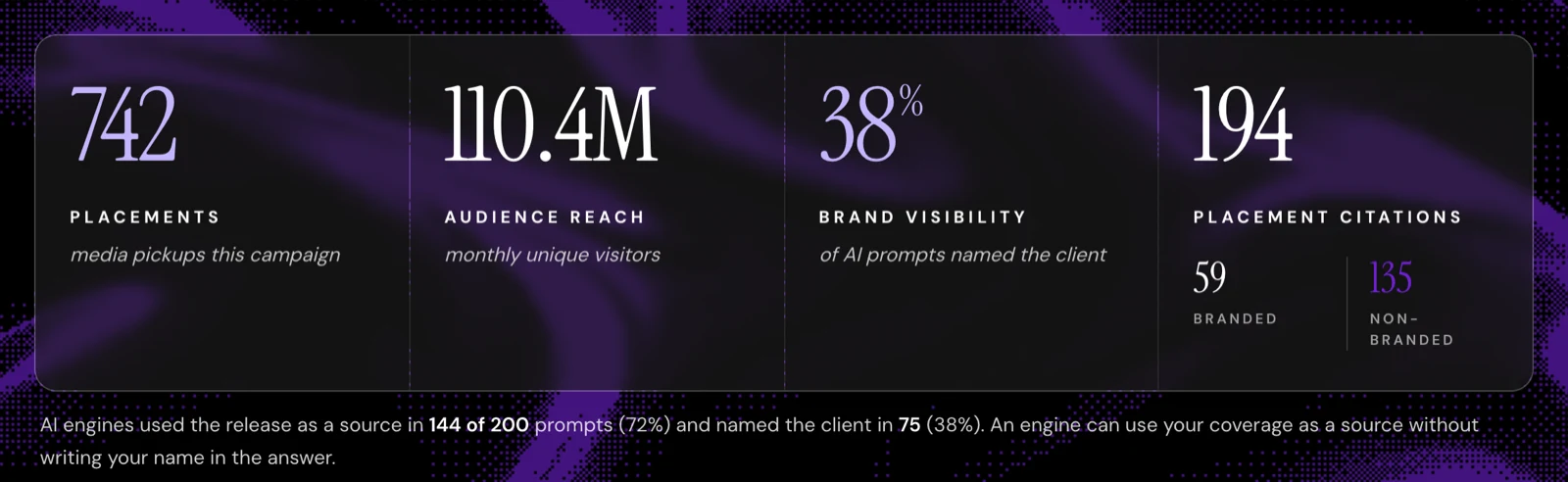
AI prompts naming the client
59 branded, 135 non-branded
The Business
The client is an independent insurance agency that writes business owner’s policies, along with other commercial and personal lines, for small businesses and property owners across the regional market it serves. Its buyers range from small business owners and contractors to rental property owners and professional offices, and it competes by shopping a business’s risk across several carriers and flagging the exclusions a single quote would miss.
The pilot tested what AI engines tell these buyers when they ask what a business owner’s policy covers, what it leaves out, and how to compare coverage before they buy. The client’s position is simple: a policy that wins on price can still leave exclusions a business never sees coming.
The Objective
The AI visibility optimization pilot set out to make the client a source AI engines cite when buyers ask what a business owner’s policy covers and how to choose one.
- Focus on buyer questions about what a business owner’s policy covers, what it leaves out, and how to compare coverage across carriers
- Publish one Anchor Article on the client’s domain to build its authority on business owner’s policies for small businesses in the market it serves
- Publish one AI Notice on the wire to carry the same coverage argument into third-party sources
- Track the client’s AI visibility on four AI engines with a fixed set of buyer prompts, and the Anchor Article’s results on Google
- Measure share of voice and prompt coverage against competing insurance carriers
Core Challenges
Competing With National Insurance Brands in AI Answers
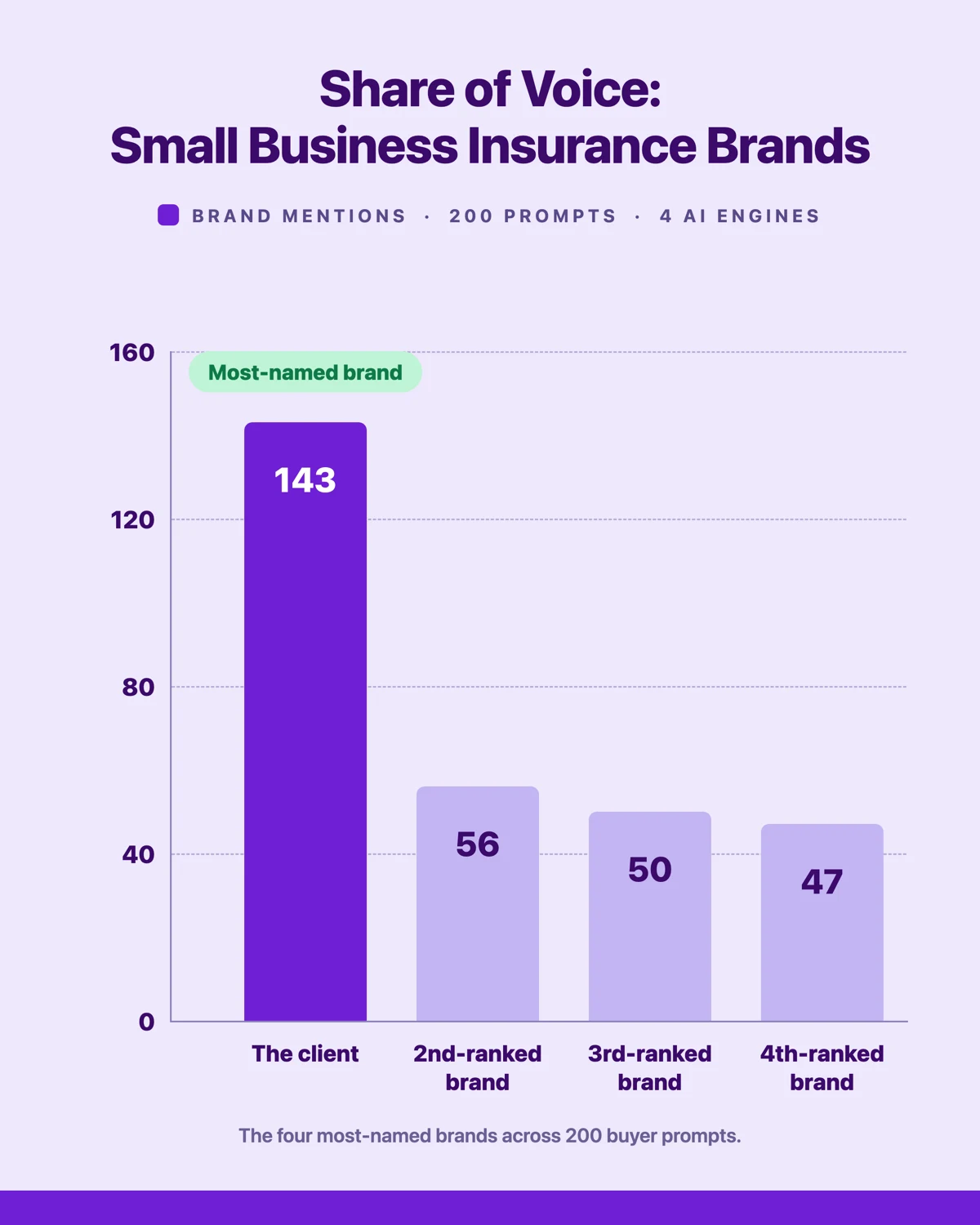
In the AI Notice prompt set, the engines named three national insurance brands 56, 50 and 47 times, while the sources they cited most were insurance-comparison sites and the websites of other insurers.
Buyers Ask AI Which Policy Fits Their Business
Buyers in this category ask exact questions, such as what coverage a retail store needs for inventory and theft or how a contractor’s insurance needs differ from a store’s.
The Strategy
Prompt Selection Around the Buying Moment
The pilot wrote its buyer prompts in the voices of the people who buy and manage business insurance, from a small business owner to a risk manager. The prompts mixed two kinds of questions: what terms like business owner’s policy and commercial package policy mean, and how to compare and bundle coverage across carriers. Together they followed a buyer from learning the terms to choosing an agency.
One Anchor Article
A long-form guide on the client’s site explains what a business owner’s policy covers and what it leaves out for small businesses in the market it serves.
One AI Notice
The AI Notice went out on the wire and restated the same coverage argument on third-party news sites.
Day-Zero Launch, Day-7 Measurement
Seven days after the AI Notice launched, the pilot ran its buyer prompts across four AI engines and tracked citations to the AI Notice’s placements. A separate Google check tracked the Anchor Article and the AI Notice’s keywords.
AI Visibility Optimization Results
143 mentions
AI Notice as a source
the client
naming the client
The four tiles measure the 200 buyer prompts. The campaign report shows how far the AI Notice traveled in the media and how often AI engines cited it.
Share of Voice Among Small Business Insurance Brands
With 143 mentions under its name in the AI Notice prompt set, the client ranked as the most-named brand the report tracked. The next three brands, all national insurance brands, were named 56, 50 and 47 times. In answers that named the client beside the national brand it met most often, the client ranked higher in 75% of the matchups.
Prompt Coverage and First-Named Finishes
75 of 200 buyer prompts named the client, a brand visibility of 38%. Across those answers, the four engines placed the client first a combined 120 times, and the report put its top-three hit rate at 33%. Brand-direct questions named the client most often, followed by buyer-intent, category, terminology and education questions.
Unprompted Discovery
Of the 75 prompts that named the client, 46 asked about coverage without using its name. These prompts asked things such as whether a personal auto policy covers vehicles used for business and whether an independent agency can review home, auto, business and rental coverage together.
The report’s awareness funnel sorted all 200 prompts into a buyer stage. Among the 29 prompts that searched by brand name, the client was named every time. On the other four stages, its coverage was strongest on Solution-Aware prompts, with 13 of 18, and weakest on Problem-Aware prompts, with 11 of 72.
| Buyer awareness stage | Coverage | Named the client | Prompts in stage | Avg position |
|---|---|---|---|---|
| Unawarehas not identified the problem | 29% | 5 | 17 | #1.0 |
| Problem-Awareknows the problem, still scoping solutions | 15% | 11 | 72 | #2.3 |
| Solution-Awareevaluating solution categories | 72% | 13 | 18 | #3.4 |
| Product-Awarecomparing specific products | 27% | 17 | 64 | #1.3 |
| Most-Awaresearching by brand name | 100% | 29 | 29 | #1.0 |
AI Visibility by Engine
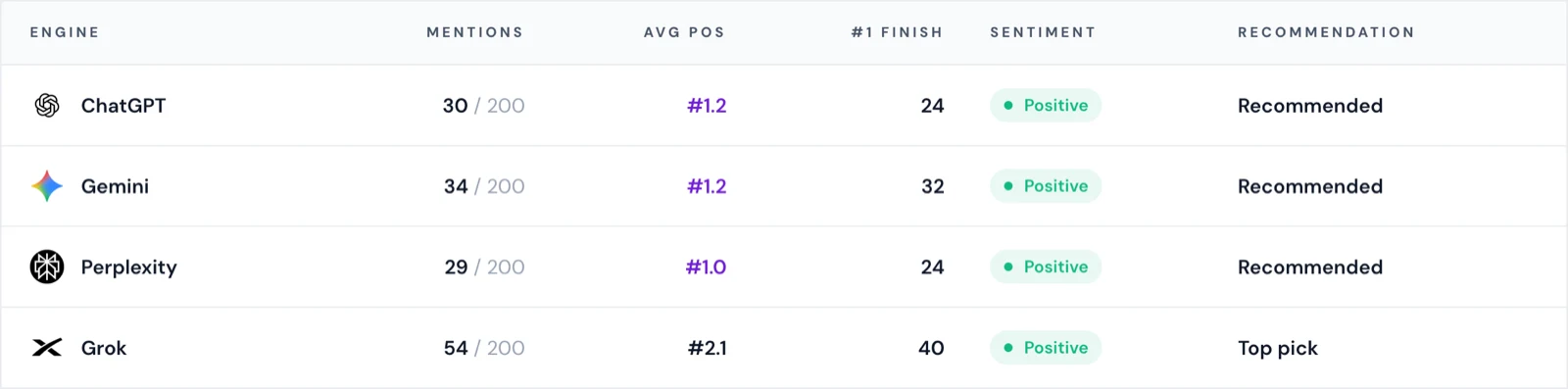
All four engines named the client in the AI Notice prompt set, and none of their mentions was negative. Grok called the client a top pick, and the other three engines rated it a recommended choice. Grok named the client in 54 of 200 prompts, the most of any engine, and contributed 40 of the 120 first-place finishes. Perplexity named it in only 29 prompts but held the best average position at #1.0. ChatGPT, with 30 prompts, averaged #1.2 and finished first 24 times, and Gemini, with 34 prompts, also averaged #1.2 and finished first 32 times.
Where the AI Visibility Came From
A placement citation is a time an AI engine listed a published copy of the AI Notice as a source. The AI Notice earned 194 placement citations, more than twice the 75 the program guarantees. Grok accounted for 130 of them, followed by ChatGPT with 28, Gemini with 24 and Perplexity with 12. By source, a financial news site’s copy drew 130 citations, the wire release itself drew 32 and a business-news site drew 24. Four smaller business-news sites drew the other 8. Of the 194 citations, 135 were non-branded, from prompts that did not ask about the client, and 59 were branded, from prompts that already named it. Measured by prompt count, the AI Notice supplied a source for 144 of the 200 buyer prompts, 72%.
Across the whole category, AI engines pulled 16,290 citations from 2,222 domains. Beyond the AI Notice, insurance information and comparison sites were the sources cited most, led by one with 678 citations and another with 487, ahead of the client’s own website, which ranked third with 337. These counts cover the four engines that ran on this pilot: ChatGPT, Gemini, Perplexity and Grok.
Distribution Reach
The AI Notice reached 742 media placements with a combined audience of 110.4M monthly unique visitors. The seven placements that AI engines cited, led by the financial news site’s copy, reach 2.9M of that audience on their own, a share of 3%.
Google AI Overview Visibility
The Google check ran on two keyword sets, one for each asset. The AI Notice had its own list of 788 keywords, 36 branded and 752 non-branded. Copies of the AI Notice ranked on Google for 69 of them, 59 in the top 10 and 13 in the top 3, and Google AI Overviews cited a copy on 77 keywords, 67 of them non-branded, quoting it as the first source on 33.
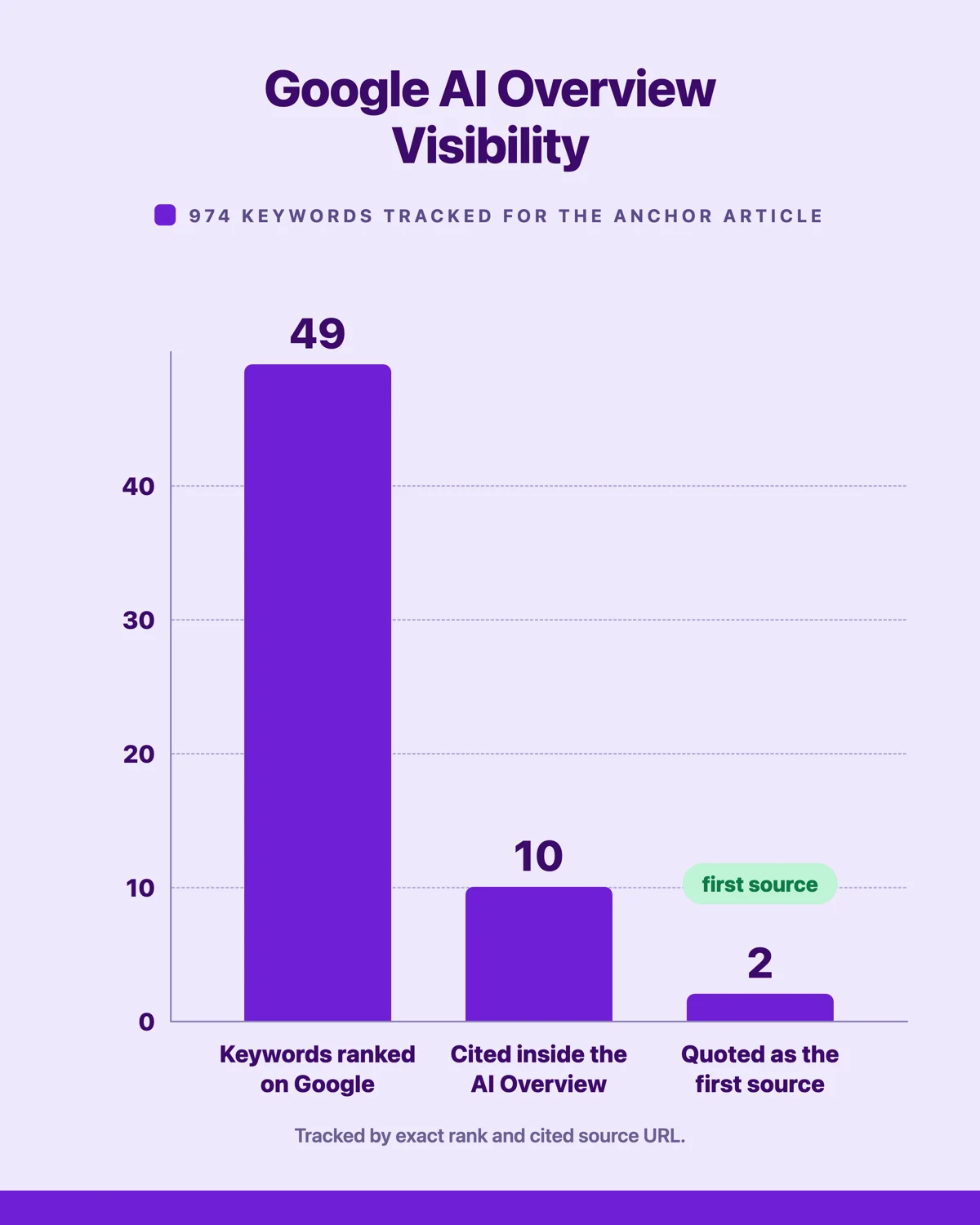
For the Anchor Article, the report tested 974 keywords. The guide ranked on Google for 49 of them, 47 in the top 10 and 13 in the top 3. Google AI Overviews cited the guide on 10 keywords, 1 of them branded, and quoted it as the first source on 2.
Examples From AI Answers
None of the three questions named the client, yet AI engines named it in every answer and put it first in at least one engine’s response each time.
“What is the difference between a landlord policy and a business owner’s policy for rental property owners?” (asked as Real Estate Investor)
Gemini ranked the client first, presenting it as the agency behind a coverage guide that recommends a business owner’s policy as the foundational small-business bundle. Grok also ranked it first, citing it as a source for business owner’s policy guidance alongside other insurance information sites.
“Does a personal auto policy cover vehicles used primarily for business?” (asked as Contractor)
For a contractor weighing whether a personal policy is enough, Gemini ranked the client first and described it as a consultative agency that compares several national carriers before recommending coverage. Grok ranked it third, citing it as a source noting that personal auto insurance generally does not cover business use, where commercial auto coverage applies.
“Does a business owner’s policy cover a manufacturer’s products liability exposure?” (asked as Manufacturer)
A manufacturer asking about products liability exposure got an answer naming the client as an independent broker: Gemini ranked it first and described it as an agency that tailors business owner’s policy bundles and compares several carriers to match the operation’s risk.
How We Measured
The pilot ran one set of 200 buyer prompts for the AI Notice on four AI engines: ChatGPT, Gemini, Perplexity and Grok. A mention counts when an engine names the client in its answer. Brand visibility is the share of prompts in which at least one engine named the client. The Anchor Article’s report ran no buyer prompts, so the guide is measured on Google alone.
A placement citation counts only when an engine lists a published copy of the AI Notice as a source, matched by exact URL. A separate Google check recorded organic keyword rankings and which Google AI Overviews cited either asset. The two Google keyword sets differ, so their figures are reported separately and never combined.
Why This Matters
The client was the most-named small business insurance brand in the AI Notice prompt set. 46 of the 75 prompts that named it never mentioned its name. These included questions about personal auto coverage for business use, reviewing several policy types together, and whether a BOP covers a customer’s slip-and-fall claim, the kind of practical coverage questions buyers ask when comparing policies.
Coverage was lowest on Problem-Aware prompts, the questions that describe a coverage worry before naming a specific policy: engines named the client in just 11 of the 72. More Anchor Articles and AI Notices aimed at those prompts can extend this AI visibility optimization work to them.
Zen Media has applied this AI visibility optimization approach in pharmacy software and MSP support. Want to see how your brand appears in AI answers to buyer questions? Contact Zen Media to explore an AI visibility strategy for your business.