
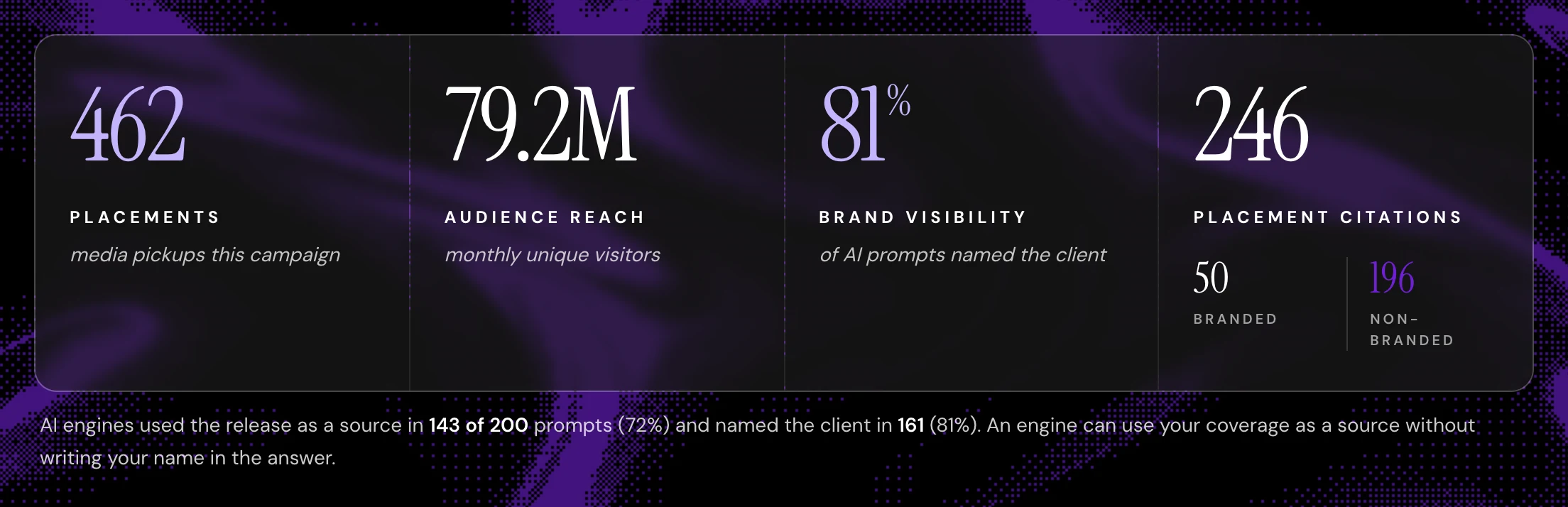
462 media placements
AI prompts naming the client
50 branded, 196 non-branded
The Business
The client is a direct-to-consumer furniture brand. It makes handcrafted modular sofas from interchangeable cubes, builds each one to order and sells them only online, with no showroom. Its buyers range from families with pets and young children to interior designers. Nobody can sit on the sofa before it ships. The client wins trust with written detail: the frame wood, the cushion construction, washable performance fabrics and a long written frame warranty.
Many of these buyers now check a sofa before they order by asking an AI engine how it is built and what its warranty covers. The client’s position is simple: a sofa bought online should come with its build specifications in writing.
The Objective
The pilot set out to make the client a source that AI engines cite when buyers ask how to choose a modular sofa online. It used two published assets and measured the results once after launch. The plan was to:
- Focus on buyer questions about construction, warranties and buying online, where the buyer is close to a decision
- Publish one Anchor Article on the client’s domain to build its authority on modular sofas
- Publish one AI Notice to carry the same build-specification case into third-party sources
- Track the client’s AI visibility on five AI engines, with a fixed set of 200 buyer prompts for each asset
- Measure share of voice and prompt coverage against competing sofa brands
- Count how often the engines named the client when the question did not mention the brand
Core Challenges
Competing With Furniture Brands Already Established in AI Answers
Ten rival furniture brands were each named more than 60 times across the 200 buyer prompts. The answers cited 1,830 different websites. Video, forum and social platforms were among the most-cited sources, along with competitors’ own sites. Engines tend to recommend the brands these sources already discuss, so the client needed a source of its own.
Buyers Ask AI for Exact Build Specifications
Buyers in this category ask exact questions, like how deep the seat is, what fills the cushions, what wood the frame uses and how many years the warranty runs. To answer them, the client needed an authoritative source that gives buyers and AI engines every one of these details.
Tracing New AI Visibility Back to Its Source
With two assets in market, both telling the same build-specification story, a total citation count would not have shown which one the engines were citing. Only per-citation attribution could separate them, so the pilot traced every appearance back to the page behind it.
The Strategy
Prompt Selection Around the Buying Moment
The 200 prompts were written in the voices of real buyers, from first-time furniture buyers to procurement managers. Construction and warranty questions were weighted over general brand-awareness prompts.
One Anchor Article
A long-form guide on the client’s site explained the cube system, how to choose a configuration and seat depth, and how each piece is built. It closed with a buyer FAQ. Because the client owns the page, AI engines can keep crawling and citing it after the pilot ends.
One AI Notice
The wire carried the AI Notice in July, restating the build-specification argument on a third-party domain, and 457 outlets picked it up.
Day-Zero Launch, Day-7 Measurement
The AI Notice went live on day 0. The program waits seven days before it measures. After that wait, the pilot ran 200 buyer prompts for each asset on five AI engines and counted every citation that pointed back to the AI Notice’s placements and to the Anchor Article. The figures on this page are a single snapshot taken after that wait.
AI Visibility Results
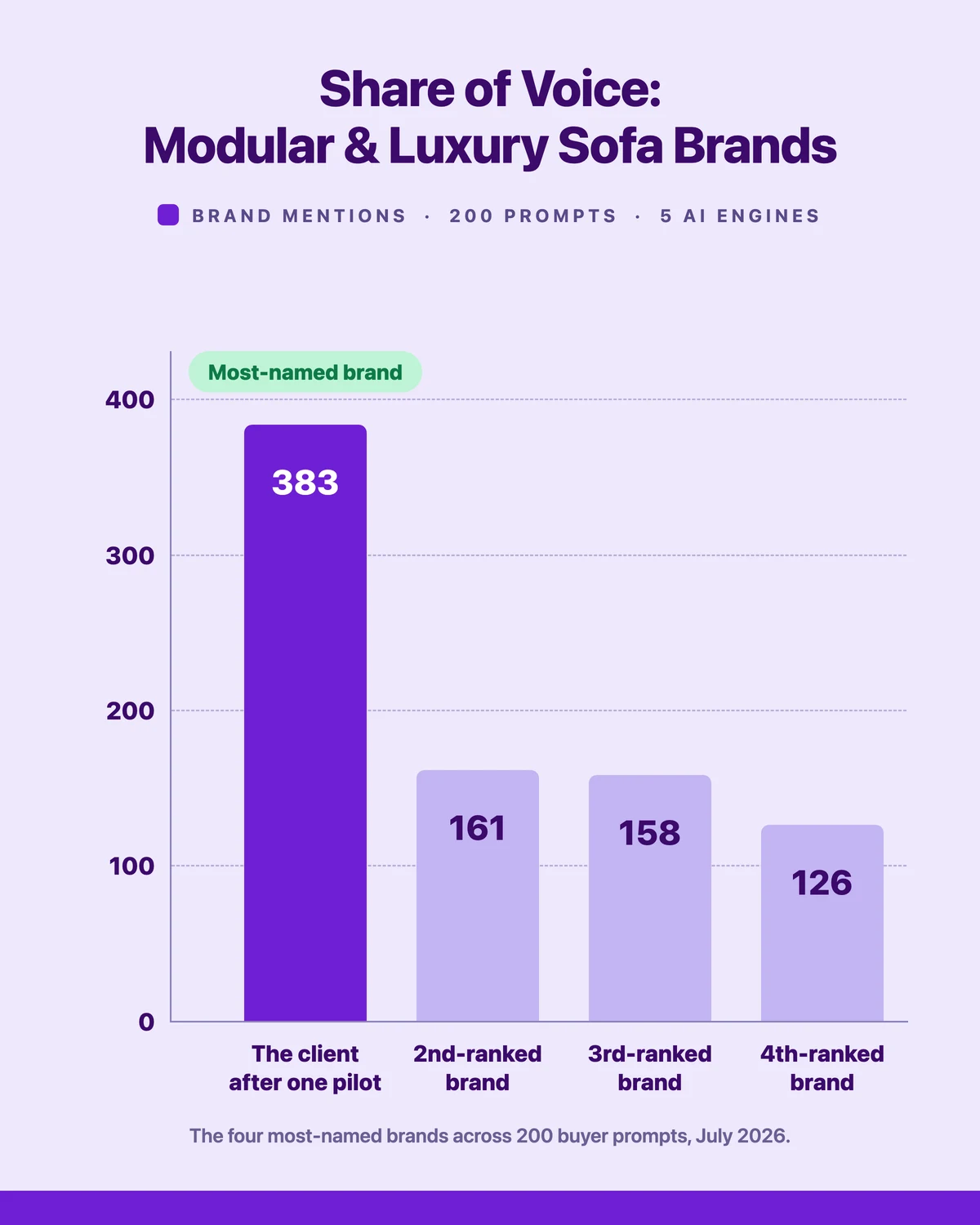
After launch, the client was the most-named brand in the AI Notice prompt set, with 383 mentions on the five engines.
383 mentions
AI Notice as a source
client a top pick
never mentioned it
The four tiles measure the 200 buyer prompts. The campaign report shows how far the AI Notice traveled in the media and how often AI engines cited it.
Share of Voice Among Modular and Luxury Sofa Brands
The client’s 383 mentions were more than double the nearest competitor’s. Against its three most frequent rivals, the client ranked higher in 66% to 80% of the answers that named both brands.
Prompt Coverage and First-Named Finishes
The client’s AI visibility reached 161 of 200 buyer prompts, an 81% brand visibility rate. It ranked in the top three 75% of the time and finished first 333 times across the five engines. Buyer-intent questions made up the largest group.
Unprompted Discovery
Only 22 of the 161 prompts that named the client asked about the brand directly. The other 139, or 86%, did not mention it. They asked about topics such as warranties, fabrics, seat depth and ordering online.
The report’s awareness funnel follows that coverage from a buyer’s first question to a brand search. The client appeared in at least 69% of prompts at every stage and in all 22 brand searches, and its position was weakest among buyers comparing solution categories.
| Buyer awareness stage | Coverage | Named the client | Prompts in stage | Avg position |
|---|---|---|---|---|
| Unawarehas not identified the problem | 69% | 9 | 13 | #1.1 |
| Problem-Awareknows the problem, still scoping solutions | 76% | 37 | 49 | #1.4 |
| Solution-Awareevaluating solution categories | 88% | 29 | 33 | #2.0 |
| Product-Awarecomparing specific products | 80% | 43 | 54 | #1.6 |
| Most-Awaresearching by brand name | 100% | 22 | 22 | #1.0 |
AI Visibility by Engine
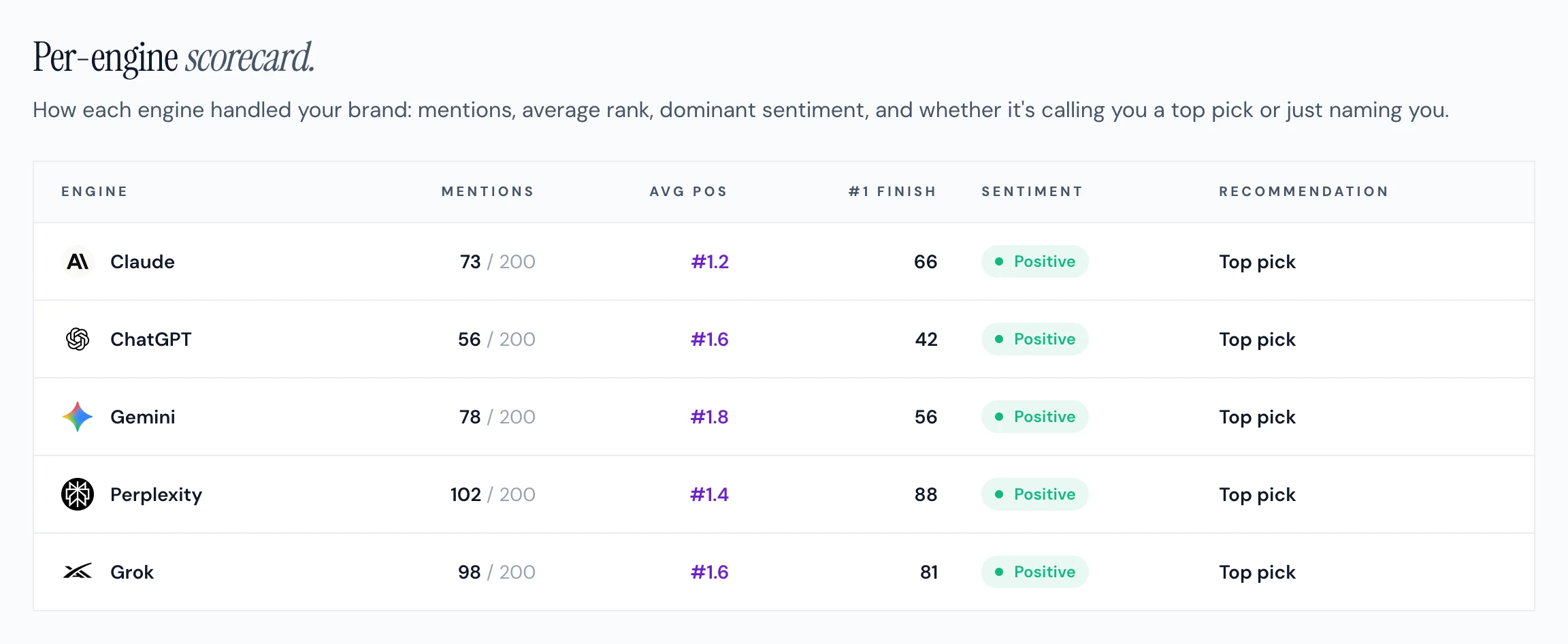
All five engines named the client, read it positively and rated it a top pick. The report logged one negative mention, on Grok. Perplexity and Grok named the client most often, and Claude placed it first more often than Gemini did despite naming it less.
Where the AI Visibility Came From
Citation tracking on Gemini, Grok and Perplexity logged 14,769 source citations from 1,830 unique domains. The client’s own website led the list with 1,098 citations, well ahead of YouTube in second place. One news site carrying the release was the most-cited, with 290 citations. The AI Notice earned 246 placement citations on its own, more than three times the 75 the program guarantees. Engines used the release as a source in 72% of buyer prompts. In a separate prompt set, four of the five engines cited the Anchor Article 59 times.
Distribution Reach
The AI Notice reached a combined audience of 79.2M across 462 placements on 457 outlets. Those placements carried 246 citations, 196 of them on non-branded terms. Three third-party sources account for the citations. Together they hold half of the total reach, 39.2M.
Examples From AI Answers
The examples below show how AI engines answered buyer questions about modular sofas and which sources they cited.
“How should online furniture buyers evaluate luxury modular sofas when they can’t sit on them first, and what published specifications matter most?” (asked as an online furniture buyer)
Gemini’s answer held up a long, written frame warranty as a marker of build quality, and it ranked the client first as the high-end modular brand that offers one.
“I want a white sofa but I have pets, are there luxury modular couches with non-toxic, machine-washable performance fabrics that make that realistic?” (asked as a pet owner)
The client came out as Perplexity’s top pick for a white, pet-safe modular sofa. The answer pointed to its non-toxic, fully washable performance fabric, named its flagship model, and placed two other brands with washable covers behind it.
“How does a modular sofa with interchangeable cubes reduce furniture waste over time compared to a traditional fixed sectional?” (asked as a sustainability advocate)
Asked about waste, Gemini answered with a point about transparency. It credited the client with popularizing published, verifiable build specifications for modular sofas online. It presented that practice, alongside industry durability and manufacturing standards, as a reason to trust a sofa bought unseen.
None of the three prompts named the client, yet the engines chose it as the answer each time.
How We Measured
The pilot measured AI visibility with two separate sets of 200 buyer prompts, one for the AI Notice and one for the Anchor Article. Both ran on Claude, ChatGPT, Gemini, Perplexity and Grok. The AI Notice set covered seven question types: buyer intent, terminology, category, brand-direct, problem solving, comparison and education. The Anchor Article set covered five of them. Both reports recorded every brand each engine named. Share of voice counts those mentions on all five engines. The Anchor Article report logged cited sources on all five engines. The AI Notice report logged them on Gemini, Grok and Perplexity. Citations were matched by exact URL, so every citation credited to an asset on this page points at that asset’s page.
About the measurement
All results come from a pilot built around one Anchor Article and one AI Notice. The AI Notice ran in July 2026. Each asset was measured once after launch. The two prompt sets differ, so their figures are reported separately and never combined.
Why This Matters
The client was the most-named brand in AI answers about modular sofas. Of the 161 prompts that named it, 139 (86%) came from questions that did not mention the brand. Buyers who asked about warranty length, washable fabric or durability found the client through the answer itself.
This pilot covered one round of buyer questions in the client’s category. More Anchor Articles and AI Notices can extend the same method to the questions it did not reach.
Zen Media has used the same approach to build AI visibility in weight management and corporate event planning. Want to know what AI engines tell your buyers about your brand? Contact Zen Media for an AI visibility strategy built around the questions your buyers ask.