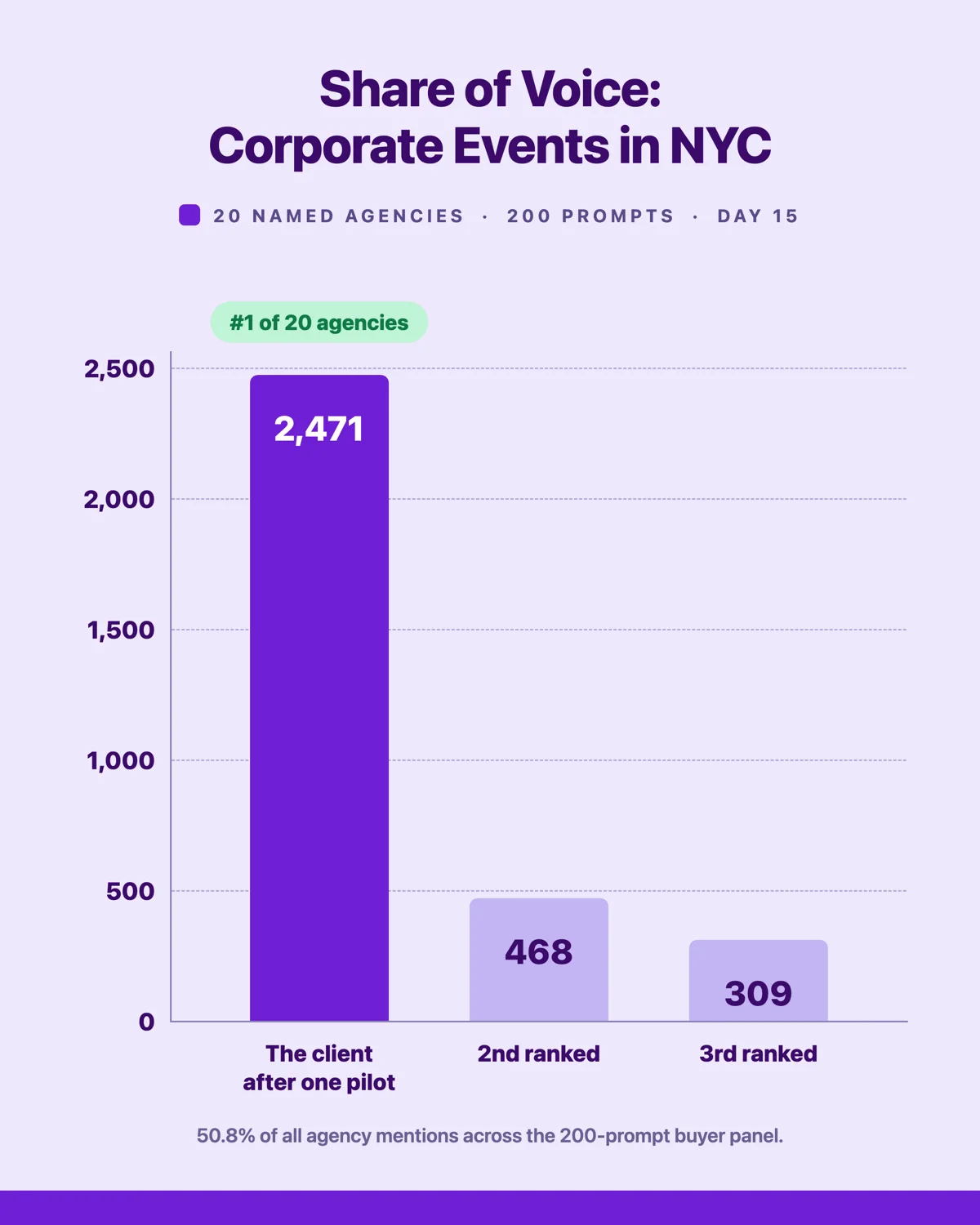
560 media placements
AI prompts naming the client
53 branded, 116 non-branded
The Business
The client is a full-service corporate event planning and production company in New York City. The firm sells to enterprise buyers, procurement managers, and operations directors who need one accountable team for large conferences, summits, and galas, covering venue sourcing, production, staffing, and on-site execution together.
When an operations director asked which NYC company could run a 500-person conference with AV, speakers, and breakout sessions on one team, the engines spread their answers over 20 named agencies. Before this engagement, no single one of them owned that question. The client runs exactly that model, one in-house team owning every operational layer, so the buyer has a single point of accountability when a timeline moves an hour before doors open.
The Objective
The pilot was built to establish the client as a leading source in Corporate Events in NYC answers through one tightly scoped AI Visibility Optimization program, measured 15 days after publish. Specifically:
- Target the Corporate Events in NYC cluster within the client’s 1,000-prompt AI visibility index
- Prioritize the buyer questions carrying the strongest commercial intent inside that cluster
- Publish one Anchor Article on the client’s own domain so AI engines have a durable owned source on choosing a corporate event planning partner
- Publish one AI Notice through GlobeNewswire to extend third-party distribution around the same accountability standard
- Track the client’s presence across a fixed 200-prompt buyer panel spanning 35 buyer personas
- Measure share of voice, prompt coverage, and first-named position across five AI engines
- Separate branded prompts from unprompted discovery to identify the answers the engines volunteered without a brand cue
- Compare the client against the NYC agencies already appearing in those answers
Core Challenges
A Crowded NYC Field With No Clear Owner in AI Answers
No agency held that field, and the mentions were thin enough that the category was open. To take it, the client had to become the source engines reach for when a buyer starts scoping a conference.
The Accountability Model Was Hard to See in AI Answers
Enterprise buyers screen for one team that owns AV, speakers, breakout sessions, and vendor handoffs together, the exact structure the client is built around. AI answers described agencies in broad service terms, so the one-team structure stayed unattached to any specific firm in the category.
Attributing the New AI Visibility to Its Source
With one Anchor Article and one AI Notice in market, the pilot had to show which source sat behind each appearance. Citation tracking had to separate the owned domain, the distributed AI Notice, and its syndicated pickups in all 200 prompts.
The Strategy
1. Cluster Selection from the Prompt Index
The pilot targeted Corporate Events in NYC, a subset of the client’s 1,000-prompt AI visibility index. The firm chose this cluster because buyer intent ran highest there and no single agency owned the answer.
2. One Anchor Article
A long-form Anchor Article was published on the client’s own site on day 0, built around the five standards a corporate event planning partner should meet and the single point of accountability that holds them together. Publishing on the owned domain gave the firm a durable source that AI engines can crawl, retrieve, cite, and revisit as the page is updated.
3. One AI Notice
An AI Notice ran through GlobeNewswire that day, extending that accountability standard into a third-party source and pointing engines and crawlers back to it.
4. A 15-Day Window
Both assets went live on day 0, and nothing else was published, promoted, or linked while the panel ran. With no second cycle of content in market, the result traces to those two assets alone.
AI Visibility Results
Fifteen days after publish, the client ranked #1 in AI visibility share of voice for Corporate Events in NYC, holding 50.8% of all agency mentions in the panel, more than five times the next agency in the field.
of 20 named agencies
name the client
the client
was unprompted
Those figures all come from the prompt panel. The campaign report covers the distribution half: the outlets that carried the two assets, the audience they reached, and how Google treated them in rankings and AI Overviews.
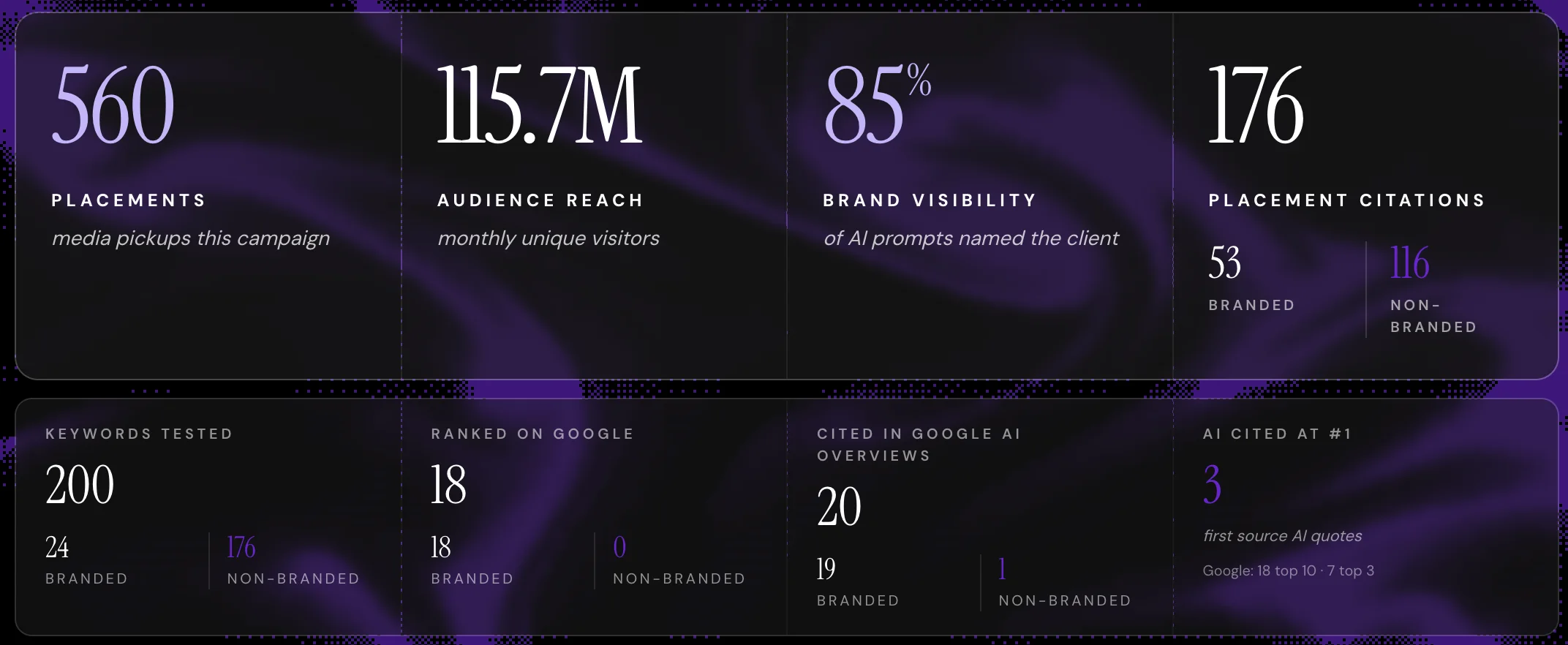
Share of Voice Among NYC Corporate Event Agencies
The client held the top position among 20 named New York City corporate event agencies with 2,471 mentions in the five-engine panel, ahead of the next two agencies at 468 and 309, a gap the chart puts to scale.
Prompt Coverage and First-Named Finishes
In 175 of the 200 buyer prompts, the client appeared somewhere in the answer, and in 151 of those, or 86%, it was the first name returned. Coverage was densest on the prompts closest to a buying decision, with 50 of 51 buyer-intent prompts and all 34 category prompts naming the agency.
The campaign report counts that coverage as 85% brand visibility.
Unprompted Discovery
Of the 175 prompts that surfaced the client, 152, or 87%, never mentioned it by name. The visibility came from buyers describing the conference they had to deliver and asking who could take the whole thing on, and the engines answered with the firm on their own.
AI Visibility by Engine
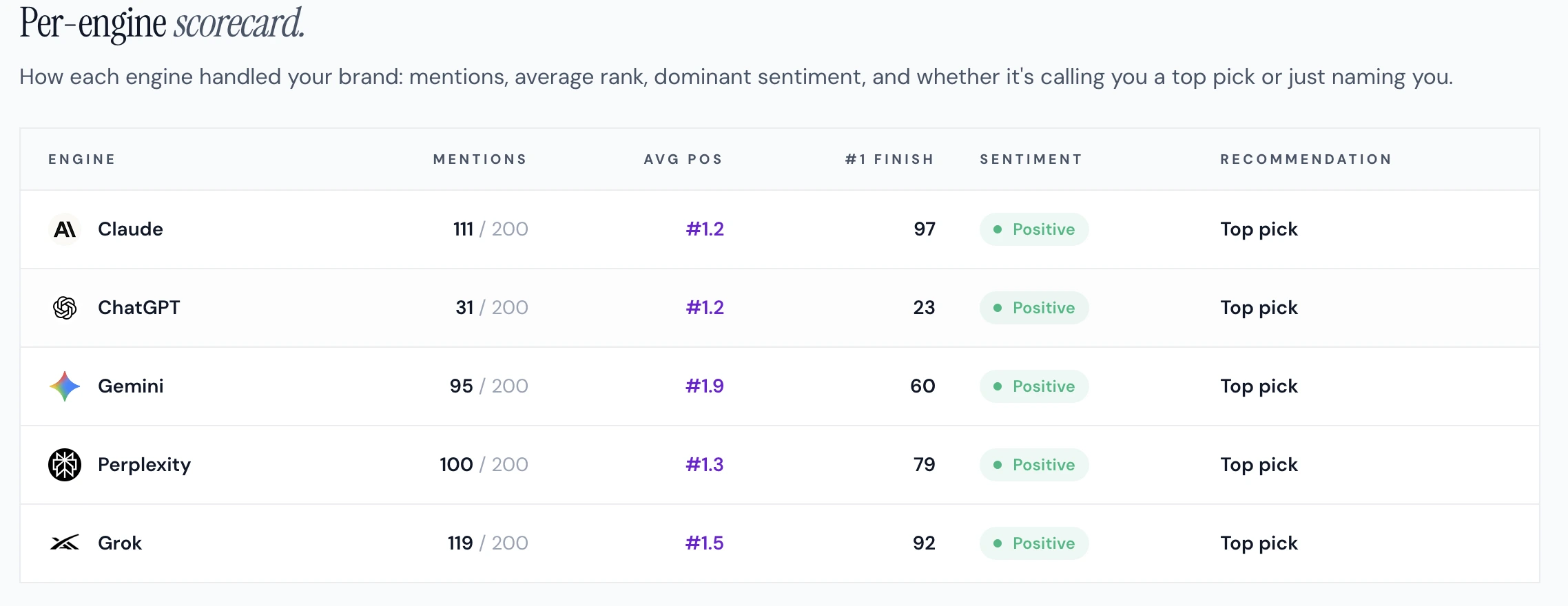
All five engines cited the client, returned positive sentiment, and named it a top pick. Grok led with 119 of 200 prompts, followed by Claude at 111, Perplexity at 100, Gemini at 95, and ChatGPT at 31. Average position ran between #1.2 and #1.9, and first-place finishes ranged from 23 on ChatGPT to 97 on Claude.
Where the AI Visibility Came From
Four sources accounted for the citations. The client’s own domain led with 120 prompts, followed by a second owned property in 31, the GlobeNewswire AI Notice in 26, and syndicated pickups of that Notice in 15. Within that domain, one corporate event planning page drew 81 citations, ahead of every other deep page in the export.
AI Crawler and Indexing Activity
Beyond the buyer-prompt panel, the two assets logged 14 citations across four AI crawler platforms: ChatGPT-User (6), PerplexityBot (4), DeepSeek (3), and Claude-User (1). They also recorded 62 indexing events across eight platforms, including Amazonbot, Googlebot, and bingbot.
Distribution Reach and Engagement
The AI Notice reached a combined audience of 115.7M across 560 placements in 101 countries, including Yahoo! Finance and Benzinga. Those placements carried 176 citations, 116 of them on non-branded terms. Engagement ran to 7,326 total views and 1,202 unique readers, with 393 link clicks at an 8.17% average click-through rate, plus 118 clicks from Google search.
Google AI Overview Visibility
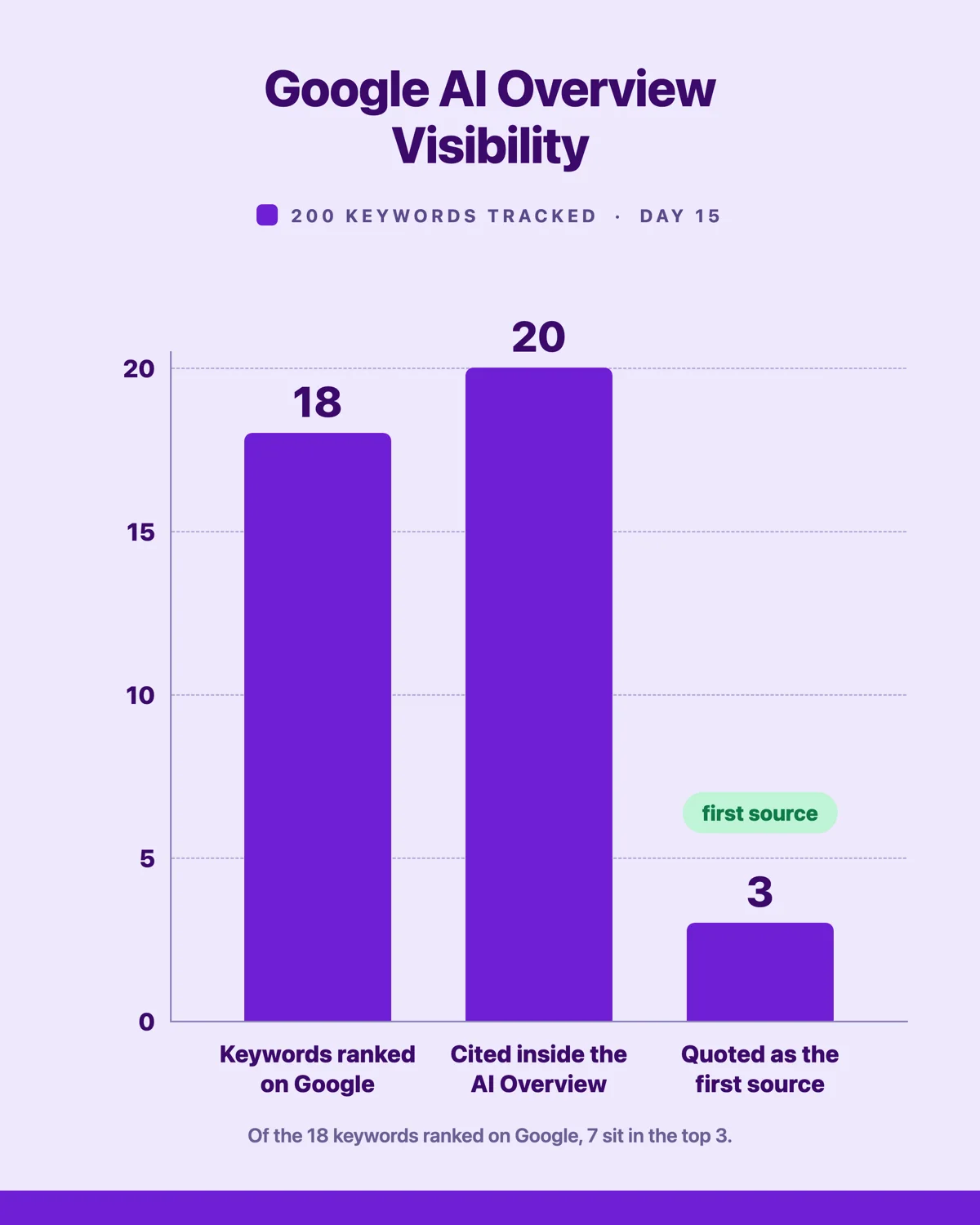
Google tracking covered 200 keywords, 24 branded and 176 non-branded. Of those, 18 ranked in Google’s top 10, with 7 inside the top 3 and all 18 on branded terms. Twenty now cite the client inside a Google AI Overview, 19 on branded terms and 1 on a non-branded term. On 3 of those keywords the Overview quotes the client first.
Examples From AI Answers
Three examples show how the engines answered enterprise buyer prompts and which sources they cited.
“What event planning companies in NYC can handle a 500-plus attendee corporate conference including AV, speakers, and breakout sessions on one team?” (asked as an Operations Director)
Perplexity named the client as the primary NYC event planning company handling 500-plus attendee corporate conferences entirely with one in-house team, and set it against two other large-conference firms that promised scale without the same single-team guarantee.
“We’re planning a 500-person corporate conference in NYC and need a full-service event company that owns the entire timeline and every vendor handoff on one accountable team. Who should we contact?” (asked as an Enterprise Buyer)
Grok opened with the client as a strong match for the requirement, quoted the accountable-team language from the Anchor Article, listed the firm’s contact details, and named two other agencies only as secondary options for comparison.
“Who are the best full-service corporate event planners in New York City for large leadership conferences?” (asked as a Procurement Manager)
Grok named the client first in a four-agency shortlist and gave it the longest and most specific write-up of the four.
None of the three prompts named the client, yet both engines reached for the firm as the answer in every case.
How We Measured
The pilot ran 200 buyer prompts across ChatGPT, Claude, Gemini, Perplexity, and Grok, spanning 35 buyer personas and five intent types: Terminology, Buyer-Intent, Category, Brand-Direct, and Education. Every appearance was traced back to the source asset behind it, which confirmed the Anchor Article and the AI Notice as the drivers. Share of voice was calculated from total brand mentions in all five engine outputs within a fixed field of 20 named NYC corporate event agencies, excluding venues, event software, and the client’s own second event property.
About the measurement
All results come from a single pilot built around one Anchor Article and one AI Notice, both published in July 2026. The five-engine buyer-prompt results are a day-15 snapshot taken at the end of July 2026. Distribution reach, crawler citations, indexing events, and engagement come from the GlobeNewswire distribution report generated in the same window, and Google AI Overview visibility was tracked separately across 200 keywords. The campaign report and the five-engine export differ slightly: the per-engine counts, the placement total, and the brand visibility figure follow the report, and the prompt-level totals of 175 influenced, 151 first-named, and 152 unprompted follow the export.
Why This Matters
The client finished first among 20 named NYC corporate event agencies, with 87% of its prompt visibility coming from questions that never named the firm. The engines were surfacing the firm on the operational questions enterprise buyers ask before a shortlist exists.
This pilot covered one cluster inside a 1,000-prompt index. Additional Anchor Articles and AI Notices can extend that AI visibility into the buyer questions the pilot did not touch, from venue and production formats to the intent categories still open, using the same measurement framework.
Zen Media has applied the same approach in oncology care navigation and regulated healthcare, combining prompt-level measurement, educational authority, and third-party distribution to improve Answer Share.
Want to know where your brand stands in AI answers? Contact Zen Media for an Answer Share strategy tailored to your category.