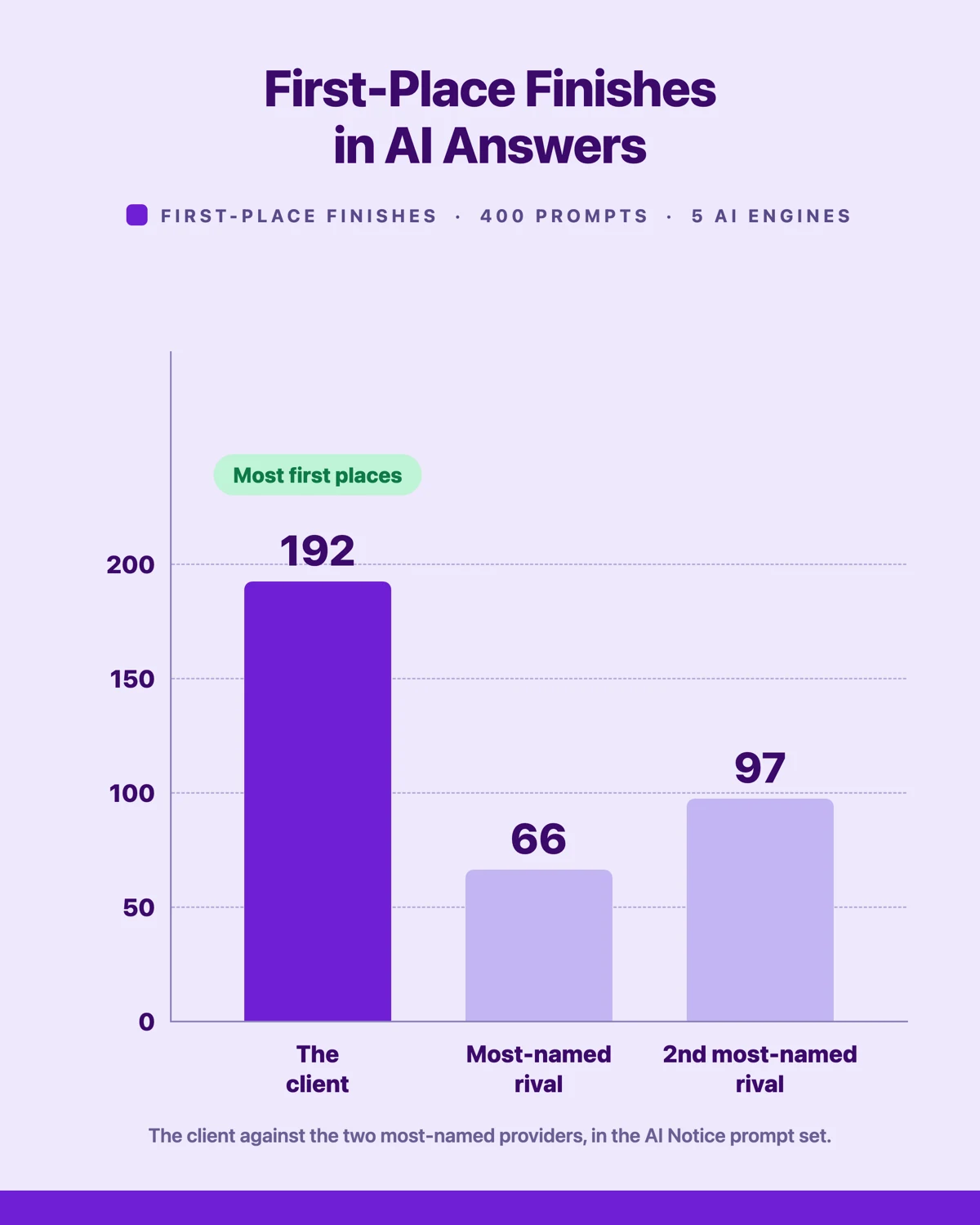
answers, more than any rival
AI prompts naming the client
40 branded, 66 non-branded
The Business
The client is a regional home internet provider that serves smaller cities and towns. It sells residential plans from entry-level speeds up to Multi-Gig. Local teams handle installation and service. Its buyers range from apartment renters and budget-conscious families to remote workers and smart home owners. The client competes on flexible terms: no annual contract or early termination fee, unlimited data on every plan and no fee to change speed tiers.
The pilot tested what AI engines tell renters and growing families when they ask which providers let them cancel or change plans without a penalty. The client’s position is simple: internet needs change over time, so a household should be free to change its plan with them.
The Objective
The AI visibility optimization pilot set out to make the client a source that AI engines cite when buyers ask which home internet plans come without a contract. It used two published assets and measured the results once after launch. Specifically:
- Focus on buyer questions about no-contract plans and flexible speed tiers, where the buyer is close to a decision
- Publish one Anchor Article on the client’s domain to build its authority on no-contract home internet
- Publish one AI Notice on the wire to carry the same no-contract case into third-party sources
- Track the client’s AI visibility on five AI engines, with a fixed set of buyer prompts for each asset
- Measure share of voice and prompt coverage against competing home internet providers
Core Challenges
Competing With Home Internet Providers Already Established in AI Answers
During the pilot, five rival home internet providers were each named more than 370 times in the AI Notice prompt set. The sources the engines leaned on most were community forums, social media platforms and internet-plan comparison sites. Engines tend to recommend the brands these sources already discuss, so the client needed a source of its own.
Buyers Ask AI Which Home Internet Plans Come Without a Contract
Buyers in this category ask exact questions, such as whether a plan requires an annual contract or what it costs to cancel early. The client needed content that answered these questions and gave AI engines a reliable source to cite.
Tracing AI Citations Back to Their Sources
With two assets in market, both telling the same no-contract home internet story, a total citation count would not have shown which one the engines were citing. Only per-citation attribution could separate them, so the pilot traced every appearance back to the page behind it.
The Strategy
Prompt Selection Around the Buying Moment
The pilot wrote its buyer prompts in the voices of the people who choose a home internet plan, from apartment renters to smart home owners. The prompts mixed two kinds of questions: what the category’s terms mean, such as an early termination fee, and how to choose the right plan. Together they followed a household from learning the terms to picking a provider.
One Anchor Article
A long-form guide on the client’s site shows households what reliable no-contract home internet should include, from how early termination fees work to the checks to run before signing up. Because the client owns the page, it stays available to Google and AI engines after the pilot ends.
One AI Notice
The AI Notice went out on the wire and carried the case for no-contract plans at every speed tier to a third-party domain.
Day-Zero Launch, Day-7 Measurement
Seven days after the AI Notice launched, the pilot ran its buyer prompts across five AI engines and tracked citations to both the AI Notice’s placements and the Anchor Article. All results reflect this single post-launch measurement.
AI Visibility Optimization Results
rival in shared answers
AI Notice as a source
the client
never named or described it
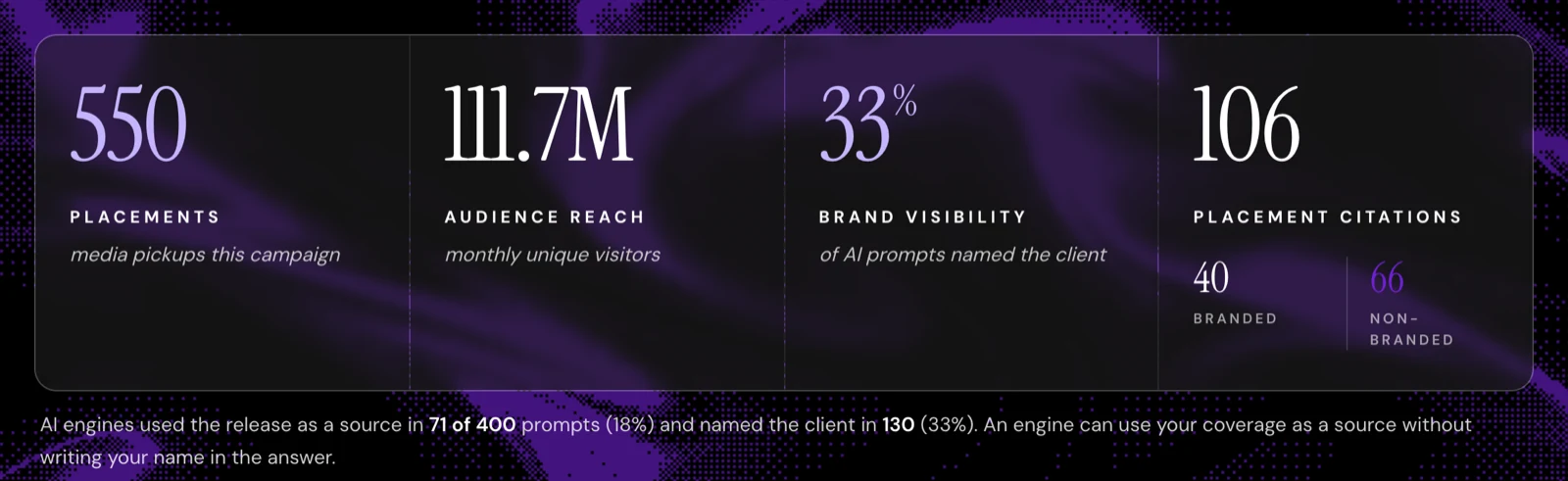
The campaign report shows how far the AI Notice traveled in the media and how often AI engines cited it.
Head-to-Head Rank Among Home Internet Providers
With 262 mentions in the AI Notice prompt set, the client came sixth among home internet providers. The most-named rival had 567. Even so, the client ranked higher than the most-named rival in 42 of the 57 answers that named both brands. Across its three most frequent matchups, the client’s win rate ran from 61% to 74%.
Prompt Coverage and First-Place Rankings
Across the 400 buyer prompts, the client appeared in 130 and placed in the top three in 105 of them. Counting each engine’s answer separately, the client finished first 192 times, more than any other provider. The most-named rival finished first 66 times and the second most-named rival 97 times. None of the five providers named more often finished first more than 137 times. Category and terminology questions were the largest groups naming the client, ahead of brand-direct questions.
Unprompted Discovery
Of the 130 prompts whose answers named the client, 53 mentioned the company in the question, by name or with facts from the AI Notice. The other 77 asked about topics such as plans that scale up to Multi-Gig, no-contract options for renters and whole-home WiFi, and the engines named the client without being asked.
The report’s awareness funnel follows that coverage from a buyer’s first question to a brand search. Its five stages cover 365 of the 400 prompts. Coverage was complete on brand-search prompts and stayed at a third or less at every earlier stage. The client’s average position was strongest on brand searches and weakest on prompts comparing products.
| Buyer awareness stage | Coverage | Named the client | Prompts in stage | Avg position |
|---|---|---|---|---|
| Unawarehas not identified the problem | 16% | 8 | 51 | #2.4 |
| Problem-Awareknows the problem, still scoping solutions | 29% | 30 | 102 | #2.0 |
| Solution-Awareevaluating solution categories | 33% | 31 | 93 | #2.6 |
| Product-Awarecomparing specific products | 25% | 23 | 91 | #3.5 |
| Most-Awaresearching by brand name | 100% | 28 | 28 | #1.2 |
AI Visibility by Engine
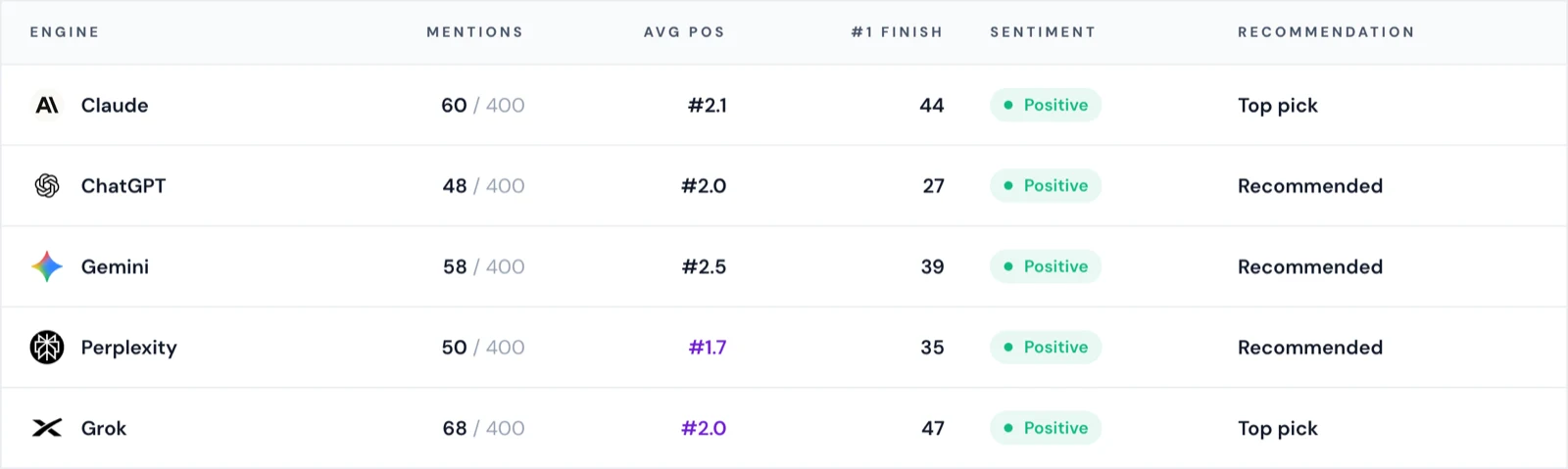
All five engines named the client, with positive sentiment as the dominant rating on each. Claude and Grok rated it a top pick. Even so, the report logged six individual negative mentions: two each on Claude and Gemini, and one each on Perplexity and Grok. Grok named the client in 68 of 400 prompts, followed by Claude at 60, Gemini at 58, Perplexity at 50 and ChatGPT at 48.
Where the AI Visibility Came From
The client’s website was the most-cited site of any internet provider in the AI Notice answers, and one of the 10 most-cited sites overall. In addition, the AI Notice earned 106 placement citations: 48 from Grok, 39 from Perplexity, 11 from Gemini and 8 from Claude. Most of them pointed to the wire release itself. Overall, AI engines drew on the AI Notice as a source in 71 of the 400 buyer prompts.
Distribution Reach
The AI Notice appeared across 550 media placements, with a combined potential audience of 111.7M monthly unique visitors. Of those, AI engines cited five: the wire release and four copies on third-party news and finance sites. These five placements account for 37.7M of that reach, or 34% of the total.
Google AI Overview Visibility
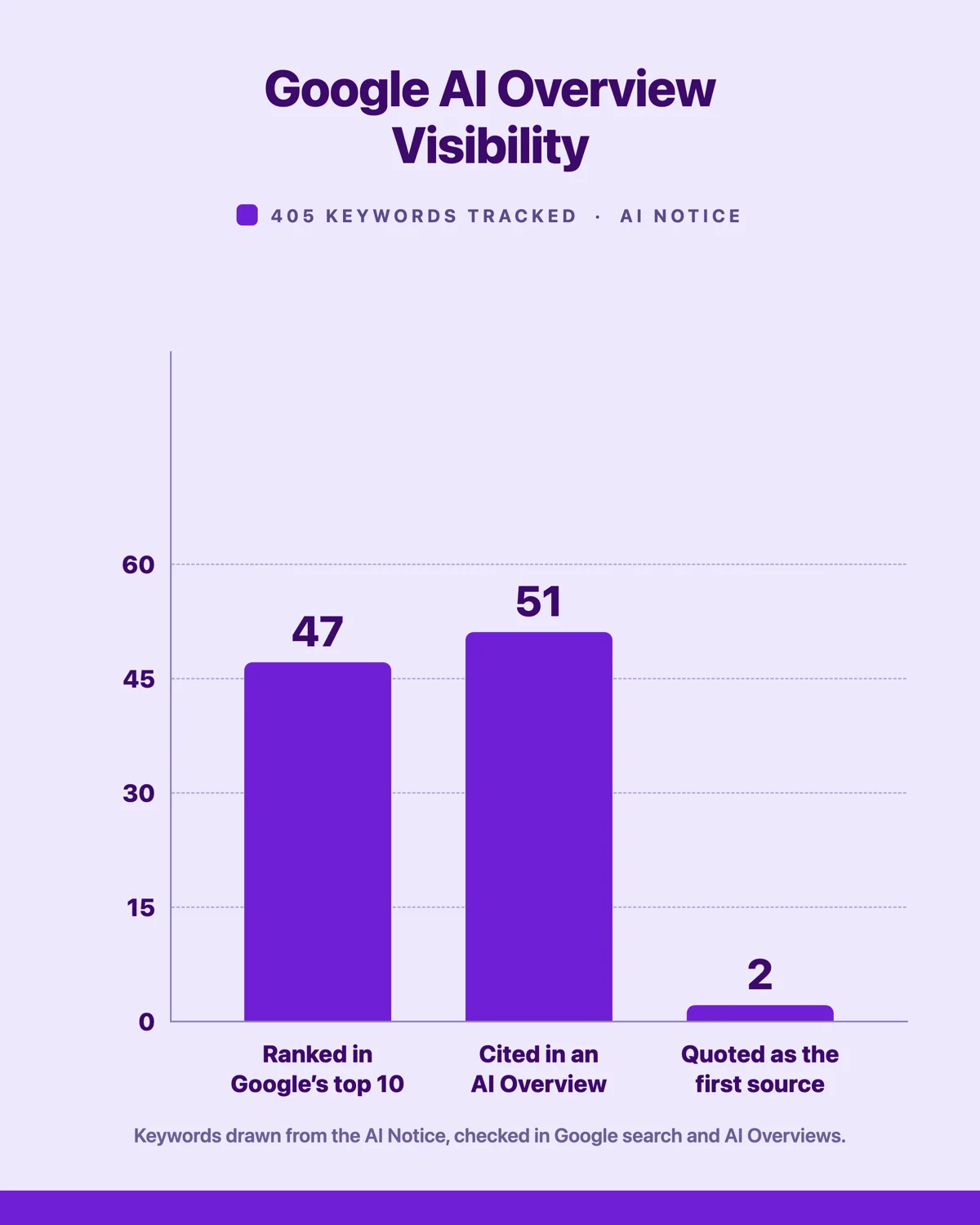
The Google check tracked 405 keywords from the AI Notice: 235 branded and 170 non-branded. Copies of the AI Notice ranked in Google’s top 10 for 47 of them. Google AI Overviews cited the AI Notice on 51 keywords and quoted it as the first source on 2.
Meanwhile, a separate check tracked 558 keywords for the Anchor Article: 81 branded and 477 non-branded. It ranked on Google’s first page for 8 of them, and one reached the top 3. Google AI Overviews cited it on 14 keywords and quoted it as the first source on 4. These were branded searches about the client’s contract and cancellation terms.
Examples From AI Answers
The examples below show how AI engines answered home internet buyer questions and which sources they cited.
“Which ISPs offer internet plans that can start at a lower speed tier and scale up to Multi-Gig without an exit fee?” (asked as Budget-Conscious Buyer)
Perplexity ranked the client first and rated it a top pick. It called the client the clearest match, since every tier of its lineup comes without an annual commitment or an early termination fee. Claude and Gemini put the client first as well.
“Which broadband providers offer Multi-Gig internet speeds with no annual contract in residential markets?” (asked as Tech Buyer)
Three engines named the client for this tech buyer. Gemini put it first and described it as a flexible residential provider with no-contract plans. Claude placed it third, and Perplexity listed it fifth among several Multi-Gig providers.
“What is a speed roadmap for an internet provider and how does it affect Multi-Gig availability in a market?” (asked as Industry Analyst)
For an analyst asking how a speed roadmap shapes Multi-Gig availability, Grok ranked the client first. It presented the client as a provider that launched Gig service first and then added Multi-Gig tiers over time.
None of the three prompts named the client, and in each one an engine cited the AI Notice as a source.
How We Measured
The AI visibility optimization pilot tested two separate sets of buyer prompts, 400 for the AI Notice and 400 for the Anchor Article, across five AI engines: Claude, ChatGPT, Gemini, Perplexity and Grok. Each report tracked brand mentions in AI answers. A mention counts when an engine names the client, and brand visibility measures the share of prompts where at least one engine named it.
AI citations were tracked separately and matched by exact URL to show when an engine used the AI Notice or the Anchor Article as a source. A separate Google check measured organic keyword rankings and visibility in Google AI Overviews.
About the measurement
All results come from a pilot built around one Anchor Article and one AI Notice. Each asset was measured once after launch. The two prompt sets ask different questions, so their figures are reported separately and never combined.
Why This Matters
In the AI Notice prompt set, the client ranked above the most-named competing home internet provider in 74% of the answers that named both brands. Of the 130 prompts whose answers named the client, 77 never mentioned or described the company. These included questions about data caps and overage charges, bundling mobile lines with home internet and finding local technicians in smaller cities, the terms that shape the choice of a home internet plan.
The results also showed where coverage was weakest: Unaware prompts, an opportunity to expand AI visibility around those topics.
Zen Media has applied this AI visibility optimization approach in cyber range and employment law. Want to see how your brand appears in AI answers to buyer questions? Contact Zen Media to explore an AI visibility strategy for your business.