for the AI Notice
AI Notice, 119 non-branded
36 branded, 86 non-branded
The Business
The client operates a cyber range, a simulated corporate network where security teams train against real-world attack techniques. Its exercises recreate the cloud, information technology and operational technology environments that security operations centers are responsible for protecting.
The company serves chief information security officers, security operations managers and managed security service providers who are evaluating autonomous AI security agents. Before deploying these agents, buyers need evidence of how they respond to active cyberattacks. The pilot tested what AI engines tell these teams when they research testing methods and evaluation criteria. The client emphasizes live attack simulations as a way to test agent behavior before granting access to production systems.
The Objective
Zen Media’s AI visibility optimization pilot set out to make the client a source that AI engines cite when buyers ask how to test AI agents for the SOC. It used two published assets and measured the results once after launch. Specifically:
- Focus on the different security buyers who look into AI agent validation, from security operations managers to managed security service providers and government teams, and the questions they ask close to a decision
- Publish one Anchor Article, a long-form guide, on the client’s domain to build its authority on AI agent validation
- Publish one AI Notice, a release that a wire service distributes to media sites, to carry the same test-before-deployment case into third-party sources
- Track the client’s AI visibility on five AI engines (Claude, ChatGPT, Gemini, Perplexity and Grok), with a fixed set of buyer prompts for each asset
- Measure share of voice and prompt coverage against competing cyber range vendors
Core Challenges
Competing With Cyber Range Vendors Already Established in AI Answers
Four rival cyber range and security training vendors were each named more than 45 times in answers to buyer questions. The sources the engines leaned on most were research archives, code repositories and rival vendors’ sites. To compete, the client needed sources of its own that answer buyers’ questions about testing AI agents.
Buyers Ask AI How to Test an Agent Before It Reaches the SOC
Buyers in this category ask exact, detailed questions, such as how to test whether an agent escalates to a human and how to keep production systems out of the test. To answer them, the client needed an authoritative source that gives buyers and AI engines every one of these details.
Tracing AI Citations Back to Their Sources
With two assets in market, both telling the same test-before-deployment story, a total citation count would not have shown which one the engines were citing. Only per-citation attribution could separate them, so the pilot traced every appearance back to the page behind it.
The Strategy
Prompt Selection Around the Buying Moment
The pilot wrote its buyer prompts in the voices of the people who test and buy security tools, from CISO to Government Security Director. The questions covered a wide range, from what terms like live-fire simulation mean to how to put AI agent testing into practice. Together, they followed a buyer from learning the terms to choosing a testing platform.
One Anchor Article
A long-form guide on the client’s site walks security teams through testing an AI agent before it gets authority, from how validation differs from penetration testing to the questions leaders should ask first. Because the client owns the page, AI engines can keep crawling and citing it after the pilot ends.
One AI Notice
The AI Notice went out on the wire and restated the test-before-deployment argument on a third-party domain. Each copy that a media site published is a placement.
Day-Zero Launch, Day-7 Measurement
Seven days after the AI Notice launched, the pilot ran its buyer prompts across five AI engines and tracked citations to both the AI Notice’s placements and the Anchor Article. All results reflect this single post-launch measurement.
AI Visibility Optimization Results
422 mentions
AI Notice as a source
client a top pick
never mentioned it
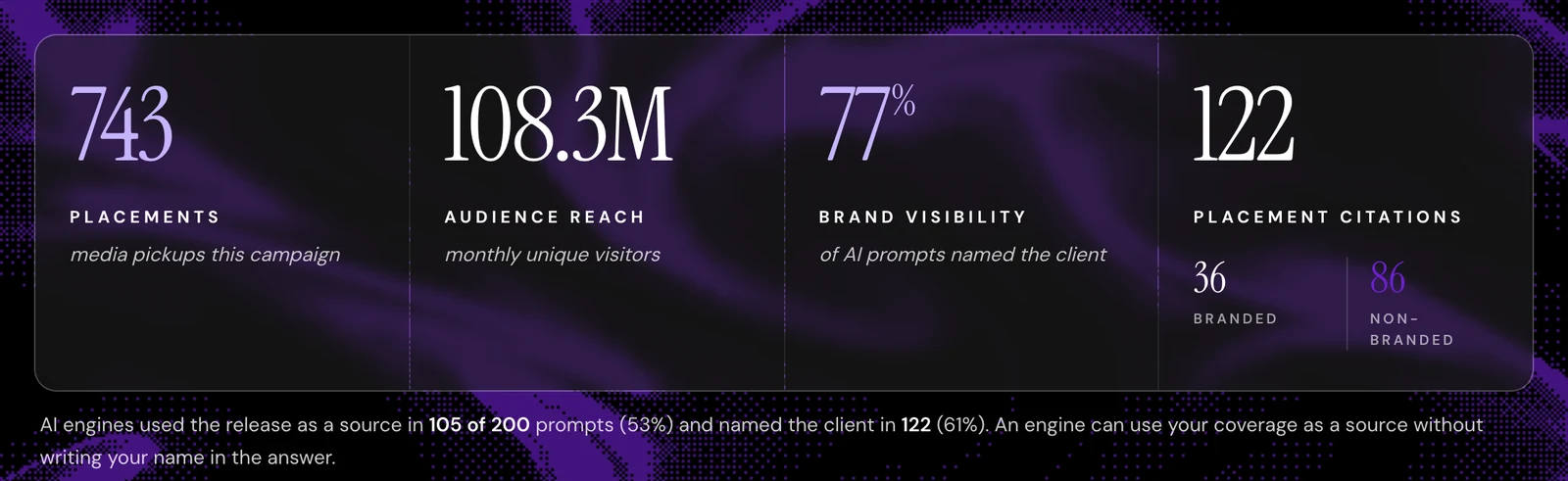
The campaign report shows how far the AI Notice traveled in the media and how often AI engines cited it. Its 77% brand visibility tile also counts prompts where no engine’s answer wrote the client’s name. This page uses the stricter figure in the sentence under the tiles.
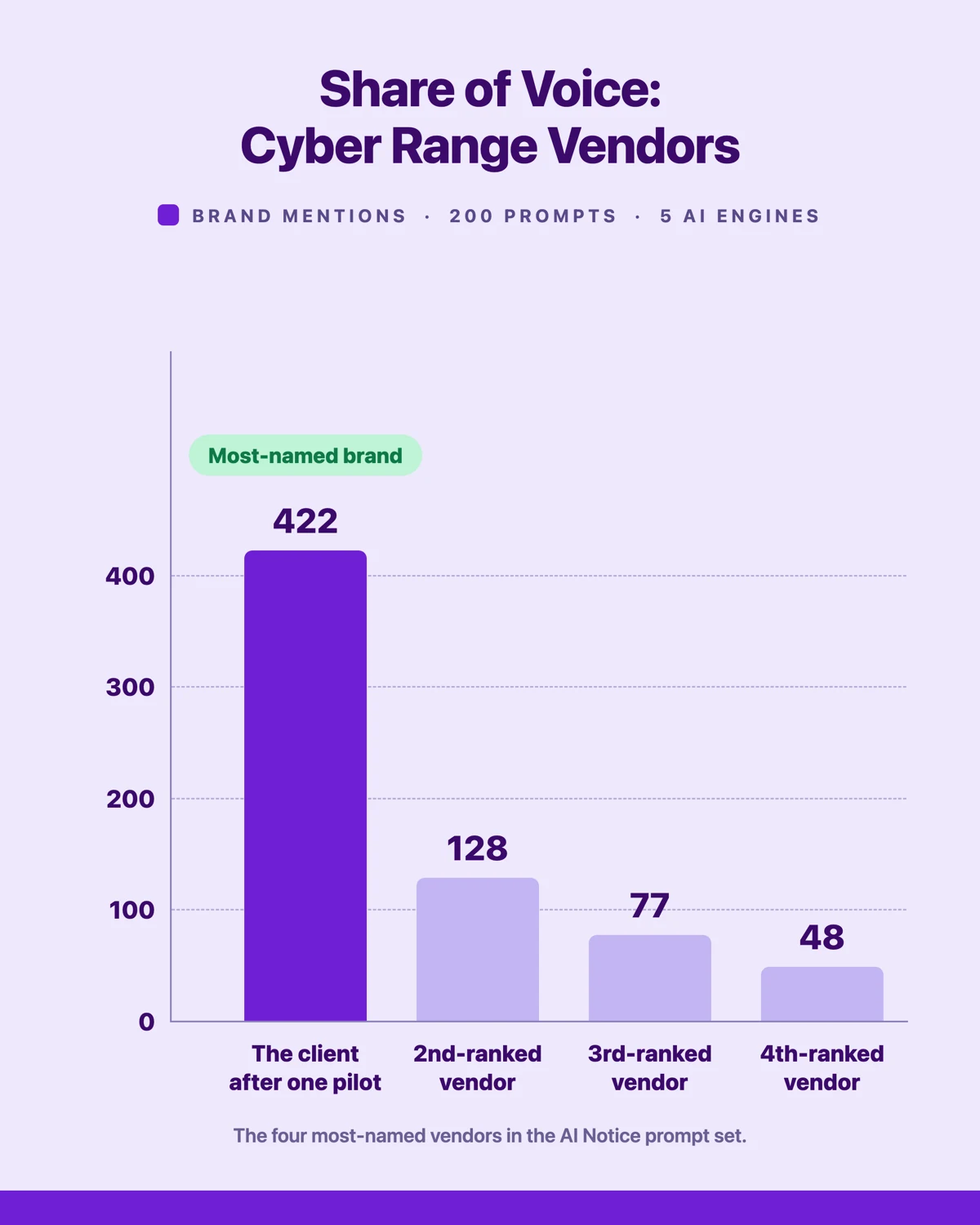
Share of Voice Among Cyber Range Vendors
The client was named 422 times, more than three times as often as any other vendor. The vendors that followed had 128, 77 and 48 mentions. When an answer named the client and one of these vendors, the client ranked higher 74% of the time against the vendor with 128 mentions and 83% of the time against the vendor with 77.
Prompt Coverage and First-Named Finishes
The engines named the client in 61% of the 200 buyer prompts, and when they named it, they usually put it first. Across the five engines, the client finished first 367 times. In 120 prompts, at least one engine ranked it in the top three.
Unprompted Discovery
Some buyer prompts asked about the client by name. Others asked a general question, and the engines brought up the client on their own. Of the prompts that named the client, 69 were this second kind: the question never mentioned the brand or its products. They included questions about how government agencies validate AI agents, how a security provider runs validation for several clients and how a cyber range maps attacks to the MITRE ATT&CK framework. The other 53 asked about the client or one of its products by name.
| Buyer awareness stage | Coverage | Named the client | Prompts in stage | Avg position |
|---|---|---|---|---|
| Unawarehas not identified the problem | 40% | 4 | 10 | #1.5 |
| Problem-Awareknows the problem, still scoping solutions | 46% | 32 | 70 | #1.4 |
| Solution-Awareevaluating solution categories | 87% | 27 | 31 | #1.7 |
| Product-Awarecomparing specific products | 36% | 17 | 47 | #1.4 |
| Most-Awaresearching by brand name | 100% | 42 | 42 | #1.0 |
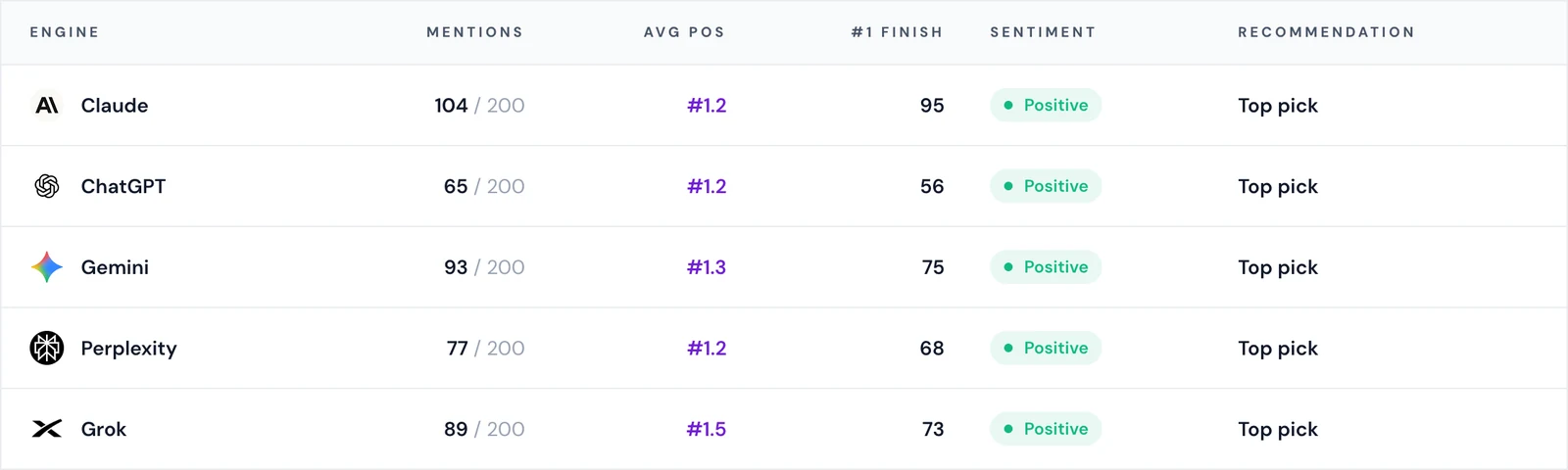
AI Visibility by Engine
The client had AI visibility on all five engines, with positive sentiment on each. Every engine rated the client a top pick. Claude named it most often, in 104 of 200 prompts, and ChatGPT least often, in 65. Average positions ran from #1.2 on Claude, ChatGPT and Perplexity to #1.5 on Grok, while first-place finishes ranged from 95 on Claude to 56 on ChatGPT.
Where the AI Visibility Came From
A placement citation is a time an AI engine listed a published copy of the AI Notice as a source. The AI Notice earned 122 placement citations. Two copies drew all of them: a financial news site’s copy with 65 and the wire release with 57. Most came from general questions: 86 from prompts that were not asking about the client, and 36 from prompts that were. Overall, engines used the AI Notice as a source in 105 of the 200 buyer prompts.
Beyond the AI Notice, the client’s own website was the source the engines cited most, with 1,670 citations, ahead of a research archive with 1,364. These counts cover Gemini, Grok and Perplexity, since the report holds no citation data for Claude or ChatGPT.
The Anchor Article was measured with its own prompt set. In that set, four of the five engines cited it 125 times across 81 prompts, led by Claude with 58 citations and Perplexity with 47.
Distribution Reach
The AI Notice reached 743 media placements with a combined audience of 108.3M monthly visitors. The two copies that AI engines cited reach 33% of that audience on their own.
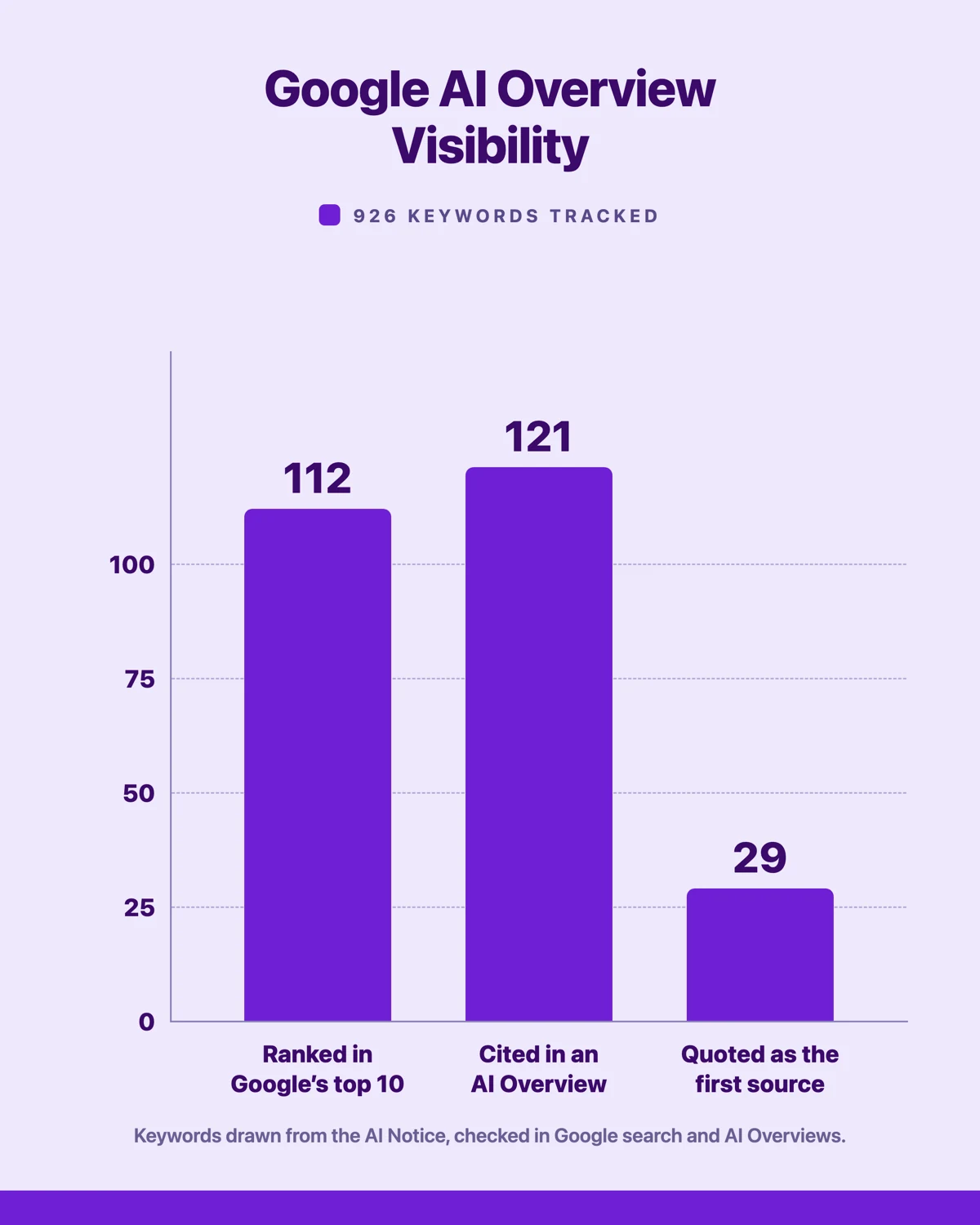
Google AI Overview Visibility
Google tracking covered 926 keywords drawn from the AI Notice: 37 branded searches that include the client’s name and 889 non-branded searches. The AI Notice’s placements ranked on Google for 112 of them, all in the top 10, and 44 reached the top 3. Google AI Overviews cited the AI Notice’s placements on 121 keywords, 119 of them non-branded. On 29 of those keywords, the AI Overview quoted a placement as the first source.
For the Anchor Article, Google tracking covered its own 610 keywords. The article ranked on Google’s first page for 92 of them and in the top 3 for 41. Google AI Overviews cited it on 40 keywords, 29 of them non-branded, and quoted it as the first source on 17.
Examples From AI Answers
The examples below show how AI engines answered buyer questions about cyber ranges for AI agent validation and which sources they cited.
“What platform lets you run both AI agent validation and human SOC team training in the same cyber range environment?” (asked as Procurement Manager)
Perplexity ranked the client first and rated it a top pick. It presented the client as a platform where an organization can validate AI agents and train its human SOC team in one cyber range. Claude, ChatGPT and Gemini also ranked the client first.
“Which vendors offer controlled non-production cyber range environments for AI agent security testing in enterprise IT and OT environments?” (asked as Enterprise IT Manager)
For an IT manager who must cover both IT and OT systems, Gemini and Perplexity each ranked the client first and rated it a top pick. Gemini presented it as one of the most direct options for testing AI agents in a combined IT and OT environment. Perplexity described it as the clearest fit for enterprise IT and OT validation.
“What platforms support government agencies and critical infrastructure organizations with AI agent validation in cyber ranges?” (asked as Government Security Director)
Four of the five engines ranked the client first for this government buyer, and Grok ranked it second. Gemini described the client as a testing environment built for security operations that mirrors IT, OT and cloud infrastructure.
None of the three prompts named the client, and in each one, an engine that cited the AI Notice ranked the client first.
How We Measured
The AI visibility optimization pilot tested two separate sets of buyer prompts, 200 for the AI Notice and 400 for the Anchor Article, across five AI engines: Claude, ChatGPT, Gemini, Perplexity and Grok. Each report tracked brand mentions in AI answers. A mention counts when an engine names the client, and prompt coverage measures the share of prompts where at least one engine named it.
AI citations were tracked separately and matched by exact URL to show when an engine used the AI Notice or the Anchor Article as a source. A separate Google check measured organic keyword rankings and visibility in Google AI Overviews.
About the measurement
All results come from a pilot built around one Anchor Article and one AI Notice. Each asset was measured once after launch. The two prompt sets differ, so their figures are reported separately and never combined.
Why This Matters
The client was the most-named cyber range vendor in the AI Notice prompt set. Of the 122 prompts that named the client, 69 never mentioned its brand. These included questions about live-fire attack simulation, comparing an agent with a human team and testing in combined IT and OT environments, the questions that come up when choosing how to test an AI agent.
The results also showed where coverage was weakest: prompts comparing specific products and early-stage questions, an opportunity to expand AI visibility around those topics.
Zen Media has applied this AI visibility optimization approach in employment law and luxury real estate. Want to see how your brand appears in AI answers to buyer questions? Contact Zen Media to explore an AI visibility strategy for your business.