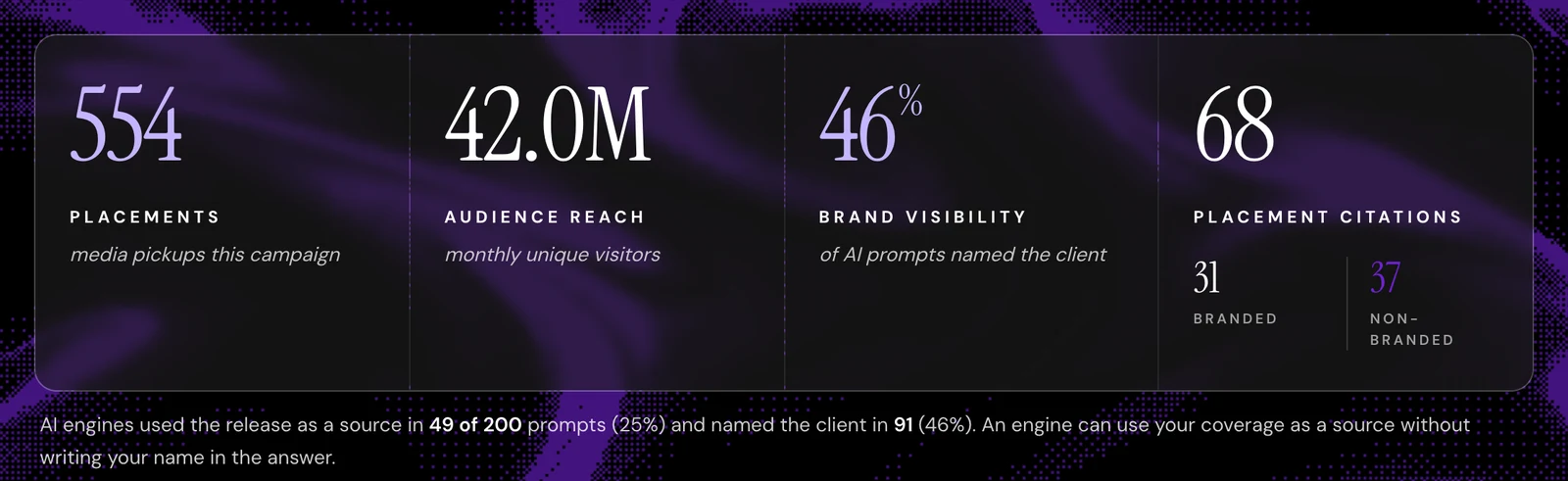
554 media placements
AI prompts naming the client
31 branded, 37 non-branded
The Business
The client is a California employment law firm that represents employees in wrongful termination, discrimination, harassment and retaliation cases. Its cases include employees fired after disclosing a medical condition, announcing a pregnancy or requesting workplace accommodations.
The pilot focused on how AI engines answer questions from employees who suspect their termination was discriminatory. In cases involving a recent medical disclosure, the timing of the firing can become important evidence. The firm helps employees examine that timeline and understand their legal options.
The Objective
The AI visibility optimization pilot set out to make the client a source that AI engines cite when employees ask what to do after a firing that follows a medical disclosure. It used two published assets and measured the results once after launch. Specifically:
- Focus on buyer questions about firings after a medical disclosure, pregnancy discrimination and filing deadlines, where the employee is close to hiring a lawyer
- Publish one Anchor Article on the client’s domain to build its authority on wrongful termination claims
- Publish one AI Notice on the wire to carry the same timing-as-evidence case into third-party sources
- Track the client’s AI visibility on five AI engines, with a fixed set of buyer prompts for each asset
- Measure share of voice and prompt coverage against competing employment law firms
Core Challenges
Competing With Employment Law Firms Already Established in AI Answers
During the pilot, six rival employment law firms were each named more than 30 times in the AI Notice prompt set. The sources the engines leaned on most were government agency websites, legal information sites, rival firms’ own websites and social media platforms.
Employees Ask AI Whether a Firing Was Legal
Employees in this situation ask exact questions, such as whether they can be fired for being sick or how long they have to file a complaint. The client needed content that answered these questions and gave AI engines a reliable source to cite.
Tracing New AI Visibility Back to Its Source
With two assets in market, both telling the same timing-as-evidence story, a total citation count would not have shown which one the engines were citing. Only per-citation attribution could separate them, so the pilot traced every appearance back to the page behind it.
The Strategy
Prompt Selection Around the Buying Moment
The pilot wrote its buyer prompts in the voices of people facing a firing, from a terminated employee to an HR professional. The prompts mixed two kinds of questions: what the field’s legal terms mean, such as a protected disclosure, and what to do after a firing. Together they followed an employee from learning the terms to choosing a lawyer.
One Anchor Article
A long-form guide on the client’s site walks California employees through a firing that follows a medical disclosure, from when it crosses the legal line to how to choose an employment lawyer. Because the client owns the page, AI engines can keep crawling and citing it after the pilot ends.
One AI Notice
The AI Notice went out on the wire and restated the timing-as-evidence argument on a third-party domain.
Day-Zero Launch, Day-7 Measurement
Seven days after the AI Notice launched, the pilot ran its buyer prompts across five AI engines and tracked citations to both the AI Notice’s placements and the Anchor Article. All results reflect this single post-launch measurement.
AI Visibility Optimization Results
any law firm
AI Notice as a source
the client
came from non-brand questions
The campaign report shows how far the AI Notice traveled in the media and how often AI engines cited it.
Share of Voice Among Employment Law Firms
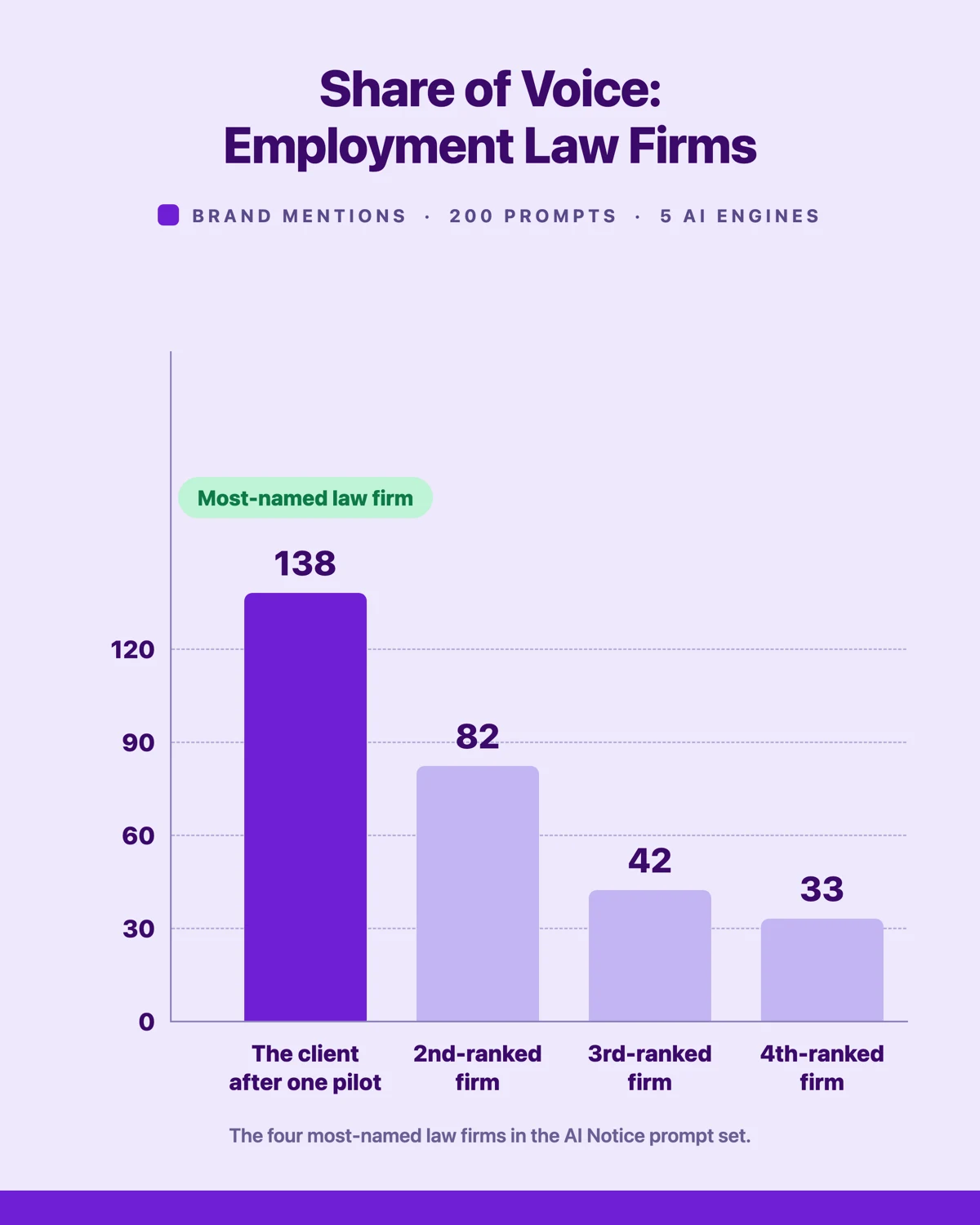
The client was the most-named law firm in the AI Notice prompt set, with 138 mentions, 56 more than the 2nd-ranked firm. The 3rd- and 4th-ranked firms followed with 42 and 33. Among all names in the answers, only the state civil rights agency was named more often, with 221 mentions, and the answers tied that agency to the complaint an employee files before a lawsuit. In head-to-head matchups, the client also ranked above one rival firm in 8 of 10 and above another in 6 of 8.
Prompt Coverage and First-Named Finishes
In the AI Notice prompt set, the client was named in 91 of 200 buyer prompts and placed in the top three on 85 of them. Counting each engine’s answer separately, the client finished first 143 times. Beyond brand-direct questions, the client was also named most often in terminology, category and buyer-intent questions.
Unprompted Discovery
Of the prompts that named the client, 23 were brand-direct questions about the firm. The other 68 never named it, yet the engines named the client in their answers. Those questions asked about topics such as what to document after a pregnancy-related firing, how the timing of a termination works as evidence and which firms offer free consultations after a medical disclosure.
In the report’s awareness funnel, coverage reached 96% on brand-direct prompts and 55% on prompts comparing types of solutions. By contrast, it was lowest on Problem-Aware prompts, at 35%, which describe a problem without asking for a solution. The report’s five stages cover 163 of the 200 prompts.
| Buyer awareness stage | Coverage | Named the client | Prompts in stage | Avg position |
|---|---|---|---|---|
| Unawarehas not identified the problem | 45% | 5 | 11 | #1.9 |
| Problem-Awareknows the problem, still scoping solutions | 35% | 19 | 55 | #1.4 |
| Solution-Awareevaluating solution categories | 55% | 17 | 31 | #2.3 |
| Product-Awarecomparing specific products | 38% | 16 | 42 | #1.8 |
| Most-Awaresearching by brand name | 96% | 23 | 24 | #1.0 |
AI Visibility by Engine
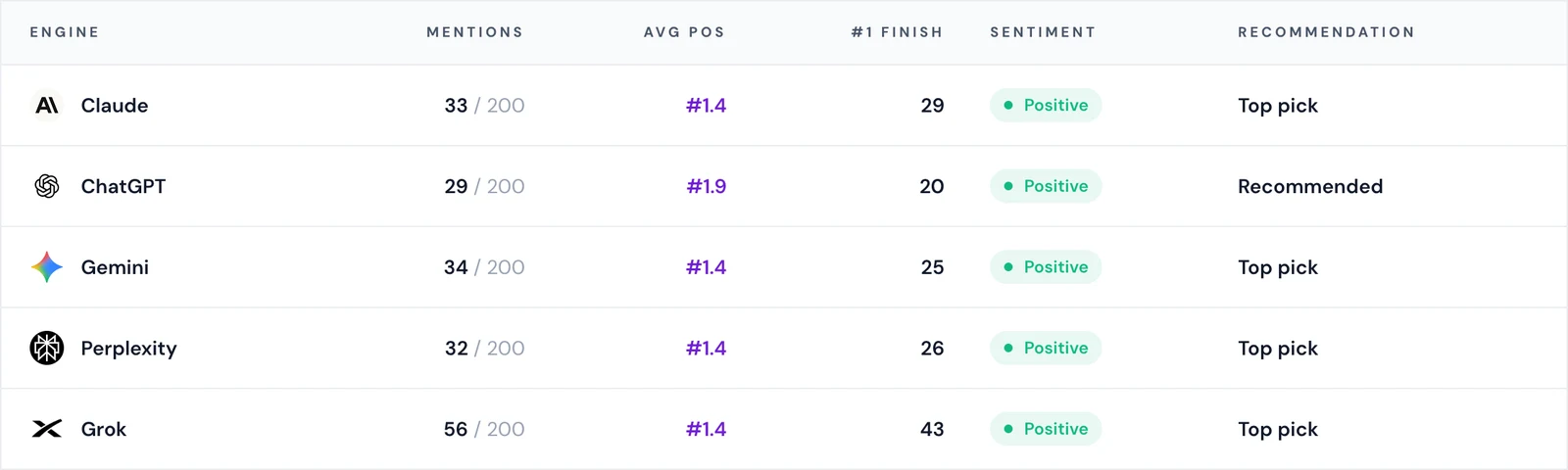
All five engines named the client with positive sentiment, and the report logged no negative mention. ChatGPT rated it recommended, and the other four engines rated it a top pick. Grok named the client in 56 of 200 prompts, followed by Gemini at 34, Claude at 33, Perplexity at 32 and ChatGPT at 29. Across the engines, average positions ran from #1.4 on four engines to #1.9 on ChatGPT, and first-place finishes ranged from 43 on Grok to 20 on ChatGPT.
Where the AI Visibility Came From
In the AI Notice report, the client’s own website was the second most-cited source, with 518 citations, behind only the state civil rights agency’s website. The AI Notice itself earned 68 placement citations: 54 to the wire release and 14 to a financial news site’s copy. The AI Notice report holds no citation data for Claude or ChatGPT. At least one engine used the AI Notice as a source in 49 of the 200 buyer prompts.
The Anchor Article was measured with its own set of 400 buyer prompts, and all five AI engines cited it, 175 times in all.
Distribution Reach
Of the AI Notice’s 554 media placements, AI engines cited two. Even so, those two hold 36.9M of the 42.0M monthly unique visitors, 88% of the total reach. Most of it comes from the financial news site, with 35.9M monthly visitors.
Google AI Overview Visibility
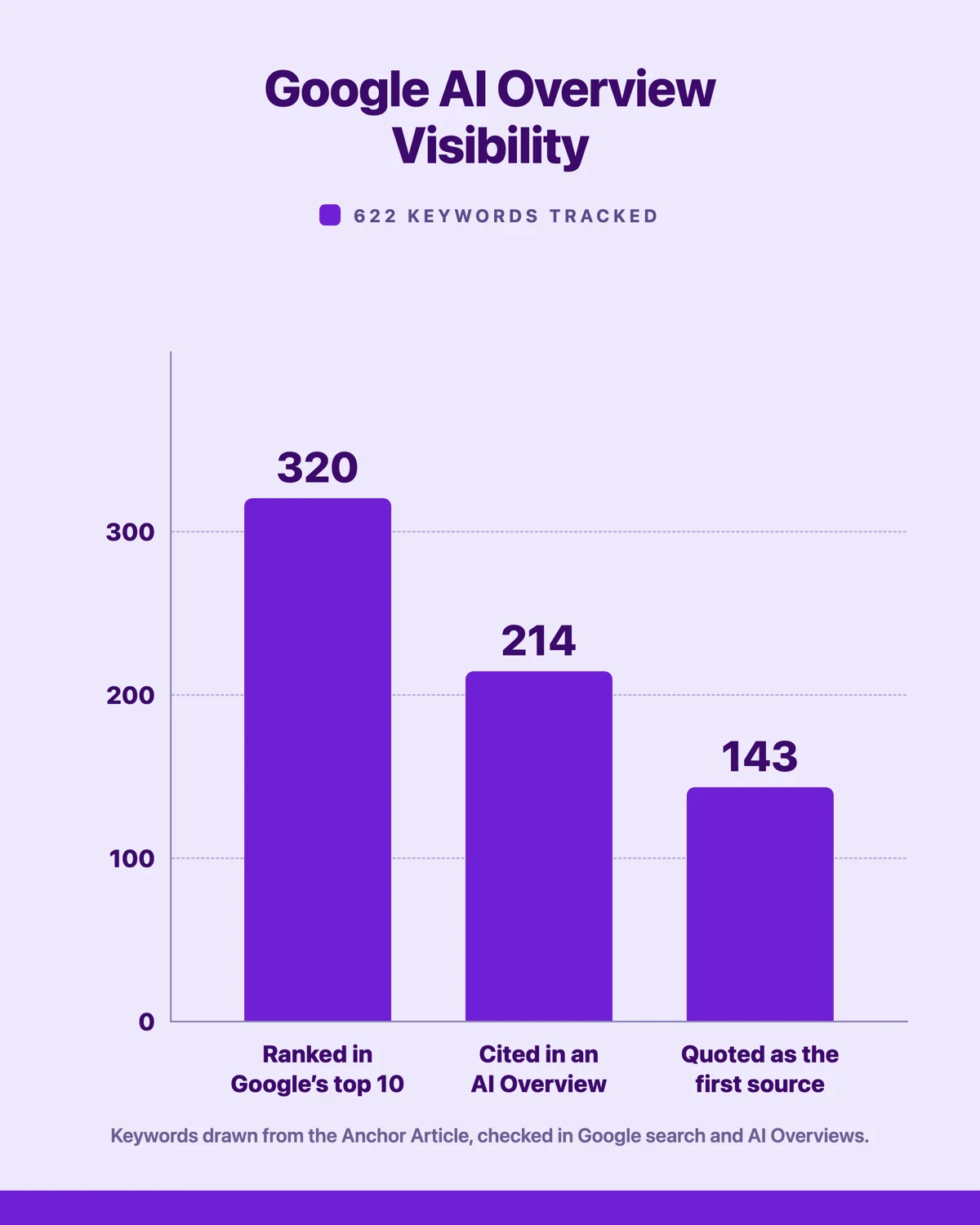
Google tracking covered 622 keywords drawn from the Anchor Article, 12 branded and 610 non-branded. The Anchor Article ranked in Google’s top 10 for 320 of them, 258 in the top 3. Beyond rankings, Google AI Overviews cited the Anchor Article on 214 keywords and quoted it as the first source on 143. Of those 214, all but two were non-branded searches about firings after a medical disclosure, the evidence such a case needs and how to find a lawyer for it.
Examples From AI Answers
The examples below show how AI engines answered wrongful termination questions from employees and which sources they cited.
“What employment law firms in California offer free initial consultations for employees fired after a medical disclosure?” (asked as Prospective Plaintiff)
Perplexity ranked the client first and rated it a top pick. It described the client as the firm most directly relevant to an employee fired after a medical disclosure and noted its free, confidential consultations. Claude also ranked the client first as a top pick, and Grok ranked it first.
“What should I document immediately after being fired following a pregnancy announcement or accommodation request in California?” (asked as Pregnant Employee)
For an employee fired after announcing a pregnancy, Gemini named only one law firm, the client, and ranked it first as a top pick. Its answer treated a written record of the announcement, followed soon after by a firing, as key evidence. It also named the state civil rights agency and its three-year window to file a complaint.
“Why does the timing of a termination after a medical disclosure matter so much in a California wrongful termination claim?” (asked as HR Professional)
The HR professional asked how the law treats timing, and Gemini answered with one firm: it ranked the client first and recommended it. Gemini treated a firing days or weeks after a disclosure as a key sign of cause. Meanwhile, Grok ranked the client second and cited its guide on firings after a medical disclosure.
None of the three prompts named the client, and in each one an engine that cited the AI Notice ranked it first.
How We Measured
The AI visibility optimization pilot tested two separate sets of buyer prompts, 200 for the AI Notice and 400 for the Anchor Article, across five AI engines: Claude, ChatGPT, Gemini, Perplexity and Grok. Each report tracked brand mentions in AI answers. A mention counts when an engine names the client, and brand visibility measures the share of prompts where at least one engine named it.
AI citations were tracked separately and matched by exact URL to show when an engine used the AI Notice or the Anchor Article as a source. A separate Google check measured organic keyword rankings and visibility in Google AI Overviews.
About the measurement
All results come from a pilot built around one Anchor Article and one AI Notice. Each asset was measured once after launch. The two prompt sets differ, so their figures are reported separately and never combined.
Why This Matters
No other law firm was named as often as the client in the AI Notice prompt set. Of the 91 prompts that named the client, 68 never mentioned its brand. These included questions about filing deadlines, accommodation requests and retaliation claims, the issues that come up before an employee hires a lawyer.
The results also showed where coverage was weakest: Problem-Aware prompts, an opportunity to expand AI visibility around those topics.
Zen Media has applied this AI visibility optimization approach in structured cabling and luxury real estate. Want to see how your brand appears in AI answers to buyer questions? Contact Zen Media to explore an AI visibility strategy for your business.