in AI answers
across 200 buyer prompts
55 branded, 135 non-branded
The Business
The client runs a telehealth platform for compounded medications, including low dose naltrexone (LDN). Independent, licensed clinicians review each patient’s online intake, and a licensed compounding pharmacy fills and ships every prescription they approve.
For an adult considering LDN, getting a prescription online is the easy part. The harder question is whether anyone checked opioid history, liver and kidney conditions and current medications first. On the client’s platform, that review sits with the clinician, and only the clinician decides whether to prescribe.
The Objective
The AI visibility optimization pilot set out to make the client a source that AI engines cite when patients ask how to get low dose naltrexone online.
- Focus on patient questions about online intake, clinician screening, opioid history and pharmacy fulfillment across different stages of the buying process
- Publish one Anchor Article on the client’s domain to build its authority on online LDN prescribing
- Publish one AI Notice on the wire to carry the same clinician screening case into third-party sources
- Track the client’s AI visibility on five AI engines, with a fixed set of buyer prompts for each asset
- Measure share of voice and prompt coverage against competing LDN telehealth brands
Core Challenges
Competing With Other LDN Services in AI Answers
During the pilot, AI answers about low dose naltrexone named several other LDN telehealth services, one of them more than 150 times in the AI Notice prompt set. Two branded naltrexone medications and an LDN nonprofit also came up often. The sources the engines cited most were a telehealth pharmacy’s website, a government medical research library and the nonprofit’s pages.
Patients Ask AI How to Get LDN Online Safely
A patient looking into LDN online asks specific questions: will a clinician check for tramadol or buprenorphine use, and which liver and kidney conditions does the clinician screen for?
Writing About a Medication With No Approved Low-Dose Form
Low dose naltrexone has no FDA-approved product at low strengths, so a pharmacy compounds it for each prescription, and compounded LDN carries no FDA approval. Any use for weight management is off-label.
The Strategy
Prompt Selection Around the Buying Moment
The buyer prompts were written as adults considering LDN, patients in recovery and pharmacists would ask them. Some asked what a clinician checks before prescribing, such as opioid history. Others asked which telehealth platforms offer compounded LDN and how they compare. Together they ran from how the process works to choosing a service.
One Anchor Article
A long-form guide on the client’s site walks patients through getting low dose naltrexone online, from the checks to run on a provider to what a clinician screens for before prescribing.
One AI Notice
Distributed on the wire, the AI Notice brought the same clinician screening case to third-party news sites.
Day-Zero Launch, Day-7 Measurement
Seven days after the AI Notice launched, the pilot ran its buyer prompts across five AI engines and tracked citations to both the AI Notice’s placements and the Anchor Article.
AI Visibility Optimization Results
265 mentions
AI Notice as a source
the client
naming the client
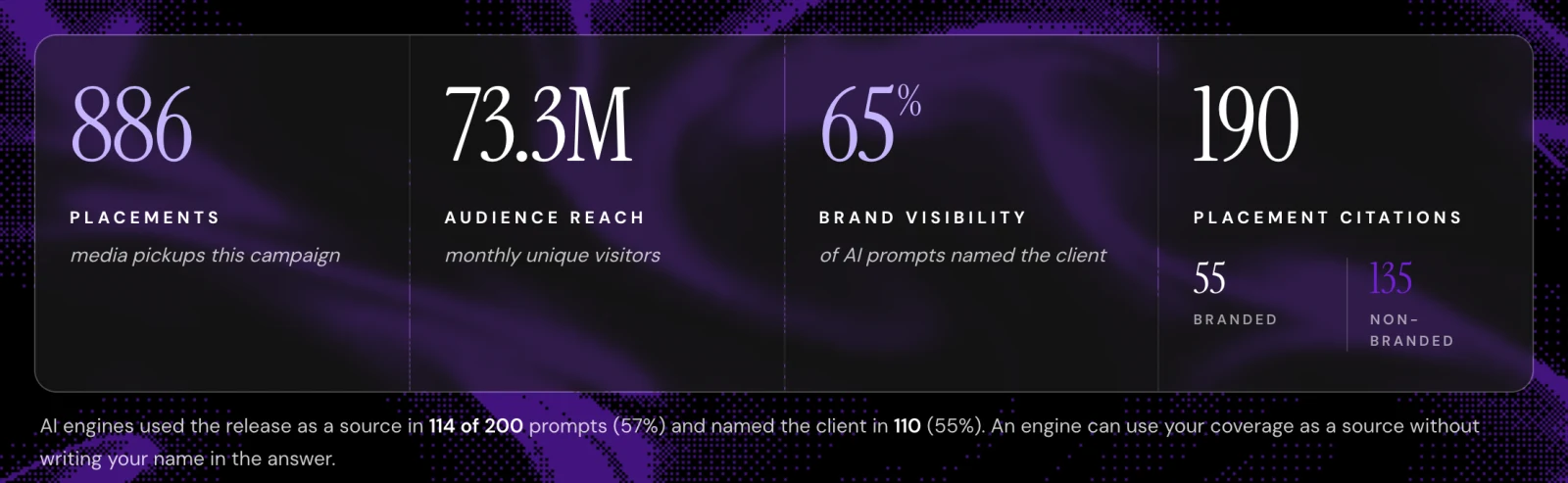
The AI Notice’s campaign report adds the media side: where the release ran, the audience it could reach and how often AI engines cited it.
Share of Voice Among LDN Telehealth Brands
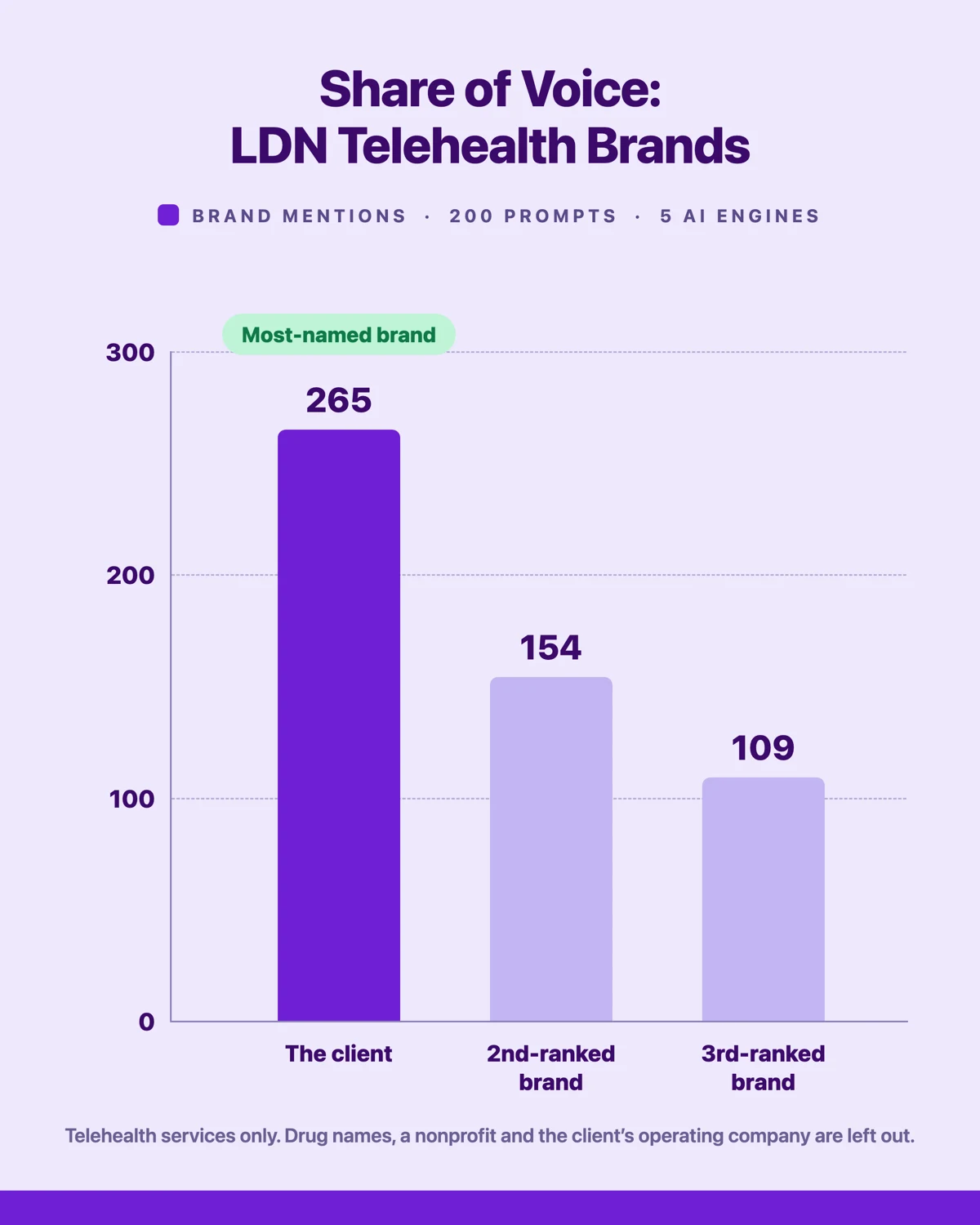
With 265 mentions, the client led every LDN telehealth brand in the AI Notice prompt set. The next two telehealth brands were named 154 and 109 times. The rankings showed the same lead. Across the engines, the client was listed first more than twice as often as its closest rival, and its average position was higher. The third-ranked brand finished first in only 14 answers. Drug names, an LDN nonprofit and the client’s operating company are left out of this comparison.
Prompt Coverage and First-Named Finishes
In 110 of the 200 buyer prompts, at least one engine named the client in its answer. The report’s 65% brand visibility counts 129 prompts: those 110 plus 21 that Gemini alone flagged, although its answer did not name the client. Each prompt drew five answers, one from each engine, so the prompt set produced 1,000 answers in all. The client was listed first in 236 of those answers. The engines named it most often on buyer-intent questions, followed by brand-direct and category questions.
Unprompted Discovery
Of the 110 prompts that named the client, 59 were unprompted: general questions that did not name the client, use its own wording or refer to its launch. They covered topics such as opioid screening before LDN, liver and kidney conditions and paying with FSA or HSA funds.
The report’s awareness funnel gives a buyer stage to 165 of the 200 prompts. Brand-search prompts reached 100% coverage, and prompts comparing specific products reached 89%. By contrast, coverage fell to 29% on Problem-Aware prompts and 17% on Unaware prompts.
| Buyer awareness stage | Coverage | Named the client | Prompts in stage | Avg position |
|---|---|---|---|---|
| Unawarehas not identified the problem | 17% | 3 | 18 | #1.0 |
| Problem-Awareknows the problem, still scoping solutions | 29% | 15 | 52 | #1.6 |
| Solution-Awareevaluating solution categories | 75% | 21 | 28 | #2.1 |
| Product-Awarecomparing specific products | 89% | 32 | 36 | #1.9 |
| Most-Awaresearching by brand name | 100% | 31 | 31 | #1.0 |
AI Visibility by Engine
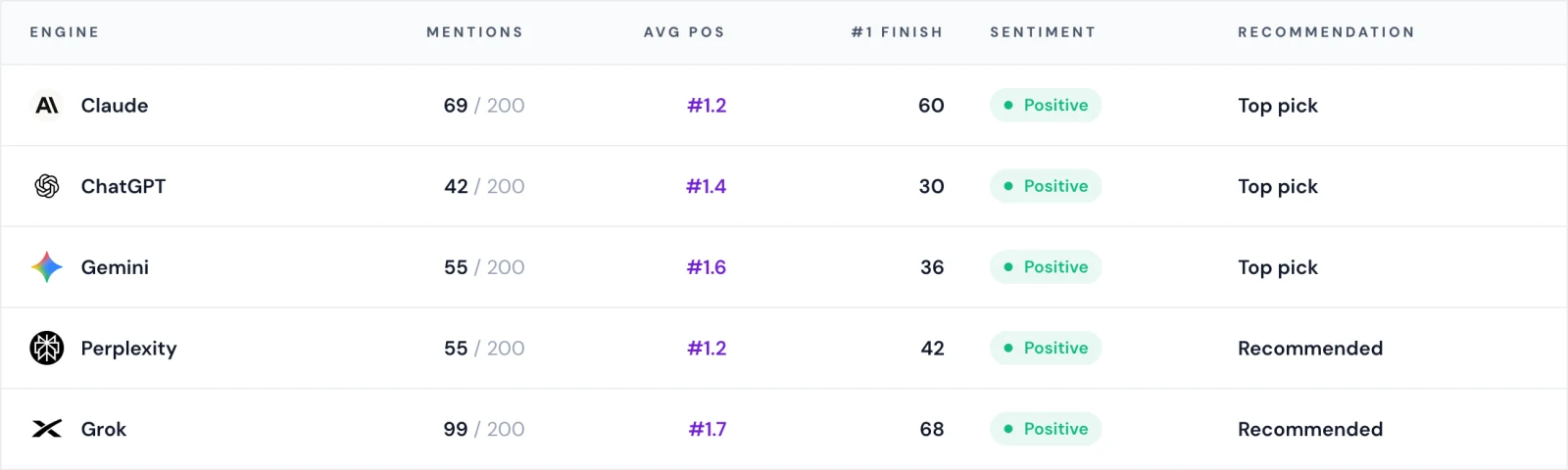
All five engines named the client in the AI Notice prompt set, with no negative mentions. Claude, ChatGPT and Gemini rated it a top pick, and Perplexity and Grok recommended it. Grok named the client in 99 prompts, more than any other engine, and put it first in 68 answers. Each of the other four engines named it in 42 to 69 prompts. Every engine placed the client first or second on average.
Where the AI Visibility Came From
AI answers listed a published copy of the AI Notice as a source 190 times, and 135 of those placement citations came from prompts that never named the client. Most of these citations came from Grok and Perplexity, with fewer from Gemini. The report holds no citation data for Claude or ChatGPT. The wire release drew more than half of them, and a financial news site’s copy drew nearly all of the rest. Counted by prompt, 114 of the 200 buyer questions drew on the AI Notice as a source.
The Anchor Article was tested with its own set of 400 buyer prompts. In 87 of those prompts, at least one AI engine listed the Anchor Article as a source. Several engines answered each prompt, so the article was cited 103 times in all. Grok cited it most often, and Claude and Gemini did not cite it. Whether or not they cited the article, the engines named the client in 97 of the 400 prompts.
Google AI Overview Visibility
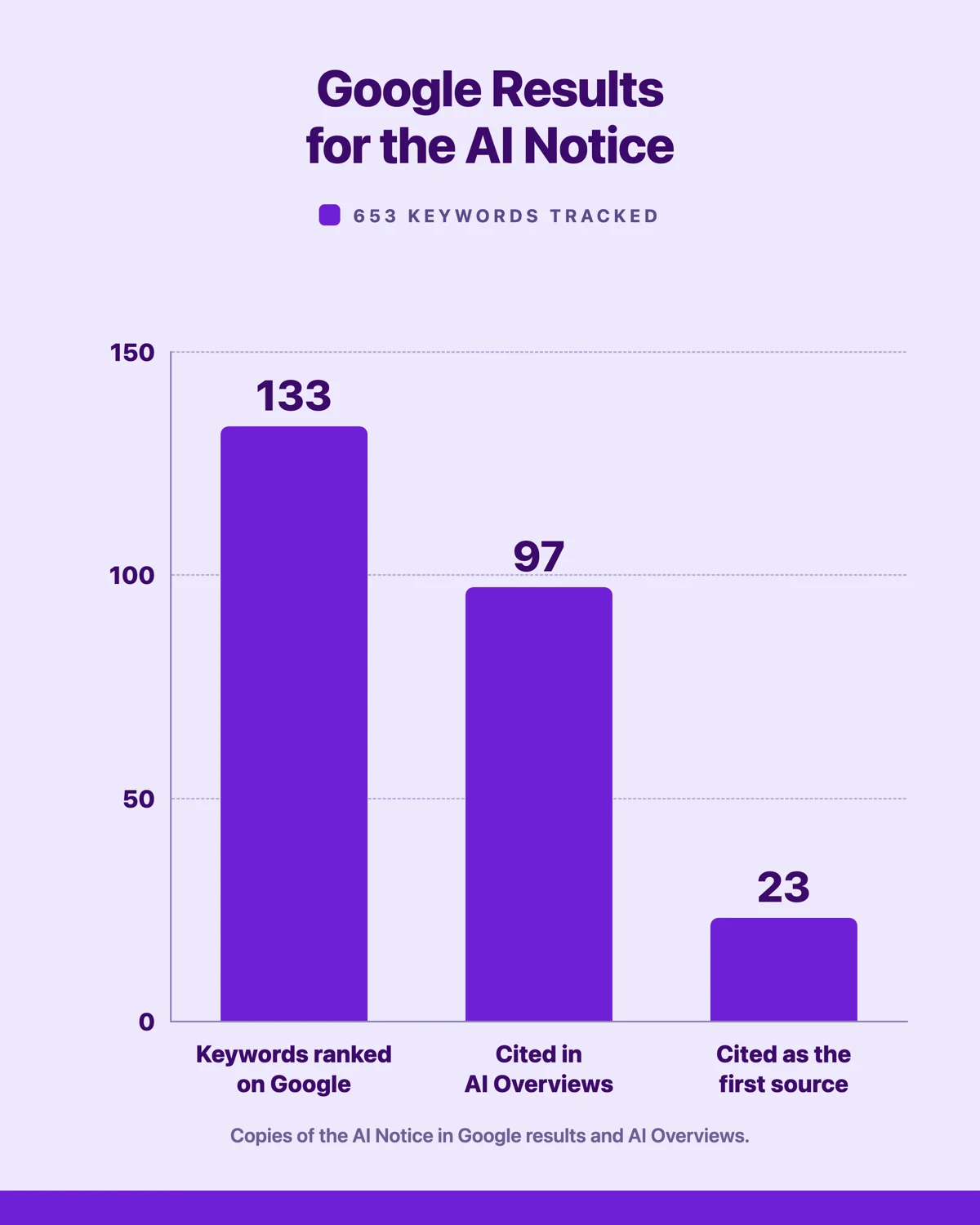
Google AI Overviews cited a copy of the AI Notice on 97 keywords, and 81 of those were non-branded. In 23 of the 97, a copy was the first source quoted. Copies of the AI Notice also ranked on Google for 133 keywords, 129 of them in the top 10. The check covered 653 keywords drawn from the AI Notice, 617 of them non-branded, and an AI Overview appeared on every one.
The Anchor Article had its own Google check of 940 keywords. The guide ranked on the first page of Google for 206 of them. Google AI Overviews also cited it on 25 keywords.
Examples From AI Answers
None of the three questions below named the client, yet at least one engine ranked it first and rated it a top pick each time.
“Is there a telehealth service where an independent clinician determines if compounded LDN is medically appropriate before prescribing?” (asked as Adult considering LDN)
Perplexity ranked the client first, rated it a top pick and presented it as the clearest match, because an independent clinician reviews the intake before any prescription. It set the client beside one other LDN telehealth service and noted that state rules can limit availability. Claude and Gemini also ranked the client first and rated it a top pick.
“Where can adults find online clinician evaluations for compounded LDN as part of a weight loss program?” (asked as Weight management seeker)
For this weight loss question, Grok named the client first and rated it a top pick. It described a platform that offers compounded LDN with review by an independent, licensed clinician, and it noted that LDN is off-label and not FDA-approved for weight loss. Claude and Perplexity also ranked the client first.
“Compare online LDN providers that do thorough opioid screening versus quick approvals” (asked as Former opioid user)
This question came from the Anchor Article prompt set. Grok ranked the client first and called it the strongest option for thorough opioid screening, with waiting periods set for each patient. Four other LDN telehealth services followed it in the answer. ChatGPT also ranked the client first and rated it a top pick.
How We Measured
The AI visibility optimization pilot tested two separate sets of buyer prompts: 200 for the AI Notice and 400 for the Anchor Article. The two sets differ, so their figures are reported separately and never combined. Each prompt ran on five AI engines: Claude, ChatGPT, Gemini, Perplexity and Grok. A mention counts when an engine names the client in its answer. Brand visibility is the share of prompts in which at least one engine named the client.
Citations were matched by exact URL, so a citation counts only when an engine listed a published copy of the AI Notice or the Anchor Article itself as a source. A separate Google check recorded organic keyword rankings and which Google AI Overviews cited either asset.
Why This Matters
The client was the most-named LDN telehealth brand in the AI Notice prompt set. Of the 110 prompts that named the client, 59 were unprompted. They included questions about pregnancy, upcoming surgery and medication allergies, the checks a clinician runs before prescribing LDN. By contrast, coverage was lowest on early prompts that describe a health goal but not yet a way to get treatment: no Problem-Aware prompt in the Anchor Article prompt set named the client. More Anchor Articles and AI Notices aimed at those prompts can extend this AI visibility optimization work to them.
Zen Media has applied this AI visibility optimization approach in telecom expense management and restaurant franchise. Want to see how your brand appears in AI answers to buyer questions? Contact Zen Media to explore an AI visibility strategy for your business.