in AI answers
across 200 buyer prompts
64 branded, 200 non-branded
The Business
The client provides managed telecom expense management services to large enterprises, combining its own software with a team of analysts who handle day-to-day telecom operations. That work covers wireless lines, fixed circuits and UCaaS licenses, from carrier invoice audits and device management to contract negotiations.
For finance, procurement and IT leaders, finding unnecessary telecom costs is only part of managing them. The client’s analysts also take responsibility for the steps that follow: resolving billing errors, pursuing carrier credits and making service changes.
The Objective
The AI visibility optimization pilot set out to make the client a source that AI engines cite when enterprise buyers ask how to evaluate managed telecom expense management.
- Focus on buyer questions about managed services, invoice auditing, carrier negotiation, chargeback reporting and provider selection across different stages of the buying process
- Publish one Anchor Article on the client’s domain to build its authority on managed telecom expense management
- Publish one AI Notice on the wire to carry the same managed-service case into third-party sources
- Track the client’s AI visibility on five AI engines, with a fixed set of buyer prompts for each asset
- Measure share of voice and prompt coverage against competing telecom expense management brands
Core Challenges
Competing With Established TEM Platforms in AI Answers
AI answers about telecom expense management name both software platforms and managed service firms. During the pilot, three rival brands were each named more than 200 times in the AI Notice prompt set. Apart from the client’s own website, the sources the engines leaned on most were an industry analyst firm’s site and rival providers’ websites.
Enterprise Buyers Ask AI How to Choose a TEM Provider
An enterprise buyer comparing providers asks detailed questions, such as how a provider tracks unused UCaaS licenses or whether it manages fixed circuits as well as wireless lines. Most of these questions name no provider, so the engines choose which ones to recommend.
The Strategy
Prompt Selection Around the Buying Moment
The buyer prompts were written as CFOs, procurement managers and IT operations managers would ask them. Some asked what a term means, such as rate plan optimization. Others asked which providers handle billing disputes and carrier negotiations as a managed service. Together they covered early research through provider selection.
One Anchor Article
A long-form guide on the client’s site shows buyers how to evaluate managed telecom expense management services, from what a fully managed program covers to what to check before choosing a provider.
One AI Notice
The AI Notice went out on the wire and placed the managed-service case on third-party news sites.
Day-Zero Launch, Day-7 Measurement
Seven days after the AI Notice launched, the pilot ran its buyer prompts across five AI engines and tracked citations to both the AI Notice’s placements and the Anchor Article.
AI Visibility Optimization Results
428 mentions
AI Notice as a source
the client
naming the client
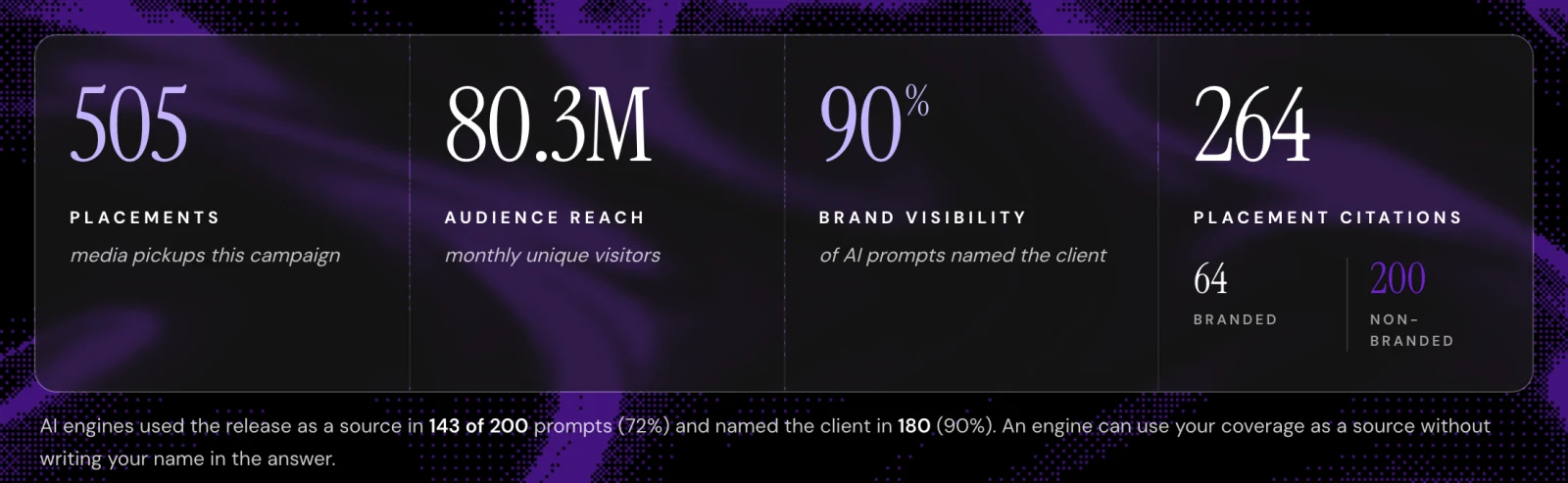
The AI Notice’s campaign report adds the media side: where the release ran, the audience it could reach and how often AI engines cited it.
Share of Voice Among Telecom Expense Management Brands
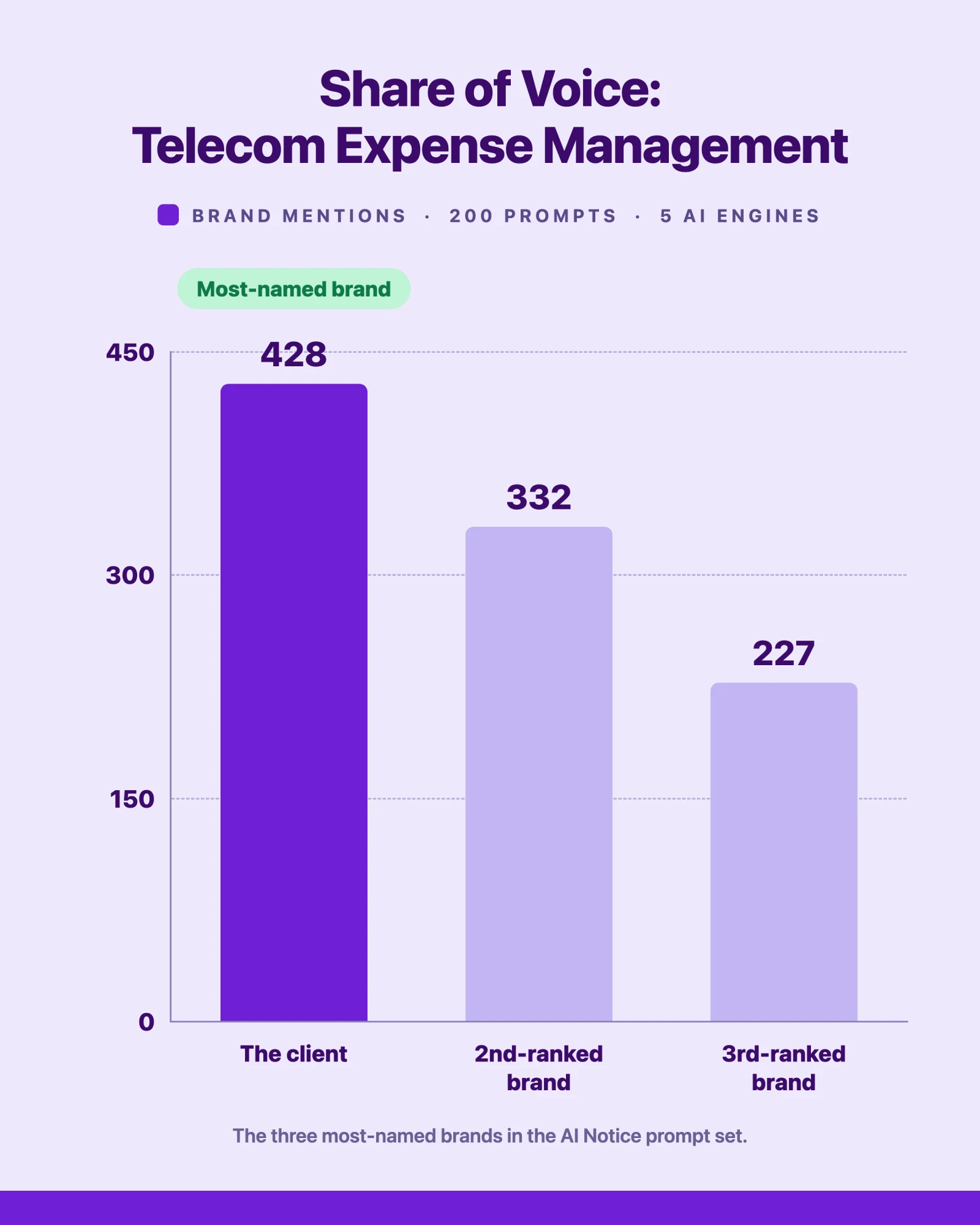
With 428 mentions, the client was named more often than any other telecom expense management brand in the AI Notice prompt set. The closest rival had 332 and the third-ranked brand 227. The lead held up in the rankings as well. The engines put the client first more than twice as often as its closest rival and placed it higher in their lists on average. The third-ranked brand was listed first only 13 times.
Prompt Coverage and First-Named Finishes
At least one engine named the client in 180 of the 200 buyer prompts, and in 162 of those it ranked in the top three. Each prompt drew five answers, one from each engine, so the prompt set produced 1,000 answers in all. The client was listed first in 300 of those answers. The engines named it most often on buyer-intent questions, followed by terminology and category questions.
Unprompted Discovery
In 57 of the 180 prompts that named the client, the question was unprompted: it did not name the client or use its own details. These questions covered topics such as rate plan optimization, device procurement, 24/7 help desk support and service orders for fixed circuits.
The report assigns 192 of the 200 prompts to a buyer awareness stage. Coverage was 100% on brand searches and on prompts that evaluate solution categories, and 91% on prompts that compare specific products. It was lower on early questions: 84% on Problem-Aware prompts and 71% on Unaware prompts.
| Buyer awareness stage | Coverage | Named the client | Prompts in stage | Avg position |
|---|---|---|---|---|
| Unawarehas not identified the problem | 71% | 15 | 21 | #1.9 |
| Problem-Awareknows the problem, still scoping solutions | 84% | 46 | 55 | #2.4 |
| Solution-Awareevaluating solution categories | 100% | 34 | 34 | #2.2 |
| Product-Awarecomparing specific products | 91% | 50 | 55 | #2.3 |
| Most-Awaresearching by brand name | 100% | 27 | 27 | #1.2 |
AI Visibility by Engine
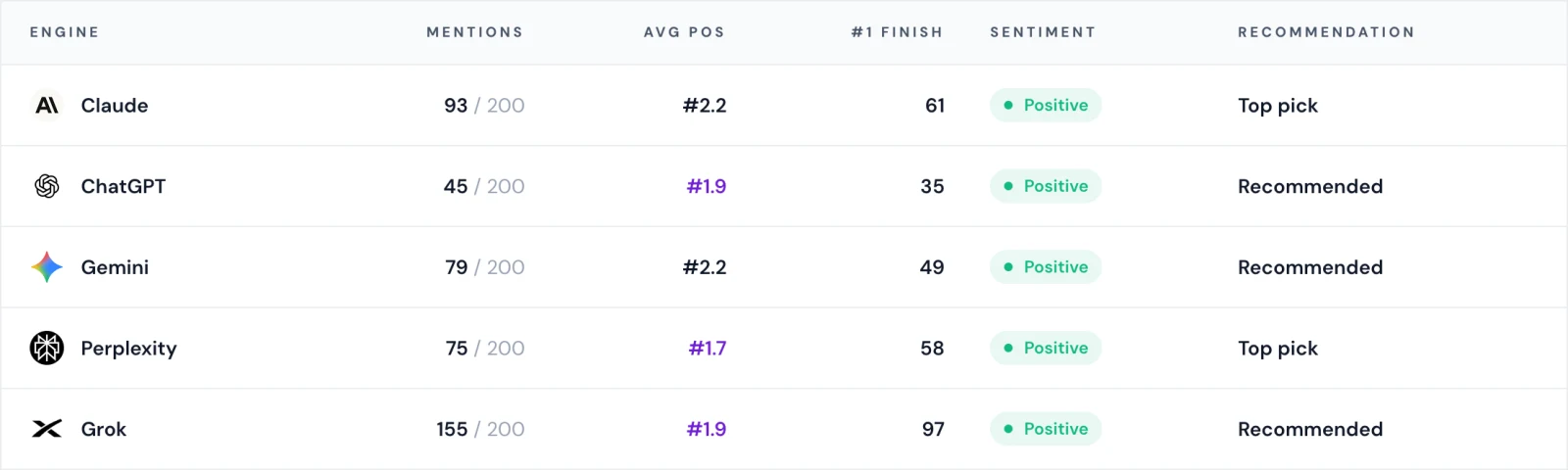
All five engines named the client in the AI Notice prompt set, and none of their mentions was negative. Claude and Perplexity rated it a top pick, and the other three recommended it. Grok was the most active engine: it named the client in 155 prompts and ranked it first in 97. Claude named it in 93 prompts, Gemini in 79, Perplexity in 75 and ChatGPT in 45. On average, Perplexity, ChatGPT and Grok placed it first or second, and Claude and Gemini placed it just below second.
Where the AI Visibility Came From
Placement citations count the times AI answers listed a published copy of the AI Notice as a source. The AI Notice earned 264 placement citations. Of those, 200 came from prompts that did not ask about the client. Grok and Perplexity cited it most, followed by Gemini. The report holds no citation data for Claude or ChatGPT. Of the 200 buyer prompts, 143 used the AI Notice as a source.
The Anchor Article was tested with a second set of 200 buyer prompts, separate from the AI Notice’s set. In 145 of those 200 prompts, at least one AI engine listed the Anchor Article as a source. Several engines answered each prompt, so the article was cited 316 times in all. Claude cited it most often, and ChatGPT did not cite it. Whether or not they cited the article, the engines named the client in 167 of the 200 prompts.
Examples From AI Answers
None of the three questions named the client, yet at least three engines ranked it first on each one.
“Which managed TEM providers include carrier contract negotiation as part of the same program as invoice auditing and rate plan optimization?” (asked as VP of Operations)
All five engines named the client in this answer, and Claude, Gemini and Perplexity ranked it first. Claude rated it a top pick. It described the client as the provider that most clearly puts contract negotiation, invoice auditing and rate plan work in one managed program.
“What is integrated TEM and managed mobility services and which providers offer both under one program?” (asked as CIO)
Grok ranked the client first and rated it a top pick. It described the client as a fully managed provider that runs both services in one program. Gemini and Perplexity also ranked it first.
“We need a single program to manage wireless, DIA, MPLS, and UCaaS expenses. What providers offer this?” (asked as Enterprise Architect)
This question came from the Anchor Article prompt set. Claude ranked the client first and rated it a top pick for managing wireless lines, fixed circuits and UCaaS in one program. Perplexity and Grok also ranked it first.
How We Measured
The AI visibility optimization pilot ran two separate sets of 200 buyer prompts, one for the AI Notice and one for the Anchor Article, on five AI engines: Claude, ChatGPT, Gemini, Perplexity and Grok. Figures from each set are reported on their own and never combined. A mention counts when an engine names the client in its answer, and brand visibility is the share of prompts in which at least one engine named it. A citation counts only when an engine lists the exact URL of a published copy of the AI Notice or of the Anchor Article as a source.
Why This Matters
The client was the most-named telecom expense management provider in the AI Notice prompt set. Of the 180 prompts that named the client, 57 were unprompted. They included questions about carrier contract negotiation and chargeback reporting, and questions comparing self-service TEM software with a fully managed service, the model the client’s program is built on. By contrast, coverage was lowest on Unaware prompts, which do not yet name a problem. More Anchor Articles and AI Notices aimed at those prompts can extend this AI visibility optimization work to them.
Zen Media has applied this AI visibility optimization approach in restaurant franchise and local florist. Want to see how your brand appears in AI answers to buyer questions? Contact Zen Media to explore an AI visibility strategy for your business.