university’s response
by an AI Notice
problem with the fix
the AI Notices
The Business
The client is a university whose student services handle payment questions, academic advising and account issues. During a period of operational change, support teams struggled to keep up, and some students waited for answers about payments or enrollment. Complaints began appearing on community forums and review sites.
Senior leaders publicly acknowledged the delays and outlined plans to add staff and make it easier for students to reach the right office. The university wanted its side of the story told next to the complaints.
The Objective
The AI visibility optimization program set out to put the university’s response into AI answers about its student service delays.
- Focus on the questions students, parents and reporters ask about the delays, from what went wrong to who can help
- Publish three AI Notices on the wire, each one answering a single question
- Track AI answers on five AI engines, with a fixed set of prompts for each AI Notice
- Compare the results with the university’s baseline reputation report
- Measure which engines picked up each AI Notice and how they used it
Core Challenges
AI Answers Told the Complaint Without the Response
In the university’s baseline reputation report, AI engines brought up the delays without the university’s side. Their answers drew on community forums and review sites, where the complaints already lived.
Students Ask Different Questions About One Problem
One delay raised several separate questions, from why a payment was late to who could help when a bill was due. Each question needed a direct answer that an engine could use on its own.
A Problem That Had to Be Named First
The delays were real and already documented in public complaints, so each AI Notice had to name the problem before it explained the fix.
The Strategy
Three Questions, Three AI Notices
The program built each AI Notice around one question students asked: what was happening with their payments, what the university was changing and whom to contact. Together, the three approached the problem from different angles and showed how the university was fixing it and what students could do next.
AI Notice One: The Delays, Acknowledged
AI answers already knew about the delays, so the first AI Notice confirmed them openly. That gave engines an official source for the problem and, in the same release, practical next steps for students: a faster review, protected enrollment and an advisor to call when a bill came due.
AI Notice Two: What Is Changing
Once the delays were on record, the next question was what the university would do about them. The second AI Notice answered it with a concrete plan to expand support capacity and shorten the wait for students.
AI Notice Three: Who to Contact
With the problem and the plan on record, students still needed to know where to go. The third AI Notice answered that on the wire and on the university’s own website. It matched each kind of question to the office that handles it, from payments to advising, so a student could reach the right team on the first try.
Day-Zero Launch, Day-7 Measurement
Seven days after the last AI Notice launched, the program ran its prompts across five AI engines and tracked how each answer used the AI Notices.
AI Visibility Optimization Results
Across five AI engines, 689 of the 1,500 answers tested mentioned what the university is doing about its student service delays. In a separate measure, 506 answers cited an AI Notice or repeated facts found only in the AI Notices.
AI Notice content
AI Notice directly
across three AI Notices
AI Notice content
Before and after
The Gap Between the Complaint and the Response
The baseline report and the AI Notice tests used different prompt sets, so each panel stands on its own terms. In the baseline, Claude and ChatGPT brought up the delays in 33 of 100 prompts, yet none of their 200 answers mentioned the university’s response. In the AI Notice tests, 689 of 1,500 answers on five engines included the university’s response.
100 prompts · 200 answers
The story AI told: slow payments, hard-to-reach advisors and complaints from community forums and review sites. The university’s side was missing.
300 prompts · 1,500 answers
The story AI tells now: the delays are real, the university has said so in public, and here is what it is changing.
The story AI tells
Five Things AI Answers Now Say
Across the 506 answers that carried AI Notice content, five messages appeared that the baseline answers never contained, and 360 answers placed the problem and the fix side by side. Claude, Gemini and Perplexity rarely show links, so the proof often sits in the wording. In three of the messages, an engine repeated a line that existed only in an AI Notice.
Answers say the university addressed the delays in public and name the senior leader who spoke for it.
Answers describe the university’s plan to expand support and the steps already under way.
The staffing targets for the student support teams.
Every staffing target, figure for figure.
Answers explain how enrollment stays protected during a delay, how to ask for a faster review and when to call an advisor.
A senior leader’s practical advice for students still waiting on a payment.
The advice almost word for word, plus what students with bills due can ask an advisor.
The delays still come up when families compare schools. Now the answer also covers what the university is doing about them.
Answers match each problem to the right office and support channel.
A senior leader’s promise to get every student to the right office the first time.
The promise in the same words, with the leader named as the public face of the fix.
AI Visibility by Engine
All five engines used the AI Notices. Grok carried AI Notice content in 237 of its 300 answers, the most of any engine, and told the full problem-and-fix story in 176 of them. Grok also cites the AI Notices by name and link.
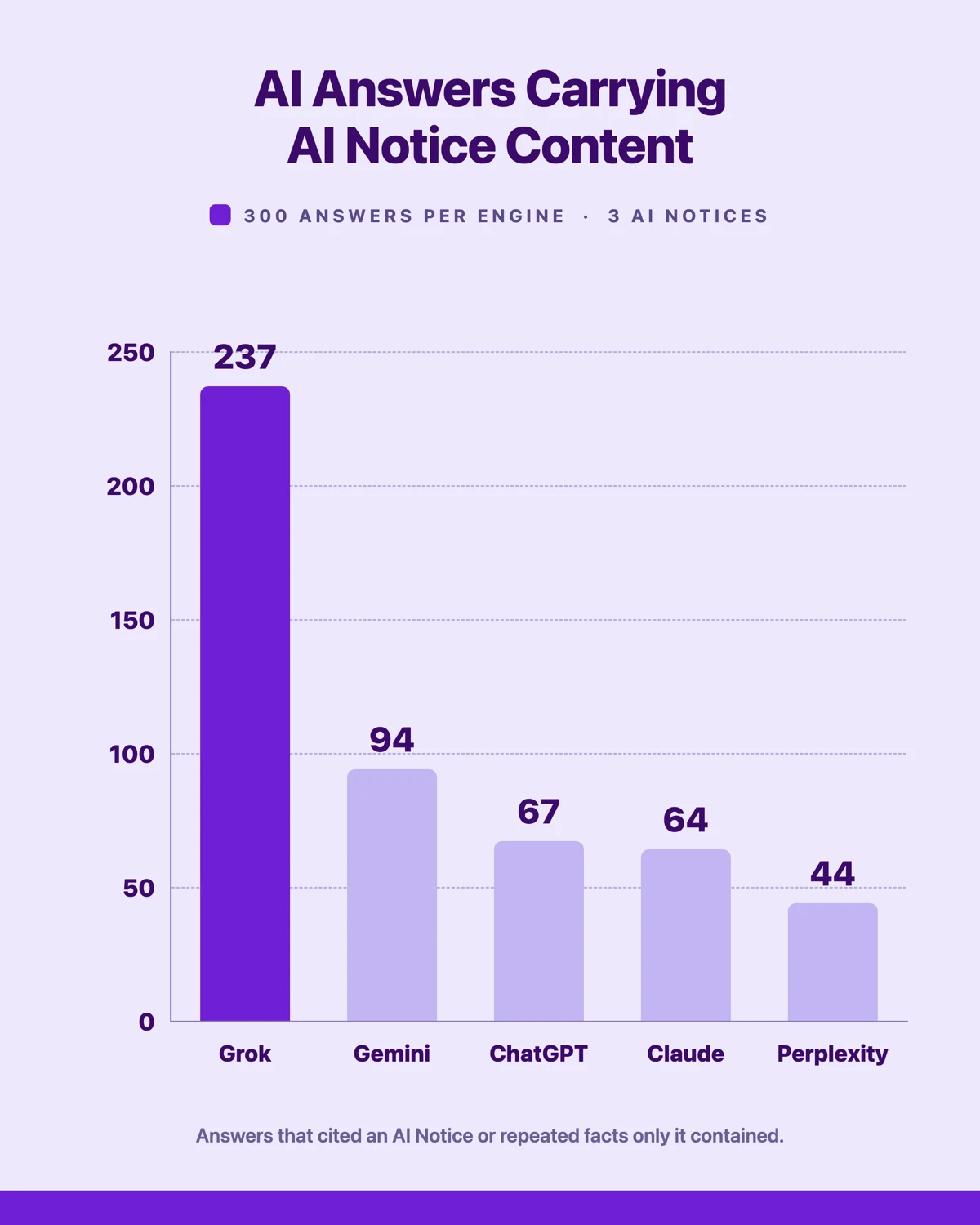
Gemini came next with 94 answers. It rarely links, yet it repeats the staffing changes and the senior leader’s wording nearly word for word. ChatGPT carried AI Notice content in 67 answers and leaned on first-party sources, citing the university’s own website copy of the third AI Notice more often than the wire release. Claude followed with 64 answers and named the release and its date before quoting it. Perplexity used the AI Notices least, in 44 answers, though those answers stayed precise and on message.
Results by AI Notice
Each AI Notice ran against its own set of 100 prompts. The first reached the most placements and influenced the most prompts. Across the three, engines cited an AI Notice directly in 236 of the 250 prompts they influenced.
| AI Notice | Prompts influenced | Direct citations | Media placements |
|---|---|---|---|
| AI Notice 1The delays, acknowledged | 88 | 81 | 535 |
| AI Notice 2What is changing | 83 | 77 | 377 |
| AI Notice 3Who to contact | 79 | 78 | 388 |
| All three | 250 | 236 | 1,300 |
How We Measured
The program tested two sets of prompts about the university. The baseline reputation report ran 100 prompts on Claude and ChatGPT, for 200 answers. The AI Notice tests ran 100 prompts for each AI Notice on five AI engines: Claude, ChatGPT, Gemini, Perplexity and Grok. That came to 300 prompts and 1,500 answers. The two sets differ, so their figures are reported separately and never combined.
A prompt counts as influenced when an engine cites an AI Notice, a syndicated copy or the university’s own copy, or repeats facts found only in that notice. Facts the university also publishes elsewhere on its own website do not count as influence on their own.
Why This Matters
AI answers still mention the delays, because the delays happened. The AI Notices added the university’s account of the fix, so answers about payments, enrollment and advising can now carry both sides.
All five engines picked up the AI Notices, Grok far more often than the rest. The next round of AI visibility optimization can cover broader reputation questions and the engines with room to grow: Perplexity, which used the AI Notices least, and ChatGPT, which leaned on the university’s own website.
Zen Media has done this work for a weight management brand and a brand naming agency. If AI answers about your organization tell only one side, contact Zen Media to start with Reputation Published Monthly.