in AI answers
across 304 buyer prompts
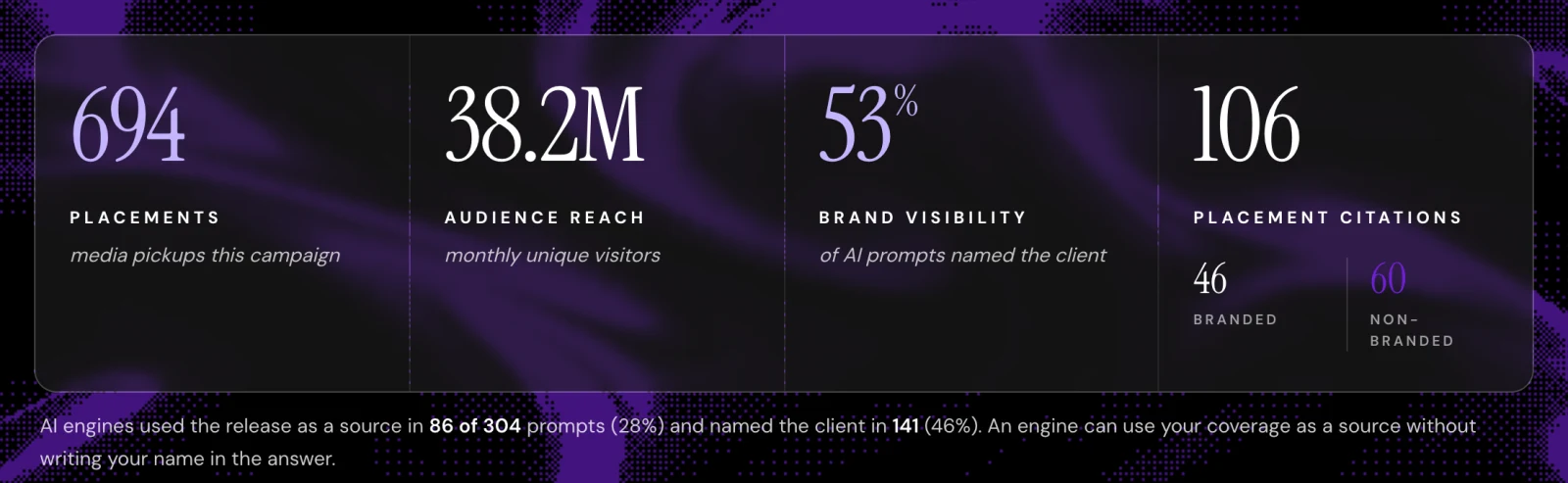
46 branded, 60 non-branded
The Business
The client is a multi-concept restaurant group operating full-service, fast-casual and nightlife venues. It works with prospective franchisees, multi-unit operators, property owners and investment firms through traditional franchising, equity partnerships, joint ventures and acquisitions. With several concepts in its portfolio, the group can convert an existing restaurant property into the concept that fits it.
When investors evaluate the group, it points them to verifiable operating history, franchise disclosure documents and what its current partners say about the system. Its lead concept has a completed franchise disclosure document available for prospective partners to review before signing.
The Objective
The AI visibility optimization pilot set out to make the client a source that AI engines cite when investors ask how to evaluate a restaurant franchise and which group to partner with.
- Focus on investor questions about franchise due diligence, operating history, partnership structures and matching restaurant concepts to existing properties
- Publish one Anchor Article on the client’s domain to build its authority on restaurant franchise due diligence
- Publish one AI Notice on the wire to carry the same due diligence case into third-party sources
- Track the client’s AI visibility on five AI engines, with a fixed set of buyer prompts for each asset
- Measure share of voice and prompt coverage against competing restaurant franchise brands
Core Challenges
Competing With Regulators and National Chains in AI Answers
During the pilot, AI answers to franchise questions often turned to the federal franchise regulator and its disclosure rules. National franchise chains also appeared in these answers. Apart from the client’s own website, the sources the engines cited most were social media platforms, a government site and franchise industry sites.
Investors Ask AI How to Vet a Restaurant Franchise
An investor weighing a restaurant franchise asks exact questions, such as what Item 19 of a franchise disclosure document should show or whether an existing restaurant building can be converted to a new concept. Deal advisers and family offices also compared equity, joint venture and acquisition structures.
Restaurant Concepts Named Apart From the Group
In the AI Notice prompt set, the engines often named the client’s individual restaurant concepts, and its lead concept alone appeared 227 times. An answer could recommend one of these concepts and leave out the group that offers the franchise and investment partnerships.
The Strategy
Prompt Selection Around the Buying Moment
The buyer prompts spoke for the people who weigh a restaurant franchise investment, from a prospective franchisee to a family office investment manager. Some asked what a disclosure term means, such as Item 20 of a franchise disclosure document. Others asked which franchise groups to shortlist and how to compare them. Together they followed an investor from learning the terms to choosing a franchisor.
One Anchor Article
A long-form guide on the client’s site walks investors through the checks to run before buying a restaurant franchise, from the operator’s record through past downturns to the earnings claims in the disclosure document.
One AI Notice
Distributed on the wire, the AI Notice brought the same due diligence checklist to third-party news sites.
Day-Zero Launch, Day-7 Measurement
Seven days after the AI Notice launched, the pilot ran its buyer prompts across five AI engines and tracked citations to both the AI Notice’s placements and the Anchor Article.
AI Visibility Optimization Results
377 mentions
AI Notice as a source
the client
naming the client
The AI Notice’s campaign report adds the media side: how many placements carried the release, how large an audience they could reach and how often AI engines cited it.
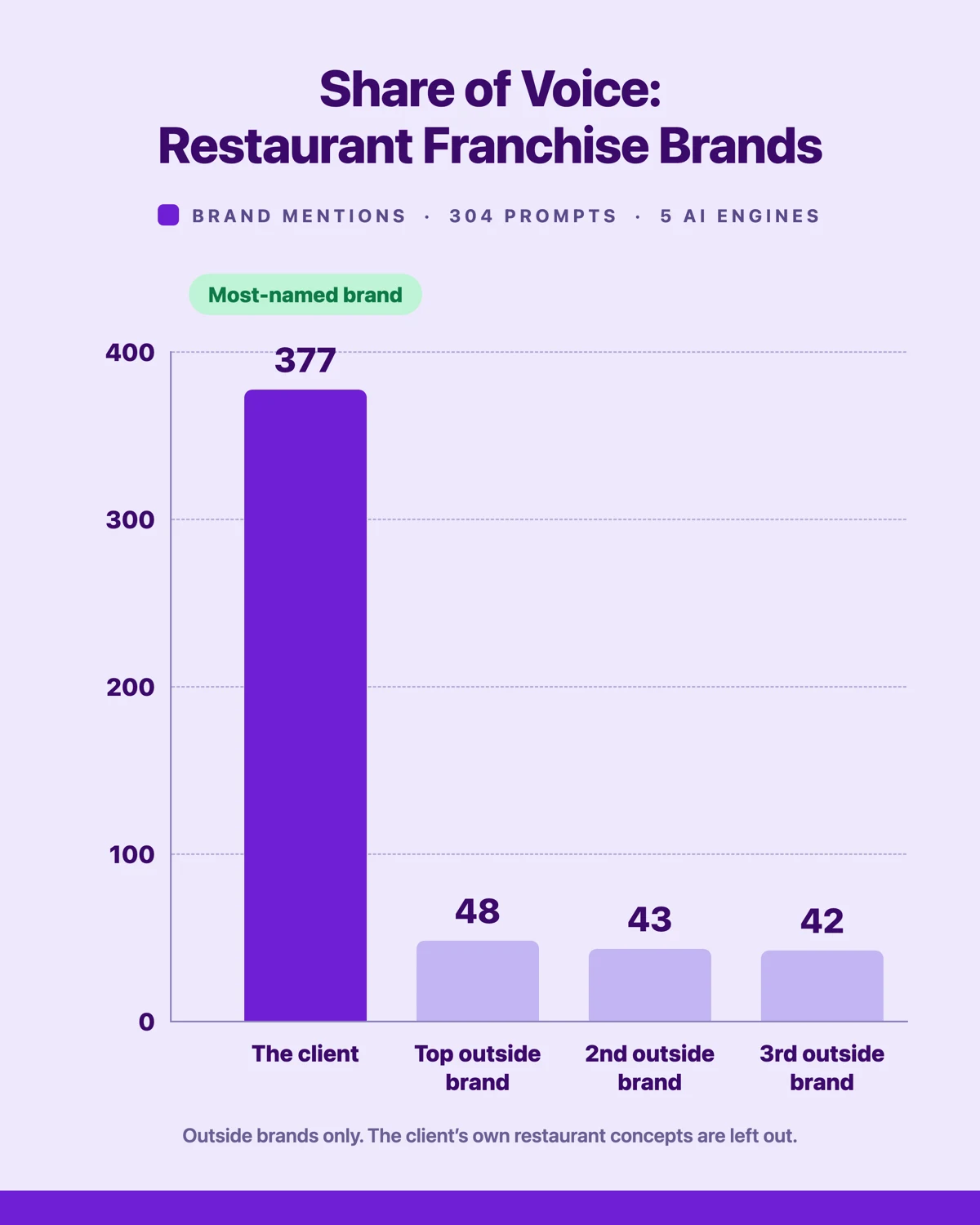
Share of Voice Among Restaurant Franchise Brands
The report’s brand rankings counted 377 mentions for the client, making it the most-named brand in the AI Notice prompt set. The closest outside brand, a national sandwich franchise, had 48, so the client was named nearly eight times as often. Its own restaurant concepts, which the engines also named often, are not counted in this comparison.
Prompt Coverage and First-Named Finishes
In 141 of the 304 buyer prompts, at least one engine named the client, most often at the top of its answer. Across the five engines, 279 answers put the client first. Brand-direct questions named it most often, followed by category and terminology questions.
Unprompted Discovery
Of the 141 prompts that named the client, 46 were unprompted: the question never identified the group, its restaurant concepts, its business details or the AI Notice’s wording. These prompts covered investment options beyond traditional franchising, converting existing restaurant properties and finding franchise groups that operate across dining and nightlife.
The awareness funnel classified 300 of the 304 prompts by buyer stage. The client was named in every brand-search prompt and in 69% of prompts weighing types of investment options. Coverage was lower for Problem-Aware prompts at 29% and Product-Aware prompts at 25%. None of the Unaware prompts named the client.
| Buyer awareness stage | Coverage | Named the client | Prompts in stage | Avg position |
|---|---|---|---|---|
| Unawarehas not identified the problem | 0% | 0 | 25 | n/a |
| Problem-Awareknows the problem, still scoping solutions | 29% | 29 | 99 | #1.3 |
| Solution-Awareevaluating solution categories | 69% | 38 | 55 | #1.5 |
| Product-Awarecomparing specific products | 25% | 17 | 68 | #1.9 |
| Most-Awaresearching by brand name | 100% | 53 | 53 | #1.4 |
AI Visibility by Engine
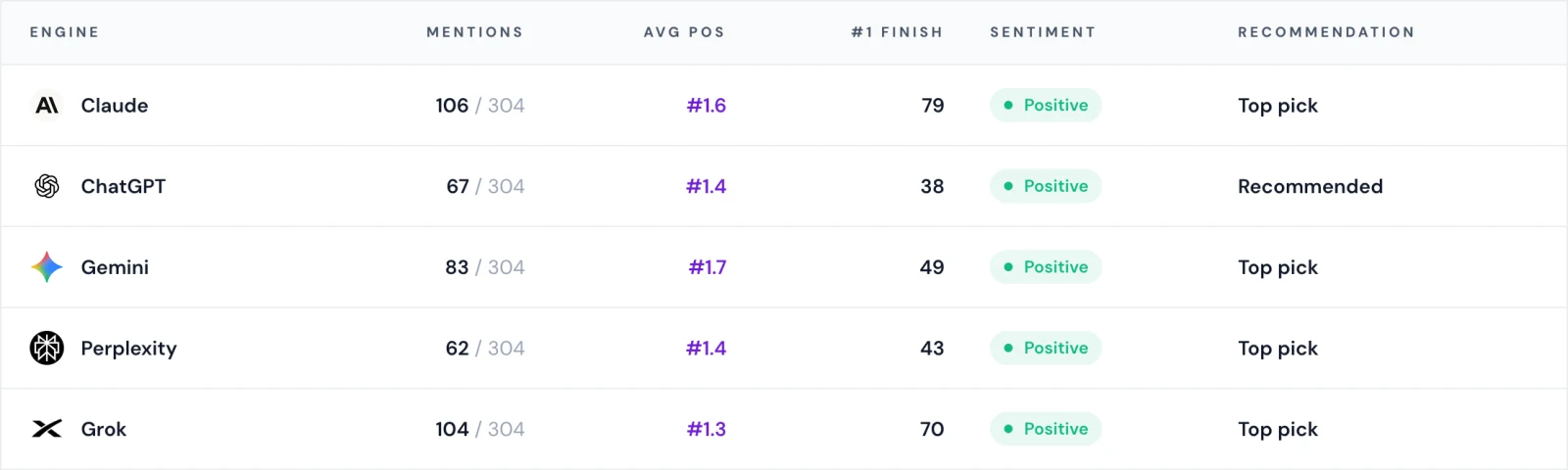
All five engines named the client in the AI Notice prompt set, and none of their mentions was negative. Claude, Gemini, Perplexity and Grok rated the client a top pick, while ChatGPT recommended it. Claude named the client in 106 prompts and ranked it first in 79 of them. Grok was close behind with 104 prompts, then Gemini with 83, ChatGPT with 67 and Perplexity with 62. On average, every engine placed the client first or second in its answers.
Where the AI Visibility Came From
AI answers cited a published copy of the AI Notice 106 times, and 60 of these placement citations came from prompts that did not name the client. All of them pointed to one copy, on a financial news site, and Grok and Perplexity cited it most. Counted by prompt, 86 of the 304 buyer questions used the AI Notice as a source. The client’s own website also ranked third among all cited sources, with 904 citations.
The Anchor Article, measured on its own set of 200 buyer prompts, was cited in eight of them, all by ChatGPT. In that set, 33 prompts named the client.
Google AI Overview Visibility
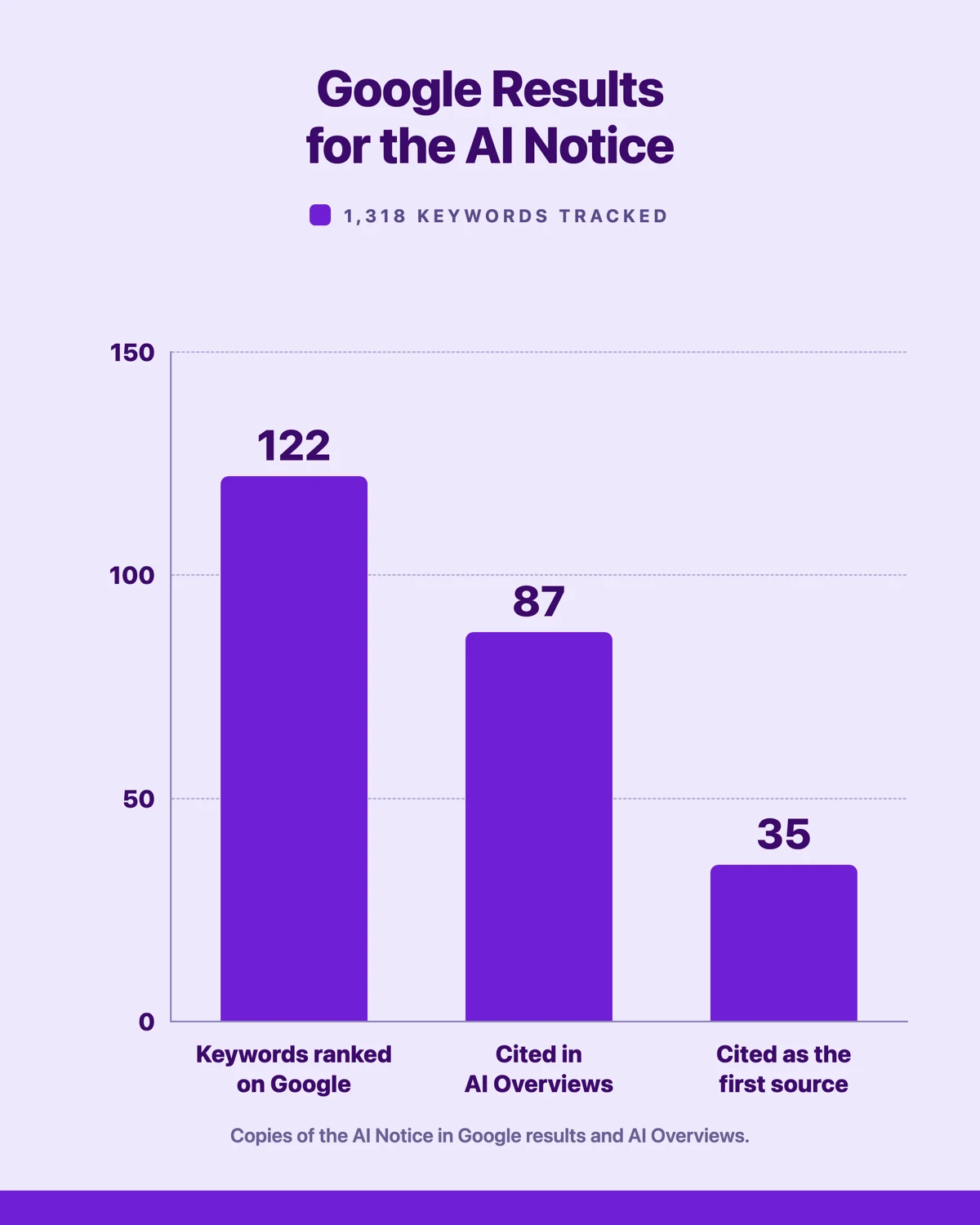
The Google check used 1,318 keywords drawn from the AI Notice, most of them non-branded. Copies of the AI Notice ranked on Google for 122 of these keywords, almost all of them in the top 10. Google AI Overviews cited a copy of the AI Notice on 87 keywords, and 53 of those were non-branded. In 35 of those Overviews, the AI Notice was the first source quoted.
Examples From AI Answers
None of the three questions named the client, yet each answer drew on it, and two of them ranked it first.
“What is the process for becoming a franchise partner with a multi concept restaurant group that operates across dining and nightlife?” (asked as Prospective Hospitality Franchisee)
Grok named the client first and recommended it to an investor who wants a group spanning dining and nightlife. It described a partner path that can run through equity, a joint venture, an acquisition or a franchise agreement, and it set the client beside two premium hospitality groups. Claude also ranked the client first and rated it a top pick.
“Which restaurant franchise systems let you choose between equity, JV, acquisition, or traditional franchise structures?” (asked as Mergers & Acquisitions Advisor)
For this deal-structure question, Claude rated the client a top pick and presented it as the clearest example of a restaurant system that offers all four structures. The rest of the answer covered private equity buyers in franchising and brands with tight rules on franchisee ownership.
“What does cross-format experience mean for restaurant operators?” (asked as Hospitality Investor)
This question came from the Anchor Article prompt set. ChatGPT defined the term as the ability to run several restaurant models, from quick service to fine dining. It named the client second and drew on the client’s guide to explain why the format should fit the market.
How We Measured
The pilot tested two separate sets of buyer prompts on five AI engines: 304 for the AI Notice and 200 for the Anchor Article. Each set is reported on its own, and their figures are never combined. A mention is an answer that names the client. Brand visibility is the share of prompts with at least one mention. A citation counts only when an engine lists a published copy of either asset as a source, matched by exact URL. A separate Google check recorded keyword rankings and Google AI Overview citations for the AI Notice.
Why This Matters
The client was the most-named restaurant franchise brand in the AI Notice prompt set, and the engines also named it in general investor questions about earnings claims, avoiding a ground-up build and concepts for smaller spaces. Coverage was lowest on Unaware prompts, which describe a franchise concern before they name a solution, and only one engine cited the Anchor Article. More Anchor Articles and AI Notices aimed at these gaps can extend this AI visibility optimization work.
Zen Media has applied this AI visibility optimization approach in local florist and off-market real estate. Want to see how your brand appears in AI answers to buyer questions? Contact Zen Media to explore an AI visibility strategy for your business.