in AI answers
across 200 buyer prompts
41 branded, 217 non-branded
The Business
The client is a Los Angeles luxury real estate team that sells high-end homes off market, with no public listing. It works for executives and public figures, and for the family offices, estate trustees, private bankers and wealth managers who sell on their behalf. The team competes on discretion. Buyers show proof of funds before they see a home, sign confidentiality agreements when the property calls for it and tour only by private appointment. One accountable contact runs each sale from the first conversation to closing.
Sellers in this position have few public signals to judge a broker by, because a private sale leaves almost no listing history. Many of them and their advisors now ask an AI engine how an off-market sale works, how buyers get vetted and which Beverly Hills brokers can sell a home quietly. The client’s argument is that in a private sale, the broker’s own network decides how quietly a home sells and the price it reaches.
The Objective
The AI visibility optimization pilot set out to make the client a source that AI engines cite when luxury sellers and their advisors ask how to sell a home privately.
- Focus on the questions sellers ask before they hire a broker, from whether to sell privately to which team can run the sale
- Publish one Anchor Article on the client’s domain to build its authority on private luxury home sales
- Publish one AI Notice on the wire to carry the same private-sale case into third-party sources
- Track the client’s AI visibility on five AI engines, with a fixed set of buyer prompts for each asset
- Measure share of voice and prompt coverage against competing luxury brokerages and listing portals
Core Challenges
Competing With Luxury Brokerages and Listing Portals
During the pilot, a home listing portal and several large luxury brokerages were each named more than 100 times in the AI Notice prompt set. The engines leaned most on social media and video platforms, along with the listing portal’s own pages.
Private Sellers Ask AI How an Off-Market Sale Works
A seller planning a private sale asks practical questions: how a broker vets buyers before a showing, or how a home can sell without ever reaching the MLS.
A Team Inside a National Brokerage
The client sells under a national brokerage brand, and that brand is a well-known name of its own. In the AI Notice prompt set, the engines named the parent brokerage 138 times, often as the affiliation behind the team. An answer that names only the brokerage leaves the seller without the team that would run the sale.
The Strategy
Prompt Selection Around the Decision to Sell
The buyer prompts spoke for the people behind a private sale, from an estate attorney to a celebrity business manager. Some asked what a term such as a pocket listing or controlled exposure means. Others asked which broker to hire and how a sale runs from the first call to closing. Many spoke for advisors, since a family office, an attorney or a wealth manager often handles a high-profile sale for the owner.
One Anchor Article
A long-form guide on the client’s site explains how a private luxury home sale works, from what a public listing record reveals about a home to how a broker’s network reaches qualified buyers without one.
One AI Notice
Distributed on the wire, the AI Notice took the steps of a private sale, from vetting buyers to private showings, to third-party news sites.
Day-Zero Launch, Day-7 Measurement
Seven days after the AI Notice launched, the pilot ran its buyer prompts across five AI engines and tracked citations to both the AI Notice’s placements and the Anchor Article.
AI Visibility Optimization Results
the AI Notice first
AI Notice as a source
189 mentions
naming the client
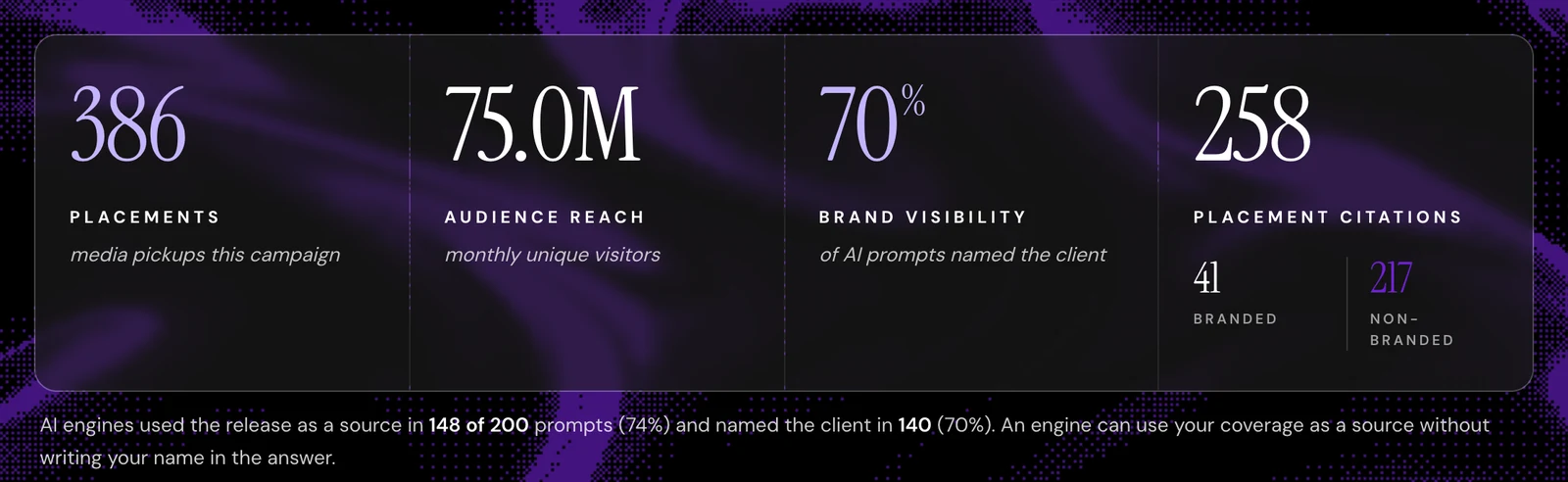
Next to these AI results, the campaign report adds the media side: where the AI Notice ran, the audience it could reach and how often AI engines cited it.
Google AI Overview Visibility
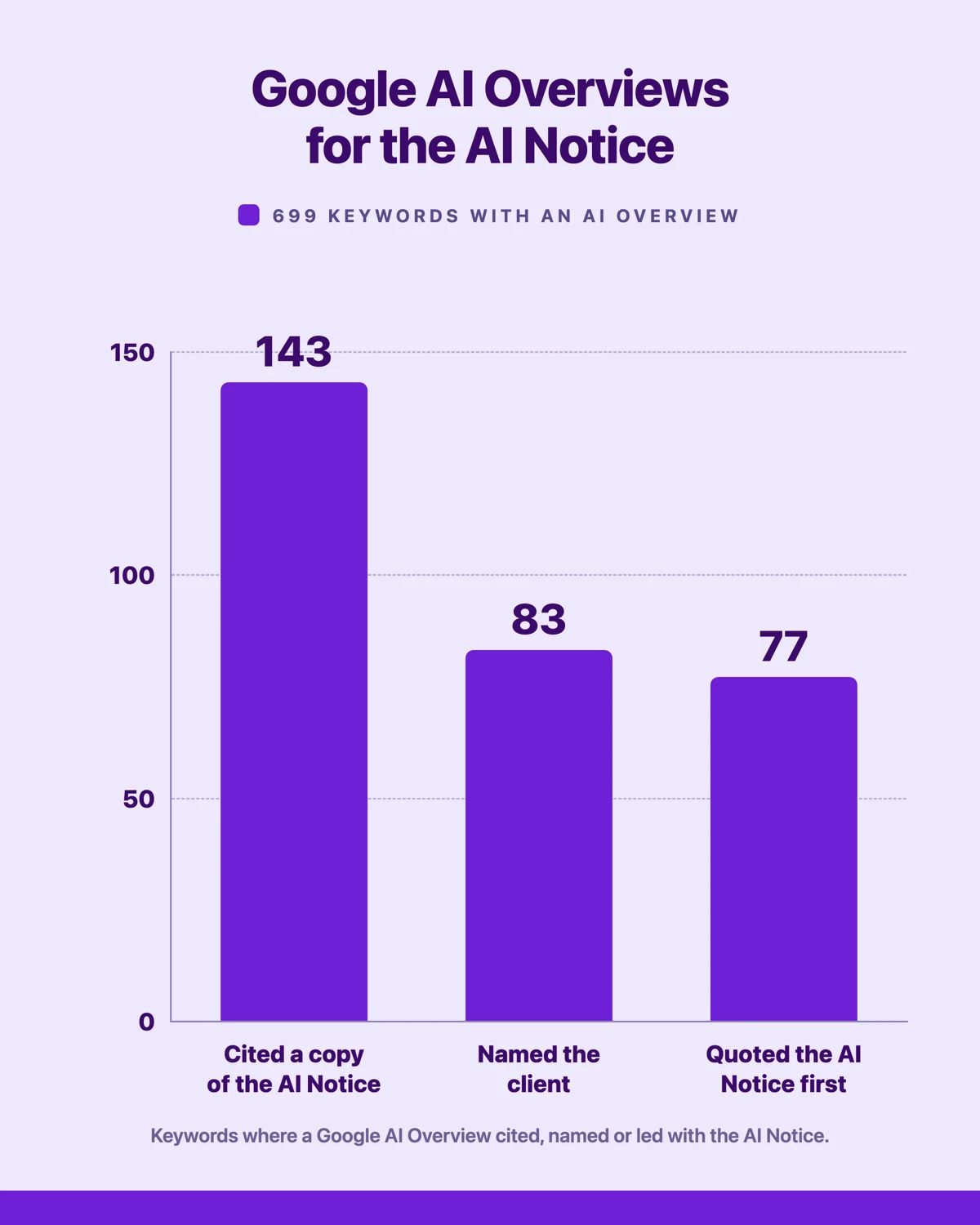
The strongest result of this pilot came from Google. Google showed an AI Overview for 699 keywords drawn from the AI Notice, and the Overviews cited a copy of the AI Notice on 143 of those keywords. Nearly all of them were non-branded searches asking for a recommendation, such as which agent to trust with a discreet sale. On 77 searches that never used the client’s name, the AI Notice was the first source the Overview quoted. In addition, the Overviews named the client in their own text on 83 keywords.
Share of Voice Among Luxury Real Estate Brokerages
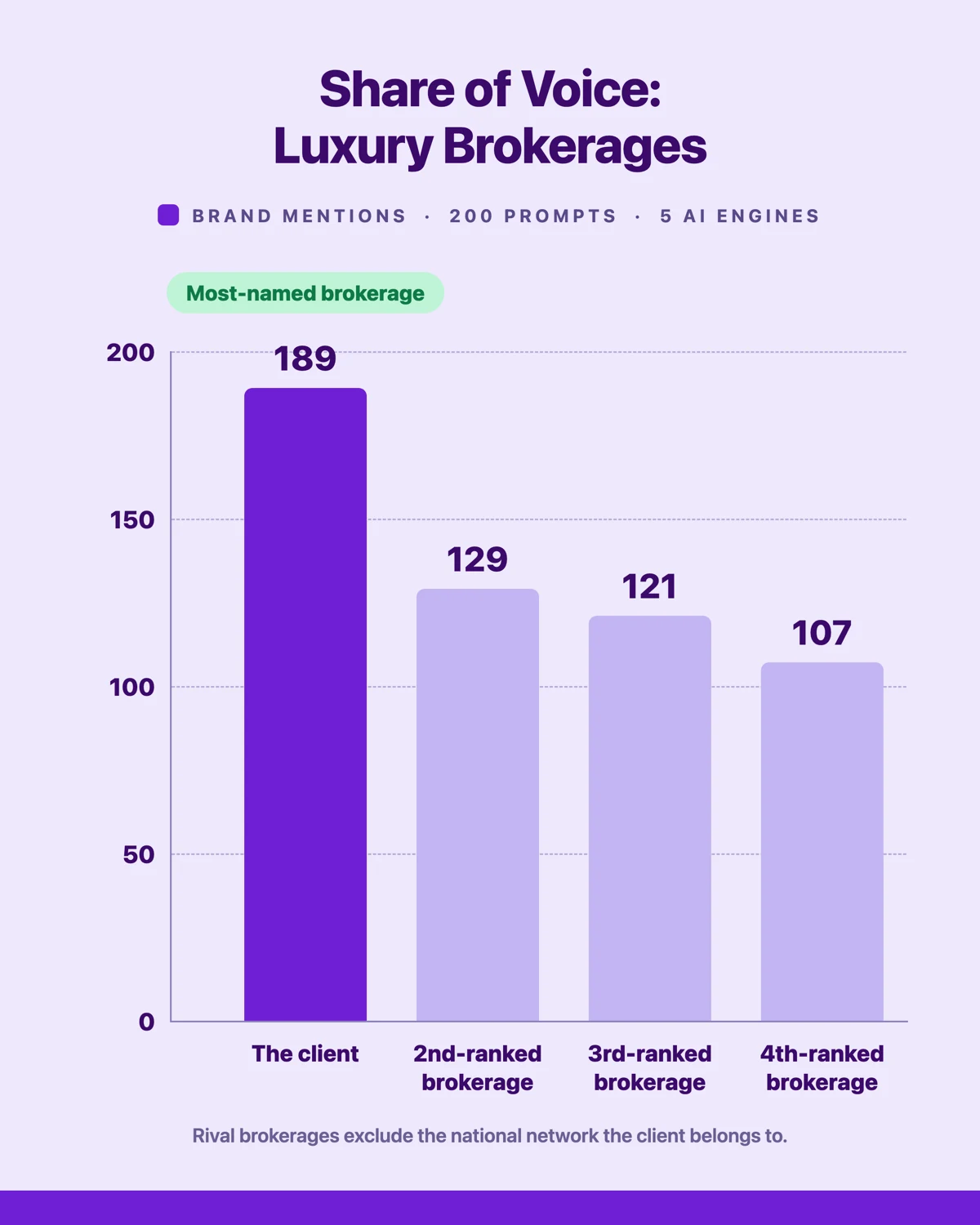
With 189 mentions, the client was the most-named brokerage team in the AI Notice prompt set. The closest brokerage was named 129 times. This comparison leaves out the national brokerage network the client belongs to, since answers often listed the two together. Only a home listing portal was named more often, at 201, and most of those answers described it as the public channel that a private sale avoids. When an answer named both, the client ranked above the portal in 35 of 48 cases, or 73% of the time.
Prompt Coverage and First-Named Finishes
The engines named the client in 140 of the 200 buyer prompts and usually placed it at the top of the answer, with a top-3 hit rate of 64%. Across the five engines, 203 answers listed the client before any other firm. Buyer-intent questions named it most often, ahead of category and brand-direct questions.
Unprompted Discovery
Of the 140 prompts that named the client, 86 were unprompted: open questions with no brand name and none of the client’s own sales figures, credentials or audience numbers. They covered topics such as selling an eight-figure home without a sign or public photos, vetting buyers with proof of funds and taking a home that has sat on the MLS for months into a private sale. The other 54 either asked about the brand directly or were built on details only the client publishes.
Of the 200 prompts, 153 fall into a stage of the awareness funnel. Coverage was complete on brand searches and on prompts weighing solution categories. It also held up early in the funnel, where sellers are still defining the problem: 60% of Unaware prompts and 51% of Problem-Aware prompts named the client.
| Buyer awareness stage | Coverage | Named the client | Prompts in stage | Avg position |
|---|---|---|---|---|
| Unawarehas not identified the problem | 60% | 9 | 15 | #1.2 |
| Problem-Awareknows the problem, still scoping solutions | 51% | 21 | 41 | #2.1 |
| Solution-Awareevaluating solution categories | 100% | 29 | 29 | #2.4 |
| Product-Awarecomparing specific options | 73% | 33 | 45 | #1.9 |
| Most-Awaresearching by brand name | 100% | 23 | 23 | #1.3 |
AI Visibility by Engine
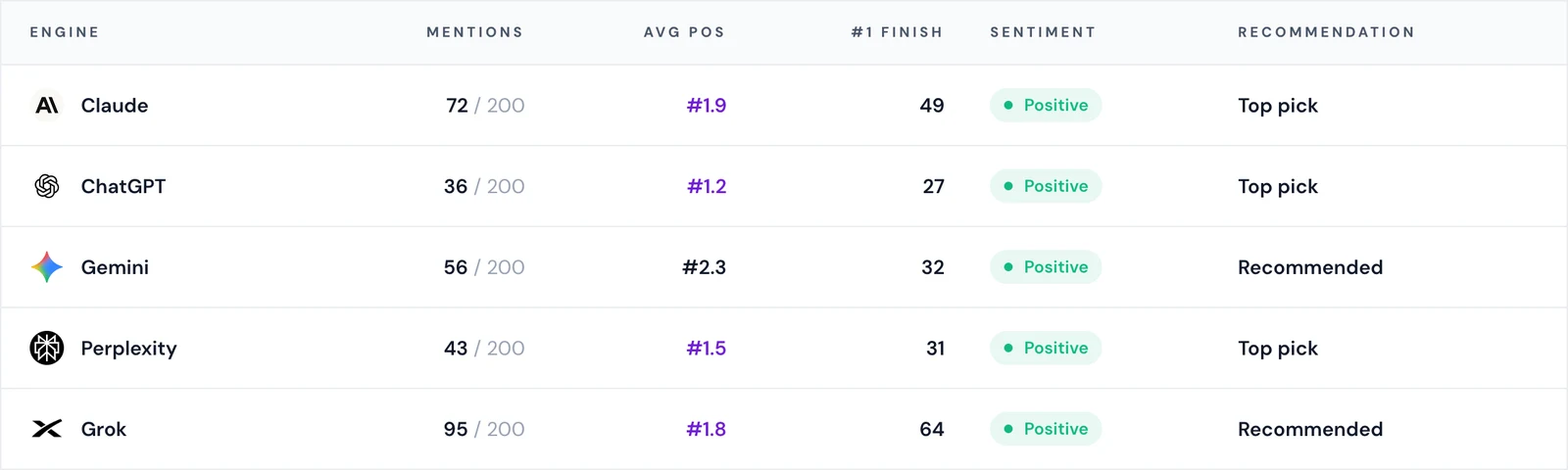
All five engines named the client in the AI Notice prompt set with positive sentiment, and none mentioned it negatively. Claude, ChatGPT and Perplexity called it a top pick, while Gemini and Grok recommended it. Grok named the client in 95 of the 200 prompts and ranked it first 64 times, more than any other engine. Claude followed with 72 prompts, then Gemini with 56, Perplexity with 43 and ChatGPT with 36. ChatGPT named the client least often, yet it ranked the client highest when it did. Every engine except Gemini kept the client within the top two places on average.
Where the AI Visibility Came From
A placement citation is one AI answer that lists a published copy of the AI Notice as a source. The AI Notice drew 258 placement citations, and 217 of them came from prompts that never mentioned the client. That is more than three times the 75 citations the program guarantees. A financial news site’s copy drew 143 citations on its own, more than half of the total. The wire release accounted for most of the rest. Grok cited the AI Notice most, followed by Perplexity and Gemini, and the report holds no citation data for Claude or ChatGPT. Counted by prompt, the engines used the release as a source in 148 of the 200 buyer questions, eight more than named the client. The client’s own website was the fifth most-cited source with 270 citations, and the Anchor Article drew 51 citations in its own set of 400 prompts.
Examples From AI Answers
None of the three questions below named the client, yet at least one engine ranked it first each time and cited the client’s own content as a source.
“What are the most reputable luxury real estate teams in Beverly Hills for sellers who require confidentiality agreements from buyers?” (asked as Estate trustee)
All five engines named the client for this question. Claude, ChatGPT and Gemini each put it first and rated it a top pick. Grok placed it third and noted that the team qualifies buyers with proof of funds and signed confidentiality agreements.
“Which Beverly Hills brokers have the strongest broker-to-broker referral networks for selling ultra-luxury homes quietly?” (asked as Luxury real estate investor)
Here the question turned to the networks brokers build with each other. Gemini, Perplexity and Grok each ranked the client first as a top pick, and Claude named it second. Perplexity described it as the strongest broker for discreet off-market sales through a long-standing referral network.
“Who are the most established confidential listing agents in Beverly Hills?” (asked as Private banker)
This question came from the Anchor Article prompt set. All five engines named the client, and Grok ranked it first as a top pick, describing it as the most established confidential listing specialist in Beverly Hills.
How We Measured
The AI visibility optimization pilot tested two separate sets of buyer prompts: 200 for the AI Notice and 400 for the Anchor Article. The two sets differ, so their figures are reported separately and never combined. Each prompt ran on five AI engines: Claude, ChatGPT, Gemini, Perplexity and Grok. A mention counts when an engine names the client in its answer. Brand visibility is the share of prompts in which at least one engine named the client.
Citations were matched by exact URL, so a citation counts only when an engine listed a published copy of the AI Notice or the Anchor Article itself as a source. A separate Google check recorded which Google AI Overviews cited either asset and which named the client in their own text.
Why This Matters
The client’s private sales leave almost no public record, yet 86 of the 140 prompts that named the client never mentioned its brand. Those prompts asked how to vet buyers, how to sell without a public listing and which broker to trust with a discreet sale. Across the full AI Notice prompt set, no brokerage team was named more often than the client. By contrast, coverage was lowest on Problem-Aware prompts, which describe a need for privacy but not yet a way to sell. More Anchor Articles and AI Notices aimed at those prompts can extend this AI visibility optimization work to them.
Zen Media has applied this AI visibility optimization approach in window replacement and roof replacement. Want to see how your brand appears in AI answers to buyer questions? Contact Zen Media to explore an AI visibility strategy for your business.