in AI answers
across 200 buyer prompts
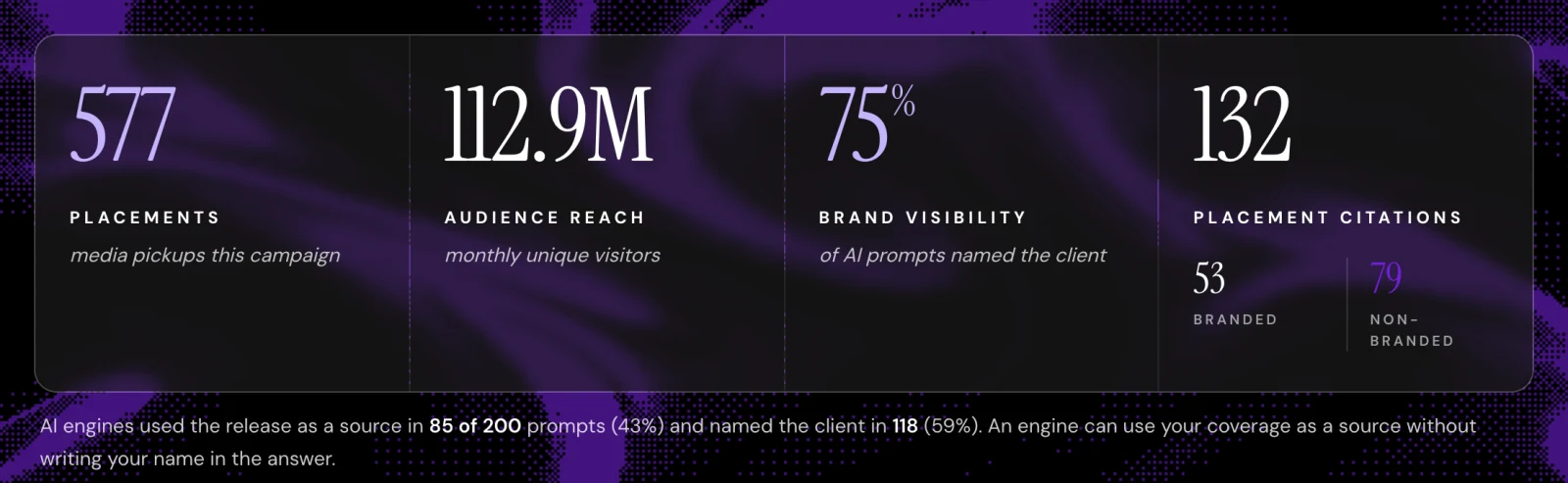
53 branded, 79 non-branded
The Business
The client is a residential window and door replacement company that serves homeowners, first-time homebuyers and home sellers. It installs vinyl, composite and aluminum replacement windows from several manufacturers, along with its own window lines. It competes on a written lifetime limited warranty that covers labor, a free in-home consultation with a written quote and a review record built over hundreds of customers.
One buyer prompt in the pilot came from a homeowner whose windows were fogging between the panes. It asked for a local installer whose warranty covers a failed sealed glass unit. ChatGPT put the client first, rated it a top pick and pointed to a warranty that covers that exact failure. The AI visibility optimization pilot tested questions like this one, about how to vet a window installer before signing. The client’s position is that a trustworthy company leaves a record a homeowner can check: its reviews, its accreditation file, a warranty that says who pays for labor and a sales process without pressure.
The Objective
The pilot set out to make the client a source that AI engines cite when homeowners ask how to choose a window replacement company. It used two published assets and measured the results once after launch. Specifically:
- Focus on homeowner questions about window warranties, installer reviews and accreditation, and the consultation process across different stages of the buying process
- Publish one Anchor Article on the client’s domain to build its authority on window replacement
- Publish one AI Notice on the wire to carry the same installer-vetting case into third-party sources
- Track the client’s AI visibility on five AI engines, with a fixed set of buyer prompts for each asset
- Measure share of voice and prompt coverage against competing window brands
Core Challenges
Competing With Window Brands Already Named in AI Answers
During the pilot, a national window replacement franchise, a local window replacement company and a window manufacturer were each named more than 100 times in the AI Notice prompt set. The engines leaned most on a business accreditation site, a social media platform, a community forum and a review site, with the client’s own website close behind. To be named, the client had to reach the answers these sources were already shaping.
Homeowners Ask AI How to Vet a Window Installer
Before hiring an installer, a homeowner asks pointed questions: does the lifetime warranty cover labor, and how can I check the company’s complaint history before a salesperson comes to the house? The client needed one trusted source that answered these questions in full, for homeowners and AI engines alike.
Tracing AI Citations Back to Their Sources
Both assets made the same installer-vetting case, so one citation total could not show which of them the engines used. The pilot matched each citation to the page it came from.
The Strategy
Prompt Selection Around the Buying Moment
The buyer prompts spoke for the people who hire a window installer, from a first-time homebuyer to a home seller. Some asked what a warranty term or a window material means. Others asked how to check an installer and who to hire. Most of them asked for proof a homeowner can check, since a record the buyer can verify is the guide’s central argument. In that order, they traced a homeowner’s path from first research to a signed contract.
One Anchor Article
A long-form guide on the client’s site explains how to check a window replacement company before signing, from reading its review and accreditation record to what its warranty says about labor. It reduces the warranty to one question a homeowner can ask: who pays for the labor if a window fails years later. The guide stays on the client’s own domain, so AI engines can return to it and keep citing it once the pilot is over.
One AI Notice
Distributed on the wire, the AI Notice brought the checks a homeowner should run before choosing a window installer to third-party news sites. There, AI engines could find the same checklist on sources the client does not own.
Day-Zero Launch, Day-7 Measurement
Seven days after the AI Notice launched, the pilot ran its buyer prompts across five AI engines and tracked citations to both the AI Notice’s placements and the Anchor Article. All results reflect this single post-launch measurement.
AI Visibility Optimization Results
380 mentions
AI Notice as a source
the client
naming the client
The AI Notice’s campaign report adds the media view: how many placements carried the release, the audience they could reach and how often AI engines cited it.
Share of Voice Among Window Replacement Brands
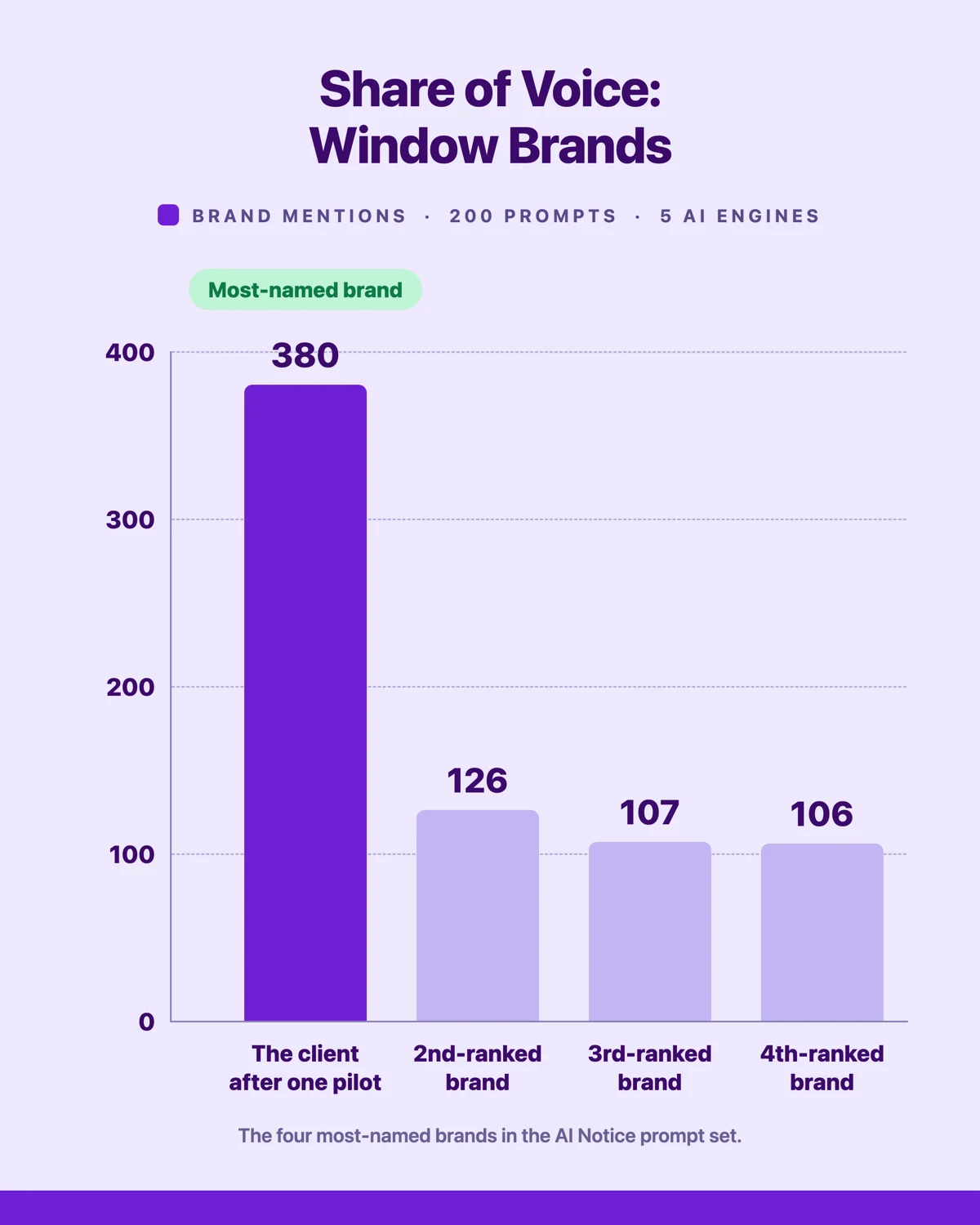
With 380 appearances in the engines’ brand rankings, the client was the most-named brand in the AI Notice prompt set. Its closest rival had 126 mentions, and every other brand had fewer. When an answer named both the client and its closest rival, the client ranked higher in 58 of 84 cases, a 69% win rate.
Prompt Coverage and First-Named Finishes
Of the 200 buyer prompts, 118 drew an answer that named the client, usually near the top of the list. For 106 of those prompts, the client sat in at least one engine’s top three. The client was the first name in 271 engine answers. Category questions named it most often, ahead of brand-direct and buyer-intent questions.
Unprompted Discovery
Most of the naming prompts did not ask about the client at all. Of the 118, 66 were unprompted: open questions with no brand name, none of the client’s own figures or product lines, and no mention of its values. They covered topics such as warranties that transfer to a new owner, which window materials hold up best in hot weather and installers that serve homes far from their base. Brand questions and prompts built on the client’s own details made up the remaining 52.
The awareness funnel places 174 of the 200 prompts in a buyer stage. Comparison, problem-solving and best-practice prompts sit outside it. Coverage was near complete late in the funnel: 100% on brand searches and 97% on prompts weighing solution categories. By contrast, it reached 60% on prompts comparing specific products, then 29% on Unaware and 24% on Problem-Aware prompts.
| Buyer awareness stage | Coverage | Named the client | Prompts in stage | Avg position |
|---|---|---|---|---|
| Unawarehas not identified the problem | 29% | 4 | 14 | #3.9 |
| Problem-Awareknows the problem, still scoping solutions | 24% | 12 | 49 | #1.8 |
| Solution-Awareevaluating solution categories | 97% | 32 | 33 | #2.4 |
| Product-Awarecomparing specific products | 60% | 29 | 48 | #1.8 |
| Most-Awaresearching by brand name | 100% | 30 | 30 | #1.0 |
AI Visibility by Engine
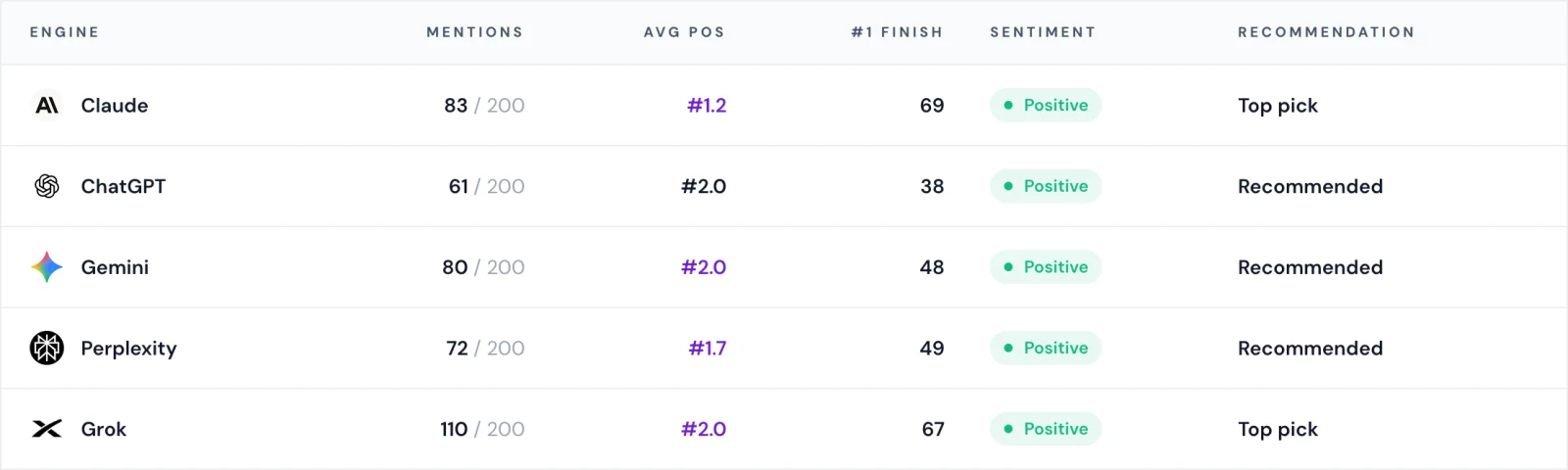
All five engines named the client in the AI Notice prompt set with positive sentiment. Claude and Grok rated it a top pick, and ChatGPT, Gemini and Perplexity recommended it. Grok named the client in 110 of the 200 prompts, more than any other engine, and put it first 67 times. The counts for the rest were 83 on Claude, 80 on Gemini, 72 on Perplexity and 61 on ChatGPT. Every engine placed the client first or second on average, and Claude ranked it first most often, 69 times. Only three mentions were negative, two on ChatGPT and one on Grok.
Where the AI Visibility Came From
Placement citations count each time an AI answer listed a published copy of the AI Notice as a source. The AI Notice received 132 of them, and 79 came from prompts that never mentioned the client. Grok cited it most, followed by Perplexity and Gemini, while the report holds no citation data for Claude or ChatGPT. The engines drew on three copies: the wire release and two editions of a financial news site. Together, those copies served as a source in 85 of the 200 buyer prompts. In the same answers, the client’s own website was the fourth most-cited source, with 782 citations. The Anchor Article had its own set of 398 buyer prompts, where AI answers cited it 37 times and the engines named the client in 201 prompts.
Google AI Overview Visibility
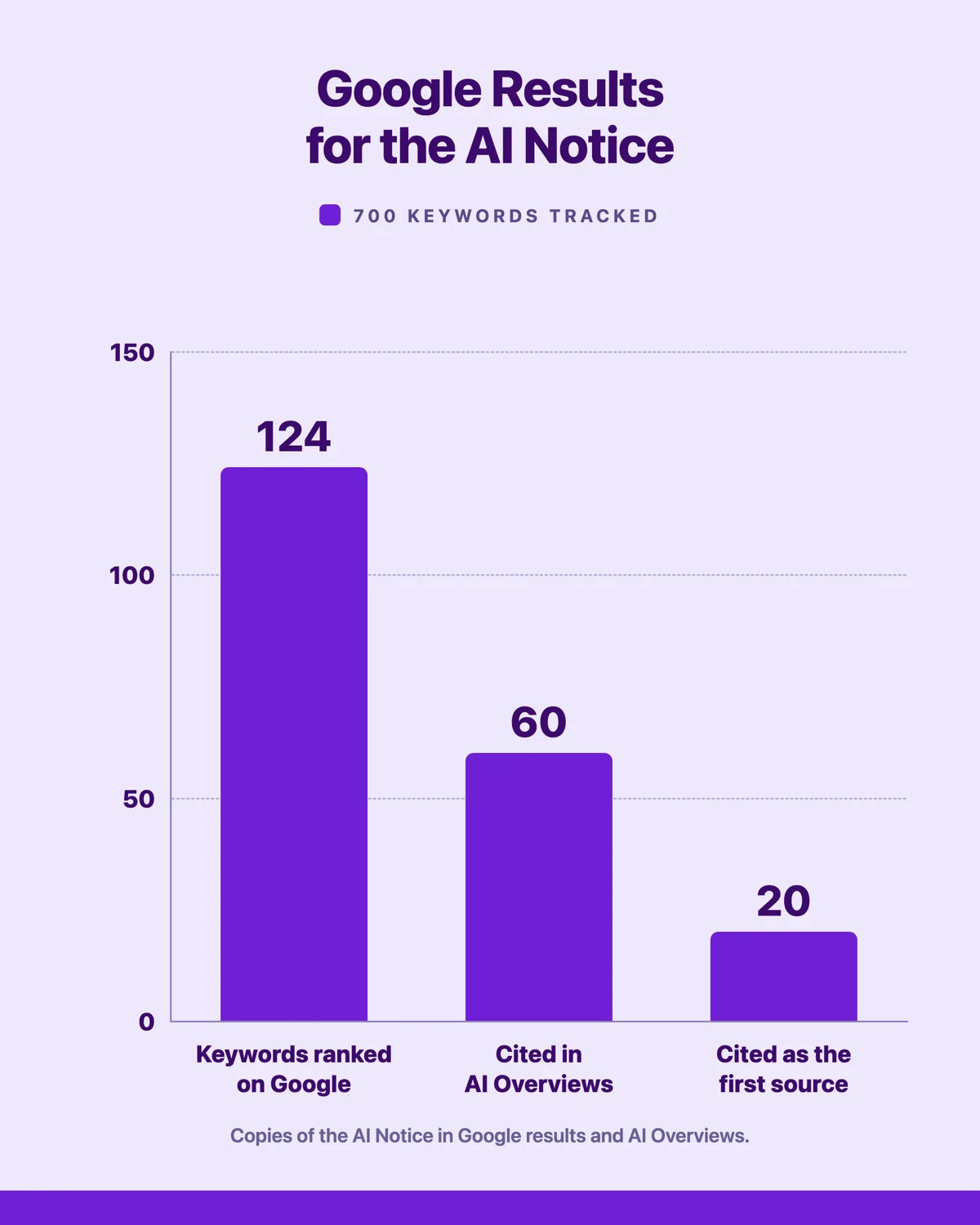
The report tested 700 keywords drawn from the AI Notice on Google. Copies of the AI Notice ranked on Google for 124 keywords, 114 of them in the top 10. Google AI Overviews cited a copy on 60 keywords, and on 20 of them the AI Notice was the first source quoted. The Overviews also named the client in their own text on 206 keywords, and 158 of those searches did not include its name.
Examples From AI Answers
The examples below show how AI engines answered window replacement buyer questions and which sources they cited.
“What does it mean when a window installer says they back installations with a written lifetime limited warranty that includes labor?” (asked as Contract-Reviewing Homeowner)
To explain the term, Grok used the client as its first example of an installer that backs its work with a written lifetime limited warranty including labor. The answer then set installer-backed warranties apart from manufacturer warranties that cover parts only.
“I need window installer that provides written warranty document at the first appointment” (asked as Contract-focused homeowner)
This question came from the Anchor Article prompt set. Claude rated the client a top pick and named no other company. The answer described a written lifetime limited warranty with labor at no charge and a process that starts with a free in-home consultation.
“Shopping for replacement windows with lifetime warranty that includes labor coverage” (asked as Long-term homeowner)
Also from the Anchor Article prompt set, this answer compared lifetime window warranties that include labor. Perplexity recommended the client in third place and noted that its warranty covers labor at no charge for the original buyer of an owner-occupied home.
None of the three questions named the client, yet each answer recommended it, and two of them ranked it first.
Where the Results Fell Short
Not every result was strong. The Anchor Article did not rank on Google for any of its 600 test keywords, and no Google AI Overview cited it. Its AI citations also leaned on one engine: Grok cited it in 36 prompts and Perplexity in one, while Claude, ChatGPT and Gemini did not cite it. Even so, Google AI Overviews named the client on 104 of those 600 keywords, so the client appeared in Google’s answers on topics where the guide itself was not a source.
How We Measured
The AI visibility optimization pilot tested two separate sets of buyer prompts, 200 for the AI Notice and 398 for the Anchor Article, across five AI engines: Claude, ChatGPT, Gemini, Perplexity and Grok. Each report tracked brand mentions in AI answers. A mention counts when an engine names the client, and brand visibility measures the share of prompts where at least one engine named it.
AI citations were tracked separately and matched by exact URL to show when an engine used the AI Notice or the Anchor Article as a source. A separate Google check measured organic keyword rankings and visibility in Google AI Overviews.
About the measurement
All results come from a pilot built around one Anchor Article and one AI Notice. Each asset was measured once after launch. The two prompt sets differ, so their figures are reported separately and never combined.
Why This Matters
No window replacement brand was named more often than the client in the AI Notice prompt set, and many of those answers came from questions that never mentioned it. They asked about warranties that cover labor, free in-home consultations and the final walkthrough after installation, the points a homeowner checks before hiring an installer.
Coverage was thinnest on Problem-Aware prompts, where homeowners know something is wrong but have not settled on a fix: 24% of them named the client. These topics are an opportunity to expand AI visibility.
Zen Media has applied this AI visibility optimization approach in roof replacement and industrial gas. Want to see how your brand appears in AI answers to buyer questions? Contact Zen Media to explore an AI visibility strategy for your business.