across 200 buyer prompts
in AI answers
60 branded, 217 non-branded
The Business
The client is a family-owned florist that designs its arrangements in its own shop and delivers them with its own drivers across a large metropolitan region and its suburbs. Orders for birthdays, anniversaries, hospital stays and funerals come from an audience that ranges from last-minute buyers to funeral planners and corporate gift buyers. What sets the shop apart is control of the whole order, from the morning design to the doorstep: delivery vans run every day of the week, and a person picks up the phone when an order runs late.
Much of this work runs on a deadline. A sympathy arrangement has to reach the funeral home before the service begins, and a hospital order needs the patient’s name and room number to reach the right floor. The client’s position is simple: same-day delivery depends on designers in a real shop and on drivers who cover the recipient’s neighborhood that day.
The Objective
The AI visibility optimization pilot set out to make the client the florist that AI engines name and cite when buyers ask who can deliver flowers today.
- Focus on buyer questions about same-day order cutoffs, Sunday and holiday delivery, and sympathy orders across different stages of the buying process
- Publish one Anchor Article on the client’s domain to build its authority on same-day flower delivery
- Publish one AI Notice on the wire to carry the same local-delivery case into third-party sources
- Track the client’s AI visibility on five AI engines, with a fixed set of buyer prompts for each asset
- Measure share of voice and prompt coverage against competing florists and flower delivery brands
Core Challenges
Competing With Local Florists Already Named in AI Answers
During the pilot, a regional florist and a local flower shop were each named more than 175 times in the AI Notice prompt set. Among third-party sources, the engines leaned most on a review site, a competing florist’s website and a social media platform.
Buyers Ask AI Which Florist Can Deliver Today
Buyers in this category ask exact questions when flowers must arrive today. They ask which shop still takes an order at noon, or who can get sympathy flowers to a funeral home on a Sunday.
Competing With National Flower Networks as Well as Local Shops
The client also competed with three national flower delivery networks, each named more than 175 times in the AI Notice prompt set during the pilot. These networks take an order online and can pass it to whichever affiliate shop has capacity. An answer could name a national brand and leave out the florist that designs and delivers the flowers.
The Strategy
Prompt Selection Around the Buying Moment
The prompts were written in the voices of people who send flowers on short notice, from a last-minute gift buyer to a funeral planner. Some asked what terms like an order gateway or a same-day cutoff mean. Others asked which florist could reach a given neighborhood, hospital or funeral home that day. Together they followed a buyer from the first worry about timing to the order itself.
One Anchor Article
A long-form guide on the client’s site explains how same-day flower delivery works, from the checks to run before paying to what to do after missing the day’s cutoff. Its advice on a missed cutoff is practical: call the shop, since a van may still be running near the address.
One AI Notice
The AI Notice went out on the wire and put the case for local same-day delivery on third-party news sites. It explained why the shop and the driver decide whether flowers arrive today.
Day-Zero Launch, Day-7 Measurement
Seven days after the AI Notice launched, the pilot ran its buyer prompts across five AI engines and tracked citations to both the AI Notice’s placements and the Anchor Article.
AI Visibility Optimization Results
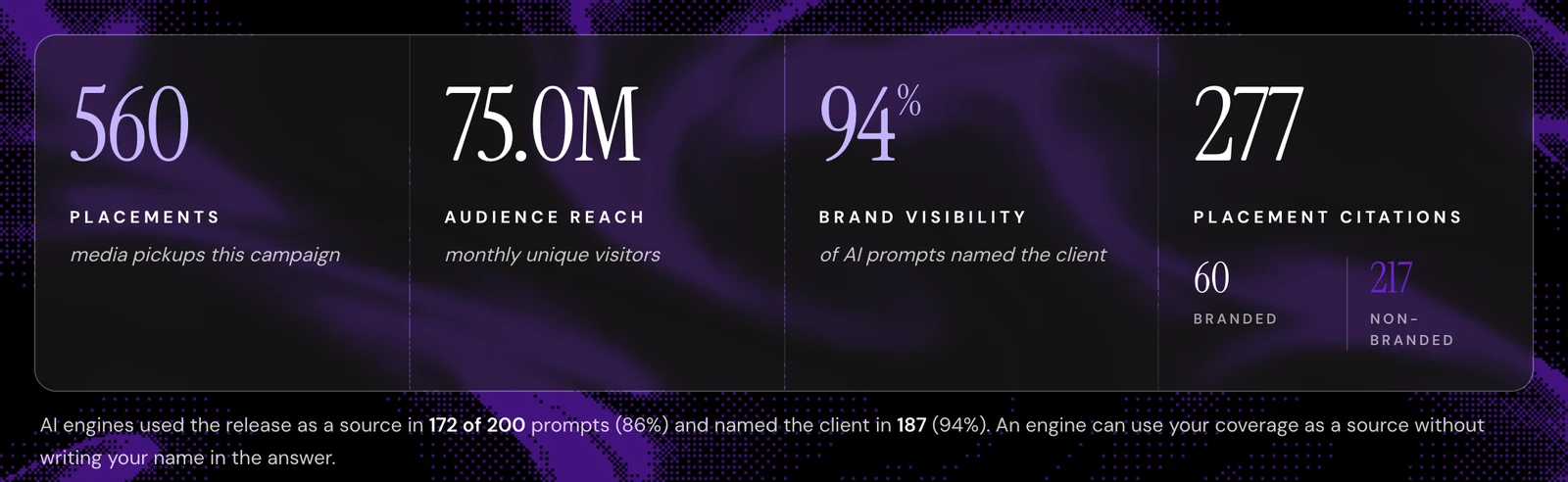
569 mentions
AI Notice as a source
the client
naming the client
The campaign report behind the AI Notice shows the media side: where the release ran, the audience it could reach and how often AI engines cited it.
Share of Voice Among Florists and Flower Delivery Brands
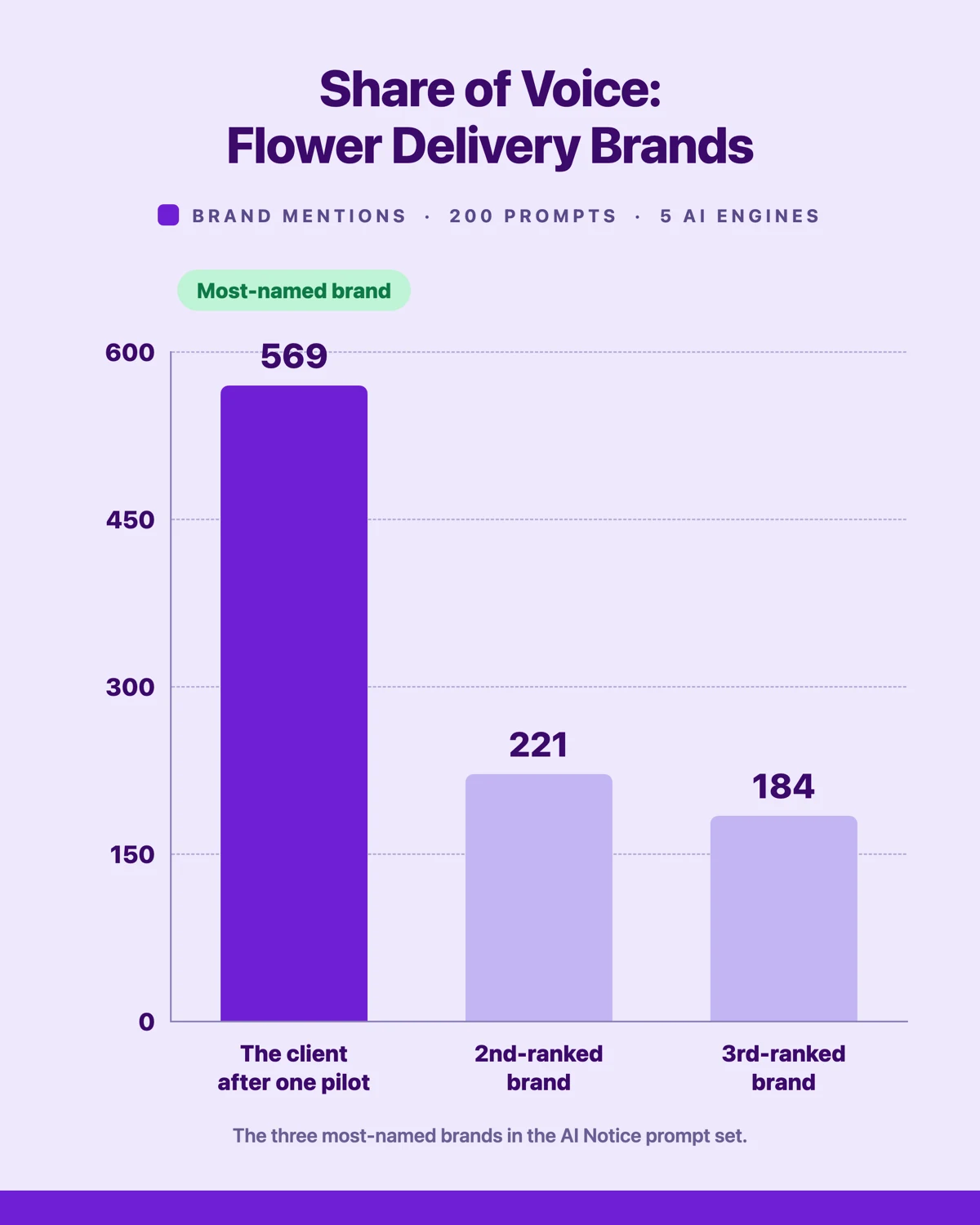
No flower delivery brand came close to the client. The engines’ brand rankings listed the client 569 times in the AI Notice prompt set, more than twice its closest rival. That rival, a regional florist, had 221, while a local flower shop came third at 184. By contrast, the three national flower delivery networks each had less than a third of the client’s count. When the client and the regional florist appeared in the same answer, the client ranked higher in 122 of 165 cases, a 74% win rate.
Prompt Coverage and First-Named Finishes
Only 13 of the 200 buyer prompts drew answers that left the client out, so 187 named it. When the client appeared, it usually led the list, and in 168 prompts at least one engine ranked it first. Counted engine by engine, the client was the first name in 433 AI answers. Buyer-intent questions named it most often, ahead of terminology and category questions.
Unprompted Discovery
Most of the answers that named the client came from questions that never asked about it: 128 of the 187 were unprompted. These questions carried no brand name and none of the client’s own details, such as its order cutoff, delivery area or years in business. They asked about a birthday surprise delivered the same afternoon, hospital deliveries on short notice and local shops that also ship nationwide. The remaining 59 were brand questions or prompts built on the client’s own details.
| Buyer awareness stage | Coverage | Named the client | Prompts in stage | Avg position |
|---|---|---|---|---|
| Unawarehas not identified the problem | 85% | 17 | 20 | #1.7 |
| Problem-Awareknows the problem, still scoping solutions | 82% | 41 | 50 | #1.8 |
| Solution-Awareevaluating solution categories | 100% | 38 | 38 | #1.7 |
| Product-Awarecomparing specific products | 98% | 60 | 61 | #1.7 |
| Most-Awaresearching by brand name | 100% | 31 | 31 | #1.1 |
AI Visibility by Engine
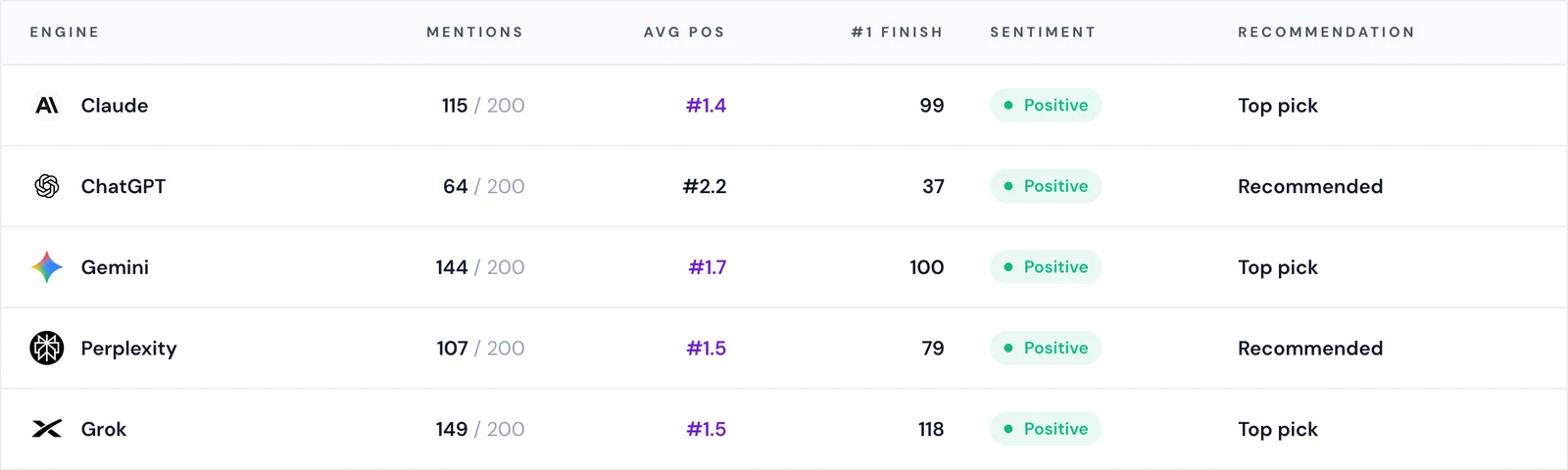
All five engines named the client in the AI Notice prompt set with positive sentiment. Claude, Gemini and Grok went further and called it a top pick, while ChatGPT and Perplexity recommended it. Grok was the most active: it named the client in 149 of the 200 prompts and put it first 118 times. Gemini was close behind at 144. Claude named it in 115 prompts, Perplexity in 107 and ChatGPT in 64. Four of the five engines placed the client first or second on average, and none of them logged a negative mention.
Where the AI Visibility Came From
Placement citations count each time an AI answer listed a published copy of the AI Notice as a source. The AI Notice received 277 of them, most from prompts that never mentioned the client. Grok led the citations, followed by Perplexity and Gemini, and the report holds no citation data for Claude or ChatGPT. In all, AI engines used the AI Notice as a source on 172 of the 200 buyer prompts. No source in those answers was cited more often than the client’s own website. Measured on its own prompt set, the Anchor Article was cited 40 times, and the engines named the client in more than half of those prompts.
Google AI Overview Visibility
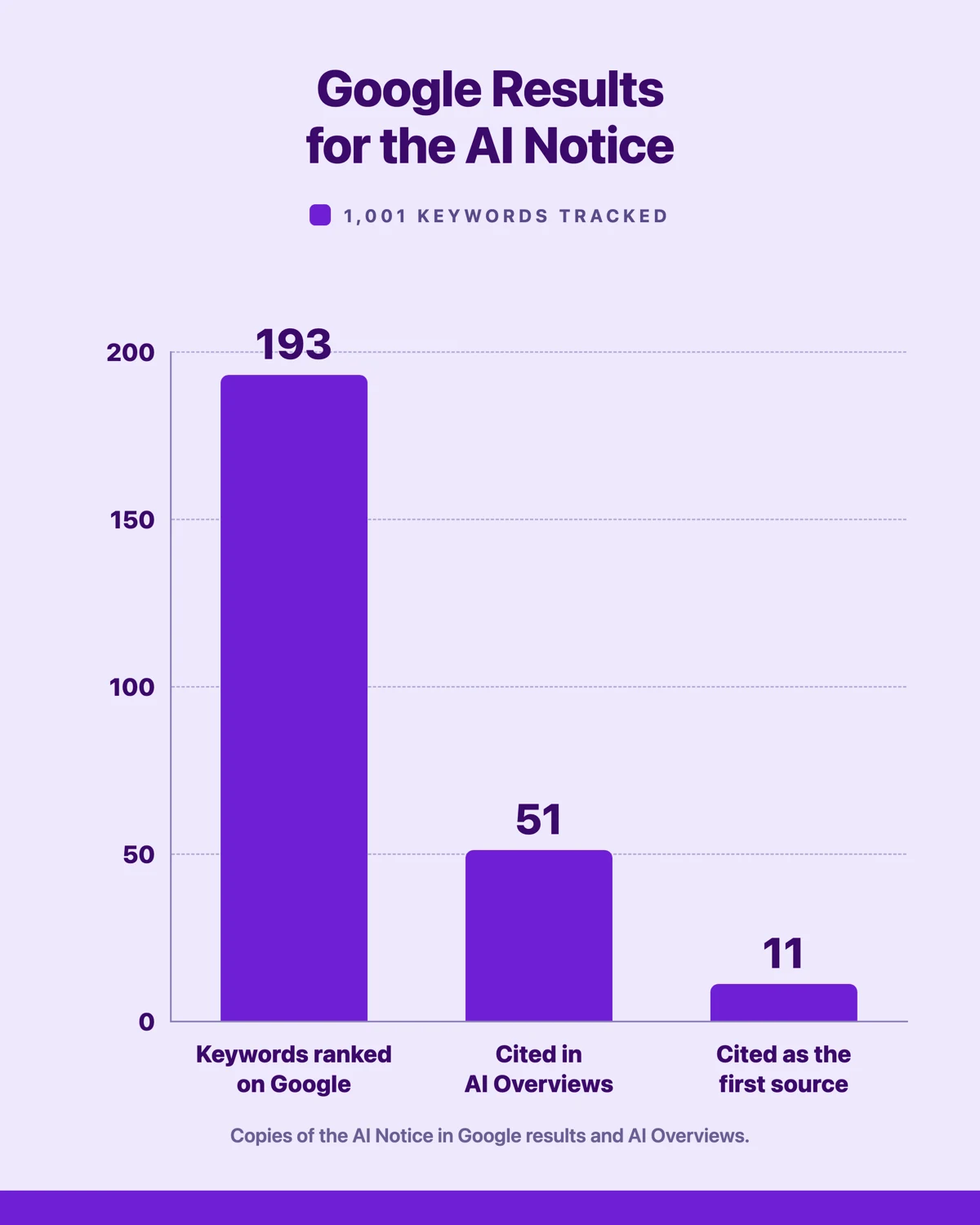
On Google, the report checked 1,001 keywords drawn from the AI Notice. Copies of the AI Notice showed up in Google’s organic results for 193 of them, 115 in the top 10. Google AI Overviews cited a copy on 51 keywords and quoted it as the first source on 11. The Overviews also named the client in their own text on 132 keywords, most of them searches that never mentioned the client. The Anchor Article, checked against its own keyword set, ranked on Google for 70 keywords, and Google AI Overviews cited it on 23.
Examples From AI Answers
None of the three questions named the client, yet every answer ranked it first.
“What is a local florist that staffs its own delivery routes every day including Sundays and holidays?” (asked as Holiday gift planner)
Three engines answered with the client as their first name and their top pick. Perplexity gave it as the only answer and named no other florist. Grok listed it ahead of three other local florists and three national delivery services.
“How does same-day flower delivery work when a local florist uses its own drivers versus routing through a national order gateway?” (asked as Curious consumer)
To explain the two models, Grok used the client as its working example of a local florist with in-house design, its own drivers and a same-day cutoff. Two national networks appeared as examples of the order gateway model. Gemini also put the client first in its answer.
“How does the floral industry order gathering model affect same-day delivery?” (asked as Industry analyst)
This question came from the Anchor Article prompt set. Grok named the client first and described it as a verified local florist whose direct ordering keeps inventory checks, routing and delivery in one place. The answer treated order gathering as a risk for any order that has to arrive today.
How We Measured
The AI visibility optimization pilot tested two separate sets of buyer prompts: 200 for the AI Notice and 200 for the Anchor Article. The two sets differ, so their figures are reported separately and never combined. Each prompt ran on five AI engines: Claude, ChatGPT, Gemini, Perplexity and Grok. A mention counts when an engine names the client in its answer. Brand visibility is the share of prompts in which at least one engine named the client.
Citations were matched by exact URL, so a citation counts only when an engine listed a published copy of the AI Notice or the Anchor Article itself as a source. A separate Google check recorded organic keyword rankings, which Google AI Overviews cited either asset and which named the client in their own text.
Why This Matters
The client was the most-named flower delivery brand in the AI Notice prompt set. Of the 187 prompts that named the client, 128 never mentioned its name or its own details. These included questions about Sunday deliveries, funeral timing and florists with their own drivers, the details that decide whether flowers arrive today. By contrast, coverage was lowest in the Anchor Article prompt set, on early-stage prompts that do not yet name a problem. A strategic next phase would aim new Anchor Articles and AI Notices at those prompts and extend this AI visibility optimization work to them.
Zen Media has applied this AI visibility optimization approach in off-market real estate and window replacement. Want to see how your brand appears in AI answers to buyer questions? Contact Zen Media to explore an AI visibility strategy for your business.