in AI answers
AI Notice, 99 non-branded
52 branded, 85 non-branded
The Business
The client is a regional distributor of industrial, medical and specialty gases. It delivers gas in bulk, microbulk and packaged form and adds equipment, technical support and safety training. Its biotech customers use liquid nitrogen to store cell samples, carbon dioxide to run bioreactors and specialty gases for lab analysis. The client competes on supply continuity: it sources gas from several production facilities, keeps inventory close to its customers and offers same-day emergency delivery.
The pilot tested what AI engines tell lab managers, operations managers and procurement directors when they ask how to protect a biotech facility’s gas supply. The client’s argument is direct: a supplier that draws on one plant can leave every customer short when that plant fails, while a distributor with several sources and local stock can keep delivering.
The Objective
The AI visibility optimization pilot set out to make the client a source that AI engines cite when buyers ask which gas supplier can keep a biotech facility supplied. It used two published assets and measured the results once after launch. Specifically:
- Focus on buyer questions about supply continuity, emergency delivery and supplier evaluation across different stages of the buying process
- Publish one Anchor Article on the client’s domain to build its authority on biotech gas supply
- Publish one AI Notice on the wire to carry the same supply-continuity case into third-party sources
- Track the client’s AI visibility on five AI engines, with a fixed set of buyer prompts for each asset
- Measure prompt coverage against competing industrial gas suppliers, along with visibility in Google AI Overviews
Core Challenges
Competing With Industrial Gas Suppliers Already Established in AI Answers
During the pilot, four large industrial gas companies were each named more than 330 times in the AI Notice prompt set. Apart from the client’s own website and the AI Notice, the sources cited most were a video platform, a research archive and rival gas distributors’ websites. To compete with these companies, the client had to appear in the answers to buyers’ supply questions.
Buyers Ask AI How to Protect Biotech Gas Supply
Buyers in this category ask exact, detailed questions, such as what single-source exposure means or how telemetry on a bulk nitrogen tank works. To answer them, the client needed an authoritative source that gives buyers and AI engines every one of these details.
Tracing AI Citations Back to Their Sources
With two assets in market, both telling the same supply-continuity story, a total citation count would not have shown which one the engines were citing. Only per-citation attribution could separate them, so the pilot traced every appearance back to the page behind it.
The Strategy
Prompt Selection Around the Buying Moment
The pilot wrote its buyer prompts in the voices of the people who buy gas for labs and production sites, from Lab Manager to Procurement Director. The questions ran from what a term like force majeure means to which supplier can deliver liquid nitrogen on the same day. Together they followed a buyer from understanding supply risk to choosing a supplier.
One Anchor Article
A long-form buyer’s guide on the client’s site shows biotech teams how to choose a bulk liquid nitrogen supplier, from the risk of relying on a single production source to the criteria to check before signing a supplier agreement. Because the client owns the page, AI engines can keep crawling and citing it after the pilot ends.
One AI Notice
The AI Notice went out on the wire and made the supply-continuity case for regional gas partners on a third-party domain.
Day-Zero Launch, Day-7 Measurement
Seven days after the AI Notice launched, the pilot ran its buyer prompts across five AI engines and tracked citations to both the AI Notice’s placements and the Anchor Article. All results reflect this single post-launch measurement.
AI Visibility Optimization Results
that named the client
cited it as a source
the client
never named or described it
The campaign report’s main figures show how far the AI Notice traveled in the media and how often AI engines cited it.
| Measure | AI Notice result |
|---|---|
| AI answers | |
| Placement citationsPerplexity listed the AI Notice as a source; 52 branded, 85 non-branded | 137 |
| Prompts where an engine named the clientany engine wrote the client’s name; out of 500 buyer prompts | 137 |
| Media reach | |
| Media placementscopies of the AI Notice on media sites | 11 |
| Combined potential audiencemonthly unique visitors | 115.9M |
Google AI Overview Visibility
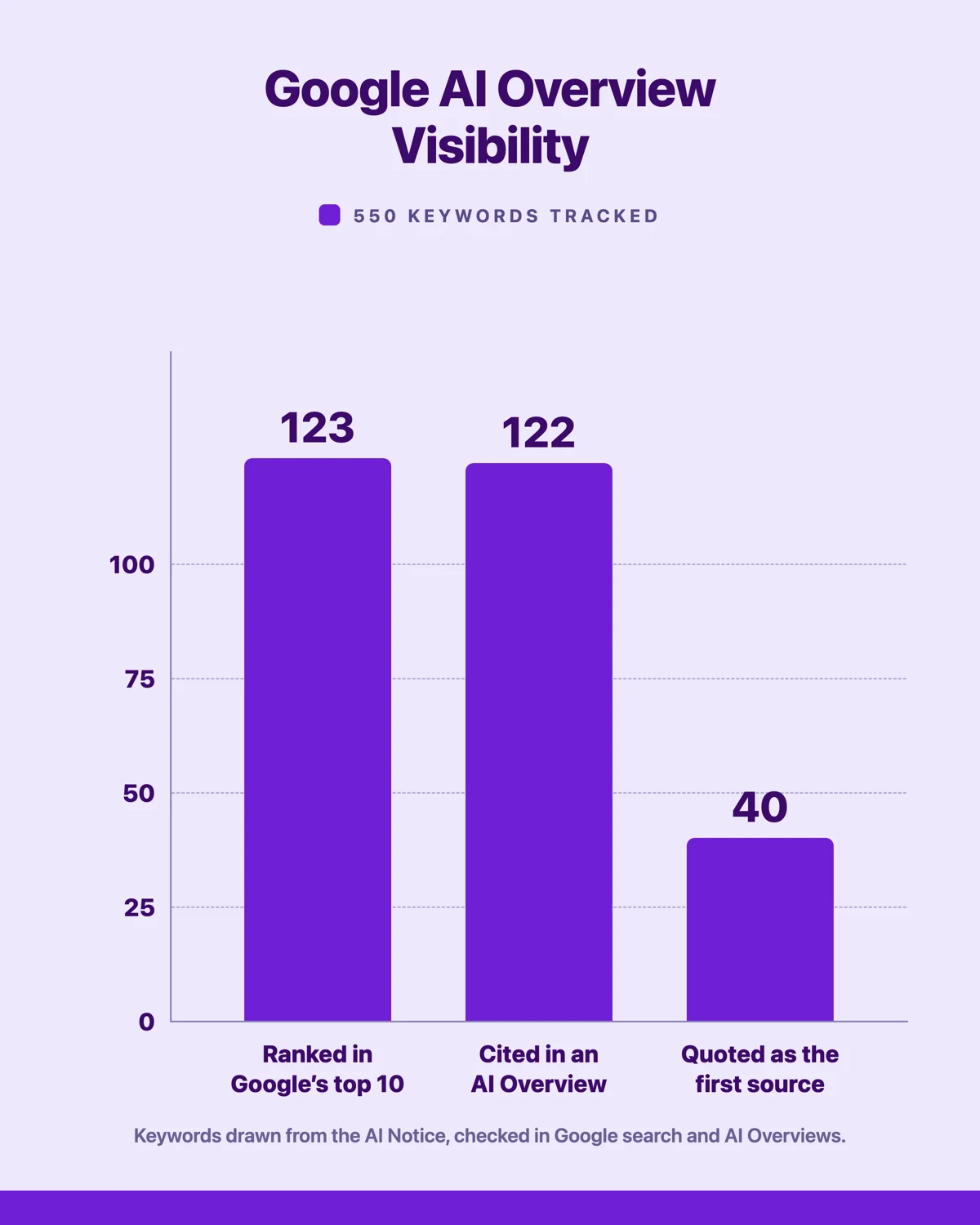
The Google check used 550 keywords drawn from the AI Notice. Of these, 60 were branded searches that include the client’s name, and 490 were non-branded. Copies of the AI Notice appeared in Google results for 125 keywords, and 123 of them reached the top 10, with 82 in the top 3. For 122 keywords, Google’s AI Overview cited the AI Notice, and 99 of those were non-branded searches. On 40 of the 122, the AI Overview quoted the AI Notice as its first source. Two copies drew these citations. The wire release was cited on 109 keywords and a financial news site’s copy on 59, so some AI Overviews cited both.
The Anchor Article was checked against its own 300 keywords, 34 branded and 266 non-branded. It ranked in Google’s top 3 for 6 of them, and Google AI Overviews cited it on 3.
Prompt Coverage and First-Named Finishes
Of the 500 buyer prompts, 137 had at least one engine naming the client. When an engine named it, the client usually sat near the top of the answer. Its average position was #1.9, and at least one engine ranked it in the top three in 86 of those prompts. The client ranked first in 114 engine answers. Brand-direct and category questions were the largest groups naming it, followed by buyer-intent questions.
Unprompted Discovery
A buyer prompt can ask about the client directly, or it can ask a general question and leave the engine to choose the suppliers. Of the 137 prompts where an engine named the client, 50 were general questions that never named it or described it with facts unique to it. They covered topics such as gas programs for gene editing work, managing several delivery schedules on one campus and lining up an alternative supplier. The other 87 asked about the client by name or by its own details.
The report’s awareness funnel sorts the prompts by buyer stage. Coverage reached 47% on prompts evaluating solution categories. By contrast, it was 12% on prompts comparing specific products and 2% on Problem-Aware prompts.
| Buyer awareness stage | Coverage | Named the client | Prompts in stage | Avg position |
|---|---|---|---|---|
| Problem-Awareknows the problem, still scoping solutions | 2% | 2 | 111 | #1.0 |
| Solution-Awareevaluating solution categories | 47% | 37 | 79 | #3.3 |
| Product-Awarecomparing specific products | 12% | 16 | 135 | #2.1 |
AI Visibility by Engine
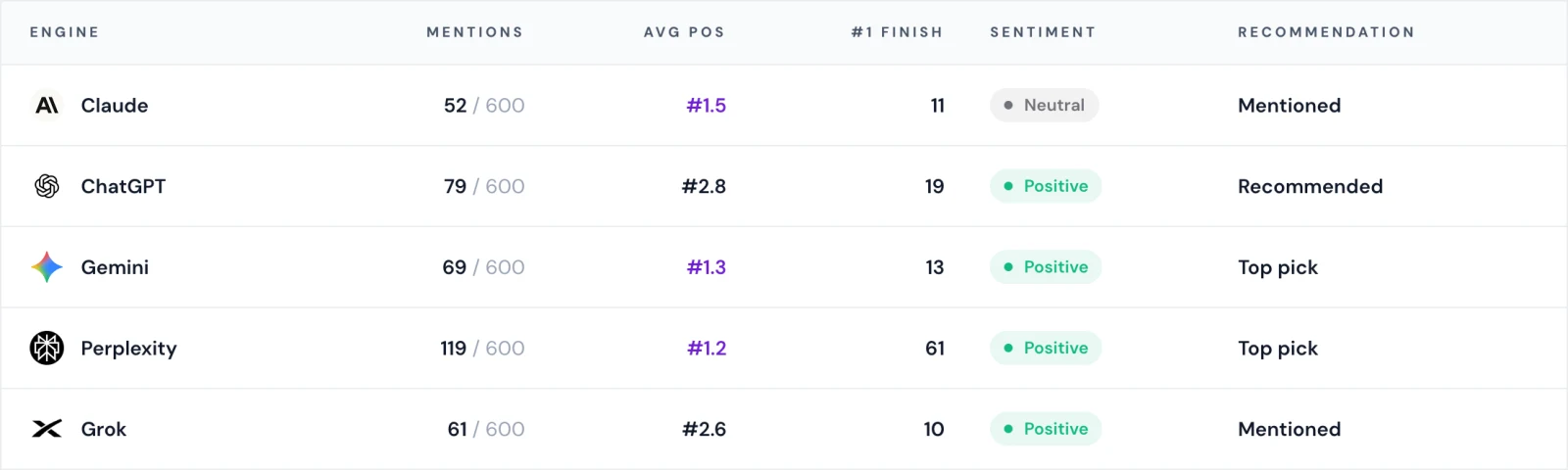
All five engines named the client, and Perplexity did so most often. Perplexity named the client in 119 prompts and ranked it first in 61 of them. ChatGPT followed at 79 prompts, Gemini at 69, Grok at 61 and Claude at 52. Gemini and Perplexity rated the client a top pick, and ChatGPT listed it as recommended. Claude and Grok mentioned it without a recommendation. Sentiment was positive on four engines and neutral on Claude, with one negative mention logged on Grok. Average positions ran from #1.2 on Perplexity to #2.8 on ChatGPT. On the other four engines, first-place finishes ranged from 19 on ChatGPT to 10 on Grok.
Where the AI Visibility Came From
Placement citations count the times AI answers listed a published copy of the AI Notice as a source. The AI Notice earned 137 placement citations. All 137 came from Perplexity, the only engine with citation data in the AI Notice report, and all pointed to the wire release. General questions produced most of them: 85 came from prompts that did not ask about the client, and 52 from prompts that did. The 137 placement citations and the 137 prompts where an engine named the client are separate measures.
In addition, the client’s own website was the source Perplexity cited most often in these answers, with 444 citations.
The Anchor Article had a separate prompt set. Engines cited the Anchor Article in 45 of its 100 buyer prompts. Grok accounted for 43 of the 50 citations, Perplexity for 5 and ChatGPT for 2. In the same set, the engines named the client in 68 prompts.
Distribution Reach
The AI Notice appeared in 11 media placements, with a combined potential audience of 115.9M monthly unique visitors. Most placements were financial news sites, and the rest were the wire release and a regional news site. AI engines cited one of the 11, the wire release, which has a potential audience of 796K on its own.
Examples From AI Answers
The examples below show how AI engines answered industrial gas buyer questions and which sources they cited.
“What gas suppliers store inventory locally for biotech emergency delivery?” (asked as Inventory Manager)
Perplexity ranked the client first and rated it a top pick. It described the client as the top option because it stores inventory locally and offers same-day and next-day emergency delivery. A large industrial gas company placed fourth in the same answer.
“Which gas suppliers offer process piping design and installation for biotech facilities?” (asked as Engineering Manager)
For an engineering manager planning gas lines in a biotech facility, Perplexity named the client first and rated it a top pick. The answer said the client offers piping design and installation along with telemetry monitoring, cylinder tracking and gas safety training. A rival gas distributor and a piping contractor followed.
“Who provides emergency same-day liquid nitrogen delivery for biotech?” (asked as Operations Manager)
This question came from the Anchor Article prompt set, and four engines named the client in their answers. Grok ranked it first, rated it a top pick and called it the strongest option for same-day liquid nitrogen delivery. Perplexity also put the client first, while ChatGPT placed it third and Gemini fifth.
In each of the three, the question left the client unnamed, and an engine that cited the client’s content ranked it first.
How We Measured
The AI visibility optimization pilot tested two separate sets of buyer prompts, 500 for the AI Notice and 100 for the Anchor Article, across five AI engines: Claude, ChatGPT, Gemini, Perplexity and Grok. Each report tracked brand mentions in AI answers. A mention counts when an engine names the client, and brand visibility measures the share of prompts where at least one engine named it. In the Anchor Article prompt set, Claude returned no answers, so that set’s figures come from the other four engines.
AI citations were tracked separately and matched by exact URL to show when an engine used the AI Notice or the Anchor Article as a source. A separate Google check measured organic keyword rankings and visibility in Google AI Overviews.
About the measurement
All results come from a pilot built around one Anchor Article and one AI Notice. Each asset was measured once after launch. The two prompt sets differ, so their figures are reported separately and never combined.
Why This Matters
In the AI Notice prompt set, the client’s AI visibility reached beyond brand searches into general supplier questions. The engines named the client in 50 prompts whose question never named or described it. These included questions about same-day liquid nitrogen delivery, bulk and microbulk supply and telemetry monitoring, the questions that come up when choosing a gas supplier for a biotech facility.
The results also showed where coverage was weakest: answers to early-stage questions about supply risk almost never named the client. These topics are an opportunity to expand AI visibility.
Zen Media has applied this AI visibility optimization approach in home internet and cyber range. Want to see how your brand appears in AI answers to buyer questions? Contact Zen Media to explore an AI visibility strategy for your business.