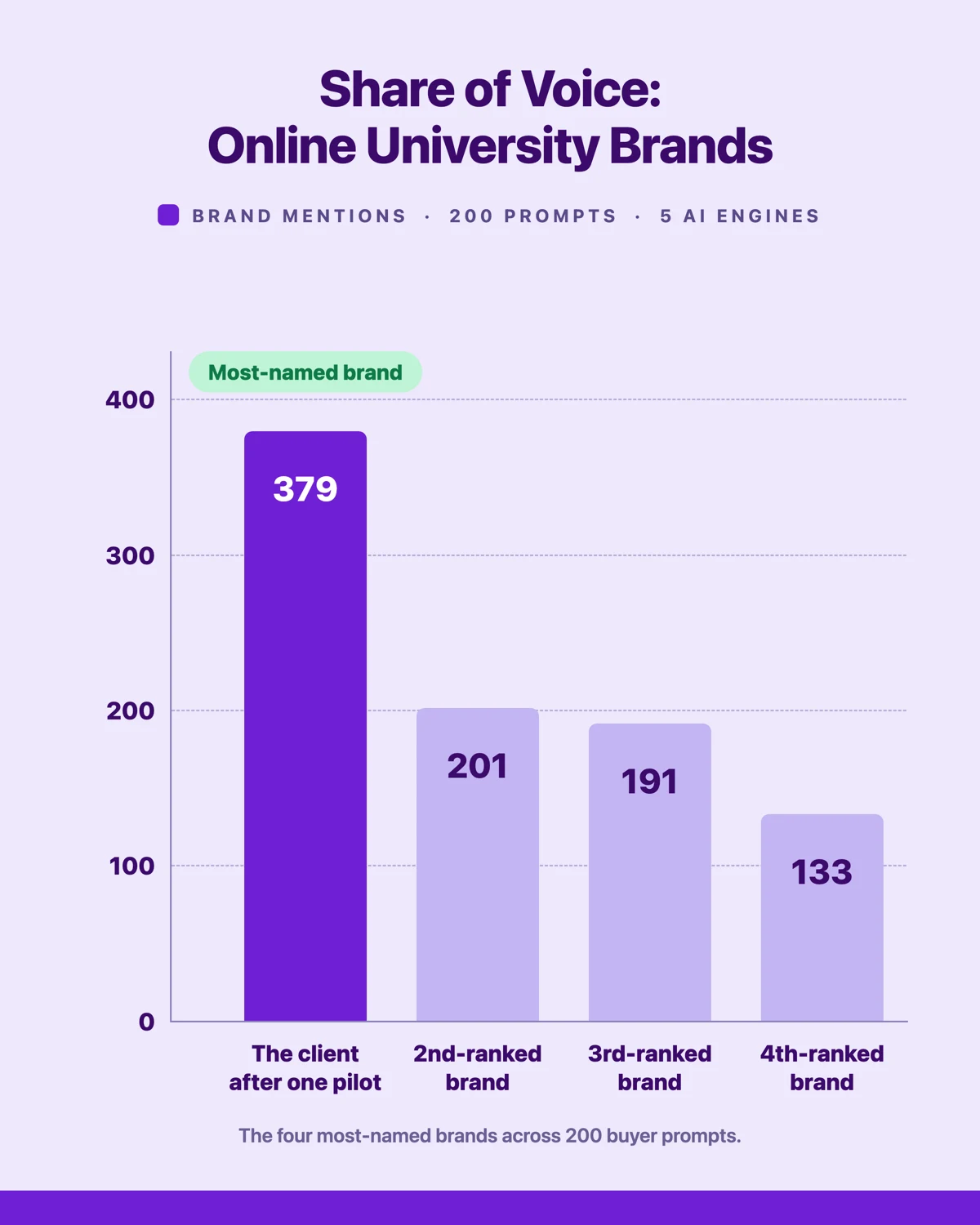
732 media placements
AI prompts naming the client
14 branded, 63 non-branded
The Business
The client is an online university for adults who study alongside a job and a family. Its learners include working adults, career changers and students who balance school with other commitments. A fixed campus timetable fails each of them for a different reason. The client shapes its programs to those reasons, with flexible course schedules, academic coaching, accessibility support and career services.
For many of these learners, the search for a school now starts in a chat with an AI assistant. A working parent asks which online universities fit around a full-time job, and an adult returning after years away asks which schools help students finish. The answer hands each of them a shortlist before they open a single college website. The client’s argument fits in one sentence: a university should be judged by how well it supports the students it enrolls.
The Objective
The AI visibility optimization pilot set out to make the client a source that AI engines cite when buyers ask which online university fits a working adult. It used two published assets and measured the results once after launch. Specifically:
- Focus on buyer questions about flexible scheduling, student support, accessibility and career outcomes, where the buyer is close to a decision
- Publish one Anchor Article on the client’s domain to build its authority on choosing an online university
- Publish one AI Notice on the wire to carry the same nontraditional-learner support case into third-party sources
- Track the client’s AI visibility on five AI engines, with a fixed set of buyer prompts for each asset
- Measure share of voice and prompt coverage against competing online universities
Core Challenges
Competing With Online Universities Already Established in AI Answers
During the pilot, the nearest rival brands were named 201 and 191 times in the AI Notice prompt set. The answers drew on thousands of websites. Social media platforms, community forums and college-ranking sites were among the most-cited. Engines tend to recommend the brands these sources already discuss, so the client needed sources of its own that engines could cite.
Buyers Ask AI for Programs That Fit Work and Family
Buyers in this category ask exact questions, like which universities offer flexible scheduling for working parents, how transfer credit works, what academic coaching looks like inside a course and which schools support students from enrollment onward. To answer them, the client needed an authoritative source that gives buyers and AI engines every one of these details.
Tracing New AI Visibility Back to Its Source
With two assets in market, both aimed at buyers who need a flexible, supported online degree, a total citation count would not have shown which one the engines were citing. Only per-citation attribution could separate them, so the pilot traced every appearance back to the page behind it.
The Strategy
Prompt Selection Around the Buying Moment
The AI Notice prompts were written in the voices of 101 buyer personas, from adult learners to the counselors who advise them. The prompts read like a buyer thinking out loud. One working parent asked for a degree they could finish “while working full time and raising a family.”
One Anchor Article
A long-form guide on the client’s site walks adult learners through choosing an online university, from scheduling to career outcomes. Because the client owns the page, AI engines can keep crawling and citing it after the pilot ends.
One AI Notice
The AI Notice went out on the wire and restated the case for nontraditional-learner support on a third-party domain.
Day-Zero Launch, Day-7 Measurement
The AI Notice went live on day 0. The program waits seven days before it measures. After that wait, the pilot ran every buyer prompt on five AI engines and counted every citation that pointed back to the AI Notice’s placements and to the Anchor Article. The figures on this page are a single snapshot taken after that wait.
AI Visibility Optimization Results
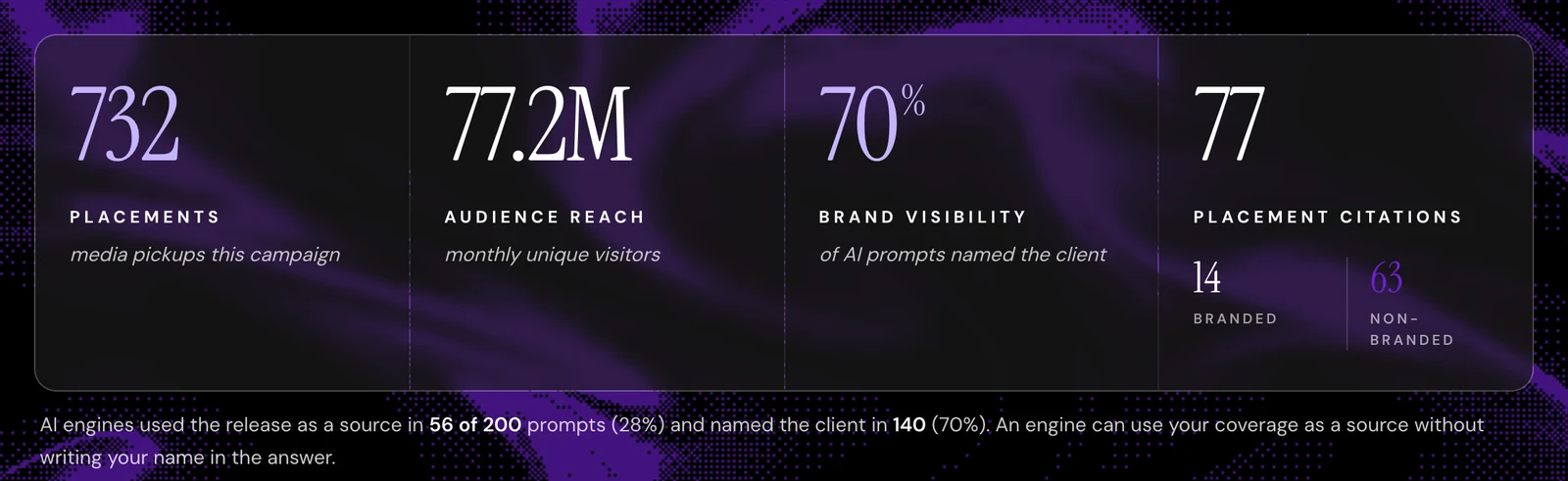
After launch, the client was the most-named brand in the AI Notice prompt set, with 379 mentions on the five engines.
379 mentions
AI Notice as a source
the client
non-brand questions
The four tiles measure the 200 buyer prompts. The campaign report shows how far the AI Notice traveled in the media and how often AI engines cited it.
Share of Voice Among Online University Brands
The client’s 379 mentions were almost twice the 201 of the 2nd-ranked brand. The next two brands were named 191 and 133 times. Against its three most frequent rivals, the client ranked higher in 46% to 51% of the answers that named both brands. The client was named far more often, and once it shared an answer with a close rival, the two were evenly matched.
Prompt Coverage and First-Named Finishes
The client’s AI visibility reached 140 of 200 buyer prompts. Its top-3 hit rate was 64%, and it finished first 278 times across the five engines. The largest group was buyer-intent questions, followed by terminology and category questions.
Unprompted Discovery
Only 24 of the 140 prompts that named the client asked about the brand directly. The other 116 did not mention it. They asked about topics such as flexible scheduling for working adults, support for students returning after a break, accessibility and academic coaching. These prospective students did not know the client’s name yet, so the answer introduced it to them.
The report’s awareness funnel follows that coverage from a buyer’s first question to a brand search. Coverage was lowest among Unaware buyers at 54% and reached 100% among buyers searching by brand name. The average position was weakest at the Solution-Aware stage and strongest at the Most-Aware stage.
| Buyer awareness stage | Coverage | Named the client | Prompts in stage | Avg position |
|---|---|---|---|---|
| Unawarehas not identified the problem | 54% | 7 | 13 | #1.4 |
| Problem-Awareknows the problem, still scoping solutions | 65% | 30 | 46 | #2.0 |
| Solution-Awareevaluating solution categories | 69% | 25 | 36 | #3.3 |
| Product-Awarecomparing specific products | 72% | 33 | 46 | #2.1 |
| Most-Awaresearching by brand name | 100% | 24 | 24 | #1.1 |
AI Visibility by Engine
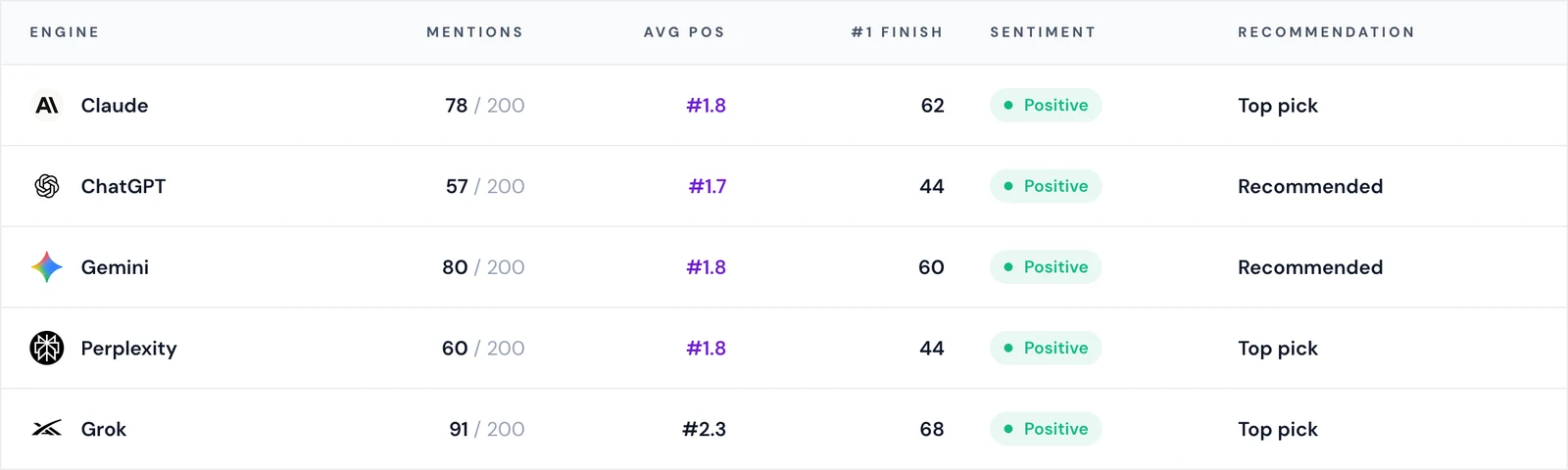
The client’s AI visibility held on all five engines, and each one read it positively. Claude, Perplexity and Grok rated it a top pick, and ChatGPT and Gemini rated it recommended. The report logged no negative mention. Grok named the client in 91 of 200 prompts, followed by Gemini at 80, Claude at 78, Perplexity at 60 and ChatGPT at 57. Across the five engines the average mention rate was 37%. Average positions ran from #1.7 on ChatGPT to #2.3 on Grok, and first-place finishes ranged from 68 on Grok to 44 on ChatGPT and Perplexity.
Where the AI Visibility Came From
Out of the thousands of websites the AI engines drew on, the client’s own site was the second most-cited source, with 979 citations. Only one social media platform was cited more often. The AI Notice added a third-party voice: engines cited it 77 times and used it as a source in 28% of buyer prompts, most often through its copy on a financial news site. The Anchor Article earned its own place in the answers. In a separate set of 395 prompts, all five engines cited it, 124 times in total.
Distribution Reach
The AI Notice reached 732 placements with a combined audience of 77.2M monthly unique visitors. Four placements carried the citations: the wire release and three third-party news sites. These account for 37.5M of the reach, 49% of the total.
Google AI Overview Visibility
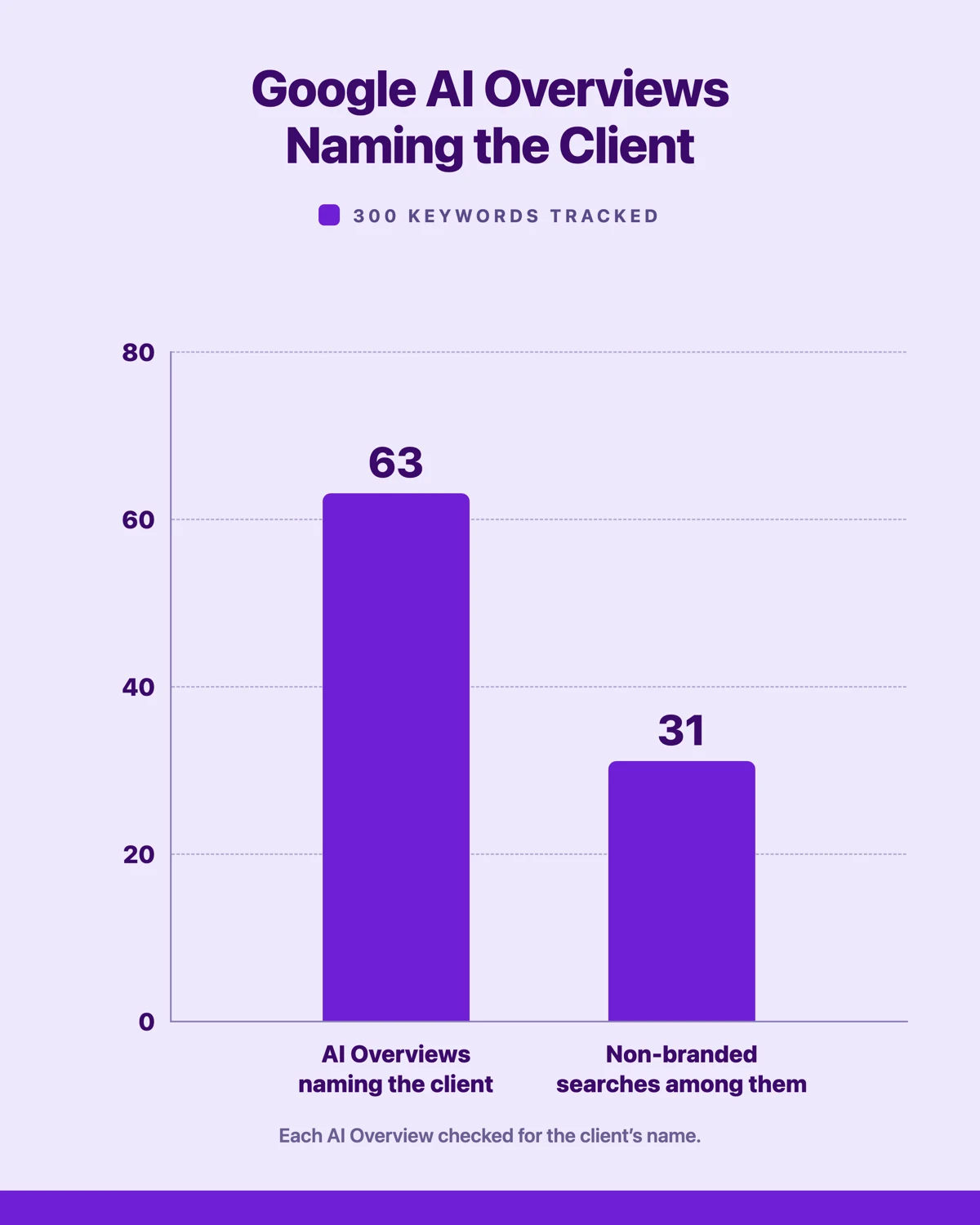
The pilot also tested 300 keywords on Google, and every one of them showed an AI Overview. Those AI Overviews named the client on 63 keywords, and half of them were non-branded searches. The AI Notice reached Google directly too: its copy on a financial news site ranked in the top 10 for one keyword, and the AI Overview for that keyword cited it.
Examples From AI Answers
The examples below show what the client’s AI visibility looked like inside real answers to online university buyer questions, and which sources the engines cited.
“What are the best online universities for adults returning to college after years in the workforce?” (asked as Adult Learner)
Gemini listed the client second among its recommendations, as a strong choice for adult learners.
“Which online universities are designed for students whose success depends on navigating processes that feel unfamiliar because they haven’t done it before?” (asked as First-Generation Student)
Both engines ranked the client first and rated it a top pick, and Perplexity ranked it first too. Gemini described it as a university with flexible scheduling and strong credit transfer support.
“What are the best universities for students with learning disabilities who need academic coaching integrated into coursework?” (asked as Disability Services Coordinator)
For a buyer asking about learning disabilities, Gemini ranked the client first and rated it a top pick, citing its flexibility, academic coaching and tutoring.
None of the three prompts named the client, yet the engines recommended it each time, ranking it first on two of the three.
How We Measured
The pilot measured AI visibility with two separate sets of buyer prompts, 200 for the AI Notice and 395 for the Anchor Article. Both ran on Claude, ChatGPT, Gemini, Perplexity and Grok. The AI Notice set covered 10 question types: buyer intent, terminology, category, brand-direct, education, problem solving, comparison, best practices, informational and buyer direct. The Anchor Article set covered five of them: terminology, category, buyer intent, education and brand-direct. Both reports recorded every brand each engine named. Share of voice counts those mentions on all five engines. Each report logged the sources behind the engines’ answers. A separate Google check ran keywords drawn from the AI Notice against live search results and AI Overviews. Citations were matched by exact URL, so every citation credited to an asset on this page points at that asset’s page.
About the measurement
All results come from a pilot built around one Anchor Article and one AI Notice. Each asset was measured once after launch. The two prompt sets differ, so their figures are reported separately and never combined.
Why This Matters
The client was the most-named brand in the AI Notice prompt set. Of the 140 prompts that named it, 116 came from questions that did not mention the brand. Buyers who asked about flexible scheduling, academic coaching and accessibility found the client through the answer itself.
Coverage was lowest at the start of a buyer’s research, before the buyer had named a problem. More Anchor Articles and AI Notices aimed at those early questions can extend this AI visibility optimization work to them.
Zen Media has used the same approach to build AI visibility in educational publishing and financial advisor training. Want to know what AI engines tell your buyers about your brand? Contact Zen Media for an AI visibility strategy built around the questions your buyers ask.