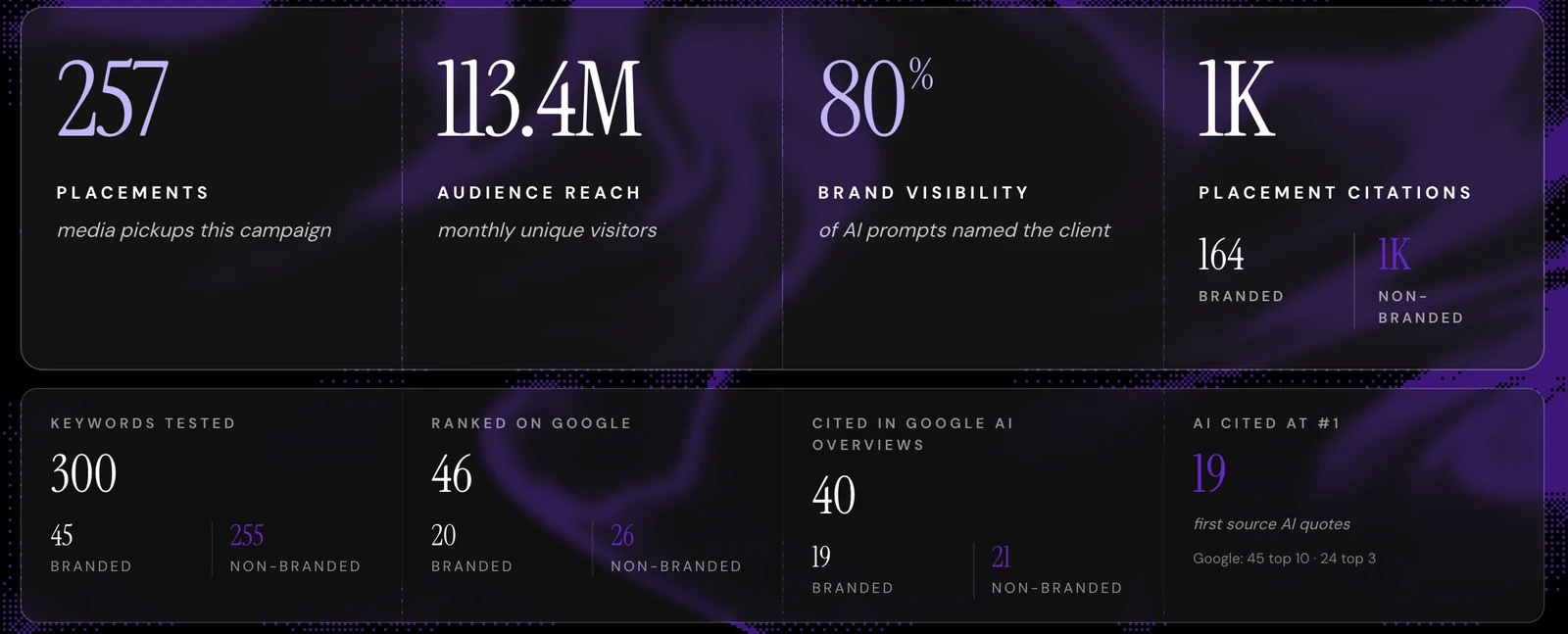
257 media placements
AI prompts naming the client
164 branded, 1,087 non-branded
The Business
The client supplies casing, tubing, and drill pipe, the OCTG (oil country tubular goods) that go down a well. It sells into drilling and completions programs across Western Canada, reaching the superintendents who run those programs and the procurement managers who buy for them. Orders turn on paperwork and timing, so the client competes on certified mill test reports, heat number traceability for every joint, and a delivery date confirmed before the rig moves to location.
While a program is still being planned, buyers in this category ask which supplier can prove certified documentation and confirm delivery. Before the pilot, AI engines answering that question reached for global manufacturers, for the API specifications themselves, and for regional distributors with far longer publishing histories. The client’s own argument, that documentation and confirmed delivery are the purchase decision, had almost no indexed material behind it, and so almost no AI visibility in the answers buyers were reading.
The Objective
The pilot was scoped to make the client a cited source in AI answers about certified OCTG supply using two published assets, then measure the result on a fixed seven-day window. Specifically:
- Target the certified documentation cluster inside the client’s 1,000-prompt AI visibility index
- Prioritize the buyer questions with a purchase decision already in motion
- Publish one Anchor Article on the client’s own domain, giving AI engines a durable source to crawl and cite
- Publish one AI Notice through GlobeNewswire to carry the same documentation case into a third-party source
- Track the client’s AI visibility across a fixed 500-prompt buyer panel and 300 SEO keywords
- Separate branded from unprompted discovery, to identify the prompts that surfaced the client with no brand cue in the question
- Prove the model on two assets and a seven-day window
Core Challenges
Competing With Manufacturers and the Standards Themselves
Global OCTG manufacturers and the API specifications carried years of indexed material behind them. An engine assembling an answer about certified supply had plenty to pull from long before it reached a Canadian intermediary, and the client entered the pilot with very little published on the question.
The Differentiator Was a Process, and Processes Go Unwritten
An engine retrieves text. It cannot inspect a warehouse, audit a mill certificate, or watch a delivery land on schedule. None of the client’s documentation discipline existed as text an engine could read, so answers about trusted supply were built without it.
Tracing New AI Visibility Back to Its Source
With two assets in market, both aimed at one cluster, a total citation count would not have shown which one the engines were reading. Only per-citation attribution could separate them, so the pilot traced every appearance back to the page behind it.
The Strategy
1. Cluster Selection from the Prompt Index
The client picked the certified documentation cluster out of its 1,000-prompt AI visibility index, the subset with the highest buyer intent and an answer already owned by national and global suppliers. Displacing them there was a harder test than any adjacent cluster offered, and that cluster sat closest to a purchase.
2. One Anchor Article
A long-form Anchor Article went live on the client’s own domain, walking through the documentation chain a Canadian operator has to verify before signing an OCTG order. Publishing on the owned domain gave the engines a source they could keep crawling, retrieving, citing, and re-reading as it was updated.
3. One AI Notice
GlobeNewswire carried the AI Notice on day 0, restating the documentation argument on a third-party domain and linking back to the Anchor Article. Notified distributed it, and 257 outlets picked it up.
4. Day-Zero Launch, Day-Seven Measurement
Nothing else was published into the cluster while the panel ran. With one owned page and one distributed release in market, every client citation the panel logged pointed at one of the two. Seven days is also short enough to catch first-pass crawling and retrieval, before any accumulated authority could build.
AI Visibility Results
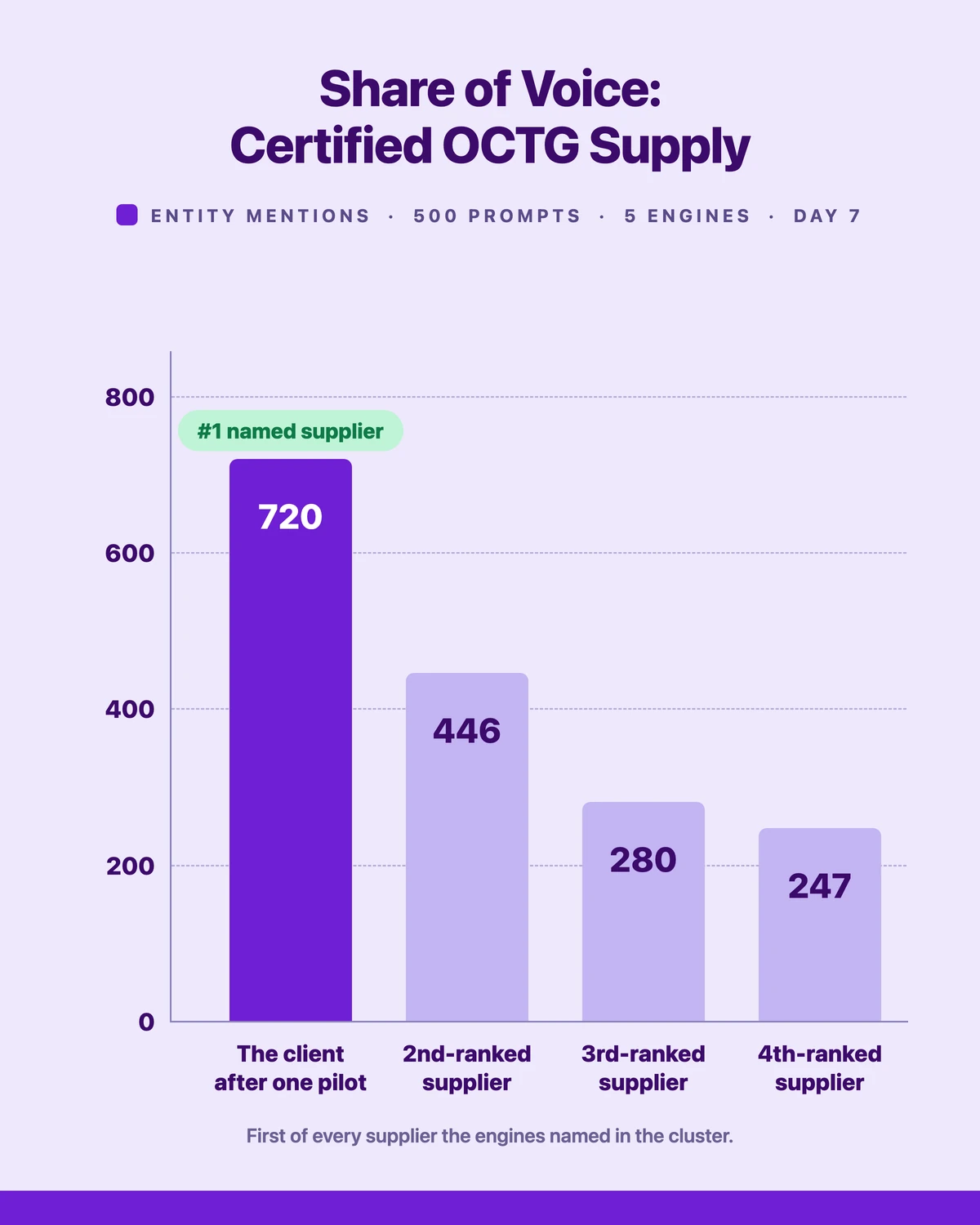
Seven days after publish, the client held #1 in AI visibility share of voice for certified OCTG supply. It finished ahead of every supplier the engines named, including the global manufacturer that had owned the category answer.
named OCTG suppliers
in the prompt panel
the client
was unprompted
Those four numbers describe what the engines said inside the buyer panel. The campaign report counts the same seven days from the outside, tracking the placements the two assets earned, how far they travelled, and what Google did with them.
Share of Voice Among Canadian OCTG Suppliers
Across the five-engine panel the client drew 720 entity mentions, ahead of the global manufacturer at 446 and the two regional distributors behind it at 280 and 247. The engines also recycled a standing narrative about Canadian drilling activity tightening supply windows. Across the 14 prompts that raised it, the client was quoted in 86% of the answers, against 64% for the second-ranked supplier.
The chart ranks the four suppliers by how often the engines named them in the 500 prompts.
Prompt Coverage and First-Named Finishes
398 of the 500 tracked buyer prompts surfaced the client, an 80% coverage rate, at an average position of #1.8 and a 76% top-three hit rate. The panel split five ways: 141 buyer-intent questions, 88 category, 86 terminology, 60 brand-direct, and 23 education. Counting each engine separately, the client finished first 774 times across the panel.
Unprompted Discovery
Brand-direct questions accounted for just 60 of the 398, so 338 of them, or 85%, came from operators describing a spud date, a documentation requirement, or a remote lease site with no confirmed supply. Placement citations split along the same line, with 1,087 of the 1,251 arriving on non-branded prompts against 164 on brand-direct ones.
The report’s awareness funnel concentrates that visibility at the buying end. All 88 solution-aware prompts named the client, along with 141 of 163 product-aware ones, the two stages when a buyer is comparing suppliers. Average position also improved toward that end, from #1.9 in the top two stages to #1.2 among buyers already searching by brand name.
| Buyer awareness stage | Coverage | Named the client | Prompts in stage | Avg position |
|---|---|---|---|---|
| Unawarehas not identified the problem | 57% | 23 | 40 | #1.9 |
| Problem-Awareknows the problem, still scoping solutions | 58% | 86 | 149 | #1.9 |
| Solution-Awareevaluating solution categories | 100% | 88 | 88 | #2.0 |
| Product-Awarecomparing specific suppliers | 87% | 141 | 163 | #1.6 |
| Most-Awaresearching by brand name | 100% | 60 | 60 | #1.2 |
| All promptsthe full five-engine panel | 80% | 398 | 500 | #1.8 |
AI Visibility by Engine
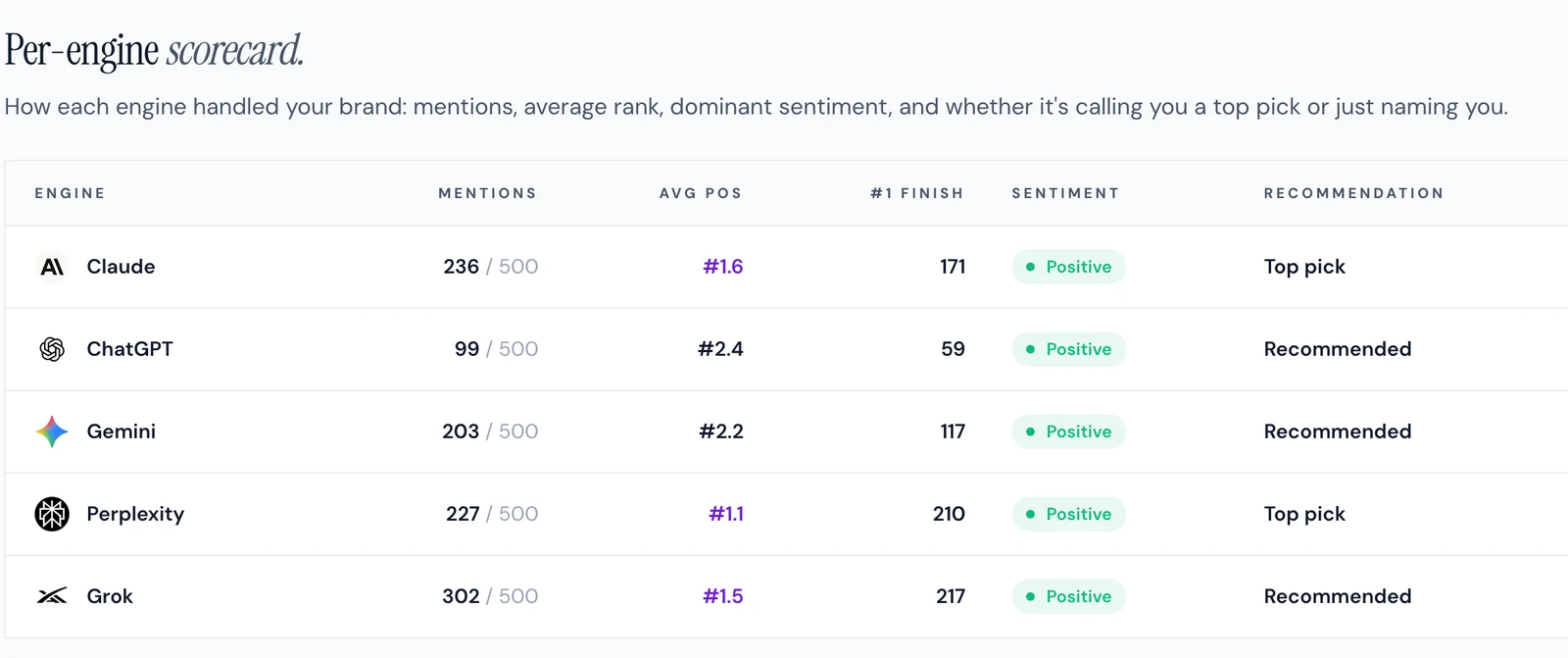
All five engines cited the client, and two went further. Claude and Perplexity classed it as a top pick, with ChatGPT, Gemini, and Grok listing it as recommended. Grok carried the most volume at 302 of 500 prompts, with Claude at 236, Perplexity at 227, Gemini at 203, and ChatGPT at 99. Average position started at #1.1 on Perplexity and ran out to #2.4 on ChatGPT, with Grok at #1.5, Claude at #1.6, and Gemini at #2.2. Grok also led on first-place finishes with 217, ahead of Perplexity at 210, Claude at 171, Gemini at 117, and ChatGPT at 59. The panel recorded 1,067 mentions in all, positive-dominant on every engine, with a single negative mention on ChatGPT.
Position, sentiment, and top-pick status sit alongside the raw counts in the report’s own scorecard.
Where the AI Visibility Came From
Citation tracking pulled 38,003 source citations from 3,599 unique domains. The client’s own domain led the list at 1,876 citations, with globenewswire.com second at 1,351. Those are the two properties the pilot published into, sitting first and second in that field. Counted on its own, the AI Notice drew 910 citations across Google, Grok, and Perplexity, roughly twelve times the 75 the program guarantees.
Distribution Reach and Engagement
The AI Notice was picked up by 257 outlets with a combined audience of 113.4M monthly unique visitors. Cited placements accounted for 38.2M of that reach, 34% of the total, and three of the five engines cited at least one placement directly.
Google AI Overview Visibility
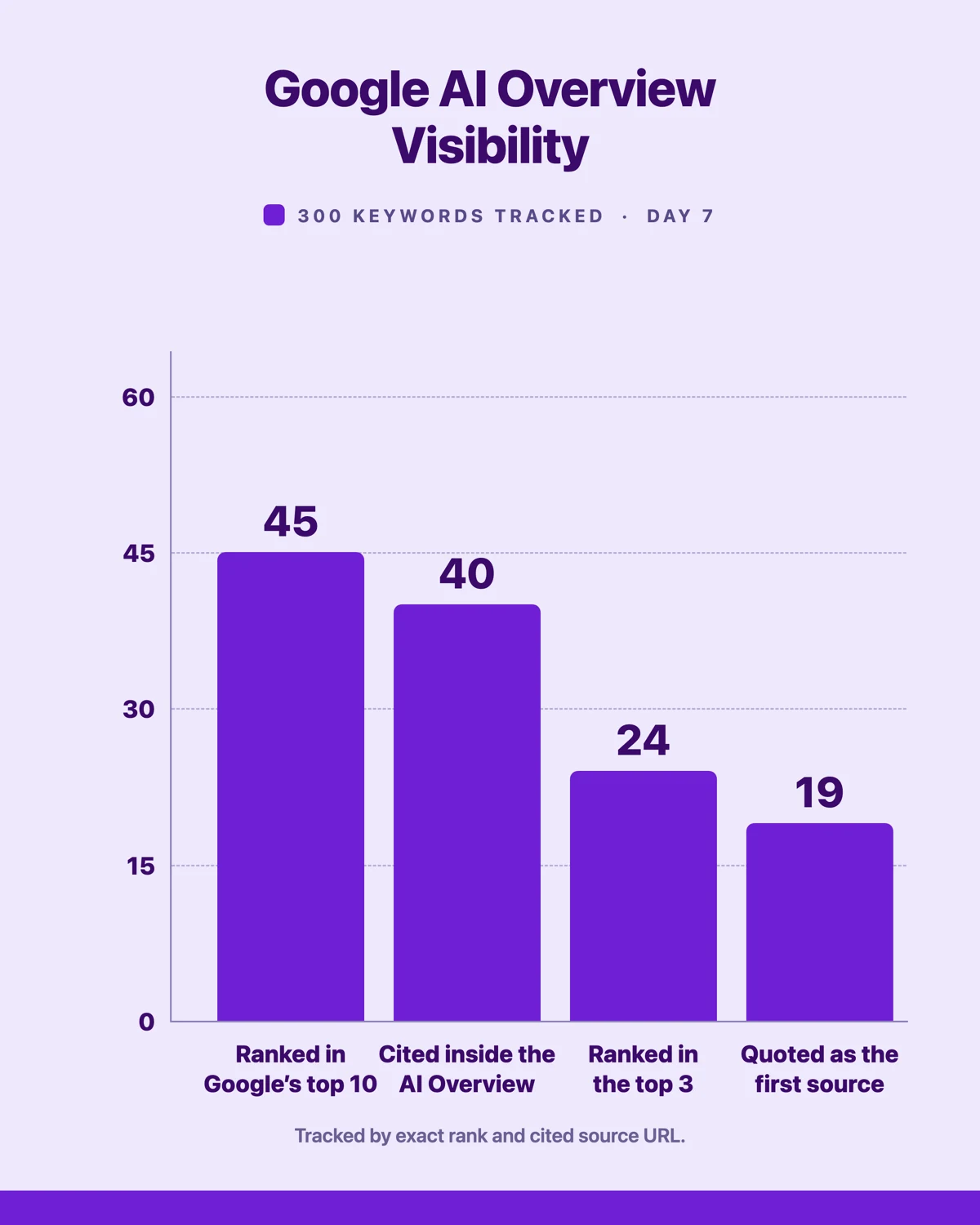
The keyword set split 255 non-branded against 45 branded, out of 300 tracked. Of those, 46 came back ranked on Google, 26 on non-branded terms, with 45 inside the top 10 and 24 in the top 3. Google AI Overviews cited the client on 40 keywords, 21 non-branded and 19 branded, and quoted it as the first source in 19 AI answers.
The Client in AI Answers
Three prompts from the panel show how the engines handled a live buying question and which sources they cited.
“With Canada projected to drill 5,709 wells in 2026, which OCTG suppliers have the staged inventory and documentation processes to keep pace without delivery misses?” (asked as an Operations VP)
Perplexity named the client as the supplier with the staged inventory and documented processes to keep pace, describing casing and tubing warehoused in Western Canada, shipments coordinated straight to the well site, and delivery timelines committed before the rig is booked.
“Which Canadian OCTG supplier can handle urgent orders for API 5CT casing when we have a program starting next month and need certified inventory confirmed now?” (asked as a Rig Supervisor)
Claude ranked the client first among the suppliers it listed, under a heading it wrote itself, “Top Recommendation for Urgent, Certified Needs,” and pulled the client’s spokesperson quote straight out of the AI Notice as its cited source.
“We are drilling in the Clearwater Formation in 2026 and need a casing supplier with staged certified inventory in the basin, who should we call?” (asked as a Heavy Oil Drilling Manager)
Perplexity answered with one company, naming the client as the supplier to call for that basin and listing no alternative alongside it.
None of these buyers offered a supplier name, and in all three cases the engine produced one, drawn from the two pages the pilot had published.
How We Measured
The pilot ran 500 buyer prompts across Claude, ChatGPT, Gemini, Perplexity, and Grok, spanning five intent types from terminology through brand-direct, alongside 300 SEO keywords tracked by exact rank and cited source URL. Every appearance was traced back to the source the engine cited. That is how the Anchor Article and the AI Notice were confirmed as the drivers behind the movement. Share of voice was calculated from entity mentions across all five engines, inside the field of supplier names the engines themselves brought into the answers.
About the measurement
All results come from a single pilot built around one Anchor Article and one AI Notice, both published in June 2026, and the five-engine buyer-prompt results are a day-7 snapshot. Campaign-level figures (media placements, audience reach, brand visibility, placement citations, and the keyword and AI Overview data) come from the PR attribution report. Prompt-level and entity-ranking figures come from the five-engine export. The two sources sometimes count the same idea on a different basis, and each figure is reported against the source it came from.
Why This Matters
Seven days and two published pages put the client first in the certified documentation cluster, with 85% of its prompt visibility coming from questions that never named it. The engines were surfacing the client on the exact problem it had built the business around.
That cluster is one slice of a 1,000-prompt index. Further Anchor Articles and AI Notices carry the same AI visibility measurement framework into the rest of it, cluster by cluster, with the buyer questions already ranked by commercial intent.
This method travels into other categories where a buyer wants proof before committing, and Zen Media has run it in oncology care navigation and regulated healthcare.
Your category already has an AI answer, with a supplier already named inside it. Contact Zen Media to find out who that is, and what it would take to move them.