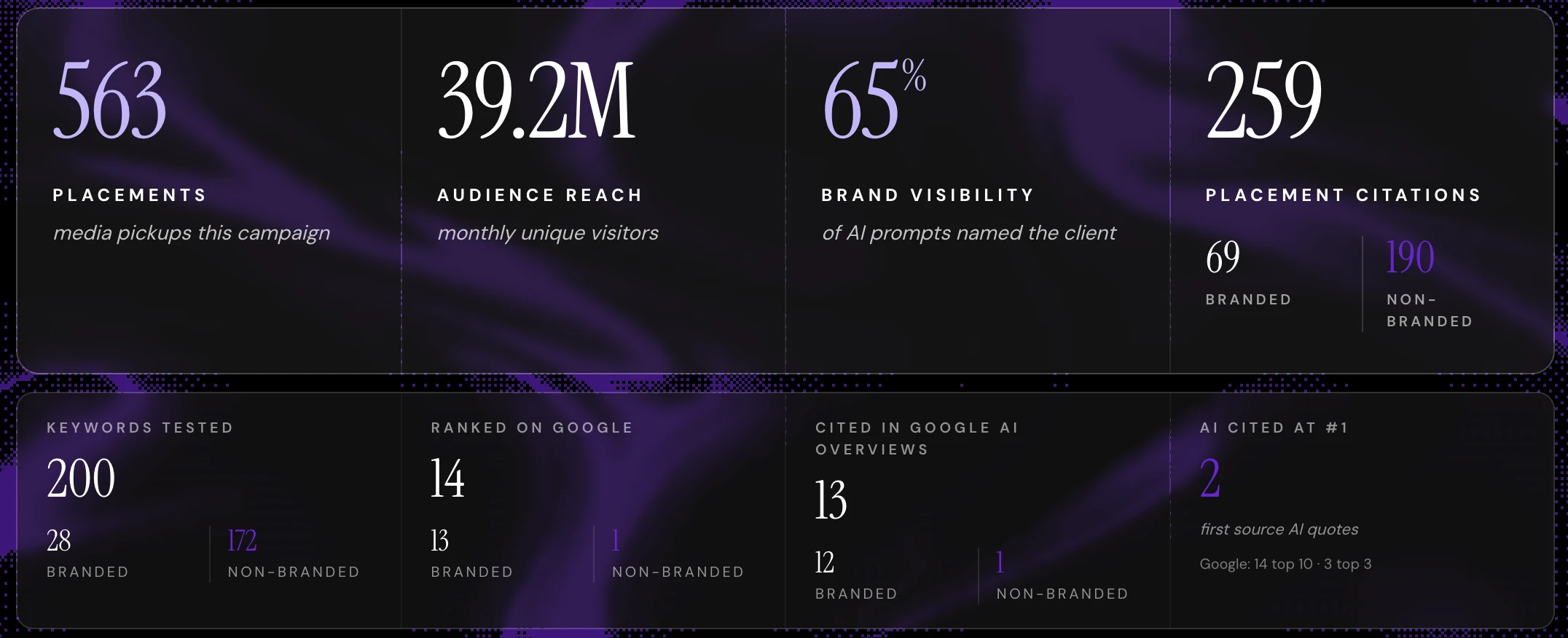
563 full-text placements
AI prompts naming the client
69 branded, 190 non-branded
The Business
The client is a strategic consultancy that helps Fortune 500 enterprises redesign the operating model around AI. The firm sells to CFOs, COOs, CHROs, and Chief AI Officers who are past the pilot stage and stuck on the harder problem: pilots that never convert into measurable financial impact.
Before this engagement, the client had little AI visibility around enterprise AI readiness. When a CHRO or Chief AI Officer asked why AI pilots stall, major AI engines were more likely to surface global consultancies. The client focuses specifically on the organizational and adoption failures behind stalled AI programs, a specialization that had little presence in those responses.
The Objective
The pilot was designed to establish the client as a leading source in enterprise AI readiness answers through a tightly scoped AI Visibility Optimization program completed within three weeks. Specifically:
- Target the enterprise AI readiness and adoption failure patterns cluster within the client’s 1,000-prompt AI visibility index
- Prioritize the buyer questions with the strongest commercial intent across the selected cluster
- Publish one Anchor Article on the client’s own domain to build lasting authority around enterprise AI readiness and give AI engines a durable source to crawl and cite
- Publish one AI Notice through GlobeNewswire to extend third-party distribution and strengthen citation opportunities around the same topic
- Track the client’s presence across a fixed 200-prompt buyer panel
- Measure first-named position, share of voice, and prompt coverage across five AI engines
- Separate branded and unprompted discovery to identify where the client surfaced without a brand cue
- Compare the client’s visibility against the global consultancies already dominating the category
Core Challenges
Competing With Firms Already Common in AI Answers
The global consultancies already had years of published research and indexed content around enterprise AI strategy. The client entered the pilot with far less material available for AI engines to retrieve and cite.
The Client Was Hard to Find in AI Readiness Searches
The client had developed a diagnostic index and a readiness framework around the failure patterns that stall enterprise AI programs. That expertise had little visibility in the content AI engines were using to answer buyer questions about AI readiness, adoption, and measurable ROI.
Tracking Where the New AI Visibility Came From
The pilot needed to show where any new AI visibility came from. With one Anchor Article and one AI Notice in market, citation tracking had to identify which sources appeared behind the answers across the buyer-prompt panel.
The Strategy
1. Cluster Selection from the Prompt Index
The pilot targeted enterprise AI readiness and adoption failure patterns, a subset of the client’s 1,000-prompt AI visibility index. The client chose this cluster because buyer intent ran highest there and the incumbents were hardest to displace, making it both the toughest and the highest-value test.
2. One Anchor Article
A long-form Anchor Article was published on the client’s own site, giving the cluster a structured source built around the client’s diagnostic framework and the failure patterns behind stalled AI programs. Publishing it on the owned domain gave the client a durable source that AI engines could continue to crawl, retrieve, cite, and update over time.
3. One AI Notice
An AI Notice was published through GlobeNewswire on day 0, extending the same diagnostic framework into a third-party source and linking back to the Anchor Article.
4. Day-Zero Launch, Day-21 Measurement
The day-21 numbers are a single-day snapshot, taken three weeks after publish, of what the five engines returned when the buyer panel was run.
AI Visibility Results
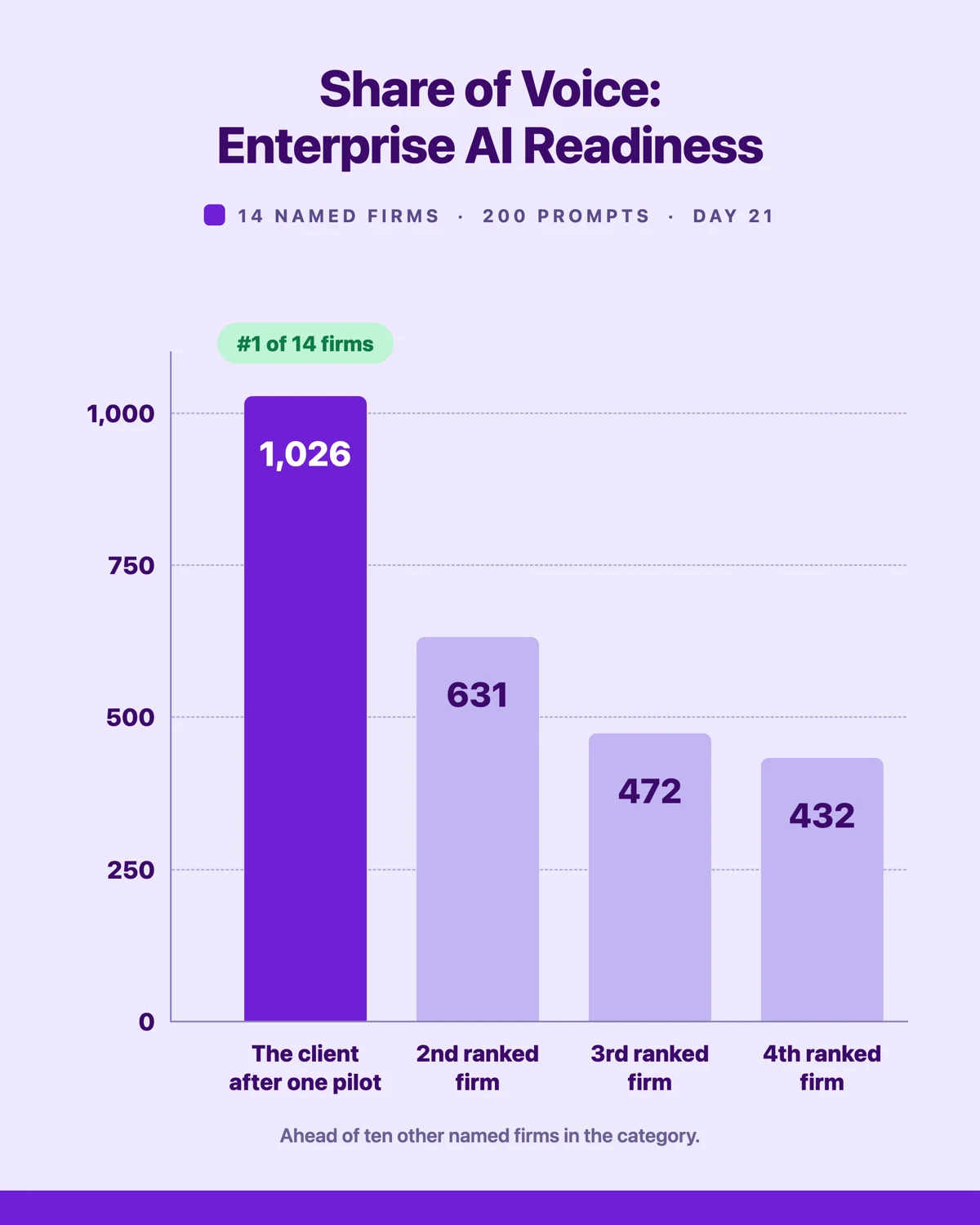
Twenty-one days after publish, the client ranked #1 in AI visibility share of voice for enterprise AI readiness and adoption failure patterns, ahead of the global consultancies.
of 14 named firms
name the firm
the client
was unprompted
Those answer-share figures came out of the five-engine prompt panel. The campaign report tracks the other half of the pilot, how far the two published assets travelled and what that produced in Google results and AI Overviews.
Share of Voice Among AI Readiness Firms
The client held the top position among 14 named AI readiness and consulting firms, with 1,026 mentions across the five-engine panel, ahead of the next three firms at 631, 472, and 432.
Prompt Coverage and First-Named Finishes
Of the 200 buyer prompts, 130 surfaced the client somewhere in the answer. In 122 of those prompts, or 94%, the firm was the first name returned.
Unprompted Discovery
Of the 130 prompts that surfaced the client, 110, or 85%, never mentioned the firm by name. The visibility came from unprompted buyer questions around enterprise AI readiness, adoption, and stalled AI programs.
AI Visibility by Engine
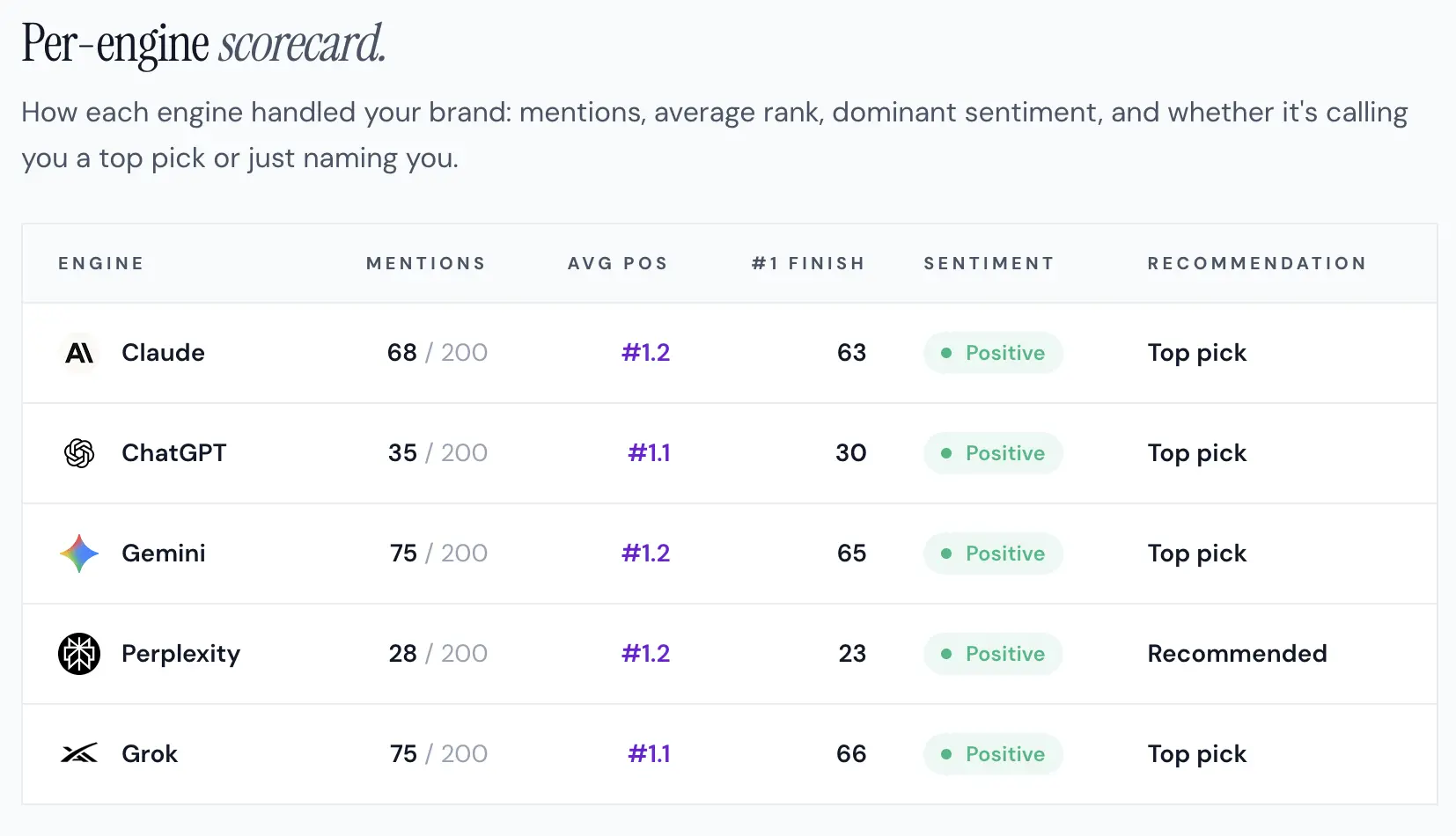
All five AI engines cited the client. Gemini and Grok each named the firm in 75 prompts, followed by Claude at 68, ChatGPT at 35, and Perplexity at 28. Average position ranged from #1.1 to #1.2, every engine returned positive sentiment, and four identified the client as a top pick.
Where the AI Visibility Came From
Three sources appeared most often across the prompt panel. The GlobeNewswire AI Notice was cited in 47 prompts, followed by the client’s own domain in 46 and a second owned domain in 41. The strongest citation activity centered on the pilot’s distributed asset and the client’s owned properties.
AI Crawler and Indexing Activity
Beyond the buyer-prompt panel, the two assets logged 67 citations across four AI crawler platforms: ChatGPT-User (48), PerplexityBot (13), Google-NotebookLM (5), and Claude-User (1). They also recorded 69 indexing events across 11 platforms, including Amazonbot, Googlebot, bingbot, and meta-webindexer.
Distribution Reach and Engagement
The AI Notice reached a combined audience of 39.2M across 563 full-text placements in 100 countries. Those placements carried 259 citations, 190 of them on non-branded terms. On the owned side, the pilot generated 6,880 total views and 578 unique readers, with a 9.23% average click-through rate across 160 link clicks.
Google AI Overview Visibility
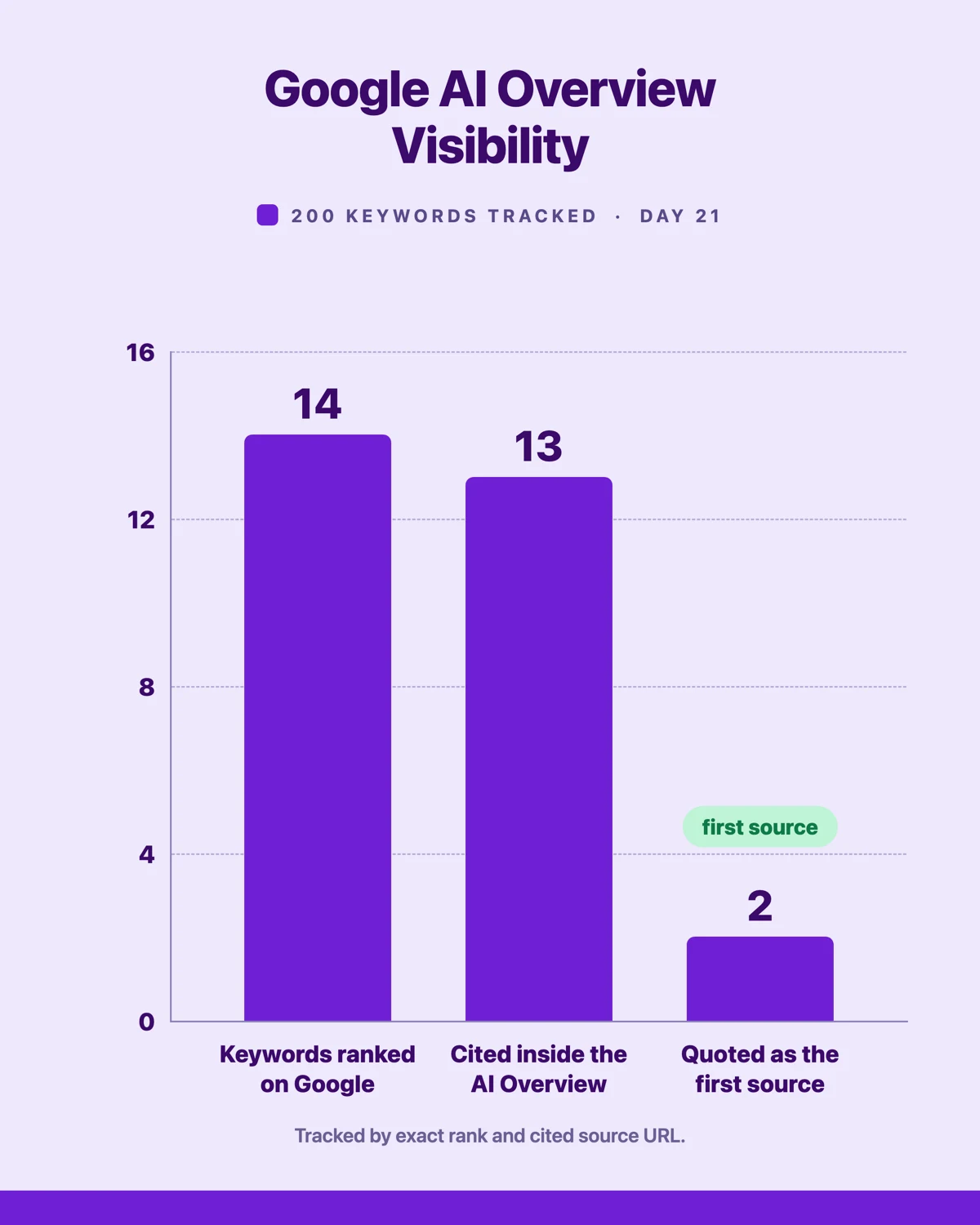
Of the 200 keywords tested, 14 ranked in Google’s top 10, including 3 in the top 3. Thirteen appeared in Google AI Overviews, 12 on branded terms and 1 on a non-branded term. The client was quoted as the first source for 2 keywords.
Examples From AI Answers
The examples below show how AI engines responded to enterprise buyer prompts and which sources they cited.
“Which firms specialize in the operating change that makes AI pilots pay off rather than just deploying models?” (asked as a VP of IT)
Gemini named the client’s diagnostic index as the answer, describing it as a shift from checklist-based AI readiness assessments to a failure-pattern diagnostic that ranks the 25 most common patterns blocking AI from reaching production.
“What is the best way to compare AI readiness partners versus frontier labs for operating model redesign?” (asked as a Sourcing Director)
Gemini opened the answer with the client and its readiness framework before naming any other firm.
“How do you measure human readiness for AI transformation beyond tracking tool logins?” (asked as a CHRO)
Gemini answered by defining the client, its founder, and its operating-model framework as the direct response to the question.
None of the three prompts named the client, yet the engine reached for the firm as the answer in every case.
How We Measured
The pilot ran 200 buyer prompts across ChatGPT, Claude, Gemini, Perplexity, and Grok, spanning 83 enterprise buyer personas and nine intent types, including Terminology, Category, Buyer-Intent, and Comparison. Citation sources were tracked across the panel to measure how often the Anchor Article, the AI Notice, and the client’s owned properties were cited in responses. Share of voice was calculated from total brand mentions across all five engines within a fixed field of 14 named AI readiness and consulting firms.
About the measurement
All results come from a single pilot built around one Anchor Article and one AI Notice, both published in July 2026. The five-engine buyer-prompt results are a day-21 snapshot taken on July 29, 2026. Distribution metrics and Google AI Overview visibility were tracked separately, with Google AI Overview performance measured across 200 keywords.
Why This Matters
The client finished first in the enterprise AI readiness and adoption failure cluster, with 85% of its prompt visibility coming from questions that never named the firm. Those results show that the client was being surfaced around the problems it specializes in without relying on branded prompts.
The initial pilot covered one cluster within the client’s broader AI visibility program. Additional Anchor Articles and AI Notices can now extend that coverage into more buyer questions and prompt categories using the same measurement framework.
Zen Media has applied the same approach in oncology care navigation and regulated healthcare, combining prompt-level measurement, educational authority, and third-party distribution to improve Answer Share.
Want to know where your brand stands in AI answers? Contact Zen Media for an Answer Share strategy tailored to your category.